AI Testing & Validation Market Size & Share Analysis - Trends, Drivers, Competitive Landscape, and Forecasts (2026 - 2032)
This Report Provides In-Depth Analysis of the AI Testing & Validation Market Report Prepared by P&S Intelligence, Segmented by Component (Software, Services), Deployment (Cloud, On-Premise), Technology (Machine Learning Testing, Generative AI Testing, Natural Language Processing Testing, Computer Vision Testing), Testing Type (Functional Testing, Security Testing, Performance Testing, Regression Testing, Compliance & Bias Testing), Enterprise Size (Large Enterprises, Small and Medium Enterprises), End User (Information Technology and Telecommunications, Healthcare and Life Sciences, Banking, Financial Services, and Insurance, Manufacturing, Retail and E-commerce, Automotive, Government and Public Sector), and Geographical Outlook for the Period of 2021 to 2032
Explore the market potential with our data-driven report
AI Testing & Validation Market Future Outlook
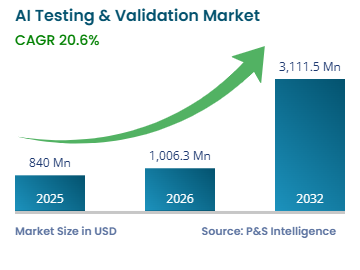
The AI testing and validation market size was USD 840 million in 2025, and it will grow by 20.6% during 2026-2032 to reach USD 3,111.5 million by 2032.
The AI testing and validation market is expanding as organizations integrate artificial intelligence into software development, digital services, and core business operations. These deployments require specialized testing capabilities to verify model accuracy, reliability, security, fairness, and regulatory compliance before systems are introduced into production environments. Traditional testing approaches are often insufficient for machine learning models, generative AI applications, computer vision systems, and natural language processing solutions because their outputs can change as data, user behavior, and operating conditions evolve. Growing adoption of DevOps practices, agile development methods, and continuous software delivery is also increasing demand for automated validation processes that can operate throughout the AI lifecycle.
The market is gaining additional momentum as businesses seek to reduce the risks associated with large-scale AI adoption. Organizations increasingly rely on AI for decision support, content generation, software development, process automation, and customer interactions, making model quality and governance critical operational priorities. According to the Stanford Institute for Human-Centered Artificial Intelligence, AI-related incidents reached 233 in 2024, the highest level recorded to date, highlighting the growing operational and governance risks associated with AI deployment. These growing risks are driving investments in testing frameworks that support automated test generation, bias detection, synthetic data creation, model monitoring, and performance validation.
Key Market Insights
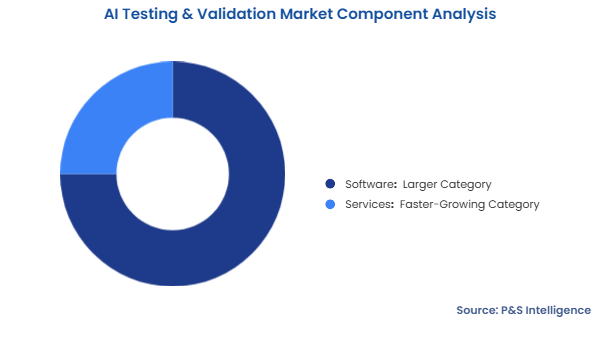
Software is the larger component, holding a market share of 75%, due to automated test execution and AI governance.
Cloud is the larger and faster deployment, holding 70% share and registering approximately 21.0% CAGR, due to scalable validation infrastructure.
Compliance & Bias Testing is the fastest-growing category, registering a CAGR of approximately 21.4%, driven by rising demand for bias detection, regulatory compliance, model transparency, and responsible AI deployment.
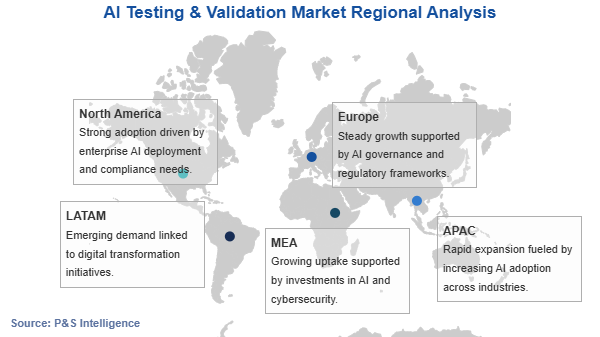
North America holds the largest share of 40%, due to mature AI ecosystems and strong enterprise technology spending.
Asia-Pacific is the fastest-growing region, registering a CAGR of approximately 21.5%, due to digital transformation and industrial modernization.
AI Testing & Validation Market Trends and Drivers
Shift toward Continuous Validation of Generative AI Models Is Major Trend
The shift toward continuous validation of generative AI models is becoming a major trend as organizations move beyond one-time testing and adopt ongoing monitoring throughout deployment and model updates. Generative AI applications are increasingly used in customer service, software development, content creation, and enterprise operations, making output quality, model drift, hallucinations, and compliance performance critical areas of focus. According to the OECD, 20.2% of firms reported using AI in 2025, up from 14.2% in 2024, reflecting the rapid expansion of AI deployment across industries and reinforcing the need for continuous validation throughout the AI lifecycle. Vendors are responding by integrating automated testing, observability, governance controls, and real-time model evaluation into unified platforms.
According to the Stanford Institute for Human-Centered Artificial Intelligence, documented AI incidents reached 362 in 2025, highlighting the increasing need for continuous AI testing, validation, and governance. The institute also reported that hallucination rates across 26 leading models ranged from 22% to 94% in 2025, demonstrating the need for continuous validation of generative AI outputs.
Rising Enterprise Adoption of Artificial Intelligence Applications Drives Market
The rising adoption of artificial intelligence across enterprise environments continues to drive demand for AI testing and validation solutions. Organizations are deploying AI for decision-making, customer engagement, process automation, fraud detection, medical analysis, and software development, where inaccurate outputs can create operational, financial, and compliance risks. Unlike conventional software, AI systems adapt to changing data and usage patterns, making testing an ongoing requirement rather than a one-time activity.
According to the Stanford Institute for Human-Centered Artificial Intelligence, 88% of surveyed organizations reported using AI in 2025, reflecting broad enterprise adoption of AI-driven technologies. According to Eurostat, 20.0% of enterprises with 10 or more employees in the European Union used AI technologies in 2025, up from 13.5% in 2024, demonstrating the accelerating adoption of AI across business operations. As AI deployment expands across mission-critical business functions, organizations are placing greater emphasis on validating model performance, reducing operational risks, and ensuring regulatory compliance throughout the AI lifecycle.
Shortage of Standardized AI Validation Frameworks Restrains Market Growth
The shortage of standardized AI validation frameworks restrains market growth because organizations lack consistent methods for evaluating model accuracy, fairness, explainability, security, and compliance across different use cases. Unlike traditional software, AI systems often produce variable outputs, making benchmark development and validation procedures more complex. This increases reliance on customized testing approaches, specialized expertise, and ongoing human oversight. According to OECD.AI, more than 900 national AI policies and initiatives were being tracked globally in 2025, reflecting the growing diversity of AI governance approaches across countries. This fragmented regulatory landscape increases implementation complexity, extends validation timelines, and creates uncertainty around deployment readiness, making it more difficult for organizations to establish standardized AI validation processes and scale AI testing programs efficiently. These challenges discourage organizations from adopting standardized AI testing practices at scale, limiting market expansion despite growing enterprise AI adoption.
Expansion of Artificial Intelligence Governance and Regulatory Assurance Creates Market Opportunity
The expansion of artificial intelligence governance and regulatory assurance is creating opportunities for providers of testing and validation solutions. Organizations increasingly require tools that verify compliance, assess model explainability, identify bias, and support audit readiness throughout the AI lifecycle. Growing emphasis on responsible AI deployment is encouraging enterprises to strengthen oversight of model development, deployment, and post-deployment monitoring activities. According to OECD.AI, the updated OECD AI Principles had 47 adherents in 2024, reflecting broad international commitment to responsible AI governance and the adoption of common AI policy principles. This growing focus on responsible AI governance is increasing demand for validation platforms that support transparency, accountability, fairness assessment, documentation management, regulatory compliance, and continuous monitoring as organizations align AI deployments with evolving policy and compliance requirements.
AI Testing & Validation Market Segmentation Analysis
Component Analysis
Software is the larger category, holding a market share of 75%, due to its central role in enabling automated test execution, model validation, continuous monitoring, and governance across AI environments. Organizations increasingly favor software platforms that integrate with development pipelines and cloud-based deployment environments used for machine learning testing. According to GitHub, developers created more than 230 repositories per minute and pushed 986 million commits in 2025, highlighting the scale of software development activity. This rapid growth in software development activity is increasing demand for AI testing software that automates model validation, accelerates release cycles, supports governance, and maintains quality across rapidly evolving AI-enabled applications.
Services are the faster category, registering a CAGR of approximately 20.8%, as organizations increasingly require specialized expertise to design, implement, customize, and manage artificial intelligence testing frameworks. Many enterprises lack the internal capabilities needed to validate complex machine learning and generative AI systems effectively. As regulatory requirements evolve and deployment environments become more sophisticated, demand is rising for consulting, integration, training, and managed services. Service providers also help businesses establish governance processes, improve compliance readiness, and optimize validation strategies, making professional support a growing requirement across industries adopting artificial intelligence technologies.
The components analysed in this report are:
Software (Larger Category)
Services (Faster-Growing Category)
Deployment Analysis
Cloud is the larger and faster-growing category, registering a CAGR of approximately 21.0%, because it provides scalable infrastructure for software-based validation platforms, machine learning testing, and continuous monitoring workloads. Organizations increasingly rely on cloud environments to manage large datasets, distributed teams, and AI development pipelines. According to Eurostat, 45.2% of enterprises in the European Union purchased cloud computing services in 2023, up 4.2 percentage points from 2021, reflecting the growing adoption of cloud infrastructure across business operations. This increasing adoption of cloud computing is driving demand for cloud-based AI testing solutions that can automate model validation, support continuous monitoring, enable scalable AI workloads, and facilitate flexible deployment across enterprise environments.
The deployments analysed in this report are:
Cloud (Larger and Faster-Growing Category)
On-Premise
Technology Analysis
Machine Learning Testing is the largest category, holding a market share of 40%, because machine learning models form the foundation of many AI applications across healthcare, finance, manufacturing, and enterprise software. Organizations require specialized testing frameworks to evaluate model accuracy, robustness, reliability, and performance before deployment. The growing focus on representative and reproducible testing methodologies is increasing adoption of machine learning validation tools that support performance assessment, model monitoring, and continuous improvement across AI development environments.
Generative AI Testing is the fastest-growing category, registering a CAGR of approximately 21.2%, as organizations rapidly adopt large language models and content generation systems across business functions. The dynamic nature of generative artificial intelligence creates new validation requirements related to hallucinations, prompt consistency, output quality, safety, and regulatory compliance. Enterprises are seeking specialized testing tools capable of evaluating model behavior under diverse scenarios while ensuring responsible deployment. As generative AI becomes integrated into software development, customer engagement, and operational workflows, demand for dedicated testing and validation solutions is expanding at a significant pace.
Functional Testing is the largest category, holding a market share of 35%, because verifying whether an artificial intelligence system performs intended tasks remains the primary requirement before deployment. Organizations prioritize functional validation to ensure models deliver accurate outputs, maintain expected behavior, and support business objectives under varying conditions. This testing approach forms a critical part of AI quality assurance processes across machine learning, natural language processing, and computer vision applications. Its broad applicability across industries and use cases has made functional testing an essential component of artificial intelligence validation strategies.
Compliance & Bias Testing is the fastest-growing category, as organizations increasingly require specialized validation solutions to detect algorithmic bias, ensure regulatory compliance, improve model transparency, and support responsible AI deployment across enterprise applications. According to the European Commission, the AI Act entered into force on 1 August 2024, establishing mandatory requirements for risk management, data governance, transparency, human oversight, and conformity assessment for high-risk AI systems. These regulatory requirements are accelerating demand for compliance and bias testing solutions that help organizations validate AI systems, demonstrate regulatory compliance, and support trustworthy AI deployment throughout the AI lifecycle.
Large Enterprises are the larger category, holding a market share of 80%, due to substantial investments in artificial intelligence initiatives, cloud infrastructure, software development programs, and governance frameworks. These organizations deploy AI across multiple business functions and require comprehensive testing capabilities to maintain quality, compliance, and operational reliability. According to Eurostat, 55.03% of large European Union enterprises used AI technologies in 2025.
Small and Medium Enterprises are the faster category, as cloud-based testing platforms and software-as-a-service delivery models make advanced validation capabilities more accessible. Smaller organizations are increasingly adopting artificial intelligence to improve efficiency, customer engagement, and decision-making processes. As adoption expands, the need for affordable and scalable testing solutions is growing rapidly. Vendors are introducing user-friendly platforms that reduce implementation complexity and lower entry barriers, allowing small and medium enterprises to strengthen AI quality assurance without requiring extensive internal resources.
The enterprise sizes analysed in this report are:
Large Enterprises (Larger Category)
Small and Medium Enterprises (Faster-Growing Category)
End User Analysis
Information Technology and Telecommunications is the largest category, holding a market share of 30%, driven by the sector's early and extensive adoption of artificial intelligence technologies across software development, network optimization, customer support, cybersecurity, and service management. Frequent software releases and complex digital ecosystems require continuous quality assurance and model monitoring. The industry's strong focus on innovation, automation, and operational performance has positioned it as the leading consumer of AI testing solutions.
Healthcare and Life Sciences is the fastest-growing category, due to increasing adoption of AI for diagnostics, medical imaging, clinical decision support, drug discovery, and patient engagement. These applications require rigorous testing and validation because model errors can directly affect patient safety, clinical outcomes, and regulatory compliance. According to the U.S. Food and Drug Administration, the number of AI/ML-enabled medical devices reached 1,016 in 2024. The growing presence of AI within healthcare workflows is increasing demand for testing and validation solutions that support reliability, transparency, safety assessment, and regulatory readiness before deployment in clinical environments.
The end users analysed in this report are:
Information Technology and Telecommunications (Largest Category)
Healthcare and Life Sciences (Fastest-Growing Category)
Banking, Financial Services, and Insurance
Manufacturing
Retail and E-commerce
Automotive
Government and Public Sector
Others
Drive strategic growth with comprehensive market analysis
AI Testing & Validation Market Regional Outlook
North America AI Testing & Validation Market Analysis
North America holds the largest share, of 40%, as the region has a highly mature artificial intelligence ecosystem supported by strong enterprise technology spending, advanced cloud infrastructure, and widespread adoption of AI across software development and business operations. Organizations in the region are among the earliest adopters of generative AI, machine learning, and intelligent automation solutions, creating substantial demand for testing and validation capabilities.
Moreover, Canada is strengthening its position in the AI testing and validation market through a mature research ecosystem and growing commercialization of AI technologies across multiple industries. Organizations increasingly require validation tools to support deployment readiness, transparency, and operational reliability as AI adoption expands. According to Statistics Canada, 12.2% of Canadian businesses used AI to produce goods or deliver services in 2025, compared with 6.1% in the previous year.
U.S. AI Testing & Validation Market Analysis
The United States serves as a major center for artificial intelligence innovation, supported by technology companies, cloud providers, software developers, and AI-focused startups. Enterprises increasingly deploy AI across customer engagement, cybersecurity, healthcare, financial services, and software engineering, creating greater demand for testing and validation solutions. According to the U.S. Census Bureau, approximately 5.4% of businesses reported using artificial intelligence in their operations during 2024. The growing business adoption of AI is increasing demand for model assessment, performance validation, governance controls, and continuous monitoring capabilities that help organizations manage risks and maintain reliability across production AI environments.
Asia-Pacific AI Testing & Validation Market Analysis
Asia-Pacific has the highest CAGR, of approximately 21.5%, because enterprises across the region are rapidly expanding artificial intelligence adoption to support digital transformation, industrial modernization, and large-scale automation initiatives. Demand for testing and validation solutions is increasing as businesses deploy AI models across manufacturing, financial services, telecommunications, retail, and public sector applications. South Korea is accelerating regional AI development through government-led initiatives, including a plan to invest KRW 9.4 trillion in artificial intelligence by 2027 to strengthen AI infrastructure, semiconductor innovation, and national AI competitiveness. Regional governments are actively supporting AI innovation through national technology programs and digital economy strategies, encouraging wider commercial adoption.
China AI Testing & Validation Market Analysis
China is the largest country in the Asia-Pacific AI testing & validation market due to its large-scale artificial intelligence ecosystem supported by widespread adoption across manufacturing, e-commerce, financial technology, smart cities, and industrial automation. The increasing scale and complexity of AI deployments are creating greater demand for testing, validation, and governance capabilities before systems are implemented at scale. According to the China Internet Network Information Center (CNNIC), approximately 249 million people had used generative AI products by the end of 2024. Widespread adoption of AI technologies is increasing attention on model reliability, security, performance consistency, and governance practices, creating demand for validation frameworks that support large-scale AI deployment environments.
India AI Testing & Validation Market Analysis
India is the fastest-growing country in the Asia-Pacific AI testing & validation market, due to expanding enterprise AI adoption, a strong software services industry, and growing development and deployment of AI-enabled business solutions. Organizations are integrating AI into customer support, financial operations, software development, and healthcare applications, creating new requirements for testing and quality assurance. According to NASSCOM, India’s AI maturity score reached 2.47 in 2024, while 87% of companies remained in intermediate stages of AI adoption.
Europe AI Testing & Validation Market Analysis
Europe is characterized by a strong emphasis on trustworthy artificial intelligence, regulatory compliance, and responsible technology deployment. Organizations across the region are increasingly investing in AI testing and validation frameworks to ensure transparency, fairness, explainability, and operational reliability of AI systems. Demand is particularly strong in sectors such as manufacturing, automotive, financial services, and healthcare, where compliance requirements are becoming increasingly important. Germany leads the regional market due to its advanced industrial base and growing use of AI within manufacturing and engineering environments. France is emerging as the fastest-growing country in the region as public and private sector initiatives continue to accelerate artificial intelligence adoption, research activities, and commercial deployment across a broad range of digital applications.
The regions and countries analysed in this report are:
North America (Largest Regional Market)
U.S. (Larger Country)
Canada (Faster-Growing Country)
Europe
Germany (Largest Country)
U.K.
France (Fastest-Growing Country)
Italy
Spain
Rest of Europe
Asia-Pacific (Fastest-Growing Regional Market)
China (Largest Country)
India (Fastest-Growing Country)
Japan
South Korea
Australia
Rest of APAC
Latin America
Brazil (Largest Country)
Mexico (Fastest-Growing Country)
Rest of LATAM
Middle East and Africa
Saudi Arabia (Largest Country)
South Africa (Fastest-Growing Country)
U.A.E.
Rest of MEA
AI Testing & Validation Market Competitive Landscape
The market is fragmented, with competition spread across established software testing providers, specialized AI validation companies, cloud platform vendors, cybersecurity firms, and emerging startups focused on model assurance technologies. The relatively early stage of the industry has encouraged a broad range of participants to develop solutions targeting specific areas such as bias detection, model monitoring, security validation, compliance assessment, and generative AI testing. Leading companies such as IBM Corporation, Microsoft Corporation, and Keysight Technologies, Inc. compete alongside emerging AI validation providers by expanding their product portfolios, strengthening AI governance capabilities, and enhancing testing solutions for machine learning and generative AI applications Market participants are differentiating themselves through industry specialization, integration capabilities, automation features, and support for diverse artificial intelligence models and deployment environments. Continuous product innovation remains a key competitive factor as vendors expand their offerings to address evolving enterprise requirements and regulatory expectations. Strategic partnerships, product innovation, acquisitions, and platform enhancements are common across the industry, allowing companies to strengthen their market presence while addressing increasingly complex AI testing and validation requirements across multiple industries.
Leading Companies in the AI Testing & Validation Market:
Microsoft Corporation
Alphabet Inc.
Amazon.com, Inc.
IBM Corporation
NVIDIA Corporation
SAS Institute Inc.
DataRobot, Inc.
H2O.ai, Inc.
Fiddler AI
Snowflake Inc.
Keysight Technologies, Inc.
ValidMind Inc.
Arthur AI
Credo AI Corp.
Robust Intelligence, Inc.
VIAVI Solutions Inc.
SmartBear Software Inc.
mabl Inc.
AI Testing & Validation Market News
In June 2026, VIAVI Solutions Inc. introduced AI Experts within its NITRO AI portfolio for wireless test, validation, and observability workflows. The release added product-specific AI guidance across OneAdvisor 800 Wireless, TM500, and TeraVM environments. The tools support configuration, diagnostics, analysis, and reporting in lab and field settings, with each expert tied to a defined VIAVI testing platform for engineers.
In May 2026, SmartBear Software Inc. released an AI test generation capability for ReadyAPI. The update allows teams to create API tests through natural language prompts while keeping human control over whether AI is enabled. The release is part of SmartBear’s API quality portfolio and is aimed at test creation, validation coverage, and controlled use of AI in regulated software environments.
In April 2026, mabl Inc. released new capabilities for its agentic testing platform, including agent instructions, cloud test generation, runtime recovery, conversational results analysis, and Atlassian Rovo integration. The release focuses on quality validation for software produced by human developers and AI coding agents. It keeps the testing layer separate from code generation and supports review of test outcomes across workspaces.
Frequently Asked Questions About This Report
What does the AI testing and validation market include for organizations?+
It includes tools and services for evaluating AI models, checking accuracy, bias, safety, robustness, and compliance before deployment across business applications.
What factors are driving demand in the AI testing and validation market?+
Demand is supported by wider AI deployment, stricter governance needs, model failures, explainability pressure, and the need to prove reliable results.
Why are organizations adopting AI testing and validation solutions across operations?+
Organizations adopt these solutions to reduce model risk, validate outputs, document testing evidence, and build trust with users, auditors, and regulators.
How do AI testing and validation solutions improve decision making and efficiency?+
They improve operations by finding data issues, model drift, and unsafe outputs earlier, which helps teams release AI systems with better control.
What challenges affect adoption of AI testing and validation solutions today?+
Adoption is affected by limited test data, fast changing models, unclear ownership, integration complexity, and shortage of skilled AI assurance teams.
Want a report tailored exactly to your business need?
Leading companies across industries trust us to deliver data-driven insights and innovative solutions for their most critical decisions. From data-driven strategies to actionable insights, we empower the decision-makers who shape industries and define the future. From Fortune 500 companies to innovative startups, we are proud to partner with organisations that drive progress in their industries.
Client Testimonials
Working with P&S Intelligence and their team was an absolute pleasure – their awareness of timelines and commitment to value greatly contributed to our project's success. Eagerly anticipating future collaborations.
McKinsey & Company
India
Unmatched Standards
Our insights into the minutest levels of the markets, including the latest trends and competitive landscape, give you all the answers you need to take your business to new heights
Complete Data Security
We take a cautious approach to protecting your personal and confidential information. Trust is the strongest bond that connects us and our clients, and trust we build by complying with all international and domestic data protection and privacy laws