AI in Fintech Market Size & Share Analysis - Trends, Drivers, Competitive Landscape, and Forecasts (2026 - 2032)
This Report Provides In-Depth Analysis of the AI in Fintech Market Report Prepared by P&S Intelligence, Segmented by Component (Solutions, Services), Deployment (Cloud, On-Premises), Application (Credit Scoring, Fraud Detection, Chatbots, Quantitative and Asset Management), and Geographical Outlook for the Period of 2021 to 2032
Explore the market potential with our data-driven report
AI in Fintech Market Overview
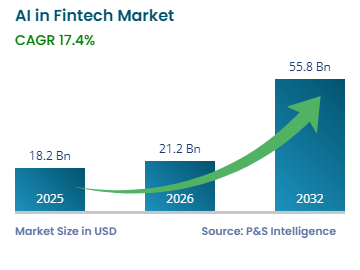
The AI in fintech market size was USD 18.2 billion for 2025, and it will grow by 17.4% during 2026–2032, to reach USD 55.8 billion by 2032.
This growth is supported by the accelerating integration of machine learning, natural language processing, and predictive analytics across fraud detection, credit scoring, chatbots, and quantitative and asset management functions, positioning AI as a core operational layer for banks, payment providers, and capital markets firms rather than a peripheral add-on.
Financial institutions are increasingly adopting AI to improve operational efficiency, strengthen risk management, automate complex business processes, and deliver more personalized customer experiences. Rising transaction volumes, evolving cybersecurity threats, and increasing regulatory expectations accompany this adoption. According to the U.S. Government Accountability Office (GAO), as of December 2024, the Federal Reserve and the U.S. Securities and Exchange Commission had the highest number of AI-related activities among federal financial regulators, reflecting growing regulatory engagement with AI in financial services. Similar momentum is evident in Europe, where the European Central Bank's targeted reviews and on-site inspections conducted during 2024–2025 highlighted increasing AI adoption across banking services.
Key Market Insights
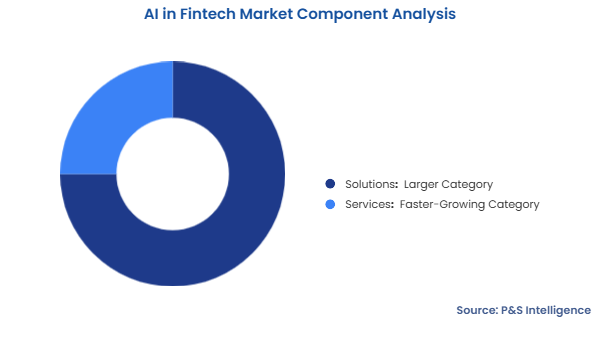
The solutions category accounts for the larger market share, of 75%, in 2025, driven by growing adoption of ready-made AI solutions.
The cloud category holds the larger market share, of 80%, in 2025, and the higher CAGR, of approximately 17.6%, driven by growing adoption of scalable AI infrastructure.
The fraud detection category holds the largest market share, of 40%, in 2025, driven by rising financial losses from fraud.
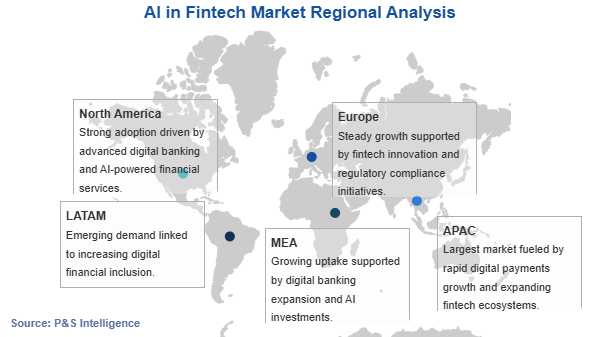
North America holds the largest market share, of 40%, in 2025, driven by its strong AI ecosystem and leading financial institutions.
Asia-Pacific will have the highest CAGR, of approximately 18.3%, driven by rapid AI adoption and digital banking expansion.
AI in Fintech Market Trends and Drivers
Generative and Agentic AI Redefining Financial Workflow Automation Is a Key Trend
The market is shifting from narrow, single-purpose machine learning models toward generative and agentic AI systems capable of executing multi-step financial workflows with limited human intervention. Where earlier AI deployments focused on discrete tasks such as flagging anomalous transactions, current systems increasingly chain together credit assessment, document processing, and customer communication into semi-autonomous pipelines. This transformation is redefining vendor positioning, as providers race to embed conversational and agentic capabilities into existing platforms rather than sell standalone point solutions.
The Financial Stability Board (FSB) reported in November 2024 that AI adoption across financial institutions has accelerated in recent years. Generative AI and large language models are substantially expanding the range of AI use cases beyond operational efficiency and regulatory compliance to document summarization, information retrieval, and code generation. The trend is expected to accelerate as agentic architectures mature, though institutions are likely to retain human oversight checkpoints for higher-risk decisions such as credit approval and large-value transaction authorization.
Escalating AI-Enabled Fraud Sophistication Is Biggest Driver
Financial institutions are shifting from rules-based fraud controls to AI-native detection systems as fraud actors themselves adopt generative AI to scale attacks. Synthetic identity fraud, voice-cloned executive impersonation, and AI-generated phishing content are outpacing the detection capacity of legacy systems, forcing banks and payment providers to deploy machine learning models capable of adapting to novel attack patterns in real time. As the sophistication and frequency of AI-enabled cyber threats continue to increase, AI-powered fraud detection has become a fundamental capability across retail banking, payments, and lending, replacing traditional rule-based systems with more adaptive, real-time risk detection.
According to the Federal Bureau of Investigation's Internet Crime Complaint Center (IC3), 22,364 complaints involving AI-related cybercrime were reported in 2025, resulting in approximately USD 893.3 million in adjusted losses. The 2025 IC3 Report marked the first time in the center's nearly 25-year history that artificial intelligence received a dedicated reporting category. This milestone underscores the growing scale and sophistication of AI-enabled fraud and reinforces the need for AI-powered fraud detection solutions across the financial services industry.
Model Governance Requirements and Regulatory Uncertainty Are Key Restraints
Financial institutions face a patchwork of evolving AI governance requirements across jurisdictions, requiring them to comply with different regulatory expectations, risk management standards, and data governance rules across global markets. At the same time, regulators have deliberately left newer AI architectures outside the boundaries of established model risk frameworks pending further evidence of their behavior. This regulatory ambiguity forces financial institutions to adopt conservative, resource-intensive validation, governance, and compliance processes before deploying generative and agentic AI solutions.
These evolving governance requirements extend deployment timelines, increase implementation and compliance costs, and require extensive model testing, documentation, and ongoing monitoring before AI systems can be deployed in production environments. Financial institutions therefore prioritize transparent, explainable, and lower-risk AI implementations while delaying the deployment of more advanced generative and agentic AI systems until governance expectations become clearer.
Underbanked Population Gaps Is Biggest Opportunity
A large share of the global adult population remains outside formal financial systems. This gap creates a durable opportunity for AI-driven underwriting models that assess creditworthiness using non-traditional data such as utility payments, mobile usage patterns, and transaction histories. Traditional credit bureaus systematically underserve these populations due to thin or absent credit files, leaving alternative-data AI models as one of the few scalable pathways to extend formal credit access.
According to the World Bank Global Findex 2025, approximately 1.3 billion adults worldwide remain unbanked, with more than half concentrated in just eight countries, underscoring the addressable market for AI-enabled inclusive lending and alternative credit assessment solutions. This opportunity is expected to expand most rapidly in markets with high mobile penetration but limited access to traditional banking infrastructure, where AI-enabled alternative credit scoring can improve financial inclusion. The same alternative-data approach enables financial institutions to expand lending to previously underserved populations.
AI in Fintech Market Segmentation Analysis
Component Analysis
The solutions category holds the larger market share, of 75%, in 2025, spanning both software tools and platform offerings that financial institutions increasingly prefer over building AI capabilities in-house. This dominance reflects the operational efficiency of licensing pre-built, vendor-maintained software rather than assuming the ongoing engineering burden of proprietary model development, particularly as institutions prioritize rapid AI deployment across fraud detection, risk management, customer engagement, and lending applications.
The services category will have the higher CAGR, of approximately 17.7%, as managed and professional services increasingly support financial institutions in model validation, governance, systems integration, cloud migration, and regulatory compliance that packaged software alone cannot address. According to the U.S. Bureau of Labor Statistics, employment in computer and information technology occupations is projected to grow much faster than the average for all occupations between 2024 and 2034, reflecting increasing demand for AI implementation, systems integration, cybersecurity, cloud computing, and technology consulting services that support enterprise AI adoption.
The components analyzed in this report are:
Solutions (Larger Category)
Software Tools
Platforms
Services (Faster-Growing Category)
Managed
Professional
Deployment Analysis
The cloud category holds the larger market share, of 80%, in 2025, and it will have the higher CAGR, as financial institutions shift core and adjacent workloads to scalable infrastructure that lowers the barrier to deploying compute-intensive AI models. Regulatory bodies have increasingly promoted secure cloud adoption and established governance frameworks, reinforcing cloud as the preferred deployment environment for AI applications across the financial sector. In July 2024, the U.S. Department of the Treasury, in collaboration with the Financial Services Sector Coordinating Council (FSSCC), published a suite of resources on effective practices for secure cloud adoption, highlighting cloud infrastructure as a strategic priority for enhancing operational resilience, cybersecurity, and digital transformation across financial institutions.
This trajectory is reinforced internationally. According to Eurostat, 52.7% of EU enterprises used paid cloud computing services in 2025, increasing to 84.7% among large enterprises, reflecting the continued expansion of cloud infrastructure to support digital transformation and AI deployment across enterprise environments.
The deployments analyzed in this report are:
Cloud (Larger and Faster-Growing Category)
On-Premises
Application Analysis
The fraud detection category holds the largest market share in 2025, reflecting the fact that fraud losses have become a board-level financial exposure rather than a routine operational cost. Financial institutions have moved AI-based fraud detection from pilot status to mission-critical infrastructure as transaction volumes and fraud sophistication have both escalated simultaneously. According to the Financial Crimes Enforcement Network (FinCEN), approximately 4.8 million Suspicious Activity Reports (SARs) were filed across all reporting institutions in FY2025, with fraud remaining one of the most frequently reported suspicious activity categories, underscoring the increasing need for AI-powered fraud detection and real-time transaction monitoring across the financial sector.
The chatbots category will have the highest CAGR, of approximately 18.0%, as financial institutions expand conversational AI beyond basic query handling into intelligent customer support, account servicing, financial guidance, and personalized banking experiences. Advances in generative AI and large language models are enabling chatbots to deliver more natural, context-aware interactions while reducing response times, improving service availability, and lowering customer service costs across digital banking channels.
The applications analyzed in this report are:
Credit Scoring
Fraud Detection (Largest Category)
Chatbots (Fastest-Growing Category)
Quantitative and Asset Management
Others
Drive strategic growth with comprehensive market analysis
AI in Fintech Market Regional Analysis
North America AI in Fintech Market Size
North America holds the largest market share, of 40%, in 2025, supported by its strong AI engineering talent, well-established regulatory framework, and the presence of major global technology companies and financial institutions. Federal supervisory bodies have moved beyond observation to actively support AI-related initiatives, signaling growing institutional confidence and encouraging broader adoption among regulated entities. Well-capitalized banks and payment providers are embedding AI across fraud detection, credit underwriting, and virtual-assistant channels faster than peer regions, supported by dense venture capital availability for fintech AI startups.
According to the Federal Reserve, the Survey of Business Uncertainty estimated that approximately 78% of the U.S. workforce was employed at firms that had adopted AI by the end of 2025, while financial and professional services ranked among the leading sectors for AI adoption. This widespread enterprise adoption has accelerated the deployment of AI-powered financial solutions across the region.
U.S. AI in Fintech Market Size
The U.S. is the largest country market within North America, supported by its unmatched concentration of AI-native technology vendors, hyperscale cloud infrastructure, and one of the world's largest bases of AI-adopting financial institutions. Rising cyber fraud and increasingly sophisticated financial crime are driving demand for AI-powered fraud detection, credit risk assessment, and cybersecurity solutions across the banking and payments ecosystem. Regulatory agencies are also playing a dual role by adopting AI while strengthening governance frameworks that encourage broader AI adoption across the financial services industry. According to the Federal Reserve, the financial sector reported an AI adoption rate of approximately 30% among firms by the end of 2025, compared with about 18% across all U.S. businesses, while work-related generative AI adoption reached 63% in the financial sector, the highest among major industries.
Asia-Pacific AI in Fintech Market Size
Asia-Pacific will have the highest CAGR, of approximately 18.3%, driven by large underbanked populations, aggressive national AI-in-finance policy frameworks, and rapid digital-native banking expansion across China and India. Regulators across the region are increasingly developing AI governance frameworks, providing greater regulatory clarity for financial institutions adopting AI technologies. Alternative-data-driven credit scoring is expanding financial access for populations historically excluded from formal credit, creating substantial incremental demand for AI underwriting tools. Cloud-native fintech infrastructure is enabling faster AI integration across the region's banking and payments ecosystem.
India is the fastest-growing country in the Asia-Pacific market, supported by its digital public infrastructure and large-scale digital payments ecosystem. According to the Reserve Bank of India (RBI), AI has the potential to improve banking efficiency by up to 46%. In addition, the Reserve Bank of India reported that India leads the world in fintech adoption with an adoption rate of 87%, significantly higher than the global average of 64%, providing a strong foundation for accelerating AI deployment across financial services.
China AI in Fintech Market Size
China represents the largest individual country market within Asia-Pacific, driven by the People's Bank of China's strategic push to embed AI across the financial system rather than treat it as an isolated pilot initiative. Financial institutions are accelerating AI adoption across payments, lending, risk management, and customer service, while cross-border payment infrastructure is increasingly integrating AI to strengthen regional financial connectivity. China's extensive digital payments ecosystem and one of the world's largest digitally active banking populations provide a strong foundation for AI model development and large-scale deployment across financial services. According to the People's Bank of China (PBOC), cumulative digital RMB (e-CNY) transactions exceeded RMB 14.2 trillion by the end of September 2025, with 3.32 billion transactions processed and 225 million personal wallets opened, reflecting the country's advanced digital financial infrastructure and strong foundation for AI-enabled financial innovation.
At Hong Kong FinTech Week in November 2025, People's Bank of China (PBOC) Deputy Governor Lu Lei highlighted the AI + Finance framework as a key initiative to accelerate AI integration across China's financial infrastructure, extending beyond payments to credit, risk management, and cross-border financial services.
The regions and countries analysed in this report are:
North America (Largest Regional Market)
U.S. (Larger Country)
Canada (Faster-Growing Country)
Europe
Germany (Fastest-Growing Country)
U.K. (Largest Country)
France
Italy
Spain
Rest of Europe
Asia-Pacific (Fastest-Growing Regional Market)
China (Largest Country)
India (Fastest-Growing Country)
Japan
South Korea
Australia
Rest of APAC
Latin America
Brazil (Largest Country)
Mexico (Fastest-Growing Country)
Rest of LATAM
Middle East and Africa
Saudi Arabia (Largest Country)
South Africa
U.A.E. (Fastest-Growing Country)
Rest of MEA
AI in Fintech Market Share Analysis
The market is fragmented due to the presence of two distinct groups of competitors serving different layers of the value chain. Diversified technology providers such as Microsoft, Amazon Web Services, and IBM supply cloud infrastructure, foundation models, and enterprise AI platforms, while specialized fintech-AI vendors including FICO, NICE, and DataRobot focus on financial applications such as fraud detection, credit decisioning, anti-money laundering, and regulatory compliance. Financial institutions typically combine general-purpose AI infrastructure with domain-specific solutions rather than relying on a single vendor, resulting in a multi-vendor ecosystem. Technology providers compete through infrastructure scale, model capabilities, and enterprise integration. Specialized vendors differentiate through financial domain expertise, regulatory-specific tuning, and pre-built compliance capabilities. Payment network operators such as Visa and Mastercard embed AI directly into payment infrastructure and transaction monitoring to enhance fraud detection, payment security, and transaction intelligence.
Leading Companies in the AI in Fintech Market:
Microsoft Corporation
Alphabet Inc.
Amazon Web Services, Inc.
IBM Corporation
Oracle Corporation
Salesforce, Inc.
SAS Institute Inc.
Fiserv, Inc.
Fidelity National Information Services, Inc.
PayPal Holdings, Inc.
Stripe, Inc.
Upstart Holdings, Inc.
Mastercard Incorporated
Temenos AG
NICE Ltd.
DataRobot, Inc.
Fair Isaac Corporation
SAP SE
AI in Fintech Market Developments
In May 2026, Temenos AG launched embedded AI Agents, Copilots, and a Conversational Studio across its Core Banking, Digital Banking, and Financial Crime Mitigation products at the Temenos Community Forum. The rollout follows a Tier 1 bank's use of the company's Financial Crime Mitigation AI Agent to automate more than 20% of sanctions-screening alerts, signaling a shift from standalone AI features toward AI embedded directly into core banking infrastructure.
In February 2026, Upstart Network, Inc. launched Cash Line, a small-dollar revolving credit line of USD 200 to USD 5,000 built on its AI underwriting models. The product targets consumers who would otherwise rely on high-interest payday lending or earned-wage-access apps, extending Upstart's AI credit engine into a new lending category beyond personal, auto, and home equity loans.
In October 2025, Mastercard Incorporated launched Mastercard Threat Intelligence, integrating insights from Recorded Future with Mastercard's global payments network to strengthen cyber threat intelligence and fraud prevention capabilities for issuing and acquiring banks following its acquisition of Recorded Future.
In May 2025, IBM Corporation extended its technology partnership with Deutsche Bank AG, expanding the bank's use of IBM's watsonx AI portfolio alongside hybrid cloud and automation tools. The extension supports Deutsche Bank's effort to phase out legacy systems while scaling AI-driven operations across its technology infrastructure.
Frequently Asked Questions About This Report
What is driving the growth of the AI in Fintech market?+
The market is primarily driven by increasing demand for fraud detection, automated customer service, digital payments, personalized financial products, and operational efficiency through artificial intelligence.
What are the key trends shaping the AI in Fintech market?+
Key trends include the adoption of generative AI, explainable AI, embedded finance, open banking, AI-powered financial assistants, hyper-personalized banking, and increasing use of predictive analytics.
What are the major challenges facing the AI in Fintech market?+
Key challenges include data privacy concerns, cybersecurity risks, regulatory compliance, AI bias, model transparency, integration with legacy banking systems, and the shortage of skilled AI professionals.
How is generative AI transforming the fintech industry?+
Generative AI is improving customer support, automating document processing, accelerating software development, enhancing financial advisory services, generating business insights, and increasing productivity across financial institutions.
What opportunities exist in the AI in Fintech market?+
Growth opportunities include AI-powered embedded finance, digital banking expansion, financial inclusion in emerging markets, intelligent risk management, real-time fraud prevention, and AI-driven investment and wealth management solutions.
Want a report tailored exactly to your business need?
Leading companies across industries trust us to deliver data-driven insights and innovative solutions for their most critical decisions. From data-driven strategies to actionable insights, we empower the decision-makers who shape industries and define the future. From Fortune 500 companies to innovative startups, we are proud to partner with organisations that drive progress in their industries.
Client Testimonials
Working with P&S Intelligence and their team was an absolute pleasure – their awareness of timelines and commitment to value greatly contributed to our project's success. Eagerly anticipating future collaborations.
McKinsey & Company
India
Unmatched Standards
Our insights into the minutest levels of the markets, including the latest trends and competitive landscape, give you all the answers you need to take your business to new heights
Complete Data Security
We take a cautious approach to protecting your personal and confidential information. Trust is the strongest bond that connects us and our clients, and trust we build by complying with all international and domestic data protection and privacy laws