AI in Drone Market Size & Share Analysis - Key Trends, Future Opportunities, Growth Strategies, and Forecasts (2025 - 2032)
This Report Provides In-Depth Analysis of the AI in Drone Market Report Prepared by P&S Intelligence, Segmented by Type (Station-based, Cloud-based), Component (Hardware, Software, Services), Technology (AI-Based Navigation, AI-Based Imaging, AI-based Data Analysis), Application (Agriculture, Logistics, Photography, Retail, Construction, Search and Rescue, Security & Surveillance), End Use (Government, Commercial, Military), and Geographical Outlook for the Period of 2019 to 2032
Explore the market potential with our data-driven report
AI in Drone Market Analysis
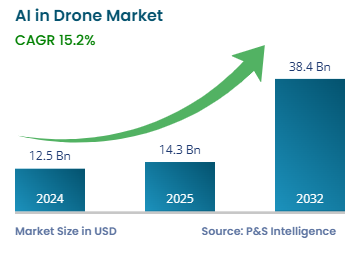
The AI in drone market size was USD 12.5 billion in 2024, and it will grow by 15.2% during 2025–2032, to reach USD 38.4 billion by 2032.
The market growth is driven by technological advancements in UAVs for cost-effectiveness and better efficiency. Also, governments’ strong policies, which include Drone Shakti and PLI scheme, increase local production and simplify drone operations.
Another key driver is the rising security concerns related to the misuse of unmanned aerial vehicles (UAVs), including incidents of illegal surveillance, aerial intrusions, and targeted attacks. The ongoing Russia–Ukraine war and recent India–Pakistan tensions have highlighted the use of small, low-altitude drones in military operations, pushing defense departments worldwide to invest heavily in AI-enabled counter-drone systems.
The global spending on military drones was USD 16.5 billion in 2024, and it is projected to reach USD 43.7 billion by the year 2032.
AI in Drone Market Emerging Trends & Growth Drivers
Expansion of BVLOS Operations and Airspace Integration Is Key Trend
The fast adoption of BVLOS operations and combined airspace operational systems is a key trend influencing autonomous drone operations.
These drones can travel over long distances autonomously, such as highways.
Governments in the U.S., the U.K., India, and Canada are modifying drone policies to boost BLVOS operations across sectors.
In the U.S., the FAA has commanded Remote ID for drones and formulated complete BVLOS guidelines by 2026.
They have also approved many waivers for these flights, highlighting the rising reliability of the associated technology.
AI helps increase safety by autonomously avoiding obstacles, detecting aircraft, and modifying flights instantly.
These integrated BLVOS operations with AI help in smart farming, provide emergency services, and enable infrastructure assessment.
Rising Adoption in Industrial Automation and Smart Infrastructure Projects Drives Market
The growing use of AI-powered drones in infrastructure and industrial automation is a key driver for the market.
Smart infrastructure projects, such as China’s Belt and Road Initiative tech upgrades, India’s Gati Shakti, and the U.A.E.’s Smart Dubai, are using AI-based drones for infrastructure modernization, urban planning, and asset management.
Drones integrated with onboard processors and AI help in bridge and tunnel inspection, live construction monitoring, digital mapping, and utility network surveillance.
The Indian government is utilizing AI-powered drones to monitor roads, construction activities, and utilities, which has reduced infrastructure monitoring costs by 40%.
In Italy, Entel applied drone-in-a-box systems at the Torrevaldaliga Nord power plant for automated asset assessment, which improved monitoring accuracy and minimized labor costs.
In Australia, RocketDNA successfully completed over 8,000 autonomous drone flights at Rio Tinto’s Gudai-Darri iron ore mine in 2024, using AI-powered drones for continuous infrastructure monitoring and operational inspections.
AI in Drone Market Segmentation Analysis
Type Analysis
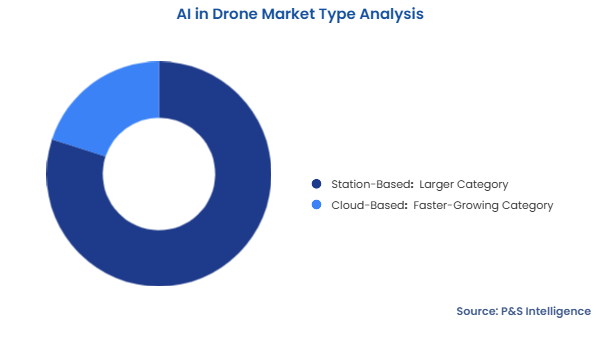
The station-based category held the larger market share, of 80%, in 2024, because of the broad usage in sectors such as defense and rising demand for continuous, autonomous monitoring. Known as drone-in-a-box solutions, they support full autonomous flight cycles and reduce human intervention. They are reliable, scalable, and help in regular data collection from a specific point.
The cloud-based category will have the higher CAGR, due to the development of 5G networks, local computing, and rising usage of cloud-optimized AI platforms. These drones are used in various sectors, such as farming, delivery, and smart city services. Additionally, Ukraine’s military is using these cloud-based drones for combat monitoring, broader coverage, and diverse applications.
The types analyzed in this report are:
Station-Based (Larger Category)
Cloud-Based (Faster-Growing Category)
Component Analysis
The hardware category held the largest market share, of 75%, in 2024 because of the growing demand for collecting and processing data for detection, surveillance, and mapping. They are lightweight and have a streamlined design, which increases efficiency and boosts drone performance. For instance, the ultra-low power module, which is the GAP 9 shield, helps in capturing high-quality images and avoiding obstacles via nano drones. They take clear, detailed pictures and videos to track the movement of the enemy, thus helping in planning for precise actions. For instance, infrared helps drones visualize their surroundings at night, by tracking heat signatures; radars can detect objects even through smoke and clouds, and LIDAR takes 3D pictures.
The software category will have the highest CAGR, because of the rapid development of AI algorithms for image analysis, self-navigation, and route optimization. This software helps drones in target identification and preventive maintenance without human intervention. Moreover, the recurring software upgrades will drive the market revenue in this category.
The components analyzed in this report are:
Hardware (Largest Category)
Sensors
Cameras
Onboard Processors
Navigation Systems
Software (Fastest-Growing Category)
Services
Technology Analysis
The AI-based imaging category held the largest market share, of 70%, in 2024, as they are widely used in infrastructure and environmental surveillance. AI-based drones can be used to examine bridges, pipelines, and power lines remotely and without humans, which increases the overall safety. Technologies such as thermal imaging and LiDAR mapping help in crop monitoring, disaster management, and breach detection.
The AI-based data analysis category will have the highest CAGR, due to the growing volume of drone-generated data and the need to turn it into helpful information. These AI-based systems are used for understanding complex data, which, in turn, helps in making smart decisions in areas such as urban planning.
The technologies analyzed in this report are:
AI-Based Navigation
AI-Based Imaging (Largest Category)
Object Detection
Thermal Imaging
LiDAR Mapping
AI-based Data Analysis (Fastest-Growing Category)
Application Analysis
The security and surveillance category held the largest market share, of 60%, in 2024. This is driven by the widespread use of AI-powered drones in law enforcement, military, and core infrastructure applications for live monitoring and external security. AI helps self-track objects and individuals and provides instant awareness, essential for national security and crowd management. These drones incorporate facial recognition and night-vision systems, boosting their operational capacity.
The logistics category will have the highest CAGR, because of the rising demand for self-driving, no-contact deliveries in sectors such as e-commerce, retail, and healthcare. They are largely used for last-stage delivery, live traffic updates, and route optimization by companies including UPS Flight Forward and Zipline.
This sector has adopted AI to minimize delivery time, reduce fuel costs, and boost shipping reliability, especially in urban and remote areas. Moreover, the rapid shift to same-day delivery is increasing the usage of AI-integrated drone technologies in the logistics sector. The U.S. Navy and Marine Corps ordered 200 T150/TRV150 cargo drones for logistical support and resupply missions in combat zones, highlighting the high demand for integrated drones, even in defense operations.
The applications analyzed in this report are:
Agriculture
Logistics (Fastest-Growing Category)
Photography
Retail
Construction
Search and Rescue
Security and Surveillance (Largest Category)
Others
End Use Analysis
The military category held the largest market share, of 65% in 2024, because of its wide use of unmanned aerial vehicles for surveillance, tracking, and strategic mission formulation. These drones are used in combat zones to boost safety and collect real-time data. AI-integrated drones in the military sector enhance surveillance, reconnaissance, and precision strike capabilities. They enable real-time data analysis, autonomous navigation, and threat detection, reducing human risk. These drones support battlefield intelligence, target identification, and mission efficiency, transforming modern warfare with faster decision-making and greater situational awareness across complex operations.
The commercial category will have the highest CAGR. They are widely used to perform routine inspections, supervise large assets, and gather precise data with minimal human intervention. These systems provide safety and boost accuracy in operations, significantly increasing their commercial viability. Live broadcasting, urban planning, disaster management, traffic monitoring, private and enterprise security, law enforcement and criminal investigation, crowd control, and hobbyist flying for social media content creation are a few key commercial applications of drones.
The end uses analyzed in this report are:
Government
Commercial (Fastest-Growing Category)
Military (Largest Category)
Drive strategic growth with comprehensive market analysis
AI in Drone Market Regional Market Performance
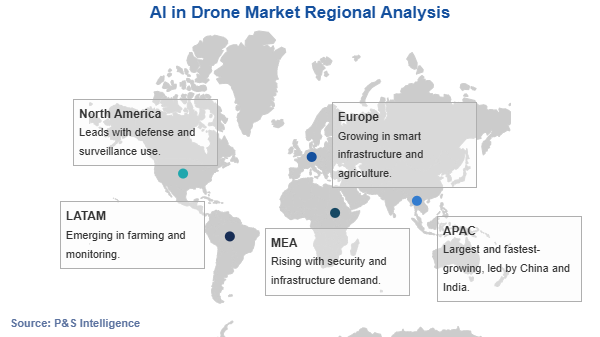
North America held the largest market share, of 40%, in 2024, due to the strong government support, well-defined FAA drone guidelines, and deployment of AI by companies, such as Skydio, for monitoring and deliveries. Moreover, Canada uses AI-based drones for mining and wildlife monitoring. Additionally, farmers in the U.S. use these AI-drones due to labor shortage and fast climate change, to check crop, soil, and irrigation status in real-time, which reduces waste.
Asia-Pacific will have the highest CAGR due to the high investments in military and commercial drones by India and China, strong focus on agriculture, expansion of e-commerce, smart city development, and disaster management. Governments in China and India are investing in AI-based drones for military use, delivery, and farming. South Korea and Japan are using them for crisis management, rescue operations, and city surveillance.
Sales of military drones in India were worth USD 1550.2 million in 2024, which will rise to USD 5574.6 million by 2032. India is providing subsidies to farmers for purchasing AI drones for monitoring and spraying crops.
The geographical breakdown of the market is as follows:
North America (Largest Regional Market)
U.S. (Larger Country)
Canada (Faster-Growing Country)
Europe
Germany (Largest Country)
U.K.
France (Fastest-Growing Country)
Italy
Spain
Rest of Europe
Asia-Pacific (Fastest-Growing Regional Market)
China (Largest Country)
India (Fastest-Growing Country)
Japan
South Korea
Australia
Rest of APAC
Latin America
Brazil (Largest Country)
Mexico (Fastest-Growing Country)
Rest of LATAM
Middle East and Africa
Saudi Arabia (Fastest-Growing Country)
South Africa
U.A.E. (Largest Country)
Rest of MEA
AI in Drone Market Share Analysis
The market is moderately consolidated because of a few local, regional, and global players holding a significant share. Companies such as Parrot, DJI, and Lockheed Martin, have a significant presence, especially in defense, logistics, and business applications. Additionally, the rising number of mergers and acquisitions is enhancing the market positions of major players, reducing the presence of new competitors. Drones are already a specialized product, and most of them are bought by governments; hence, the performance requirements to meet are rather stringent. Moreover, UAVs present a significant safety threat; hence, only a handful of registered companies are allowed to sell their products in specific countries. Developing AI algorithms for an already strictly regulated class of products further complicates things for hopeful startups and emerging firms.
Key AI in Drone Companies:
NVIDIA Corporation
Intel Corporation
Qualcomm Incorporated
SZ DJI Technology Co., Ltd.
Skydio, Inc.
Ambarella, Inc.
International Business Machines Corporation
Teledyne FLIR LLC
Parrot Drones SAS
Autel Robotics Co., Ltd.
Skycatch, Inc.
CEVA, Inc.
AI in Drone Market Developments
In June 2025, Skydio Inc. introduced its most advanced drone, named Skydio X10, with smart navigation and FLIR thermal imaging.
In June 2025, NVIDIA Corporation joined a 42-member EU collaboration, led by Nokia Corporation, Safran SA, and Saab SA, to create AI-powered drones for infrastructure monitoring.
In February 2025, NVIDIA Corporation and Foresight Autonomous Holdings partnered to integrate Jetson Orin AI modules into drones. This will help in improving drone capabilities in night vision and energy-efficient autonomous flights.
In July 2023, Qualcomm Incorporated acquired Auterion to boost AI drone technology for delivery, mapping, and robotics applications.
Want a report tailored exactly to your business need?
Leading companies across industries trust us to deliver data-driven insights and innovative solutions for their most critical decisions. From data-driven strategies to actionable insights, we empower the decision-makers who shape industries and define the future. From Fortune 500 companies to innovative startups, we are proud to partner with organisations that drive progress in their industries.
Client Testimonials
Working with P&S Intelligence and their team was an absolute pleasure – their awareness of timelines and commitment to value greatly contributed to our project's success. Eagerly anticipating future collaborations.
McKinsey & Company
India
Unmatched Standards
Our insights into the minutest levels of the markets, including the latest trends and competitive landscape, give you all the answers you need to take your business to new heights
Complete Data Security
We take a cautious approach to protecting your personal and confidential information. Trust is the strongest bond that connects us and our clients, and trust we build by complying with all international and domestic data protection and privacy laws