Agriculture Waste Management Market Size Forecast
Key Highlights
| Study Period | 2021 - 2032 |
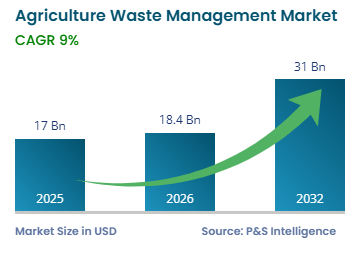
| Market Size in 2025 | USD 17.0 Billion |
| Market Size in 2026 | USD 18.4 Billion |
| Market Size by 2032 | USD 31.0 Billion |
| Projected CAGR | 9% |
| Largest Region | Asia-Pacific |
| Fastest-Growing Region | Asia-Pacific |
| Market Structure | Fragmented |
Market Size
Explore the market potential with our data-driven report
Agriculture Waste Management Market Key Insights
- The animal manure & bedding materials category holds the largest market share, of 45%, in 2025, driven by high livestock waste volume and contamination risks requiring mandatory management.
- The composting category holds the largest market share, of 40%, in 2025, driven by low cost, wide adoption, and easy farm-level implementation without complex infrastructure.
- The processing services category will have the highest CAGR, of 9.4%, driven by value-added outputs like biogas, compost, and organic fertilizers.
- The fertilizers category holds the largest market share, of 40%, in 2025, driven by widespread use of compost, digestate, and treated residues as low-cost alternatives to synthetic fertilizers.
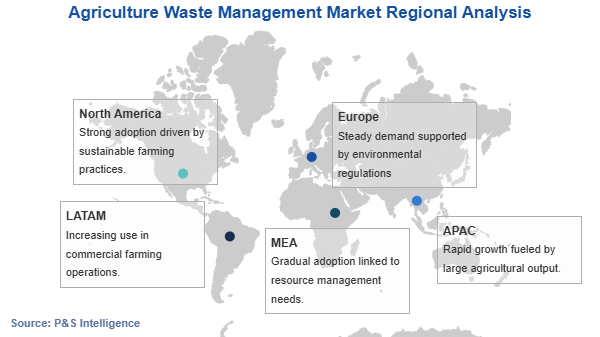
- Asia-Pacific holds the largest market share, of 40%, in 2025, and it will have the highest CAGR, of 9.1%, driven by high agricultural residue generation, rising biomass-to-energy adoption, and supportive government policies.
Agriculture Waste Management Market Overview
The agriculture waste management market size was USD 17.0 billion for 2025, and it will grow by 9.0% during 2026–2032, to reach USD 31.0 billion by 2032.
The market expansion is driven by regulatory mandates for sustainable agricultural waste disposal that have established compliance requirements for agribusinesses across major producing economies. Circular economy frameworks have expanded the commercial viability of converting crop residues, animal manure, and agro-industrial by-products into organic fertilizers, biogas, and bioenergy, while environmental compliance obligations are compelling agribusinesses to replace open burning and landfill disposal with structured collection and treatment systems. The Food and Agriculture Organization (FAO) reports that global cereal production reached approximately 2.8 billion tonnes in 2023, generating substantial volumes of agricultural residues requiring organized management systems.
The European Commission’s REPowerEU plan targets 35 billion cubic meters of biomethane production by 2030, accelerating investment in agricultural waste-to-energy infrastructure across the region. This environmental burden is accelerating public and private investment in anaerobic digesters, vermicomposting units, and biogas capture facilities, which redirect organic agricultural waste from open disposal toward productive valorization pathways.
Agriculture Waste Management Market Trends & Drivers
Circular Economy Integration and Waste Valorization Are Key Trends
A defining structural trend in the agriculture waste management market is the progressive transition from disposal-oriented operations toward circular economy frameworks. Agricultural residues are increasingly treated as commercially valuable input materials for organic fertilizer, biogas, biofuel, and biomaterial production. The International Energy Agency (IEA) Renewables 2024 outlook reports that global demand for biogas and biomethane is expected to grow through 2030, with agricultural waste feedstocks constituting a substantial share of the supply base, supported by strong policy incentives across the European Union, India, the United States, and Brazil.
This shift transforms revenue models for waste management operators from pure service contracts to integrated by-product monetization strategies, where digestate and compost sales generate incremental income streams alongside biogas and biomethane offtake agreements. Major agri-industrial processors are establishing on-site anaerobic digestion and composting facilities under closed-loop production strategies. These facilities reduce waste disposal costs while generating certified organic fertilizer inputs for contract farming operations. Germany is one of the leading biogas producers, operating over 9,500 biogas plants, with a significant proportion utilizing agricultural residues and manure as primary feedstock, reflecting the advanced integration of circular waste-to-energy systems within the country’s agricultural sector.
Tightening Environmental Regulations and Climate Commitments Is Biggest Driver
Mounting regulatory obligations centered on greenhouse gas reduction and sustainable land management are compelling agribusinesses, livestock operators, and food processors worldwide to replace open disposal practices with structured agricultural waste treatment systems. The Food and Agriculture Organization of the United Nations (FAO) reports that global agrifood systems emitted approximately 16.5 billion tonnes of CO₂ equivalent in 2023, up from 16.2 billion tonnes in 2022, with farm-gate activities accounting for approximately 48% of total agrifood emissions, thereby positioning agricultural waste management as a direct lever within national decarbonization strategies.
This quantified emissions burden is translating into increasingly stringent national policy frameworks across major agricultural economies, including the European Union's Farm to Fork Strategy mandating a 50% reduction in nutrient losses and at least a 20% reduction in fertilizer use by 2030, alongside the REPowerEU plan targeting 35 billion cubic meters of biomethane production annually, and China's 14th Five-Year Plan setting explicit targets for manure biogas capture and crop residue utilization. The United States Environmental Protection Agency (EPA) reports that over 2,000 anaerobic digesters are operational across the United States, with many supported through the AgSTAR program, as renewable energy incentives and emissions reduction policies drive expanding adoption of manure-to-biogas systems. As carbon pricing mechanisms expand and penalties for open burning intensify, the economic cost of non-compliance increasingly exceeds the capital investment required for anaerobic digesters, composting infrastructure, and waste collection systems.
Untapped Agricultural Residue Streams Are Biggest Opportunities
The global agriculture waste management market faces a significant structural opportunity across South Asia, Southeast Asia, Sub-Saharan Africa, and Latin America, where vast volumes of agricultural residues remain unmanaged or are openly burned, representing addressable market potential for waste collection, processing, and valorization service providers. The United Nations Environment Programme (UNEP) estimates that food loss and waste generate 8–10% of global greenhouse gas emissions, with agricultural waste forming a significant upstream component, particularly in emerging economies where waste management infrastructure remains limited.
International development financing through the World Bank, Asian Development Bank, and African Development Bank is progressively channeling capital toward rural waste management infrastructure in these underserved geographies, unlocking project pipelines for composting facilities, small-scale biogas installations, and waste collection network development.
Government subsidies for biogas adoption among smallholder farming communities in India, Vietnam, and Kenya are creating commercially replicable models for private sector operators, reducing per-unit deployment costs and demonstrating viable return profiles that lower the risk threshold for market entry. For instance, India's GOBAR-Dhan (Galvanizing Organic Bio-Agro Resources) scheme supports decentralized biogas and composting infrastructure at the village level, promoting conversion of cattle dung and agricultural waste into bioenergy and organic fertilizers, while Kenya's National Climate Change Action Plan (NCCAP) supports decentralized biogas systems and organic waste-to-energy solutions in rural areas.
Infrastructure Gaps and Feedstock Supply Chain Fragmentation Are Key Restraints
Despite strong policy intent and growing investment flows, inadequate rural logistics infrastructure and fragmented feedstock supply chains continue to limit the deployment of industrial-scale agricultural waste treatment facilities across emerging and transitional economies. The International Energy Agency (IEA) Biogas and Biomethane Special Report notes that agriculture, particularly livestock, accounts for approximately 40% of global anthropogenic methane emissions, while the waste sector contributes a further approximately 20%. Industrial biogas capture rates remain well below technical potential due to persistent challenges in aggregating dispersed farm-level waste volumes into economically viable feedstock supply chains.
Smallholder farming systems dominate agricultural production across South and Southeast Asia, Sub-Saharan Africa, and parts of Latin America, generating waste in small, geographically scattered volumes that require extensive collection and aggregation networks before treatment becomes economically viable at scale. Capital requirements for biogas plants, composting facilities, and waste transport fleets present substantial barriers for smaller agribusinesses and cooperative farming organizations, many of which lack access to long-tenor project finance or government viability gap funding, leaving structured waste treatment infrastructure economically out of reach without external financing support.
Agriculture Waste Management Market Segmentation Analysis
Waste Type Analysis
The animal manure & bedding materials category holds the largest market share, of 45%, in 2025, driven by the volumetric scale of livestock waste generation and the high organic content in raw manure, which creates direct contamination risks for soil and water resources, making structured collection and processing operationally necessary rather than discretionary. Livestock operations generating concentrated manure streams create consistent, year-round demand for collection, storage, treatment, and valorization services. This demand continuity underpins the segment's structural dominance within agricultural waste management systems.
The crop residues category will have the highest CAGR, of 9.2%, driven by increasing regulatory restrictions on open burning, rising adoption of biomass conversion and composting solutions across emerging economies. Expanding utilization of crop residues for bioenergy, biogas, and organic fertilizer production is further accelerating demand for collection and processing infrastructure. FAO data shows that global cereal production exceeded 2.8 billion tonnes in 2023.
The waste types analyzed in this report are:
- Animal Manure & Bedding Materials (Largest Category)
- Crop Residues (Fastest-Growing Category)
- Agro-Industrial / Food Processing Waste
- Others
Disposal Treatment Process Analysis
The composting category holds the largest market share, of 40%, in 2025, driven by its status as the most widely deployed treatment method for agricultural organic waste globally, supported by low capital requirements that make it accessible across operator types and compatibility with farm-level operations that eliminate the need for specialized infrastructure or external logistics networks. The organic fertilizers it produces support soil health and reduce operator dependence on synthetic inputs. The Food and Agriculture Organization of the United Nations (FAO) highlights that manure and organic waste recycling through composting and land application represents a major pathway for nutrient recovery and soil fertility management globally.
The anaerobic digestion category will have the highest CAGR, driven by increasing renewable energy mandates creating binding policy requirements for biogas and biomethane production across major agricultural economies. The growing economic viability of biomethane production from agricultural waste feedstocks is reducing the investment risk threshold for project developers and agribusinesses. Anaerobic digestion offers the capacity to manage organic waste streams and generate renewable energy within a single treatment process. This dual-output profile is accelerating adoption across both developed and emerging agricultural economies.
The disposal treatment processes analyzed in this report are:
- Composting (Largest Category)
- Anaerobic Digestion (Fastest-Growing Category)
- Biomass Conversion
- Bioenergy Production
- Recycling
Management Service Analysis
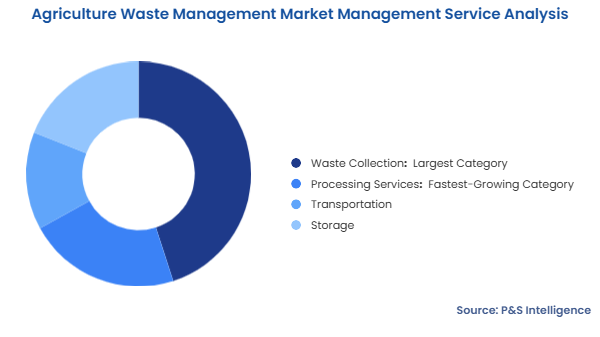
The waste collection category holds the largest market share of 45% in 2025, driven by the aggregate geographically dispersed crop residues, livestock manure, and agro-industrial by-products forming the essential logistical foundation for downstream treatment and valorization activities. The need to connect decentralized waste generation points with processing facilities, composting units, and anaerobic digestion plants sustains continuous demand for collection infrastructure across both developed and emerging agricultural markets. According to the World Bank, over 2 billion tonnes of municipal and organic waste are generated globally each year, highlighting the scale of waste management infrastructure required across sectors, including agriculture.
The processing services category will have the highest CAGR, of 9.4%, reflecting the global shift toward value-added agricultural waste utilization, with biogas production, composting, and organic fertilizer processing as the dominant output pathways. Increasing investments in waste-to-energy infrastructure and biofertilizer production are expanding the role of processing services beyond basic disposal toward revenue-generating resource recovery systems. The International Energy Agency (IEA) notes that over 50 new policy measures supporting biogas and biomethane have been introduced globally, accelerating investment in waste processing and anaerobic digestion infrastructure worldwide.
The management services analyzed in this report are:
- Waste Collection (Largest Category)
- Processing Services (Fastest-Growing Category)
- Transportation
- Storage
Application Analysis
The fertilizers category holds the largest market share, of 40%, in 2025, driven by the widespread use of composted manure, digestate, and treated crop residues as cost-effective alternatives to synthetic fertilizers across major agricultural economies. Government policies promoting sustainable agriculture are reinforcing the integration of organic fertilizers into soil nutrient management practices. This policy foundation continues to consolidate fertilizer production's structural position within agricultural waste treatment systems.
The renewable energy category will have the highest CAGR, of 9.3%, driven by expanding policy support for biogas and biomethane and increasing carbon pricing incentives that are improving the financial returns from biogas capture and biomethane upgrading projects. Improving the economic viability of waste-to-energy technologies is lowering the deployment threshold for agribusinesses and project developers. The growing integration of agricultural biogas into national renewable energy systems is accelerating investment in anaerobic digestion and biomethane upgrading infrastructure across major agricultural regions.
The applications analyzed in this report are:
- Fertilizers (Largest Category)
- Renewable Energy (Fastest-Growing Category)
- Animal Feed
- Biofuels
- Others
Drive strategic growth with comprehensive market analysis
Agriculture Waste Management Market Regional Outlook
Asia-Pacific Agriculture Waste Management Market Size
Asia-Pacific holds the largest market share, of 40%, in 2025, and it will have the highest CAGR, of 9.1%. The region's position is underpinned by its vast agricultural scale, with China generating approximately 700–800 million tonnes of crop residues annually. This feedstock volume supports composting, anaerobic digestion, and bioenergy conversion operations at scale across the country.
Government-backed programs across China, India, Indonesia, and Vietnam subsidize biogas production, composting infrastructure, and biofertilizer adoption, such as China’s Rural Biogas Development Program and Vietnam’s National Biogas Programme. Rural development mandates and clean energy incentive frameworks provide the policy foundation for these programs. High agricultural intensity across Southeast and South Asia ensures a continuous supply of crop residues, livestock manure, and agro-processing by-products that underpin both established and emerging waste treatment infrastructure.
FAOSTAT data shows that Asia and the Pacific region accounts for the largest share of global cereal production, at 1.4–1.5 billion tonnes annually, generating proportionately the highest agricultural residue output of any region globally.
China Agriculture Waste Management Market Size
China is the largest market within the Asia-Pacific. The country leads globally in both agricultural waste generation volumes and biogas infrastructure deployment, supported by its 14th Five-Year Plan, which targets expanded rural biogas plant networks, organic fertilizer production from animal manure, and systematic crop residue utilization as part of its pathway to carbon neutrality by 2060.
Domestic manufacturers offering modular, plug-and-play digesters and remote monitoring systems have substantially reduced adoption costs, enabling rapid penetration among small and medium-scale farms. Soil health improvement and rural clean energy access are twin policy priorities within China's national sustainability framework. This overlap positions agricultural waste treatment as a dual-benefit investment under programs that reward both outcomes.
India Agriculture Waste Management Market Size
India is one of the fastest-growing country markets within Asia-Pacific, with an annual crop residue generation of approximately 500 million tonnes, providing the feedstock foundation for composting, anaerobic digestion, and bioenergy conversion at scale, while regulations penalizing open burning of crop residues across Punjab, Haryana, and other major agricultural states are creating compliance-driven demand for structured waste treatment alternatives. The government's Sustainable Alternative Towards Affordable Transportation (SATAT) initiative targets 5,000 compressed biogas plants, establishing a defined infrastructure build-out target for the sector.
The Ministry of New and Renewable Energy promotes biogas and biomass-based power generation through capital subsidies and viability gap funding. These instruments lower the investment burden on agribusinesses and cooperative farming organizations, while growing awareness of soil health benefits from compost application is expanding demand for organic fertilizer production, supported by crop residues and animal manure as primary feedstock inputs. The Food and Agriculture Organization of the United Nations (FAO) reports that India ranks among the world's largest producers of wheat, rice, and sugarcane, generating approximately 500–550 million tonnes of crop residues annually, which serve as substantial feedstock for composting, anaerobic digestion, and bioenergy conversion programs.
The regions and countries of the market are as follows:
- North America
- U.S. (Larger Country Market)
- Canada (Faster-Growing Country Market)
- Europe
- Germany (Largest Country Market)
- U.K.
- France (Fastest-Growing Country Market)
- Italy
- Spain
- Rest of Europe
- Asia-Pacific (Largest and Fastest-Growing Regional Market)
- China (Largest Country Market)
- India (Fastest-Growing Country Market)
- Japan
- South Korea
- Australia
- Rest of APAC
- Latin America
- Brazil (Largest Country Market)
- Mexico (Fastest-Growing Country Market)
- Rest of LATAM
- Middle East and Africa
- Saudi Arabia (Largest Country Market)
- South Africa (Fastest-Growing Country Market)
- U.A.E.
- Rest of MEA
Agriculture Waste Management Market Share
The market is fragmented due to its localized nature and variability in waste generation across regions, farm sizes, and agricultural practices. Waste collection and processing must occur close to the source, encouraging the presence of numerous small and regional service providers. The diversity of waste types, such as crop residues, livestock manure, and agro-industrial by-products, requires different treatment technologies, limiting standardization. Additionally, differences in regulatory frameworks, infrastructure availability, and financial capacity across countries make it difficult for large players to scale uniformly, resulting in a market structure dominated by a wide range of participants.
Leading Companies in the Agriculture Waste Management Market:
- Waste Management, Inc.
- Republic Services, Inc.
- Veolia Environnement S.A.
- SUEZ S.A.
- Renewi plc
- REMONDIS SE & Co. KG
- FCC Environment
- Anaergia Inc.
- BiofuelCircle
- Hitachi Zosen Inova AG
- ENGIE SA
- EnviTec Biogas AG
Agriculture Waste Management Market News
- In January 2026, ENGIE SA signed a 10-year biomethane purchase agreement with PepsiCo UK and began constructing a new anaerobic digestion facility in North England with ~60 GWh annual capacity, supported by agricultural and agro-industrial waste feedstocks.
- In October 2025, Anaergia Inc. entered a joint venture with Tozzi Sud and Isolmec Group to develop the Ora biogas facility in southern Italy, expected to produce approximately 47 GWh of biomethane annually for grid injection.
- In August 2025, Anaergia Inc. signed an agreement to expand and upgrade the Moglia anaerobic digestion facility in northern Italy, significantly increasing agricultural residue processing capacity and biomethane output.
- In June 2025, Anaergia Singapore Pte. Ltd. secured a ~CAD 40 million contract with New Jeju Bio Co. Ltd. to develop a biogas plant in South Korea, processing ~54,000 tonnes of organic waste annually into renewable energy and digestate.
- In April 2025, Anaergia Inc. signed a binding agreement with Capwatt Biomethane to design and build nine biomethane production facilities across Portugal, Spain, and Italy using agro-industrial waste feedstocks.