This Report Provides In-Depth Analysis of the Agricultural Robots Market Report Prepared by P&S Intelligence, Segmented by Type (UAVs / Drones, Driverless / Autonomous Tractors, Milking Robots, Harvesting & Picking Robots), Application (Crop Farming, Dairy & Livestock Management, Soil & Irrigation Management, Crop Monitoring), Component (Hardware, Software, Services), Farm Environment (Outdoor Farming, Indoor Farming), and Geographical Outlook for the Period of 2021 to 2032
Explore the market potential with our data-driven report
Agricultural Robots Market Outlook
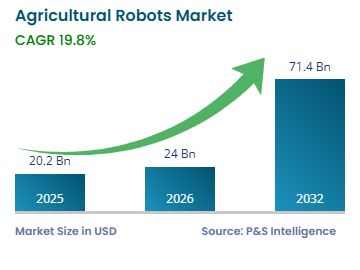
The agricultural robots market size was USD 20.2 billion for 2025, and it will grow by 19.8% during 2026–2032, to reach USD 71.4 billion by 2032.
The market is driven by widespread adoption of artificial intelligence, machine learning, computer vision, and IoT-enabled sensing technologies, which are now deployed across crop farming, dairy and livestock management, soil analysis, and precision spraying operations. Autonomous UAVs, driverless tractors, robotic milking systems, and harvesting robots are increasingly embedded within commercial farming operations. Labor-intensive manual processes are being displaced at scale, and data-driven precision agriculture is being adopted across diverse agricultural environments.
Agricultural labor shortages and steadily rising farmworker wages are accelerating investment in farm automation across major producing economies. Intensifying global food security pressures are reinforcing this investment trajectory. The Food and Agriculture Organization of the United Nations (FAO) projects that global food production must increase by approximately 70% by 2050 to sustain a projected population of 9.1 billion. This production imperative establishes a durable structural demand floor for productivity-enhancing robotic technologies across global farming systems.
Key Market Insights
The UAVs/drones category holds the largest market share, of 40%, in 2025, driven by rapid commercialization across crop monitoring, precision spraying, soil mapping, and field scouting applications, which have established the segment's structural depth.
The harvesting and picking robots category will have the highest CAGR, of 19.9%, as specialty crop harvesting requires delicate manual handling that robotic systems equipped with computer vision and soft-grip end-effectors are increasingly capable of replicating.
The crop farming category holds the largest market share, of 40%, in 2025, driven by the wide-scale deployment of UAV-based precision spraying, driverless tractors for autonomous tillage and planting, and AI-guided robotic weeding systems across commodity crops.
The hardware category holds the largest market share, of 55%, in 2025, driven by the high capital intensity associated with deploying functional robotic systems across agricultural operations.
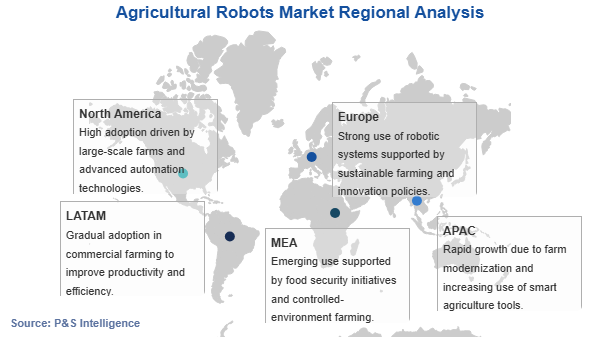
North America holds the largest market share, of 40%, in 2025, driven by mature precision agriculture infrastructure and substantial federal investment in farm automation, which together have established the institutional foundation.
Agricultural Robots Market Growth Factors
AI Integration and Computer Vision Are Key Trends
The convergence of artificial intelligence, computer vision, machine learning, and IoT-enabled sensor networks is fundamentally reshaping the functional boundaries of agricultural robotics. Computer vision models trained on multispectral imagery now enable robotic platforms to distinguish between healthy and diseased plant tissue at individual leaf level. Weed species identification has reached sufficient precision to replace broadcast herbicide application with targeted micro-dosing. Fruit ripeness estimation is now guiding selective harvesting arms in orchards and vineyards, giving growers a level of harvest selectivity previously achievable only through skilled manual labor.
According to the Food and Agriculture Organization (FAO), precision agriculture technologies enabled by AI and sensor systems can reduce pesticide use by up to 30% while maintaining crop yields. This reduction represents the operational efficiency gains achievable through intelligent farm automation.
Persistent Agricultural Labor Shortages and Rising Wage Costs Are Biggest Drivers
Chronic agricultural labor shortfalls across major producing economies are compelling farm operators to substitute manual workforces with autonomous robotic systems at an accelerating pace. The farm sector provides employment for around 2.6 million workers in the United States, representing approximately 1.2% of total national employment. This relatively small labor pool creates a structural constraint on the capacity to sustain large-scale agricultural production.
Specialty crop producers bear the most acute exposure, particularly those cultivating fruit, vegetables, and horticultural products. Labor accounts for roughly 38% of total cash expenses on specialty crop farms. This cost concentration makes these operations highly sensitive to labor shortages and wage volatility. This structural cost pressure creates a durable economic case for autonomous harvesting, planting, and crop monitoring robots that deliver productivity without the regulatory complexity and cost escalation associated with seasonal guest worker programs.
Reliance on foreign seasonal labor has also expanded. The United States issued approximately 310,000 H-2A agricultural worker visas in 2023 to address domestic farm labor shortages. As urbanization continues to draw rural working-age populations toward non-agricultural employment across Asia, Europe, and Latin America, labor availability constraints are expected to intensify through the forecast period. Robotic adoption is emerging as a structural necessity rather than a discretionary investment across all farming scales and geographies.
Smallholder Farm Digitalization and Emerging Market Expansion Are Biggest Opportunities
A substantial untapped addressable market is emerging as agricultural robotics and precision farming technologies become increasingly accessible to smallholder and mid-scale farm operations across developing economies. According to the Food and Agriculture Organization (FAO), smallholder farms represent approximately 84% of the world's farms but operate only about 12% of global agricultural land. Eurostat reports that about 65% of farms in the European Union are smaller than five hectares. This fragmented farm structure establishes a clear demand basis for compact, cost-efficient robotic solutions across the region.
In India, government-backed digital agriculture programs and NABARD-led financing initiatives are extending robotic and precision technology access to smallholder farmers. This access is generating demand for compact, cost-optimized robotic platforms specifically engineered for smaller field geometries and diverse cropping systems. According to the Government of India's Agriculture Census, nearly 86% of Indian farmers operate on small and marginal landholdings of less than two hectares. This landholding profile establishes the structural case for compact and affordable automation technologies tailored to fragmented farm structures. Across Sub-Saharan Africa and Southeast Asia, AI-powered mobile applications are enabling crop disease diagnosis and pest management guidance for farmers with no prior technology access. As connectivity infrastructure improves and sensor costs decline, these emerging market segments represent a major structural expansion vector for agricultural robot manufacturers. Scalable, low-cost solutions adapted to diverse farm environments will be required to capture growth beyond the large-scale commercial operations that have historically anchored market demand.
High Capital Expenditure Requirements and Rural Digital Infrastructure Are Key Restraints
The adoption of agricultural robots across various farming operations remains limited due to high capital investment requirements and gaps in rural digital infrastructure. Advanced robotic harvesting and milking systems frequently carry unit costs ranging from tens of thousands to hundreds of thousands of dollars. This price range places them beyond the economic reach of small and mid-sized farm operations, which collectively represent the majority of global agricultural land area.
Uneven availability of reliable rural broadband connectivity compounds the cost barrier. Cloud-connected precision agriculture and autonomous farm equipment operations depend on consistent connectivity infrastructure that remains absent across large portions of the developing world. According to the International Telecommunication Union, approximately 2.6 billion people worldwide remained offline in 2023, with the majority located in rural regions of developing economies. These infrastructure gaps directly constrain adoption of cloud-connected agricultural technologies across the farm segments where growth potential is greatest.
Interoperability gaps between robotic platforms from different manufacturers add further friction to adoption decisions across operations evaluating multi-vendor deployments. Limitations in data sharing, fleet management, and integration with existing farm management software mean that operators assembling multi-vendor fleets face system fragmentation that reduces the operational efficiency gains automation is intended to deliver.
Agricultural Robots Market Segmentation Analysis
Type Analysis
The UAVs/drones category holds the largest market share, of 40%, in 2025, driven by rapid commercialization across crop monitoring, precision spraying, soil mapping, and field scouting applications, which have established the segment's structural depth. Comparatively low acquisition cost relative to ground-based robotic platforms gives the technology a broad addressable market across farm scales. An established regulatory pathway under frameworks including the FAA's Part 107 in the United States and EASA's UAS category structure in Europe enabled early commercial deployment at scale. UAV systems can collect multispectral, thermal, and LiDAR imaging data across large field areas within a single mission. This data density delivers actionable crop intelligence that ground-based systems cannot replicate at comparable speed or cost efficiency.
The harvesting and picking robots category will have the highest CAGR, of 19.9%, as specialty crop harvesting requires delicate manual handling that robotic systems equipped with computer vision and soft-grip end-effectors are increasingly capable of replicating. The Food and Agriculture Organization of the United Nations (FAO) has documented that labor shortages and rising wages in agro-food sectors across East Asia and Mexico are creating structural demand for harvesting automation. This demand profile is accelerating R&D investment and expanding deployment scale across robotic picking platforms for strawberry, apple, grape, and tomato production globally.
The crop farming category holds the largest market share, of 40%, in 2025, driven by the wide-scale deployment of UAV-based precision spraying, driverless tractors for autonomous tillage and planting, and AI-guided robotic weeding systems across commodity crops. Corn, soybean, wheat, and rice represent the dominant global agricultural production base, and commercial robotics adoption has reached its greatest operational depth across these crops. Large commercial row-crop operations in North America, South America, and Australia generate sufficient operational hours and yield data to justify the capital investment in autonomous equipment. As the per-acre cost of robotic operations declines with fleet utilization, these adoption cycles become self-reinforcing.
Herbicide resistance trends are accelerating adoption of precision robotic weeding and targeted spraying systems across cereal and oilseed operations. Over 500 unique weed biotypes have been confirmed as resistant to at least one herbicide mode of action globally, removing the chemical control option for a growing share of commercial acreage and making robotic precision application a practical rather than discretionary investment.
The crop monitoring category will have the highest CAGR, of 20.1%, driven by the increasing commercial availability of multispectral and hyperspectral UAV imaging systems, which are expanding the data inputs available to farm management platforms. Satellite-integrated farm management platforms are enabling early disease detection, nutrient deficiency mapping, and irrigation optimization at a fraction of the cost of field scouting labor. AI-powered crop advisory tools are extending this capability to farm operators without specialist agronomy staff. In Asia, where smallholder farm fragmentation limits the scalability of traditional manual scouting, these tools are becoming the primary mechanism through which farms optimize yield, reduce input waste, and improve crop health monitoring.
The applications analyzed in this report are:
Crop Farming (Largest Category)
Dairy & Livestock Management
Soil & Irrigation Management
Crop Monitoring (Fastest Growing Category)
Others
Component Analysis
The hardware category holds the largest market share, of 55%, in 2025, driven by the high capital intensity associated with deploying functional robotic systems across agricultural operations. The segment encompasses the primary revenue-generating physical systems across agricultural robots, including airframes, robotic arms, end-effectors, LiDAR and multispectral sensors, motors, actuators, GPS/GNSS receivers, and battery and propulsion systems. Physical platform procurement currently represents the majority of per-transaction value across all robotic system categories.
Solid-state LiDAR units cost approximately USD 10,000 per unit in 2020 and declined below USD 1,000 by late 2024, a 90% price reduction. These hardware cost reductions are sustaining revenue volume through higher deployment quantities and expanding the addressable customer base to smaller farm operations that could not previously afford advanced robotic systems. The U.S. Department of Agriculture National Agricultural Statistics Service (USDA NASS) recorded that guidance autosteering and precision equipment installations expanded across large-scale U.S. farm operations through 2023.
The software category will have the highest CAGR, of 20.2%, driven by agricultural robot manufacturers progressively shifting their business models toward AI platform subscriptions, farm management software licenses, and robot-as-a-service (RaaS) arrangements. These recurring revenue structures operate independently of hardware replacement cycles, giving manufacturers a more predictable and margin-accretive revenue base than hardware sales alone. Fleet management systems, computer vision AI model subscriptions, agronomic data analytics platforms, and cloud-connected farm intelligence tools are commanding increasing value within total robotic deployments. OEMs including Deere & Company and CNH Industrial N.V. are actively building proprietary software ecosystems, with the John Deere Operations Center representing the most developed commercial example of this strategy.
The components analyzed in this report are:
Hardware (Largest Category)
Software (Fastest Growing Category)
Services
Farm Analysis
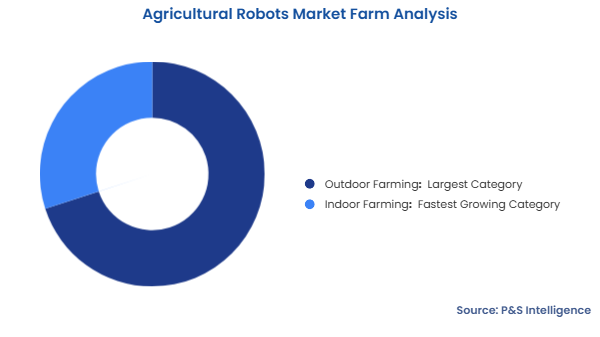
The outdoor farming category holds the largest market share, of 70%, in 2025, driven by the widespread deployment of autonomous tractors, UAV-based crop monitoring systems, and robotic spraying technologies across large-scale field agriculture. GPS/GNSS-based guidance systems, RTK correction networks, and autonomous path-planning algorithms are optimized for outdoor field geometries. The global installed base of precision agriculture hardware is overwhelmingly deployed in open-field agricultural settings, reinforcing the segment's structural depth across all major producing regions.
The indoor farming category will have the highest CAGR, of 20.3%, driven by the expansion of controlled-environment agriculture across North America, Europe, and Asia-Pacific. Climate risk, water scarcity, and urban food security goals are compelling investment in intensive indoor production systems where year-round output is operationally required. Land constraints, extreme climates, and water scarcity across these geographies make precision indoor production both economically and strategically essential, establishing a durable policy and commercial foundation for indoor agricultural robotics investment through the forecast period.
The farms analyzed in this report are:
Outdoor Farming (Largest Category)
Indoor Farming (Fastest Growing Category)
Drive strategic growth with comprehensive market analysis
Agricultural Robots Market Geographical Analysis
North America Agricultural Robots Market Size
North America holds the largest market share, of 40%, in 2025, driven by mature precision agriculture infrastructure and substantial federal investment in farm automation, which together have established the institutional foundation. Large-scale row-crop operations across the Midwest and high-value specialty crop and dairy farming in California and Wisconsin have created established commercial pathways for autonomous tractor systems, drone-based crop monitoring, and robotic milking deployments.
The U.S. Department of Agriculture Economic Research Service (USDA ERS) reports that guidance autosteering systems were adopted by 70% of large-scale crop-producing farms in 2023, up from single-digit adoption rates in the early 2000s. This trajectory illustrates the sustained pace of precision technology diffusion across U.S. commercial agriculture. The American Farm Bureau Federation projected that farm labor costs across U.S. agriculture will exceed USD 53 billion in 2025. This cost pressure reinforces the economic imperative for substituting high-cost manual labor with autonomous robotic systems.
U.S. Agricultural Robots Market Size
The United States is the dominant country market within North America, accounting for the majority of regional revenue in 2025, driven by an advanced precision agriculture ecosystem and expansive commercial farming operations that provide the structural foundation. Deep public and private investment in autonomous systems has further accelerated deployment across the country. AI-guided harvesting robots, autonomous milking systems, and UAV-based crop monitoring have achieved commercial scale across commodity crop, specialty crop, and dairy segments. This deployment breadth has established the U.S. as a global benchmark for agricultural robotics.
The U.S. Government Accountability Office (GAO) reported that only 27% of U.S. farms or ranches used precision agriculture practices in 2023. This adoption rate highlights significant untapped potential even within the world's largest agricultural economy. The U.S. Department of Agriculture National Agricultural Statistics Service (USDA NASS) recorded that farm operators paid hired workers an average gross wage of USD 19.52 per hour during April 2025, up 3% year-on-year. These persistent labor cost pressures sustain the economic case for automation investment across farm operations nationwide.
Asia-Pacific Agricultural Robots Market Size
Asia-Pacific will have the highest CAGR, of 20.0%, driven by structural labor shortages and urbanization-driven food demand growth. Government-backed mechanization programs across China, Japan, India, South Korea, and Australia are providing the policy and financial infrastructure required to translate this demand into deployment. Japan's average farmer age now exceeds 68 years. This demographic reality has prompted the Ministry of Agriculture, Forestry, and Fisheries to subsidize autonomous rice transplanting and harvesting systems at scale.
China is advancing its smart-farming modernization agenda through substantial investment in domestic robotic manufacturers. DJI and XAG have become the primary commercial vehicles for drone-based precision farming, with systems engineered specifically for the narrow, irregular field geometries that characterize Asian agricultural landscapes. China's Ministry of Agriculture and Rural Affairs data shows that more than 300,000 agricultural drones were deployed across Chinese farms by 2025. These systems covered over 30 million hectares of farmland annually, establishing China as the world's largest operational market for agricultural drone deployment.
The regions and countries of the market are as follows:
North America (Largest Regional Market)
U.S. (Larger and Faster-Growing Country Market)
Canada
Europe
Germany (Largest Country Market)
U.K.
France (Fastest-Growing Country Market)
Italy
Spain
Rest of Europe
Asia-Pacific (Fastest-Growing Regional Market)
China (Largest Country Market)
India (Fastest-Growing Country Market)
Japan
South Korea
Australia
Rest of APAC
Latin America
Brazil (Largest Country Market)
Mexico (Fastest-Growing Country Market)
Rest of LATAM
Middle East and Africa
Saudi Arabia (Fastest-Growing Country Market)
South Africa (Largest Country Market)
U.A.E.
Rest of MEA
Agricultural Robots Market Share Analysis
The market exhibits a fragmented competitive structure, driven by the diversity of product categories such as UAVs, autonomous tractors, robotic milking systems, harvesting robots, and precision spraying platforms. This diversity across multiple robotic technologies contributes to the structural fragmentation of the competitive landscape. No single manufacturer commands a dominant share across all application categories. Competitive intensity varies by segment, with distinct leaders emerging in dairy automation, field robotics, aerial precision agriculture, and guidance technology sub-markets. The broad range of technical requirements across farming systems sustains this fragmentation. Geographic diversity of agricultural practices prevents platform standardization, and the capital investment required to develop robots capable of operating across different crop types, field geometries, and regulatory environments raises the barrier to cross-segment expansion for all but the largest manufacturers.
Agricultural Robot Manufacturers:
Deere & Company
AGCO Corporation
CNH Industrial N.V.
DJI Technology Co., Ltd.
GEA Group Aktiengesellschaft
Lely B.V.
DeLaval Inc.
Yanmar Holdings Co., Ltd.
Trimble Inc.
Kubota Corporation
Na
Carbon Robotics, Inc.
Agrobot S.E.
CLAAS KGaA mbH
Agricultural Robots Market News & Updates
In June 2025, CNH Industrial N.V. introduced SenseApply, an AI-powered precision spraying technology integrated into Case IH, New Holland, and Miller application equipment. Camera-based sensing and machine learning algorithms enable real-time weed detection and targeted input application, removing the need for broadcast herbicide coverage.
In January 2025, Deere & Company showcased its autonomous farming technology portfolio at CES 2025. The portfolio included autonomous tractor platforms equipped with multi-camera perception systems and advanced sensors. These systems are designed to support driverless tillage, spraying, and orchard operations across large-scale farm environments.
In September 2024, Lely B.V. unveiled its Zeta concept for automated barn monitoring. The system combines AI-driven analytics with LED lighting and multiple overhead cameras positioned to monitor cow behavior and health conditions across barn operations in real time.
In April 2024, DJI Technology Co., Ltd. launched the Agras T50 and Agras T25 agricultural drones globally. Both platforms feature improved payload capacity and upgraded radar systems. Integration with the DJI SmartFarm platform supports precision spraying, aerial seeding, and crop monitoring within a single connected workflow.
Frequently Asked Questions About This Report
What factors are driving the growth of the agricultural robots market?+
The market is driven by increasing labor shortages in agriculture, rising adoption of precision farming technologies, growing demand for higher crop productivity, and the need to reduce operational costs through automation.
Which type of agricultural robot is most widely used?+
Agricultural drones (UAVs) are the most widely used robots in agriculture because they enable efficient crop monitoring, pesticide spraying, field mapping, and precision agriculture data collection across large farming areas.
What are the major applications of agricultural robots?+
Major applications include crop farming operations such as planting and harvesting, dairy and livestock management through robotic milking systems, soil and irrigation management, and crop monitoring using autonomous drones and sensors.
Why is the Asia-Pacific region growing rapidly in the agricultural robots market?+
The Asia-Pacific region is growing rapidly due to increasing food demand, government initiatives supporting agricultural mechanization, expansion of smart farming technologies, and rising adoption of automation in countries such as China, Japan, and India.
How do agricultural robots improve farm productivity?+
Agricultural robots improve productivity by automating labor-intensive tasks such as planting, harvesting, spraying, and crop monitoring, enabling precise resource utilization and improving operational efficiency on farms.
Want a report tailored exactly to your business need?
Leading companies across industries trust us to deliver data-driven insights and innovative solutions for their most critical decisions. From data-driven strategies to actionable insights, we empower the decision-makers who shape industries and define the future. From Fortune 500 companies to innovative startups, we are proud to partner with organisations that drive progress in their industries.
Client Testimonials
Working with P&S Intelligence and their team was an absolute pleasure – their awareness of timelines and commitment to value greatly contributed to our project's success. Eagerly anticipating future collaborations.
McKinsey & Company
India
Unmatched Standards
Our insights into the minutest levels of the markets, including the latest trends and competitive landscape, give you all the answers you need to take your business to new heights
Complete Data Security
We take a cautious approach to protecting your personal and confidential information. Trust is the strongest bond that connects us and our clients, and trust we build by complying with all international and domestic data protection and privacy laws