This Report Provides In-Depth Analysis of the Acetone Market Report Prepared by P&S Intelligence, Segmented by Application (Solvent, Methyl Methacrylate, Bisphenol-A, Methyl Isobutyl Ketone), End Use (Paints & Coatings, Plastics, Automotive, Adhesives, Pharmaceuticals, Cosmetics & Personal Care, Electricals & Electronics), and Geographical Outlook for the Period of 2019 to 2032
Explore the market potential with our data-driven report
Acetone Market Overview
The acetone market size was USD 5.7 billion in 2024, which is predicted to reach USD 11.2 billion by 2032, growing at a CAGR of 9% during 2025–2032.
The market expansion is attributed to the increase in the usage of dimethyl ketone in the solvents used across various verticals, such as pharmaceuticals, paints and coatings, automobiles, and cosmetics. Being a good solvent, it is abundantly used for producing numerous plastic and homecare products. Moreover, its usage as a key ingredient of methyl methacrylate (MMA) and bisphenol-A (BPA), which are heavily used in industrial manufacturing, is offering opportunities for further product development for various industries.
Further, the demand for (CH3)2CO is supported by the growing count of mergers and acquisitions among the leading market players, which is expected to lead to the creation of more grades of this chemical and an expansion of the customer base during the forecast period.
Acetone Market Dynamics
Consumer Demand for Green Products Is a Key Trend
Consumers are becoming more conscious of the environmental impact of the products they use, driving demand for sustainable and eco-friendly alternatives.
As per reports, the sale of green chemicals could be worth more than USD 22 billion by 2030.
In industries such as cosmetics, there is a shift toward natural and biodegradable ingredients.
Bio-based acetone fits into this demand for green products, as it is produced from renewable sources rather than petrochemicals.
According to the World Health Organization, chemical safety management has become increasingly important globally, with over 40,000 to 60,000 chemicals currently found in commerce, emphasizing the need for safer alternatives in industrial applications.
The personal care industry is increasingly adopting environment-friendly practices, including the use of bio-based solvents in nail polish removers, makeup removers, and other cosmetic formulations.
Retailers and brands are under pressure to offer products that align with consumer preferences for sustainability.
This shift is pushing companies to incorporate more sustainable ingredients, including bio-based acetone, in their product lines.
It is common knowledge now that consumers are willing to pay more for sustainable products.
Over 66% of global consumers are willing to spend more on brands that are committed to sustainability.
The rise in eco-friendly labeling, such as “green,” “natural,” or “bio-based,” is motivating consumers to make more sustainable purchasing decisions, with bio-based acetone being a preferred option in these product categories.
Governments are encouraging the adoption of eco-friendly products through incentives and regulations, making green products more accessible and appealing to both manufacturers and consumers.
According to PhRMA, global pharmaceutical spending reached USD 1.6 trillion in 2023, with continued growth expected through 2032.
The increasing awareness and education about the environmental and health risks associated with synthetic chemicals are pushing consumers to seek products made with safer, greener alternatives, such as bio-based acetone.
Growing Demand in Pharmaceuticals and Personal Care Sectors Is a Major Growth Driver
The pharmaceutical industry uses acetone as a solvent in oral and injectable medications.
Acetone is widely used in the extraction of active pharmaceutical ingredients (APIs), enhancing its demand in drug manufacturing processes.
As the global pharmaceutical market continues to expand due to increasing healthcare needs and aging populations, acetone’s role in drug production will remain significant.
The personal care industry relies heavily on acetone for nail polish removers, cosmetics, and hair treatments, where its solvent properties are essential.
The growing demand for beauty and wellness products, driven by rising disposable incomes and increasing consumer awareness, is increasing the use of acetone in personal care.
The global cosmetics market is experiencing rapid growth, which fuels further demand for acetone in personal care applications.
According to Cosmetics & Toiletries, the global cosmetics market revenue reached USD 430 billion in 2023, with nail care products representing one of the fastest-growing categories.
The increasing popularity of nail art and professional nail treatments is driving substantial demand for acetone-based nail polish removers and related products.
Acetone's rapid evaporation rate and ability to dissolve a wide variety of compounds make it highly suitable for use in personal care, including skin care formulations and cosmetic cleaning products.
The increasing popularity of organic and natural beauty products is influencing the demand for bio-based acetone alternatives, aligning with trends in the pharmaceutical and personal care sectors toward sustainability.
Studies predict bio-based cosmetic and personal care ingredients to fetch USD 7,316.4 million in sales revenue from across the world by 2030.
Acetone Market Segmentation Analysis
Application Analysis
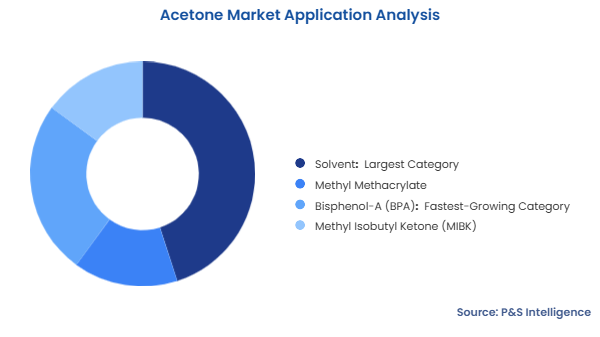
The solvent category held the largest market share, of 45%, in 2024, because of the increase in the demand for solvents in pharmaceuticals, paints and coatings, automobiles, and other industries, the base chemical is extensively used in industrial manufacturing. Upon being added to numerous products, such as paints and coatings, solvents serve a key purpose of dissolving binders, pigments, and other soluble additives. When solvents are incorporated into these intermediates, they encourage rapid evaporation of the liquid, allowing for the formation of a reliable film of coatings on the surface. This process dries quickly and enhances the visual appeal of the structure.
Furthermore, adhesives hold a considerable market share, as solvent-based adhesives are frequently used in automotive parts, adhesive tapes for medical applications, and packaging. These adhesives are popular for their flexibility, durability, and ease of application.
Solvent-based adhesives are widely employed in manufacturing tapes and a host of healthcare devices. Many medical products and devices require protective coverings that remain intact even when exposed to chemicals or diluents. These requirements make solvent-based adhesives particularly suitable for drug delivery products, such as transdermal patches.
The bisphenol-A category will grow at the highest CAGR during the forecast period. This growth is due to the significant use of dimethyl ketone in the production of BPA, which is a key ingredient in polycarbonates, polymerization inhibitors, PVC, polyester, and epoxy resins, and other chemicals. Consequently, the growing demand for BPA in the plastic industry, driven by its durability, excellent thermal insulation, low weight, and UV protection properties, is anticipated to propel the market.
Owing to their above-mentioned properties imparted by BPA, polycarbonates are widely used in the production of plastic lenses for eyewear, automotive components, greenhouses, medical devices, and other products. Further, food containers, infant formula and milk bottles, dinnerware, refillable water bottles, and many other types of storage containers are made of polycarbonates.
The applications analyzed here are:
Solvent (Largest Category)
Methyl Methacrylate (MMA)
Bisphenol-A (BPA) (Fastest-Growing Category)
Methyl Isobutyl Ketone (MIBK)
End Use Analysis
The plastics category held the largest market share, of 35%, in 2024, due to acetone’s essential role in the production of polycarbonate and acrylic plastics. Both of them are in high demand across various industries, including automotive, construction, and electronics. Polycarbonate, known for its durability, transparency, and impact resistance, is commonly used in eyewear lenses, optical discs, and automotive parts. Acrylic plastics are valued for their clarity and are used in applications such as signs, displays, and lighting fixtures.
The use of acetone in the polymerization and processing of these plastics makes it indispensable in the production of these materials, contributing to their dominance on the market. As demand for polycarbonate and acrylic plastics continues to grow, particularly in emerging economies and industrial applications, acetone’s role in the plastics sector remains crucial.
The pharmaceuticals category will grow at the highest CAGR during the forecast period. In pharmaceuticals, solvents are a key component as they are used as the medium in which the chemical reaction takes place that leads to the creation of APIs. Additionally, they are used to separate the desired chemical products from the undesirable ones, thereby maintaining the drug purity level.
(CH3)2CO is often used as a solvent in active pharma ingredients and blending fillers to ensure the accurate dosage of the medicine in the pill and liquid forms. Without this chemical, it would be harder to compact some pills to the correct density, with the partially dissolved APIs making some pills more potent than the others. Thus, the chemical is used to ensure consistent efficacy across all the pills in a bottle or blister pack.
The growing patient and aging populations are creating a huge demand for medicines and medical devices, which, in turn, is creating a substantial demand for acetone. Apart from being a good solvent, it is a major ingredient of the polycarbonates used in medical device manufacturing.
The end uses analyzed here are:
Paints & Coatings
Plastics (Largest Category)
Automotive
Adhesives
Pharmaceuticals (Fastest-Growing Category)
Cosmetics & Personal Care
Electricals & Electronics
Drive strategic growth with comprehensive market analysis
Acetone Market Geographical Analysis
APAC Acetone Market Size
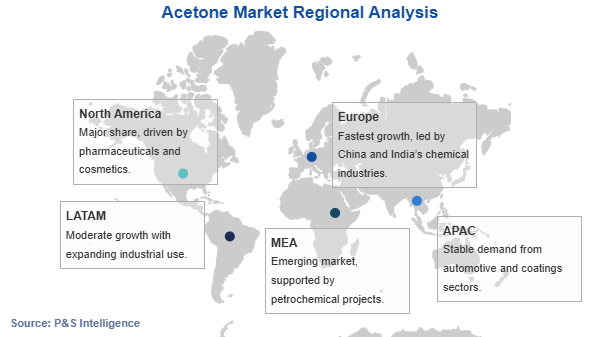
APAC held the largest share, around 35%, in 2024, and it will witness the highest CAGR during the forecast period. This is credited to the increase in the (CH3)2CO demand to produce different derivatives for various industries. The major demand for the chemical is coming from emerging economies, such as China and India.
China is expected to witness high dimethyl ketone consumption owing to the increase in its utilization as an ideal and cost-effective solvent in paints and coatings, adhesives, cosmetics, chemicals, and petrochemicals.
Further, the market advance is supported by the growing automobile demand and production, flourishing pharma industry, with the government initiatives to boost local drug production, rising health expenditure, and enhancing personal care awareness. In this regard, the growing working population and its increasing disposable income are expected to boost the usage of acetone in the region.
China Acetone Market Size
China stands as the largest market for acetone due to its advanced manufacturing and industrial sectors. In China, acetone demand is driven by its use in high-growth sectors like cosmetics, paints, adhesives, and plastics. Nail polish removers and skincare products rely heavily on acetone’s solvent properties, with China’s beauty market projected to reach RMB 1 trillion by 2026. In construction, methyl methacrylate (MMA), derived from acetone, is used in acrylic sheets and coatings—vital for infrastructure and real estate. Electronics manufacturing, where bisphenol A (another acetone derivative) is used in polycarbonates, also fuels demand. With China producing over 30% of the world’s electronics, acetone remains indispensable across multiple booming industries.
The regions and countries analyzed in this report are:
North America
U.S. (Larger Country Market)
Canada (Faster-Growing Country Market)
Europe
Germany (Largest Country Market)
U.K. (Fastest-Growing Country Market)
France
Italy
Spain
Rest of Europe
Asia-Pacific (Largest and Fastest-Growing Regional Market)
Japan
China (Largest Country Market)
India (Fastest-Growing Country Market)
South Korea
Australia
Rest of APAC
Latin America
Brazil (Largest Country Market)
Mexico (Fastest-Growing Country Market)
Rest of LATAM
Middle East and Africa
Saudi Arabia (Largest Country Market)
South Africa
U.A.E. (Fastest-Growing Country Market)
Rest of MEA
Acetone Market Competitive Landscape
The acetone market is fragmented because it has multiple players across various regions and industries contributing to the overall market share. There are several large multinational corporations as well as regional producers, leading to a competitive environment where no single company dominates globally. Acetone is used across a broad range of applications, including pharmaceuticals, automotive, personal care, paints, coatings, and chemicals, which further diversifies the market participants. As these industries require different grades and types of acetones, various players, both large and small, cater to the specific needs of each sector.
Geographically, the market is spread across multiple regions, with key players holding stronger positions in certain areas, such as North America, Europe, and Asia-Pacific, but the market is still highly competitive due to the presence of local and regional producers. Additionally, the growing demand for bio-based acetone as a sustainable alternative has led to the emergence of new players, adding to the overall competition and diversity in the market.
Top Acetone Manufacturers:
INEOS A.G.
Honeywell International Inc.
CEPSA QU
Mitsui Chemicals Inc.
SABIC
Arkema
Solvay SA
Formosa Chemicals & Fibre Corporation
Sasol Limited
Altivia
Kumho P&B Chemicals Inc.
Arkema
Acetone Market Developments
In August 2024, Altivia Petrochemicals raised acetone prices throughout North America by approximately USD 0.05 per pound, effective August 21, 2024.
In January 2024, Haldia Petrochemicals Ltd. announced the start of site execution for India's largest phenol and acetone plant in Haldia, West Bengal. The facility, set to be completed by Q1 2026, will have an annual capacity of 300,000 tonnes of phenol and 185,000 tonnes of acetone.
In September 2023, INEOS AG acquired Mitsui Phenols Singapore Pte. Ltd. on Jurong Island for USD 330 million. This acquisition increased INEOS's total acetone production capacity to 185,000 tonnes per year.
In April 2023, KBR Inc. and Wanhua Chemical Group Co. Ltd. announced the successful startup of a 650,000-tonne-per-annum phenol and acetone plant in Yantai City, Shandong Province, China.
Want a report tailored exactly to your business need?
Leading companies across industries trust us to deliver data-driven insights and innovative solutions for their most critical decisions. From data-driven strategies to actionable insights, we empower the decision-makers who shape industries and define the future. From Fortune 500 companies to innovative startups, we are proud to partner with organisations that drive progress in their industries.
Client Testimonials
Working with P&S Intelligence and their team was an absolute pleasure – their awareness of timelines and commitment to value greatly contributed to our project's success. Eagerly anticipating future collaborations.
McKinsey & Company
India
Unmatched Standards
Our insights into the minutest levels of the markets, including the latest trends and competitive landscape, give you all the answers you need to take your business to new heights
Complete Data Security
We take a cautious approach to protecting your personal and confidential information. Trust is the strongest bond that connects us and our clients, and trust we build by complying with all international and domestic data protection and privacy laws