Accelerometer Medical Sensors Market Size Estimation
Key Highlights
| Study Period | 2021 - 2032 |
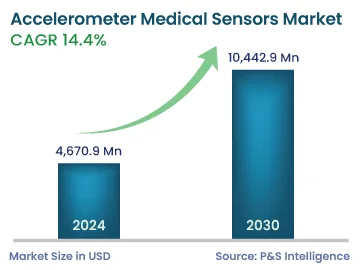
| Market Size in 2025 | USD 5.2 Billion |
| Market Size in 2026 | USD 5.9 Billion |
| Market Size by 2032 | USD 13.5 Billion |
| Projected CAGR | 14.6% |
| Largest Region | North America |
| Fastest-Growing Region | Asia-Pacific |
| Market Structure | Fragmented |
Market Size
Explore the market potential with our data-driven report
Accelerometer Medical Sensors Market Key Insights
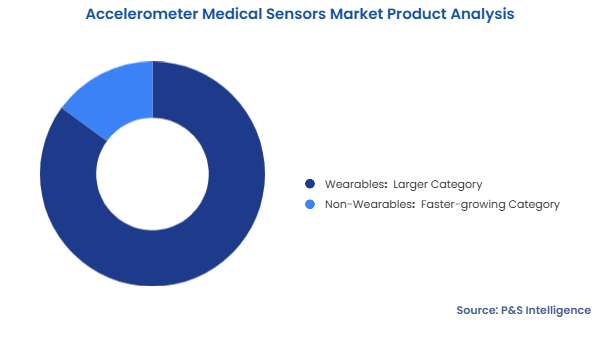
- Wearables hold the larger share of 85%, because consumers and clinicians track daily activity and chronic health signals continuously.
- Non-wearables are the faster-growing type, registering a CAGR of 14.7%, as hospitals expand remote monitoring without direct physical contact.
- Chronic illness & risk monitoring holds the largest share of 40%, driven by continuous surveillance of patient movement and stability for healthcare providers.
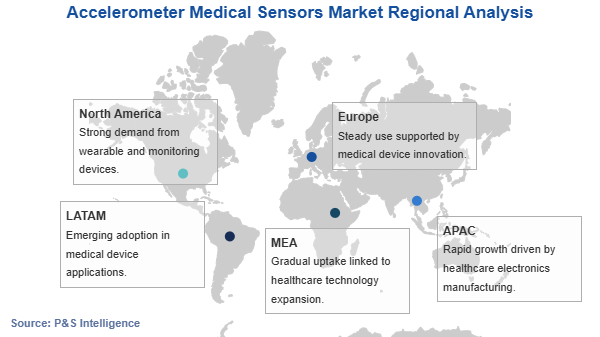
- North America holds the largest regional share of 40%, due to advanced healthcare infrastructure and early adoption of remote monitoring devices.
- Asia-Pacific is the fastest-growing region with 15.0% CAGR, driven by increased healthcare expenditure and adoption of wearable and non-wearable sensors.
Accelerometer Medical Sensors Market Overview
The accelerometer medical sensors market size was USD 5.2 billion for 2025, and it will grow by 14.6% during 2026-2032, to reach USD 13.5 billion by 2032.
The market expands because healthcare systems actively adopt these devices to monitor patient fall risks and post-treatment rehabilitation progression. The International Telecommunication Union recorded that 5.5 billion people utilised the internet globally in 2024. This creates expansive connected infrastructure that allows manufacturers to integrate miniaturised sensors into wearable products for real-time clinical data transmission. Consequently, physicians increasingly implement remote care services, driving continuous technological adoption across home and clinical settings.
Accelerometer Medical Sensors Market Emerging Trends & Growth Drivers
Use of Wearable and Remote Health Tracking Devices Is Major Trend
The medical device industry is increasingly developing portable monitoring equipment because an ageing population requires continuous post-surgical evaluation outside clinical facilities. The World Bank recorded the global population aged 65 and above at well over 830 million in 2024, creating a significant demand for remote patient monitoring solutions. Technology companies actively integrate motion sensors with advanced wireless capabilities to transmit real-time rehabilitation data. The International Telecommunication Union recorded 3 billion 5G subscriptions worldwide in 2025, enabling physicians to monitor at-home recovery, detect potential complications sooner, and respond immediately to patient emergencies.
Impact of Ageing Population and Chronic Health Needs Drives Market
The demand for motion-tracking sensors grows because ageing populations increasingly require continuous medical monitoring for chronic conditions. Elderly patients often face mobility limitations and cardiovascular complications that necessitate daily surveillance. The United Nations Department of Economic and Social Affairs reported global life expectancy at birth of 73.3 years in 2024, reflecting the expanding need for long-term monitoring. Furthermore, the World Health Organization recorded 1.4 billion adults living with hypertension globally in 2024, emphasising the necessity for physicians to implement remote tracking devices to monitor patient fall risks, evaluate rehabilitation, and reduce costly hospital readmissions.
Strict Data Protection Protocols Hamper Market Growth
A key restraint in the accelerometer medical sensor market is data accuracy and reliability. Medical accelerometers are widely used in wearable devices to monitor patient movement, falls, rehabilitation progress, and vital signals. Sensor drift, motion artifacts, interference from surrounding electronics, and improper device placement can reduce measurement accuracy. In clinical settings, even small inaccuracies may lead to incorrect patient assessments or delayed medical interventions. Consistent performance across different patient activities and environments further complicates device reliability.
Stringent regulatory compliance requirements compound these technical constraints. The U.S. Food and Drug Administration's FDA 21 CFR Part 820 establishes quality system requirements governing the methods, facilities, and controls used in the design and manufacture of medical devices. The European Union's EU Medical Device Regulation (MDR) 2017/745 mandates comprehensive clinical evaluation, post-market surveillance, and conformity assessment procedures for devices entering the European market. The International Organization for Standardization's ISO 13485 sets out quality management system requirements specific to medical device manufacturers. Patient data collected through wearable sensors must additionally comply with the Health Insurance Portability and Accountability Act (HIPAA) in the United States, which governs the handling, storage, and transmission of protected health information. These compliance obligations increase development costs, extend approval timelines, and slow the adoption of accelerometer-based medical sensing technologies.
Accelerometer Medical Sensors Market Segmentation Analysis
Product Analysis
Wearables are the larger category, holding a market share of 85%, because consumers and clinicians actively utilise these devices for continuous tracking of daily physical activity and chronic health signals. These body-attached sensors seamlessly capture real-time movement data to detect potential medical issues early. The World Health Organization recorded that over 800 million adults lived with diabetes globally in 2024. This highlights the massive chronic disease demographic driving the aggressive adoption of comfortable, wearable sensor technologies across both personal fitness and professional medical settings.
Non-wearables are the faster-growing category, because clinical facilities increasingly capture patient mobility metrics without requiring direct physical contact. Smart environments utilise these contactless sensors to safely monitor vulnerable individuals while minimising disruption to their daily routines. The United Nations Department of Economic and Social Affairs recorded that the global population aged 60 years or older is estimated to be around 1.2 billion in 2025, driving hospitals and eldercare facilities to expand their remote monitoring systems using non-wearable sensor technologies.
The products analysed in this report are:
- Wearables (Larger Category)
- Non-Wearables (Faster-growing Category)
Application Analysis
Chronic illness & risk monitoring is the largest category, holding a market share of 40%, because complex medical conditions increasingly require continuous surveillance of patient movement and stability. Physicians actively utilise these sensitive accelerometers to detect early physical deterioration and immediately adjust personalised care plans.
Wellness monitoring is the fastest-growing category, because consumers actively adopt motion sensors to independently track daily activity and sleep patterns. Technological improvements continuously make these complex biometric tracking devices more accurate, affordable, and accessible. According to the World Health Organization (2024), nearly 1.8 billion adults globally do not meet recommended physical activity levels. This significantly increases the demand for wearable devices to proactively manage personal health and fitness goals.
The applications analysed in this report are:
- Chronic Illness & Risk Monitoring (Largest Category)
- Wellness Monitoring (Fastest-growing Category)
- In Hospital Monitoring
- Therapeutics
- Post-Acute Care Monitoring
End User Analysis
Hospitals & clinics are the larger category, holding a market share of 80%, because these institutions conduct the majority of comprehensive health assessments and intensive patient monitoring activities. Physicians actively utilise advanced motion-tracking sensors to evaluate patient mobility, track recovery metrics, and support critical clinical decision-making. According to the World Health Organization (2024), neurological conditions are the leading cause of ill health and disability globally, affecting over 1 in 3 people worldwide.
Ambulatory care centres are the faster-growing category, because healthcare networks increasingly deliver specialised care outside traditional inpatient settings. These highly agile facilities require wireless, portable solutions to rapidly assess patient health during short outpatient visits. The United Nations recorded 1.3 billion people living with a significant disability globally in 2024, motivating ambulatory networks to adopt portable sensor-based systems for accurate, flexible mobility tracking without requiring prolonged clinical admissions.
The end users analysed in this report are:
- Hospitals & Clinics (Larger Category)
- Ambulatory Care Centres (Faster-growing Category)
Drive strategic growth with comprehensive market analysis
Accelerometer Medical Sensors Market Geographical Analysis
North America Accelerometer Medical Sensors Market Analysis
North America holds the largest share, of 40%, because it has the most developed health care infrastructure and smart medical device adoption rate. Hospitals and clinics in this region utilise motion and position sensors in patient monitoring, fall detection and post-surgical care. Strong funding of medical research and early adoption of telehealth and remote monitoring equipment also support ongoing demand for these sensors, as patients and providers alike believe technology can increase the quality of care and provide better outcomes for the patient.
U.S. Accelerometer Medical Sensors Market Analysis
Healthcare providers in the United States increasingly deploy motion-tracking sensors to monitor chronic conditions and prevent falls. The Centers for Disease Control and Prevention reported 38.4 million individuals living with diabetes in the USA in 2024, representing a large population requiring continuous monitoring. Consequently, hospitals and home care providers actively implement sensor-based systems to track mobility and support real-time clinical interventions.
Canada Accelerometer Medical Sensors Market Analysis
Healthcare networks in Canada adopt connected monitoring technologies to manage ageing populations efficiently. Statistics Canada reported over 7.6 million people aged 65 and older in 2024, highlighting the need for remote patient surveillance. Additionally, the Canadian Institute for Health Information recorded more than 212,000 fall-related emergency department visits among seniors in 2024. This drives healthcare providers to implement wearable sensor systems to enhance patient safety across urban and rural settings.
Asia-Pacific Accelerometer Medical Sensors Market Analysis
Asia‑Pacific has the highest CAGR, of 15.0%, because of the growth in healthcare expenditures and clinical service offerings, which will lead to increased demand for both wearable and non-wearable accelerometers in this area. The need to modernise health care systems and provide more remote monitoring options for the increasing aged and patient populations propels the use of accelerometer-based solutions outside traditional hospitals. Additionally, as the prices for smart technology decrease and more people are using wellness applications, the adoption of accelerometer-based solutions outside of hospitals is expected to grow.
China Accelerometer Medical Sensors Market Analysis
Accelerometer medical sensor adoption in China is driven by government support for digital health initiatives and an ageing population. The National Bureau of Statistics of China reported 310.31 million individuals aged 60 and above in 2024, which necessitates continuous monitoring of chronic diseases and vulnerable demographics. Consequently, healthcare institutions and consumers aggressively deploy accelerometer-based sensors across clinical and home-care environments.
India Accelerometer Medical Sensors Market Analysis
India’s healthcare providers and technology startups increasingly integrate motion sensors into telehealth platforms to expand remote care services. The Telecom Regulatory Authority of India recorded 928.96 million wireless internet subscribers in December 2024, enabling widespread deployment of mobile health services. As a result, the connected infrastructure drives demand for wearable and portable monitoring tools across urban and rural populations.
Europe Accelerometer Medical Sensors Market Analysis
Europe is a major market for sensors due to strong, established healthcare systems that emphasise preventive care. In many European countries, sensors are used to monitor patient movement as part of ageing care and rehabilitation programs. Providers have begun to include accelerometer information within their broader electronic health record (EHR) to support personalised care planning and alerting staff to potential mobility issues.
The regions and countries analysed in this report are:
- North America (Largest Regional Market)
- U.S. (Larger Country)
- Canada (Faster-Growing Country)
- Europe
- Germany (Largest Country)
- U.K. (Fastest-Growing Country)
- France
- Italy
- Spain
- Rest of Europe
- Asia-Pacific (Fastest-Growing Regional Market)
- China (Largest Country)
- India (Fastest-Growing Country)
- Japan
- South Korea
- Australia
- Rest of APAC
- Latin America
- Brazil (Largest Country)
- Mexico (Fastest-Growing Country)
- Rest of LATAM
- Middle East and Africa
- Saudi Arabia (Largest Country)
- U.A.E. (Fastest-Growing Country)
- South Africa
- Rest of MEA
Accelerometer Medical Sensors Market Share
The market is fragmented because many different companies supply accelerometer sensors for use in healthcare, fitness wearables, hospital devices, and remote monitoring tools. No one provider dominates the industry. Instead, numerous small and mid‑sized players compete alongside larger tech and medical firms. Each generally focuses on specific niches such as wearable health trackers, clinical motion sensing, or rehabilitative devices. This wide variety of suppliers spreads market participation across many businesses, making it hard for a single company to control most of the sales.
Leading Companies in the Accelerometer Medical Sensors Market:
- STMicroelectronics NV
- Analog Devices Inc
- Texas Instruments Incorporated
- NXP Semiconductors NV
- Bosch Sensortec GmbH
- TDK Corporation
- Murata Manufacturing Co Ltd
- Honeywell International Inc
- TE Connectivity Ltd
- Infineon Technologies AG
- Knowles Corporation
- Kionix Inc
- Invensense Inc
- Panasonic Corporation
- Apple Inc
Accelerometer Medical Sensors Market News
- In February 2026, STMicroelectronics introduced the MIS2DU12 MEMS accelerometer designed for wearable and implantable medical devices. Biocompatible materials support applications such as cardiac monitors and skin-patch health sensors.
- In November 2025, STMicroelectronics announced the ISM6HG256X motion sensor, integrating accelerometer and gyroscope functions in a compact module for wearable monitoring systems, event-recording equipment, and industrial sensing platforms.
- In October 2025, Apple revealed the development work for a future AirPods Pro model integrating heart-rate monitoring with motion-sensing components. It combines internal accelerometers with additional sensors to support workout tracking and physiological data collection.
- In May 2025, STMicroelectronics presented the LSM6DSV320X inertial measurement unit featuring dual MEMS accelerometers and embedded processing, designed for electronics and wearable devices requiring motion and impact detection.