This Report Provides In-Depth Analysis of the 5G NTN Market Report Prepared by P&S Intelligence, Segmented by Component (Hardware, Solutions, Services), Platform (LEO Satellite, UAS Platform, MEO Satellite, GEO Satellite), Application (EMBB, MMTC, URLLC), End-Use (Aerospace and Defense, Maritime, Government, Mining), and Geographical Outlook for the Period of 2019 to 2032
Explore the market potential with our data-driven report
5G NTN Market Outlook
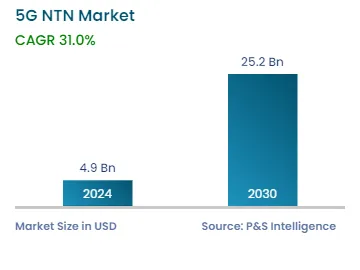
The global 5G NTN market was valued at USD 4.9 billion in 2024 and is projected to reach USD 42.1 billion by 2032, growing at a CAGR of 31% during 2025–2032. 5G Non-Terrestrial Networks represent an evolutionary leap in telecommunications technology, extending 5G connectivity beyond traditional terrestrial infrastructure through satellites, high-altitude platforms, and unmanned aerial systems to bridge connectivity gaps in remote and underserved areas worldwide.
The market expansion is primarily driven by the escalating demand for ubiquitous connectivity and the proliferation of IoT devices. The aerospace & defense sector emerges as a key growth catalyst, leveraging 5G NTN solutions for mission-critical communications, real-time surveillance, and secure data transmission across diverse operational environments. Additionally, the commercial satellite industry's robust performance.
The integration of low-earth-orbit (LEO) satellite constellations is revolutionizing global connectivity by offering reduced latency and enhanced coverage capabilities. These technological advancements, coupled with increasing government investments in digital infrastructure and the growing need for disaster-resilient communication networks, position the 5G NTN market for sustained expansion throughout the forecast period.
5G NTN Market Trends & Drivers
Software-Defined Networking Integration Is Key Trend
The adoption of software-defined networking and network function virtualization represents a transformative trend reshaping the 5G NTN market landscape. As per studies, the global SD-WAN market will reach USD 42,606.9 million by 2030.
Software-centric approaches enable greater flexibility and scalability in network management, allowing operators to rapidly deploy new services and adapt to changing market demands without requiring extensive hardware modifications. This paradigm shift reduces operational complexity while enhancing network performance across diverse deployment scenarios.
SDN and NFV technologies facilitate dynamic resource allocation and automated network optimization, particularly crucial for managing the complex interplay between terrestrial and non-terrestrial network elements. These technologies enable real-time network reconfiguration based on traffic patterns, user demands, and environmental conditions, maximizing spectrum efficiency and improving service quality. The integration of artificial intelligence and machine learning algorithms further enhances automated network management capabilities.
The software-centric approach significantly reduces operational costs by minimizing the need for specialized hardware and enabling centralized network control. Service providers can leverage cloud-native network functions to deliver consistent service experiences across different platform types, whether satellite-based, high-altitude platforms, or unmanned aerial systems. This flexibility accelerates time-to-market for new services and applications.
Enterprise and government customers particularly benefit from software-defined 5G NTN solutions that can be customized to meet specific operational requirements. The ability to implement policy-based network management, dynamic bandwidth allocation, and service-specific quality parameters makes software-defined NTN solutions increasingly attractive for mission-critical applications across various industries.
Satellite Industry Growth Is Key Driver for Market Growth
The commercial satellite industry's remarkable expansion provides crucial infrastructure support for 5G NTN market development. This robust growth demonstrates the maturity and reliability of satellite-based communication systems. As per studies, USD 8,517.9 million by 2030 will generated by satellite launch vehicle sales and services, while 5G satellite communication services will see demand worth USD 40.2 billion by 2032.
The deployment of record numbers of commercial satellites further strengthens the infrastructure foundation for 5G NTN services. A historic 2,781 commercial satellites were launched in 2023, marking a 20% increase compared to the previous year, while the total number of active satellites orbiting Earth reached 9,691 by the end of 2023. ISRO launched 8 satellites in total across 2024.
This increased launch activity and improved affordability enable the rapid deployment of satellite constellations essential for 5G NTN coverage expansion. The growing adoption of Low Earth Orbit satellites particularly benefits 5G NTN applications by offering lower latency and higher data transmission capabilities compared to traditional geostationary satellites.
High Deployment and Operational Costs Are Restraining Market Growth
The substantial capital expenditure requirements for 5G NTN infrastructure deployment represent a significant barrier to market expansion, particularly for smaller operators and emerging market service providers. Satellite development, manufacturing, and launch costs typically range from millions to billions of dollars, depending on the constellation size and technical specifications. Ground infrastructure development, including gateway stations, network operations centers, and user terminals, adds considerable additional investment requirements.
Ongoing operational expenses further compound the cost challenge, encompassing satellite maintenance, orbital adjustments, spectrum licensing fees, and ground facility operations. Satellite operators must account for insurance costs, replacement satellite preparation, and end-of-life disposal expenses throughout the operational lifecycle. These recurring costs can significantly impact profitability, particularly during the initial market development phase when subscriber bases remain limited.
5G NTN Market Segmentation Analysis
Component Analysis
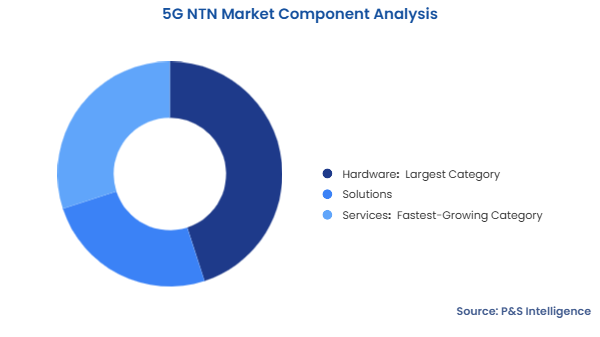
The hardware category dominated the 5G NTN market in 2024 with an approximately 45.0% share, driven by the critical infrastructure requirements for deploying and maintaining non-terrestrial networks. This category encompasses essential components, including satellites, antennas, transceivers, and ground-based equipment, for establishing reliable 5G NTN connectivity. The hardware category's prominence reflects the capital-intensive nature of satellite and high-altitude platform deployments.
The services category is projected to register the highest CAGR during 2025–2032, reflecting the growing importance of network management, maintenance, and data analytics as 5G NTN deployments expand globally. Service providers are developing sophisticated solutions to optimize network performance and support diverse applications, from maritime communications to emergency response systems. The evolution of managed services and the integration of artificial intelligence in network operations drive this category's accelerated growth trajectory.
These components are covered:
Hardware (Largest Category)
Satellites
Antennas
Transceivers
Ground Stations
Solutions
Services (Fastest-Growing Category)
Platform Analysis
LEO satellites held the largest market share in 2024, of 40.0%. LEO satellites offer superior performance characteristics for 5G applications, including reduced latency, higher bandwidth capabilities, and improved global coverage compared to traditional geostationary systems. The growing deployment of LEO constellation projects by major aerospace companies reinforces this category's market leadership position.
UAS platforms are expected to witness the highest CAGR during the forecast period, driven by their versatility and rapid deployment capabilities. Unmanned Aerial Systems provide flexible, high-altitude connectivity solutions that can be quickly positioned to address specific coverage requirements or emergency situations. Their ability to serve as temporary communication bridges and support disaster recovery operations makes them increasingly valuable for both commercial and government applications.
These platforms are covered:
LEO Satellite (Largest Category)
UAS Platform (Fastest-Growing Category)
MEO Satellite
GEO Satellite
Application Analysis
Enhanced mobile broadband dominated the application category in 2024 with an approximately 55.0% share, reflecting the primary focus on delivering high-speed internet connectivity to underserved regions. EMBB applications enable improved data rates and network capacity, supporting everything from consumer broadband services to enterprise communications in remote locations. The category's growth is driven by increasing demand for seamless connectivity across diverse geographical areas.
Massive machine-type communications is projected to register the fastest growth during 2025–2032, fueled by the exponential expansion of IoT device deployments. MMTC enables connectivity for vast numbers of devices with varying power consumption and communication requirements, from smart agriculture sensors to industrial monitoring systems. The category's growth aligns with the projected increase in IoT connections to 40 billion devices by 2030.
These applications are covered:
EMBB (Largest Category)
MMTC (Fastest-Growing Category)
URLLC
End-Use Industry Analysis
The aerospace & defense category captured the largest market share in 2024, of approximately 35.0%, driven by the sector's sophisticated requirements for secure, reliable communications across global operations. Defense organizations require resilient communication systems capable of maintaining connectivity in contested or remote environments, characteristics that 5G NTN inherently provides through its satellite-based architecture.
5G Non-Terrestrial Networks (NTN) enable high-speed, secure communication for military operations in remote or contested environments. They support real-time surveillance via drones and satellites, beyond-visual-line-of-sight (BVLOS) connectivity, and low-latency control of autonomous vehicles and weapon systems. NTN enhances mission coordination by enabling rapid data sharing between command centers and deployed units, even in harsh terrains or at sea. It also strengthens cybersecurity and ensures network resilience if ground infrastructure is compromised. By extending global coverage, 5G NTN improves situational awareness, intelligence gathering, and the effectiveness of multinational missions, making it a critical asset in modern defense strategy.
The maritime industry is expected to witness the fastest growth during the forecast period, reflecting the increasing digitization of maritime operations and the need for continuous connectivity across vast ocean areas. Maritime applications include vessel tracking, crew communications, cargo monitoring, and safety systems, all of which benefit from the global coverage capabilities of 5G NTN solutions.
5G Non-Terrestrial Networks (NTN) are transforming the marine sector by providing seamless, high-speed connectivity across oceans. They enable real-time vessel tracking, remote monitoring of offshore platforms, and improved navigation and safety systems. NTN supports autonomous ship operations, predictive maintenance, and efficient cargo management. It enhances crew welfare through better communication and internet access, even in deep-sea environments. For naval forces, it ensures secure communication, surveillance, and coordination during maritime missions. By bridging connectivity gaps beyond coastal areas, 5G NTN boosts operational efficiency, safety, and digital transformation across commercial shipping, offshore energy, fisheries, and maritime defense operations.
These end-use industries are covered:
Aerospace and Defense (Largest Category)
Maritime (Fastest-Growing Category)
Government
Mining
Drive strategic growth with comprehensive market analysis
5G NTN Market Geographical Analysis
North America 5G NTN Market Size
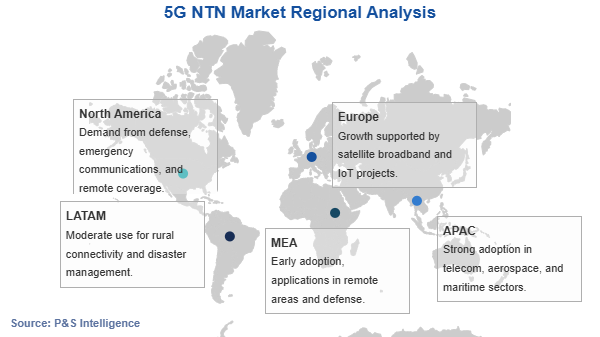
North America held the largest regional market share in 2024, of approximately 45%, driven by its advanced technological infrastructure and substantial government investments in space and defense technologies. The region's leadership position is supported by the presence of major aerospace companies, robust satellite manufacturing capabilities, and strong government support for 5G infrastructure development. The U.S. market particularly benefits from NASA's research initiatives and Department of Defense investments in satellite communication systems.
According to the Federal Communications Commission, approximately 19 million Americans lack access to fixed broadband service at threshold speeds, creating significant opportunities for 5G NTN deployment in rural and remote areas. The U.S. government has allocated USD 65 billion through the Infrastructure Investment and Jobs Act for broadband expansion, with the FCC's 5G Fund for Rural America planning to distribute up to USD 9 billion over ten years to enhance 5G wireless coverage in rural regions.
The North American market benefits from the presence of leading technology companies actively developing 5G NTN solutions, including SpaceX's Starlink constellation and other satellite communication initiatives. The region's established aerospace and defense industry provides both demand for advanced communication systems and the technical expertise necessary for continued innovation in NTN technologies.
Asia-Pacific 5G NTN Market Forecast
Asia-Pacific is projected to register the highest CAGR during 2025–2032, driven by the rapid economic development, massive population centers, and increasing government investments in digital infrastructure. The region's large geographic areas and numerous remote locations create substantial demand for non-terrestrial connectivity solutions that can bridge coverage gaps left by traditional terrestrial networks.
The Asia-Pacific region's focus on smart city development, IoT expansion, and autonomous vehicle technologies creates substantial demand for reliable, high-bandwidth connectivity solutions. Major economies, including South Korea, Japan, and India, are investing heavily in 5G infrastructure, with 5G NTN playing a crucial role in extending coverage to remote and underserved areas throughout the diverse geographical landscape.
China 5G NTN Market Forecast
China's aggressive space program and satellite deployment initiatives significantly contribute to regional market growth. The successful completion of China Telecom, ZTE, and SpaceIoT's 5G NTN deployment in marine environments demonstrates the region's commitment to advancing NTN technologies. Japan's government support for 5G infrastructure development, including financial incentives for rural network deployment, further accelerates market expansion across the region.
These regions and countries are covered:
North America (Largest Regional Market)
U.S. (Larger Country Market)
Canada (Faster-Growing Country Market)
Europe
Germany (Largest Country Market)
U.K. (Fastest-Growing Country Market)
France
Italy
Spain
Rest of Europe
Asia-Pacific (Fastest-Growing Regional Market)
China (Largest Country Market)
Japan (Fastest-Growing Country Market)
South Korea
India
Australia
Rest of APAC
Middle East & Africa
Saudi Arabia (Largest Country Market)
South Africa (Fastest-Growing Country Market)
Rest of MEA
Latin America
Brazil (Largest Country Market)
Mexico (Fastest-Growing Country Market)
Rest of LATAM
5G NTN Market Share
The 5G NTN market exhibits a fragmented competitive landscape characterized by numerous established players and emerging companies competing across different technology segments and geographical regions. The market's fragmentation reflects the diverse technical approaches to implementing non-terrestrial networks, ranging from satellite constellation deployment to high-altitude platform development, each requiring specialized expertise and substantial capital investment.
Leading companies adopt various competitive strategies, including strategic partnerships, technology integration initiatives, and vertical market specialization. The hardware category attracts companies with satellite manufacturing capabilities and aerospace expertise, while the services category appeals to telecommunications operators and managed service providers. No single company dominates the entire value chain, creating opportunities for collaboration and strategic alliances across different market segments.
The market's fragmented nature stems from the specialized requirements of different end-use industries and the technical complexity of integrating terrestrial and non-terrestrial networks. Companies typically focus on specific technology platforms or target markets, such as maritime communications, aerospace applications, or IoT connectivity, rather than attempting to serve all market segments simultaneously.
Key 5G NTN Companies:
Qualcomm Technologies Inc.
SoftBank Group Corporation
Thales Group
Rohde & Schwarz GmbH & Co KG
Keysight Technologies Inc.
MediaTek Inc.
ANRITSU CORPORATION
SES S.A.
EchoStar Corporation
AST & Science LLC
Omnispace LLC
ZTE Corporation
Nelco Limited
Inmarsat Global Limited
Spirent Communications plc
5G NTN Market News
In March 2024, OQ Technology Group successfully launched two LEO satellites, named Tiger-7 and Tiger-8, built by Nanoavionics, featuring 6U-sized configurations carrying cell tower NB-IoT payloads to expand global connectivity capabilities.
In March 2024, Gatehouse Satcom A/S and Druid Software signed a memorandum of understanding to collaborate on enhancing NTN services, focusing on integrating satellite and terrestrial network solutions for improved industry interoperability.
In March 2024, Keysight Technologies Inc. and Capgemini SE validated a tailored 5G New Radio RAN solution for non-terrestrial networks, aligning with 3GPP Release 17 standards to enhance radio access network functionalities for remote area coverage.
In February 2023, Samsung Electronics Co. Ltd. announced the launch of standardized 5G NTN modem technology enabling direct communication between smartphones and satellites, integrated into the Exynos modem lineup to accelerate commercial satellite communication deployment.
In December 2023, Lockheed Martin Corporation completed the inaugural demonstration of its regenerative non-terrestrial network Satellite Base Station, planning to launch this innovative payload into orbit in 2024 to extend 5G capabilities to outer space.
Want a report tailored exactly to your business need?
Leading companies across industries trust us to deliver data-driven insights and innovative solutions for their most critical decisions. From data-driven strategies to actionable insights, we empower the decision-makers who shape industries and define the future. From Fortune 500 companies to innovative startups, we are proud to partner with organisations that drive progress in their industries.
Client Testimonials
Working with P&S Intelligence and their team was an absolute pleasure – their awareness of timelines and commitment to value greatly contributed to our project's success. Eagerly anticipating future collaborations.
McKinsey & Company
India
Unmatched Standards
Our insights into the minutest levels of the markets, including the latest trends and competitive landscape, give you all the answers you need to take your business to new heights
Complete Data Security
We take a cautious approach to protecting your personal and confidential information. Trust is the strongest bond that connects us and our clients, and trust we build by complying with all international and domestic data protection and privacy laws