This Report Provides In-Depth Analysis of the 4D Imaging Radar Market Report Prepared by P&S Intelligence, Segmented by Type (Short-Range, Medium-Range, Long-Range), Application (Automotive, Aerospace & Defense, Security & Surveillance, Traffic Monitoring & Management, Industrial), Component (Hardware, Software, Services), Frequency Band (77–81 GHz, 60 GHz, 24 GHz), and Geographical Outlook for the Period of 2019 to 2032
Explore the market potential with our data-driven report
4D Imaging Radar Market Overview
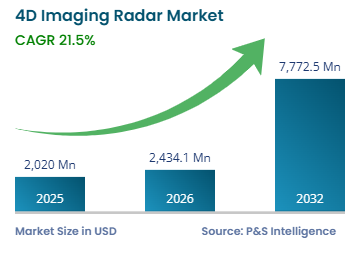
The global 4D imaging radar market size is estimated at USD 2020.0 million in 2025, which is predicted to reach USD 7772.5 million by 2032, growing at a CAGR of 21.5% during 2026–2032.
The expansion is driven by increasing adoption of autonomous and semi-autonomous vehicles, stringent vehicle safety regulations, and growing demand for all-weather sensing capabilities in automotive and non-automotive applications. The rapid adoption of advanced driver assistance systems (ADAS) is a key driver for the growth of 4D imaging radar systems. Unlike traditional 3D radar, which measures range, azimuth, and velocity, 4D imaging radar also captures elevation data, enabling precise detection and classification of object heights. This enhanced capability is crucial for distinguishing between overhanging structures and road obstacles, making 4D radar essential for safe and reliable autonomous navigation in complex driving environments.
Government regulations promoting vehicle safety are accelerating market growth across major automotive markets. From July 2024, the General Safety Regulations of the European Commission require all new cars sold in the EU to include forward-collision warning and lane-keeping technologies, with over 28 million vehicles annually in Europe projected to be equipped with enhanced radar sensors to meet these safety criteria. This regulatory push extends beyond Europe, with North America and Asia-Pacific implementing similar mandates that drive OEM investments in advanced sensing technologies.
The superior performance of 4D imaging radar in adverse weather conditions provides a significant advantage over competing technologies like cameras and LiDAR. While cameras struggle in low visibility and LiDAR performance degrades in rain, fog, and snow, 4D radar maintains consistent object detection capabilities across all environmental conditions. This all-weather reliability makes 4D imaging radar a critical sensor for achieving higher levels of vehicle autonomy, where consistent environmental perception is non-negotiable for safety-critical applications.
4D Imaging Radar Market Growth Factors
Technological Advancements in Radar Architecture Are Key Trends
Radar architecture is evolving to support advanced 4D imaging, enhancing the detection of objects in three dimensions plus velocity.
Integration of digital and software-defined radar technologies allows for more-flexible and adaptive operation.
Phased array antennas are improving, enabling faster beam steering and higher-resolution imaging.
Poland signed a USD 1.6-billion contract with the PGZ-Narew consortium to procure 46 passive-location radars, to strengthen its short-range anti-aircraft and anti-missile defense systems.
This initiative is part of Poland's broader defense strategy, which includes allocating 4.8% of its GDP to defense in 2026.
AI and advanced signal processing techniques improve object detection, classification, and tracking accuracy.
Miniaturization of components reduces size, weight, and power consumption, making 4D radars suitable for vehicles and drones.
Germany's government has placed unprecedented orders for radar systems, leading Hensoldt AG to invest EUR 1 billion over the next two years to expand its production capacity.
The company plans to produce up to 1,000 radars annually by 2027 to meet the increased demand.
Higher frequency radars, such as millimeter-wave, provide better range, precision, and resolution for imaging.
Improved networking and sensor fusion enable real-time data sharing with other systems for enhanced situational awareness.
These technological advancements are driving growth and adoption in automotive, defense, and autonomous systems globally.
Rising Adoption of Autonomous Vehicles Is Driving Market Expansion
The growing development and deployment of autonomous vehicles are increasing the demand for advanced sensing technologies.
4D imaging radar provides high-resolution detection of objects, including their position, velocity, and direction, which is crucial for autonomous navigation.
It enhances vehicle safety by detecting pedestrians, cyclists, and other obstacles in various weather and lighting conditions.
Integration of 4D radars with cameras and LiDAR improves situational awareness and decision-making for self-driving systems.
Rising government regulations and safety standards are encouraging the use of advanced radar systems in vehicles.
Automotive manufacturers are investing heavily in 4D radar technology to achieve higher levels of vehicle autonomy.
The technology supports ADAS functionalities, including collision avoidance, adaptive cruise control, and lane-keeping.
Bitsensing, a South Korea-based startup, raised USD 25 million in Series B funding from investors, including the Korea Development Bank and HL Mando Corp., to develop AI-powered 4D imaging radar for autonomous vehicles, enhancing sensor performance for ADAS and self-driving systems.
Increasing consumer demand for safer and smarter vehicles is further driving the adoption of 4D imaging radar.
4D Imaging Radar Market Segmentation Analysis
Type Analysis
The short-range category holds the largest share in the 4D imaging radar market in 2025, of approximately 65%, and is expected to maintain its dominant position through the forecast period. This stems from widespread adoption in parking assistance, blind spot detection, and collision avoidance systems, where short-range radar's ability to detect objects within 50 meters provides essential safety functionality across all vehicle segments.
Long-range radar is expected to register the highest CAGR, during 2026–2032, driven by increasing deployment in highway automation features and adaptive cruise control systems. Long-range 4D radar's ability to detect and track objects beyond 200 meters enables predictive driving behaviors essential for Level 2+ and Level 3 automation, where vehicles must anticipate traffic patterns and execute complex maneuvers at highway speeds.
The superior angular resolution of 4D long-range radar enables precise lane-level positioning and multi-object tracking across adjacent lanes. This capability is essential for automated lane changing, where the system must simultaneously track vehicles in the current lane, adjacent lanes, and approaching from behind while predicting their trajectories. The combination of range, velocity, and elevation data from 4D radar provides the comprehensive situational awareness required for safe execution of complex automated driving maneuvers.
These types are covered:
Short-Range (Largest Category)
Medium-Range
Long-Range (Fastest-Growing Category)
Application Analysis
The automotive category accounts for the largest share in the 4D imaging radar market in 2025, of approximately 35%, reflecting the automotive industry's dominant role in driving radar technology development and deployment. The integration of 4D radar into passenger vehicles and commercial vehicles spans applications from basic safety features to advanced autonomous driving systems, creating sustained demand across multiple vehicle segments and automation levels.
The aerospace & defense category is the fastest-growing category in the 4D imaging radar market, primarily due to the rising need for advanced situational awareness, precision targeting, and enhanced threat detection capabilities in modern defense systems. Governments and defense organizations across the world are investing heavily in next-generation radar technologies to strengthen surveillance, reconnaissance, and missile defense operations. According to news, airlines based in Asia-Pacific carried around 27 million international passengers in February 2024, an increase of around 56.7% from around 17.3 million in February 2023; capacity increased by around 53.1%.
Additionally, the growing emphasis on electronic warfare, border security, and unmanned aerial vehicles (UAVs) is fueling adoption, as these platforms demand compact, high-performance radar solutions capable of operating in all weather conditions. The integration of AI and machine learning with radar systems further boosts efficiency and automation in defense applications, making 4D imaging radar an essential component of modern military infrastructure.
These applications are covered:
Automotive (Largest Category)
Aerospace & Defense (Fastest-Growing Category)
Security & Surveillance
Traffic Monitoring & Management
Industrial
Others
Component Analysis
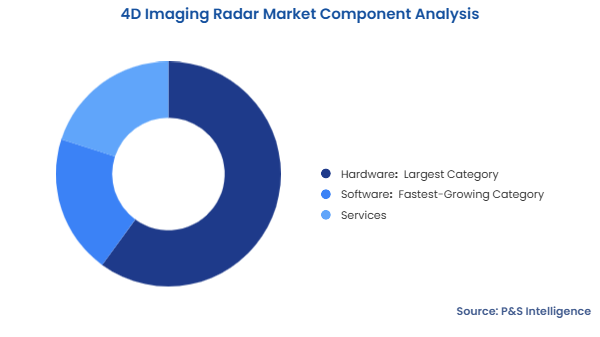
The hardware category holds the largest share in the 4D imaging radar market in 2025, of approximately 60%, reflecting the substantial value concentration in physical radar modules, antenna arrays, and radio frequency integrated circuits. Hardware encompasses the transmit and receive chains, antenna structures, power management systems, and analog processing components that comprise the core radar functionality.
MIMO antenna arrays represent the most-critical hardware innovation, enabling 4D imaging capabilities. These sophisticated antenna structures utilize multiple transmit and receive elements arranged in precise configurations to achieve virtual aperture sizes far exceeding the physical antenna dimensions. The resulting angular resolution enables 4D radar to generate point cloud data with spatial precision approaching LiDAR performance while maintaining radar's fundamental advantages in challenging environmental conditions.
The software category is expected to register the highest CAGR, during 2026–2032, driven by increasing emphasis on AI-powered signal processing, sensor fusion algorithms, and over-the-air update capabilities. Software defines the functional capabilities of modern radar systems, transforming raw sensor data into actionable intelligence for ADAS and autonomous driving systems.
Machine learning algorithms are revolutionizing radar data interpretation, enabling sophisticated object classification, trajectory prediction, and scene understanding that was previously impossible with conventional signal processing techniques. Deep neural networks trained on massive datasets can distinguish between vehicle types, identify pedestrians and cyclists, and predict object behaviors based on motion patterns.
These components are covered:
Hardware (Largest Category)
Software (Fastest-Growing Category)
Services
Frequency Band Analysis
The 77–81 GHz category holds the largest share in the 4D imaging radar market in 2025, of approximately 45%. The technical advantages of this frequency band, combined with international regulatory harmonization, have created a unified platform for radar development that benefits from economies of scale and cross-market applicability.
This band offers an optimal balance between propagation characteristics, antenna size, and achievable bandwidth. The 4 GHz sweep bandwidth available within this range enables radar systems to achieve range resolution below 4 centimeters, sufficient for distinguishing between closely spaced objects and creating detailed environmental maps. This resolution capability is essential for 4D imaging radar applications requiring precise object localization and dimensional estimation.
The 60 GHz category is expected to register the highest CAGR, during 2026–2032, driven by emerging in-cabin monitoring and gesture recognition applications. This frequency band offers extremely high bandwidth, enabling millimeter-level resolution, making it ideal for detecting subtle movements associated with occupant vital signs monitoring, driver drowsiness detection, and touchless human-machine interfaces.
In-cabin monitoring systems utilizing 60-GHz radar can detect occupant presence, monitor respiratory rates, and identify child-left-behind scenarios without requiring camera systems that raise privacy concerns. The contactless nature of radar sensing, combined with its ability to function in darkness, positions 60 GHz radar as an enabling technology for advanced driver monitoring systems mandated by emerging safety regulations.
These frequency bands are covered:
77–81 GHz (Largest Category)
60 GHz (Fastest-Growing Category)
24 GHz
Others
Drive strategic growth with comprehensive market analysis
4D Imaging Radar Market Geographical Analysis
North America 4D Imaging Radar Market Size
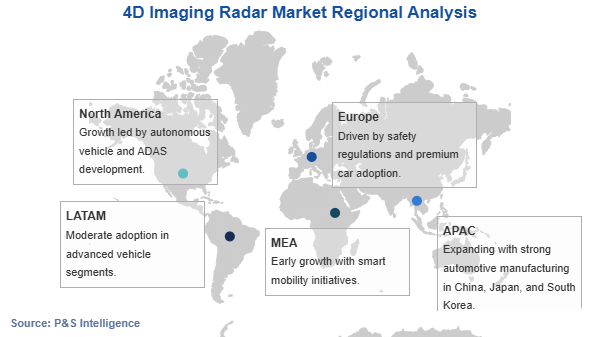
North America holds the largest share in the 4D imaging radar market in 2025, of approximately 40%. This dominance stems from the region's advanced automotive industry, stringent safety regulations, robust R&D ecosystem, and consumer demand for cutting-edge vehicle technologies. The presence of major automotive OEMs alongside technology giants creates a collaborative environment, accelerating radar innovation and deployment.
U.S. 4D Imaging Radar Market Growth
The United States leads North American radar adoption, driven by voluntary safety commitments from major automakers and regulatory initiatives promoting crash avoidance technologies. Leading OEMs, including General Motors, Ford, and Tesla, are deploying sophisticated radar systems across their vehicle lineups, extending advanced safety features beyond premium segments into mainstream offerings. The competitive dynamics of the U.S. automotive market incentivize continuous innovation in sensor technologies as manufacturers differentiate their products through superior safety and automation capabilities.
Asia-Pacific 4D Imaging Radar Market Forecast
Asia-Pacific is expected to register the highest CAGR, of approximately 22.5%, during 2026–2032, driven by explosive automotive market growth, aggressive EV adoption, and smart city initiatives across the region's major economies. China, Japan, South Korea, and India represent distinct markets with unique drivers, collectively creating the most dynamic growth environment for radar technology globally.
China 4D Imaging Radar Market Forecast
Chinese government policy actively promotes autonomous vehicle development through supportive regulations, substantial R&D funding, and dedicated testing zones in major cities. National initiatives targeting smart transportation infrastructure create additional demand for radar sensors in traffic management and vehicle-to-infrastructure applications. The integration of 4D radar into China's ambitious smart city projects extends beyond automotive applications into urban infrastructure, creating diverse revenue streams for radar suppliers.
The regions and countries analyzed in this report are:
North America (Largest Regional Market)
U.S. (Larger Country Market)
Canada (Faster-Growing Country Market)
Europe
Germany (Largest Country Market)
U.K. (Fastest-Growing Country Market)
France
Italy
Spain
Rest of Europe
Asia-Pacific (Fastest-Growing Regional Market)
Japan
China (Largest Country Market)
India (Fastest-Growing Country Market)
South Korea
Australia
Rest of APAC
Latin America
Brazil (Largest Country Market)
Mexico (Fastest-Growing Country Market)
Rest of LATAM
Middle East and Africa
Saudi Arabia (Largest Country Market)
South Africa
U.A.E. (Fastest-Growing Country Market)
Rest of MEA
4D Imaging Radar Market Share
The global 4D imaging radar market exhibits a consolidated competitive structure. This concentration reflects the significant technical barriers to entry, substantial R&D investment requirements, and established relationships between incumbent suppliers and automotive OEMs that characterize the radar sensor industry.
The market's consolidated nature stems from the complex integration of semiconductor design, RF engineering, signal processing expertise, and automotive qualification requirements necessary to develop commercially viable 4D radar systems. Established players benefit from decades of radar development experience, extensive patent portfolios, and proven track records in automotive safety-critical systems. These advantages create substantial moats protecting market leaders from new entrants, while simultaneously enabling them to capture disproportionate value from market growth.
Semiconductor manufacturers play critical enabling roles, developing the specialized radar chipsets that form the foundation of modern radar systems. These companies' leadership in RF semiconductor technology and automotive-qualified manufacturing processes positions them as essential partners for radar module manufacturers, influencing both technical capabilities and cost structures across the industry.
Key 4D Imaging Radar Companies:
Texas Instruments Incorporated
NXP Semiconductors N.V.
Infineon Technologies AG
Robert Bosch GmbH
Mobileye Vision Technologies Ltd.
Aptiv PLC
Zendar, Inc.
Uhnder, Inc.
Oculii Corporation
Steradian Semiconductors Ltd.
Mistral Solutions Pvt. Ltd.
Echodyne Corporation
Vayyar Imaging Ltd.
Aeva Technologies, Inc.
Ghostwave Technologies, Inc.
4D Imaging Radar Market News
In August 2025, bitsensing announced a strategic partnership with KAIST AVE Lab and ZETA Mobility to commercialize AI-powered 4D imaging radar technology, combining advanced hardware design with artificial intelligence algorithms and extensive automotive datasets to enhance autonomous vehicle safety and ADAS system performance.
In May 2025, Mobileye unveiled its 4D Imaging Radar system designed to enable SAE Level 3 highway autonomous driving by 2028, featuring best-in-class long-range detection capabilities and processing power of 11 TOPS with over 1,500 virtual channels per chip for precise all-weather perception across diverse environmental conditions.
In March 2025, Mobileye introduced its Surround ADAS platform specifically engineered for mass-market vehicle adoption, incorporating 11 surround-view cameras and a scalable computing architecture to deliver Level 2+ safety features, including hands-off highway driving capabilities, across non-luxury vehicle segments.
Want a report tailored exactly to your business need?
Leading companies across industries trust us to deliver data-driven insights and innovative solutions for their most critical decisions. From data-driven strategies to actionable insights, we empower the decision-makers who shape industries and define the future. From Fortune 500 companies to innovative startups, we are proud to partner with organisations that drive progress in their industries.
Client Testimonials
Working with P&S Intelligence and their team was an absolute pleasure – their awareness of timelines and commitment to value greatly contributed to our project's success. Eagerly anticipating future collaborations.
McKinsey & Company
India
Unmatched Standards
Our insights into the minutest levels of the markets, including the latest trends and competitive landscape, give you all the answers you need to take your business to new heights
Complete Data Security
We take a cautious approach to protecting your personal and confidential information. Trust is the strongest bond that connects us and our clients, and trust we build by complying with all international and domestic data protection and privacy laws