3D Motion Capture System Market Size & Share Analysis - Emerging Trends, Growth Opportunities, Competitive Landscape, and Forecasts (2025 - 2032)
This Report Provides In-Depth Analysis of the 3D Motion Capture System Market Report Prepared by P&S Intelligence, Segmented by Component (Hardware, Software, Service), System (Optical, Non-Optical), End Use (Media & Entertainment, Education, Sports, Healthcare, Industrial/Robotics, Automotive), and Geographical Outlook for the Period of 2019 to 2032
Explore the market potential with our data-driven report
3D Motion Capture System Market Future Outlook
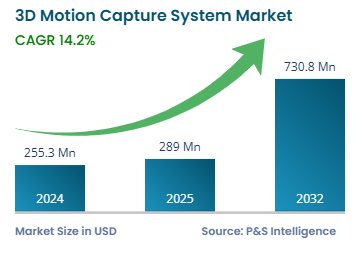
The 3D motion capture system market generated revenue of USD 255.3 million in 2024, which is expected to witness a CAGR of 14.2% during 2025–2032, to reach USD 730.8 million by 2032. This can be ascribed to the rising demand for high-quality 3D animations in video games with advanced features enabled by real-time animation software like Unity 3D.
3D motion capture is essential across multiple applications, including gaming, entertainment, sports analytics, healthcare, robotics, and simulation training. Nearly half of deployments use optical systems, while inertial and marker-less technologies are rapidly growing due to advances in AI. Over 50% of motion capture applications support film and game studios, with healthcare making up about 20% through gait analysis and rehabilitation.
Sports applications use these technologies to help teams optimize athlete performance and reduce injury risk. For instance, broadcasters use advanced 3D motion capture technologies to study and provide insights into the bodily positions and movements of the players in cricket. The path of the ball with and without the swing or spin, the position of the bowling arm as the bowler approaches the crease, and the relative positions of the head, feet, and waist as the batsman leans into a drive or tries to fend off a bouncer are all displayed via 3D motion capture.
The multiple cameras that take shots of the live play from different angles and then combine them into one rotating image also use this technology, as does the ball tracking technology used for judging LBW. The same approaches are applied in baseball, which involves many of the same body movements as cricket.
Additionally, industrial and robotics sectors increasingly adopt motion capture to enhance ergonomic design and improve human-robot interaction. Further, there has been a growing trend of new product launches, collaborations, partnerships, and acquisitions among major players in the media and entertainment industry. Moreover, advancements in sensor technology, along with the growing use of 3D motion capture systems in industrial sectors for ergonomics analysis and in medical fields for rehabilitation, are driving market growth
3D Motion Capture System Market Trends & Drivers
Increasing Usage of Motion Capture Systems in Sports Biomechanics Is Key Driver
The growing adoption of 3D motion capture systems in sports biomechanics is transforming how athletes and coaches analyze and enhance performance, thereby driving market growth.
These advanced systems provide accurate data on joint movements, muscle activations, and kinetics, allowing for comprehensive biomechanical analysis.
This helps identify strengths, weaknesses, and opportunities for improvement in athletic techniques.
By utilizing mocap technology, sports professionals can refine training programs, reduce the risk of injuries, and elevate overall athletic performance.
Moreover, motion capture systems with VR and AR functionalities provide athletes with immersive training experiences, allowing them to visualize and adjust their movements in real-time.
This combination enhances learning and skill acquisition by providing immediate feedback in an engaging format.
Globally, 3D motion capture is used by over 40% of elite sports organizations to analyze biomechanics in real time.
This technology helps reduce injury rates by around 20% and improves athlete performance by up to 15%.
Its adoption is rapidly expanding across soccer, basketball, and track and field worldwide.
The New York Mets have integrated 3D motion capture into their training program through a specialized pitching lab at their Port St. Lucie facility.
This lab uses high-speed cameras and motion sensors to analyze pitchers’ biomechanics in detail, providing data on joint angles, timing, and force production.
Such analysis allows coaches and medical staff to identify inefficiencies in movement, tailor training programs, and reduce injury risk.
The Mets also collaborate with the American Sports Medicine Institute on using motion capture to refine mechanics and enhance athlete performance through objective, data-driven feedback.
Rising Demand for Real-Time Analytics Is a Key Opportunity
The growing demand for real-time analytics represents a substantial opportunity for the market by spurring the development of advanced mocap systems that can deliver immediate feedback and insights.
By allowing users to observe and evaluate 3D motion capture data, real-time analytics support immediate modifications and interventions in a range of applications, such as live performances, sports training, and virtual production.
This feature not only improves decision-making and performance but also enhances user experiences by delivering timely feedback and actionable insights.
As industries increasingly prioritize efficiency, responsiveness, and interactivity, the integration of real-time analytics with mocap technology presents a compelling value proposition.
This synergy drives market growth while creating expanded opportunities for innovation and differentiation among mocap system providers.
Furthermore, the ability to offer tailored solutions that respond to real-time data can attract a wider range of clients, including those in the entertainment, healthcare, and training sectors.
In elite sports, real-time analytics from 3D motion capture enable adjustments within milliseconds.
In football, real-time analytics using 3D motion capture have become crucial for performance optimization and injury prevention.
About 45% of top-tier clubs use these systems to monitor player movements during training and matches.
This immediate feedback enables tailored adjustments, enhancing agility and reducing muscle strain risks significantly.
The English Premier League club Liverpool FC employs 3D motion capture for real-time player analysis.
Since adopting this technology, they reported a 30% reduction in muscle injuries and a 12% improvement in sprint efficiency during matches, contributing to enhanced overall team performance and player longevity.
Concerns Regarding Data Privacy and Security in 3D Motion Capture Systems
Data privacy and security concerns pose significant challenges in the adoption of 3D motion capture systems, as the collection and storage of sensitive biometric data raise ethical and legal issues.
These systems record intricate anatomical movements and physiological information, which, if compromised, could result in privacy violations and the misuse of personal data.
Moreover, the incorporation of motion capture technology with cloud-based systems for data storage and analysis introduces risks associated with unauthorized access and potential data breaches.
Consequently, it is crucial to ensure robust data encryption, comply with privacy regulations, such as GDPR and HIPAA, and implement stringent access controls to address these issues and build trust among users, ultimately reducing barriers to market adoption.
3D Motion Capture System Market Segmentation and Category Analysis
Component Insights
The hardware category is projected to grow at the highest CAGR during 2025–2032, after holding the largest market share of around 60% in 2024. Hardware components, including sensors, cameras, and suits, are essential to motion capture systems, serving as the primary tools for accurately capturing and processing motion data. Moreover, hardware dominates the market because it is the most-expensive component of the system, with average prices for hardware used for live sports telecasting between USD 50,000 and USD 500,000. This can depend on the system’s complexity, number of cameras or sensors, and real-time processing capabilities.
These devices are essential for a range of applications, including animation, virtual reality, biomechanics, and the analysis of sports performance. Furthermore, advancements in hardware technology have led to the creation of more sophisticated and reliable mocap equipment, improving the quality of motion capture and broadening its use across multiple industries. The tangible nature of hardware solutions also instills a sense of reliability and security in users, reinforcing their dominance in the market over software or service-based alternatives.
During the study, we have analyzed the following components in the report:
Hardware (Largest and Faster-Growing Category)
Software
Service
System Analysis
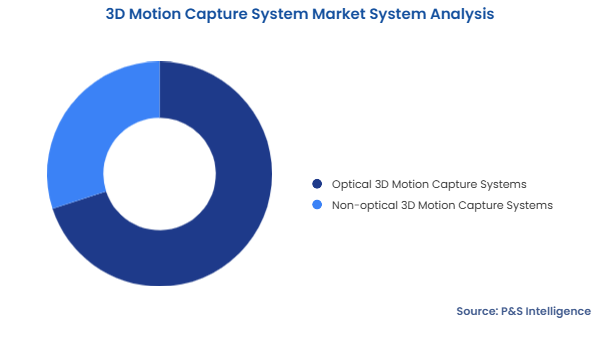
The optical 3D motion capture systems category holds the larger market share of approx. 70% in 2024 due to their widespread use in films, video games, and biomechanics. These systems use high-resolution cameras and reflective markers to accurately track movements, providing high-quality, detailed data that is essential for creating realistic animations and analyses. The precision and reliability of optical systems make them the preferred choice for high-end applications, such as feature films and AAA video games, where visual fidelity is paramount.
The non-optical 3D motion capture systems category is projected to witness the higher CAGR of 14.8% during 2025–2032 in the market. These include technologies such as inertial sensors, magnetic systems, and mechanical suits. These non-optical systems are typically easier to use, requiring less setup and calibration, which allows for quicker deployment in various environments. This ease of use is particularly beneficial in outdoor or uncontrolled settings where optical systems may struggle with lighting and occlusions.
Below are the systems analyzed:
Optical 3D Motion Capture Systems (Largest Category)
Non-optical 3D Motion Capture Systems (Faster-Growing Category)
End Use Insights
The media & entertainment category accounted for the largest share in 2024 of about 35%. This is primarily due to its extensive use in film, television, and video game production. Mocap technology is crucial for creating realistic character animations and visual effects, enabling filmmakers and game developers to deliver high-quality content. Major film studios and gaming companies invest heavily in advanced motion capture systems to enhance their productions, which drives demand for these technologies. The established presence of motion capture in high-profile projects and its integral role in the creative process contribute to its demand.
Industrial & robotics is the fastest-growing category over the forecast period. This is credited to its role in enhancing precision in human-robot interaction, improving worker ergonomics, and streamlining automated processes. Motion tracking systems now support real-time feedback across manufacturing, assembly, and quality control environments. Industrial robots improve manufacturing efficiency, consistency, and safety. Over 3.5 million industrial robots are currently in use globally, led by the automotive, electronics, and metal industries. Robotics enhances productivity, reduces human error, and supports 24/7 operations, especially in regions facing labor shortages or high-precision demands.
The following end uses are included in the report:
Media & Entertainment (Largest Category)
Education
Sports
Healthcare
Industrial/Robotics (Fastest-Growing Category)
Automotive
Others
Drive strategic growth with comprehensive market analysis
3D Motion Capture System Market Geographical Analysis
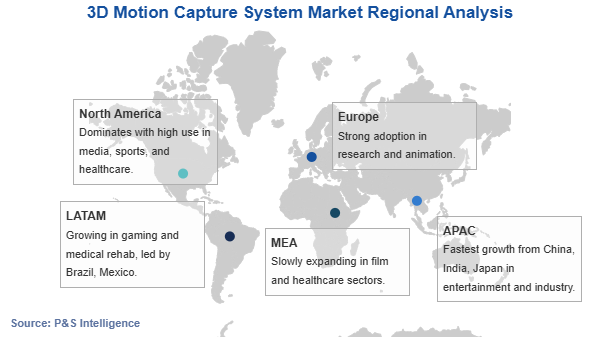
Geographically, North America holds the largest market share of around 35% in 2024. The region is home to numerous leading companies in the motion capture industry, fostering a competitive landscape that promotes continuous technological advancements and innovation. The media and entertainment sector, particularly in Hollywood, plays a significant role, as it has a high demand for motion capture systems to create realistic animations and visual effects for high-budget film and television projects. Additionally, North America is at the forefront of technological developments, focusing on research and development that enhances the capabilities of motion capture systems through real-time analytics and integration with virtual and augmented reality.
The New York Mets have integrated 3D motion capture into their training program through a specialized pitching lab at their Port St. Lucie facility. This lab uses high-speed cameras and motion sensors to analyze pitchers’ biomechanics in detail, providing data on joint angles, timing, and force production. Such analysis allows coaches and medical staff to identify inefficiencies in movement, tailor training programs, and reduce injury risk. The Mets are among several Major League Baseball teams that also collaborate with institutions like the American Sports Medicine Institute, using motion capture to refine mechanics and enhance athlete performance through objective, data-driven feedback.
APAC is the fastest-growing market during the forecast period. The industrial robotics market in the Asia-Pacific region is experiencing robust growth, driven by increasing automation across manufacturing sectors. China leads in robot installations, accounting for over half of global industrial robot deployments, particularly in automotive and electronics assembly. Japan and South Korea continue to invest heavily in precision robotics for semiconductor and automotive production, with robot density among the highest worldwide. In India, growth is accelerating as industries adopt robotics to boost productivity and address labor challenges. Across APAC, demand is fueled by government incentives, a push for smart factories, and the rise of collaborative robots in mid-sized enterprises.
Industrial robotics adoption is rapidly expanding in the region, with China alone installing over 290,000 new industrial robots in a year, mainly in electronics and automotive production. Japan uses robotics extensively in precision tasks, such as semiconductor handling, with over 390 robots per 10,000 manufacturing employees. South Korea leads in robot density, especially in car manufacturing. In India, robotics is gaining momentum in welding, packaging, and pharma. Key growth drivers include labor shortages, rising wages, and smart factory initiatives. Use cases span from automated circuit board assembly in China to surgical robotics integration in South Korea and pharmaceutical packaging in India.
Further, regions and countries analyzed for this report include:
Brazil (Largest and Fastest-Growing Country Market)
Mexico
Rest of LATAM
Middle East and Africa (MEA)
Saudi Arabia (Largest Country Market)
South Africa
U.A.E. (Fastest-Growing Country Market)
Rest of MEA
3D Motion Capture System Market Competitive Landscape
The industry is fragmented with the presence of several key players. This is evident due to the variety of technologies and applications within the motion capture domain, leading to numerous providers offering specialized solutions tailored to different industries such as media and entertainment, sports, healthcare, and virtual reality. Key players include Vicon, OptiTrack, and Noraxon, which dominate specific segments of the market with their advanced technologies and comprehensive product offerings. However, the presence of many smaller and niche companies contributes to the competitive landscape, as they often innovate rapidly to meet specific customer needs or target emerging applications.
3D Motion Capture System Companies:
Vicon Motion Systems Ltd.
Naturalpoint Inc.
Movella Inc.
Codamotion Ltd.
Dassault Syst
Qualisys AB
PhaseSpace Inc.
Motus Digital
Noitom Ltd.
Move AI Ltd.
Noraxon USA
STT INGENIER
3D Motion Capture System Market News & Updates
In June 2025, Sony Group Corporation launched the mocopi Pro Kit for the full professional mode of the mocopi motion capture system. Intended for use with the XYN Motion Studio app and mocopi PC app, the kit enables motion capture of the full body.
In October 2024, NaturalPoint Inc., via its brand OptiTrack, announced a partnership with B & H Foto & Electronics Corp. to sell the former’s motion capture systems in the U.S. via B&H’s The Studio.
In February 2024, Motion Analysis Inc. launched the Thunderbird range of motion-capture cameras, which deliver higher precision and versatility for motion capture professionals across applications. The Thunderbird range includes five advanced cameras that accommodate both active and passive markers.
In November 2023, OptiTrack, a brand of NaturalPoint Inc., unveiled three new advanced motion capture cameras: the Prime 120W, Prime 120, and Slim 120. These new high-resolution cameras feature enhanced resolution and an expanded field of view. These advancements allow for larger tracking areas, accommodating a broader range of training and simulation scenarios, as well as larger cinematic virtual production studios.
In May 2023, Movella Inc. launched the MTi-320, a compact and high-performance Active Heading Tracker (AHT) designed for integration into systems that require precise heading tracking, including warehouse, last-mile delivery robotics, and autonomous vehicles. Featuring the advanced Xsens sensor fusion algorithm, the MTi-320 effectively tracks heading changes by accurately integrating gyroscope data and mitigating distortions from external magnetic fields.
Want a report tailored exactly to your business need?
Leading companies across industries trust us to deliver data-driven insights and innovative solutions for their most critical decisions. From data-driven strategies to actionable insights, we empower the decision-makers who shape industries and define the future. From Fortune 500 companies to innovative startups, we are proud to partner with organisations that drive progress in their industries.
Client Testimonials
Working with P&S Intelligence and their team was an absolute pleasure – their awareness of timelines and commitment to value greatly contributed to our project's success. Eagerly anticipating future collaborations.
McKinsey & Company
India
Unmatched Standards
Our insights into the minutest levels of the markets, including the latest trends and competitive landscape, give you all the answers you need to take your business to new heights
Complete Data Security
We take a cautious approach to protecting your personal and confidential information. Trust is the strongest bond that connects us and our clients, and trust we build by complying with all international and domestic data protection and privacy laws