This Report Provides In-Depth Analysis of the DDoS Protection & Mitigation Security Market Report Prepared by P&S Intelligence, Segmented by Component (Solutions, Services), Deployment Mode (Cloud-based, Hybrid, On-premises), Application (Network security, Application security, API & web application security, Endpoint security, Database security), Organization Size (Large Enterprises, Small and Medium Enterprises), End-User (Healthcare, Banking, Financial Services, and Insurance, IT & Telecommunications, Government & Defense, Retail & E-commerce, Media & Entertainment, Energy & Utilities, Manufacturing), and Geographical Outlook for the Period of 2021 to 2032
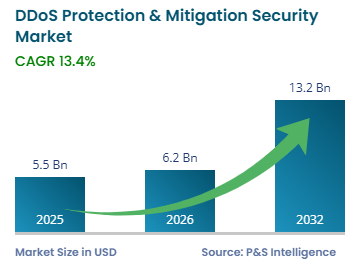
The DDoS protection & mitigation security market size was USD 5.5 billion for 2025, and it will grow by 13.4% during 2026-2032, to reach USD 13.2 billion by 2032.
The market is expanding because organizations across industries are increasingly dependent on digital platforms, cloud applications, online transactions, and interconnected networks to support daily operations and customer engagement. As businesses continue to digitize critical processes, the risk associated with service interruptions has become more significant. DDoS attacks are evolving in scale and complexity, targeting network infrastructure, web applications, APIs, and cloud environments that support essential services. At the same time, remote work models, multicloud deployments, and connected devices are creating larger attack surfaces that require continuous protection. Organizations are therefore prioritizing security strategies that can maintain availability, protect user access, and reduce operational disruptions caused by malicious traffic and network congestion.
The growing focus on cyber resilience is further strengthening demand for DDoS protection and mitigation solutions across public and private sectors. According to the International Telecommunication Union (ITU), the global cybersecurity commitment score reached 65.7 in 2024, marking a 27% rise since 2020. This improvement reflects stronger national cybersecurity programs, broader security investments, and greater attention to protecting critical digital infrastructure. Enterprises are responding by adopting advanced mitigation technologies that provide real-time traffic analysis, automated threat detection, and scalable response capabilities. These solutions help organizations maintain application performance, support uninterrupted digital services, and protect revenue-generating platforms while operating across increasingly complex network environments.
Key Market Insights
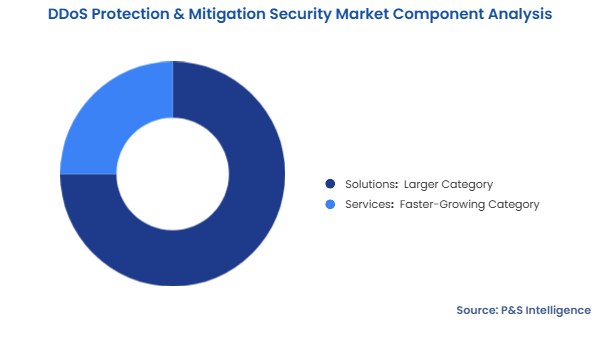
Solutions is the larger component, holding a market share of 75%, due to demand for real-time detection and automated multi-layer attack mitigation.
Services are the faster-growing component, registering a CAGR of approximately 13.6%, driven by increasing reliance on managed protection and lack of in-house expertise.
Cloud-based is the largest deployment mode, holding a market share of 60%, due to scalable protection, easy integration, and the ability to handle large attack volumes.
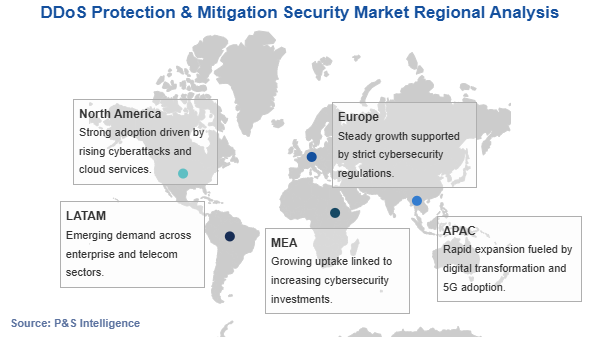
North America holds the largest share of 40%, due to advanced digital infrastructure, strong cloud presence, and high cybersecurity investment levels.
Asia-Pacific is the fastest-growing region, registering a CAGR of approximately 14.3%, driven by rapid digital expansion, rising internet penetration, and increasing cyber threat exposure.
DDoS Protection & Mitigation Security Market Trends and Drivers
Shift Toward Cloud-Based and AI-Driven DDoS Protection Solutions Is Major Trend
The market is shifting toward cloud-delivered mitigation platforms that can handle large-scale distributed traffic without dependence on on-premises infrastructure. Organizations are increasingly adopting cloud-native applications, multicloud environments, and edge computing architectures, creating a need for security solutions that can scale dynamically across geographically distributed networks. According to Microsoft, DDoS attacks reached peaks of 4,500 incidents per day globally in 2024. Furthermore, the World Economic Forum reports that 47% of organizations identify AI-driven cyber threats as a major concern in 2024. Growing attack frequency, combined with the emergence of AI-enhanced threat techniques, is driving investment in automated mitigation, real-time traffic analysis, and edge-based protection platforms that help maintain application availability, network performance, and uninterrupted digital service delivery.
Rising Frequency and Impact of Large-Scale Cyberattacks on Online Services Drives Market
The market is growing due to the increasing frequency, scale, and sophistication of distributed cyberattacks targeting critical digital infrastructure, online platforms, and customer-facing services. Organizations across banking, e-commerce, government, and technology sectors face greater exposure to service disruptions as threat actors deploy larger and more persistent attack campaigns against internet-facing assets. According to Cloudflare, 21.3 million DDoS attacks were mitigated globally in 2024, representing a 53% annual increase. Additionally, according to Akamai Technologies, application-layer DDoS attack volumes reached 1.1 trillion in a single month by December 2024. The growing volume of network- and application-layer attacks is increasing demand for always-on mitigation platforms, automated traffic analysis, real-time threat detection, and high-capacity protection architectures that help enterprises maintain service availability, safeguard digital transactions, and support uninterrupted business operations.
High Deployment Cost and Complexity for Smaller Organisations
The market faces constraints due to the high cost of deploying advanced DDoS protection platforms and the operational demands associated with continuous threat monitoring and mitigation. Organizations, particularly smaller businesses, often struggle to integrate sophisticated security technologies into existing network environments while maintaining adequate cybersecurity resources. According to the World Economic Forum's Global Cybersecurity Outlook 2024, 31% of leaders from the smallest organizations by revenue reported missing critical cybersecurity skills and personnel. Limited access to specialized talent affects solution deployment, policy management, and incident response capabilities, reducing adoption of comprehensive DDoS protection platforms and increasing reliance on basic security controls.
Growing Demand from Emerging Digital Economies and the Untapped SME Segment
The market presents strong growth opportunities driven by rapid digital expansion across emerging economies and underserved business segments. Additionally, increasing adoption of online platforms among small and mid-sized enterprises is creating demand for scalable and cost-efficient protection solutions. According to the International Telecommunication Union (ITU), global internet users reached 5.8 billion in 2024, accounting for 71% of the population. Furthermore, this expanding digital user base is increasing exposure to cyber threats across developing regions. Moreover, vendors offering flexible, subscription-based, and easy-to-deploy mitigation services are well-positioned to capture demand and expand market penetration.
Solutions is the larger category, holding a market share of 75%, because organizations require integrated platforms that can identify, analyze, and mitigate DDoS attacks across network, application, and cloud environments from a centralized interface. Growing reliance on hybrid and multicloud infrastructure is increasing the need for automated protection capabilities that deliver consistent security across distributed environments. According to IBM, citing 2024 Statista data, 73% of enterprises used hybrid cloud models in 2024. The widespread use of hybrid environments is driving demand for unified DDoS mitigation solutions that improve visibility, streamline threat response, and maintain service availability across interconnected infrastructure and cloud resources.
Services is the faster-growing category, registering a CAGR of approximately 13.6%, because many organisations lack in-house expertise to manage advanced DDoS protection systems. They are increasingly relying on managed and professional services for continuous monitoring and incident response. This shift is more visible among small and mid-sized businesses that prefer outsourcing over building internal teams. Service providers also offer flexible deployment and support, which makes adoption easier. As cyber threats evolve, dependence on external expertise continues to rise.
The components analysed in this report are:
Solutions (Larger Category)
Network layer protection
Application layer protection
DNS security & bot mitigation
Traffic monitoring & anomaly detection
Services (Faster-Growing Category)
Managed protection services
Professional services
Deployment Mode Analysis
Cloud-based is the largest category, holding a market share of 60%, because it allows organisations to scale protection instantly without investing in physical infrastructure. These solutions can absorb large attack volumes using distributed networks, making them suitable for modern digital environments. Businesses prefer cloud deployment due to its flexibility and ease of integration with existing systems. It also supports remote operations and multi-location networks, which are common today. This makes cloud-based protection a preferred choice across industries.
Hybrid is the fastest-growing category, because enterprises increasingly require DDoS protection architectures that combine the control of on-premises infrastructure with the scalability of cloud-based mitigation. Organizations operating across private clouds, public clouds, and internal data centers are adopting flexible security models that can respond to changing attack volumes and traffic patterns. According to the IBM Institute for Business Value, 85% of surveyed companies operated in multicloud environments. Growing multicloud complexity is increasing demand for hybrid DDoS protection platforms that provide centralized visibility, consistent policy enforcement, and coordinated threat mitigation across interconnected infrastructure environments.
The deployment modes analysed in this report are:
Cloud-based (Largest Category)
Hybrid (Fastest-Growing Category)
On-premises
Application Analysis
Network security is the largest category, because most DDoS attacks are designed to overwhelm network infrastructure, disrupt connectivity, and degrade service availability across enterprise, cloud, and telecom environments. The segment also benefits from growing reliance on high-bandwidth applications and interconnected digital ecosystems that require continuous network performance. According to Radware's H1 2024 Global Threat Analysis Report, the average network-layer DDoS attack volume per organization increased by 127% between 2023 and 2024. Rising attack volumes are driving investment in infrastructure-level mitigation platforms, higher-capacity traffic filtering, and network resilience capabilities that support uninterrupted operations across critical digital services.
Application security is the fastest-growing category, registering a CAGR of approximately 13.8%, because attackers are increasingly targeting specific applications rather than just network layers. These attacks are harder to detect as they mimic normal user behaviour and exploit application vulnerabilities. Businesses are focusing more on securing web applications and APIs that handle critical operations. As digital services expand, protecting the application layer becomes more important. This shift is driving faster adoption of advanced application-focused security solutions.
The applications analysed in this report are:
Network security (Largest Category)
Application security (Fastest-Growing Category)
API & web application security
Endpoint security
Database security
Organisation Size Analysis
Large Enterprises is the larger category, holding a market share of 80%, because they operate complex IT environments with high exposure to cyber threats. These organisations manage large volumes of traffic and cannot afford service disruptions, which drives continuous investment in advanced protection systems. They also have the resources to deploy multi-layered security frameworks. Their need for customised and scalable solutions keeps demand strong, especially in sectors like finance, telecom, and large-scale digital services.
Small and medium enterprises are the faster-growing category, because increasing digital adoption is exposing smaller businesses to higher cyber risks. Additionally, limited internal expertise is pushing SMEs toward managed and cloud-based protection solutions. According to OECD, 44% of SMEs used only one or two cybersecurity measures, while 19% had none in 2023. Furthermore, this protection gap is accelerating the adoption of scalable and cost-efficient DDoS mitigation services among SMEs.
The organization sizes analysed in this report are:
Large Enterprises (Larger Category)
Small and Medium Enterprises (SMEs) (Faster-Growing Category)
End-User Analysis
Healthcare is the largest category, because continuous access to digital health systems is essential for patient care and operational stability. Additionally, increasing reliance on connected devices and electronic records is expanding vulnerability to cyber disruptions. According to IBM, the average healthcare data breach cost reached USD 10.93 million in 2023. Furthermore, this high financial exposure is driving healthcare providers to adopt advanced protection systems to maintain uninterrupted service delivery.
Banking, Financial Services, and Insurance (BFSI) is the fastest-growing category, registering a CAGR of approximately 14.0%, because financial institutions are rapidly expanding digital banking and online transaction services. These platforms are prime targets for attacks that aim to disrupt services or exploit vulnerabilities. Banks and fintech companies are investing in advanced protection to maintain trust and ensure secure transactions. The rise of real-time payments and mobile banking increases exposure, which drives faster adoption of DDoS mitigation solutions in this sector.
The end-users analysed in this report are:
Healthcare (Largest Category)
Banking, Financial Services, and Insurance (BFSI) (Fastest-Growing Category)
IT & Telecommunications
Government & Defense
Retail & E-commerce
Media & Entertainment
Energy & Utilities
Manufacturing
Others
Drive strategic growth with comprehensive market analysis
North America DDoS Protection & Mitigation Security Market Analysis
North America holds the largest share, of 40%, because enterprises across the region operate highly distributed digital infrastructure that requires constant traffic monitoring and threat mitigation. Organisations prioritise advanced DDoS protection as part of broader cybersecurity frameworks to ensure service continuity. Strong presence of hyperscale cloud providers and content delivery networks enables rapid deployment of edge-based mitigation solutions. In addition, enterprises actively invest in multi-layered defence architectures to handle volumetric and application-layer attacks. High awareness, mature IT budgets, and strict operational risk management practices continue to support sustained demand across critical industries.
U.S. DDoS Protection & Mitigation Security Market Analysis
The U.S. leads the market due to its advanced digital infrastructure and high concentration of enterprises operating large-scale online platforms. Additionally, frequent exposure to sophisticated cyber threats is driving continuous upgrades in protection systems. According to the Federal Bureau of Investigation (FBI), cybercrime complaints reached 859,532 in 2024, with losses exceeding USD 16 billion. Furthermore, this high threat intensity is accelerating the adoption of advanced DDoS mitigation solutions across finance, retail, and government sectors.
Canada is growing steadily due to increasing digital service expansion and strengthening cybersecurity focus among organisations. Additionally, the rising adoption of cloud-based operations among SMEs is increasing exposure to network-based threats. According to Statistics Canada, cybercrime incidents reached 225.1 cases per 100,000 people in 2024, more than double since 2018. Furthermore, this growing cyber risk is encouraging businesses to adopt scalable and managed DDoS protection solutions to ensure service continuity and customer trust.
Asia-Pacific has the highest CAGR, of approximately 14.3%, because the region is witnessing aggressive expansion of digital platforms supported by telecom upgrades and rising internet penetration. Businesses are scaling online services quickly, which increases exposure to large-scale traffic-based attacks. Governments are also promoting digital ecosystems, leading to higher deployment of cloud and connected infrastructure. This creates demand for flexible and high-capacity mitigation solutions. Enterprises are gradually shifting from basic network security to advanced, cloud-based protection models. The combination of rapid digital growth and evolving threat landscape is accelerating market expansion across diverse economies.
China DDoS Protection & Mitigation Security Market Analysis
China is a major market due to its large-scale digital ecosystem and high-volume online platforms handling continuous traffic flows. Additionally, the rapid expansion of e-commerce and fintech services is increasing exposure to network-based disruptions. According to the Government of China, internet users reached 1.1 billion in 2024, with 78.6% penetration. Furthermore, this extensive user base is driving demand for high-capacity DDoS mitigation systems to maintain platform stability and ensure uninterrupted digital service delivery.
India DDoS Protection & Mitigation Security Market Analysis
India's demand for cybersecurity solutions is increasing as organizations, financial institutions, and digital platforms face a growing volume of cyber-enabled fraud and network-based attacks. Rapid adoption of digital payments, online banking, and cloud-connected services is expanding the potential attack surface across multiple sectors. According to the Ministry of Home Affairs, the Suspect Registry has shared more than 18.43 lakh suspect identifiers and 24.67 lakh Layer 1 mule accounts with participating entities, helping decline fraudulent transactions worth INR 8,031.56 crore. The increasing scale of fraudulent activity is encouraging enterprises to strengthen threat mitigation capabilities and invest in scalable DDoS protection technologies to improve operational resilience and service continuity.
Europe DDoS Protection & Mitigation Security Market Analysis
Europe demonstrates steady development as enterprises align cybersecurity strategies with strict regulatory and data protection frameworks. Organisations across sectors such as banking, healthcare, and manufacturing require consistent uptime, which drives the adoption of reliable DDoS mitigation systems. The region’s focus on data privacy and compliance encourages implementation of secure and resilient network architectures. At the same time, increasing reliance on cross-border cloud environments and digital services is adding complexity to traffic management. This pushes enterprises to adopt integrated security solutions that ensure service availability while meeting regulatory requirements across multiple jurisdictions.
The regions and countries analysed in this report are:
The market is fragmented, with many global and regional players offering different types of protection solutions. Large companies provide advanced, full-scale platforms, while smaller vendors focus on niche services or specific industries. New entrants are also joining with cloud-based and easy-to-deploy offerings, which increases competition further. No single player has full control, as customers often choose providers based on pricing, performance, and specific needs. Partnerships and service bundling are common as companies try to expand reach and improve offerings. This wide mix of players keeps the market competitive and diverse.
Top Companies in the DDoS Protection & Mitigation Security Market:
A10 Networks Incorporated
Akamai Technologies Incorporated
Amazon Web Services Incorporated
Cloudflare Incorporated
Corero Network Security Public Limited Company
DigiCert Incorporated
F5 Incorporated
Fastly Incorporated
Fortinet Incorporated
Huawei Technologies Company Limited
Microsoft Corporation
NetScout Systems Incorporated
Radware Limited
Tencent Holdings Limited
Thales Group
DDoS Protection & Mitigation Security Market News
In February 2026, Link11 launched an AI Management Dashboard within its Web Application and API Protection platform, enabling enhanced visibility, monitoring, and control of AI-driven traffic by making it transparent, traceable, and auditable within existing security workflows.
In August 2025, Akamai Technologies, in collaboration with LevelBlue, launched a managed Web Application and API Protection (WAAP) service integrating web application firewall, DDoS mitigation, bot protection, and API security into a unified enterprise security offering.
Frequently Asked Questions About This Report
What is the DDoS protection and mitigation security market?+
It covers solutions and services that detect, absorb, and filter malicious traffic to protect networks, applications, APIs, and digital services from downtime.
What factors are driving growth in the DDoS protection market?+
Growth is driven by rising attack frequency, higher traffic volumes, cloud adoption, application exposure, and stronger dependence on continuous digital service availability.
Why are cloud-based DDoS mitigation solutions gaining adoption?+
Cloud-based platforms scale quickly, inspect traffic near the edge, reduce hardware dependence, and support distributed applications running across multiple locations.
How does DDoS mitigation protect websites and online services?+
DDoS mitigation filters attack traffic, absorbs abnormal requests, and allows legitimate users to access targeted servers or applications during attack events.
What is the difference between network-layer and application-layer DDoS protection?+
Network-layer protection handles bandwidth and protocol floods, while application-layer protection addresses HTTP, DNS, and SSL attacks that mimic normal behavior.
Want a report tailored exactly to your business need?
Leading companies across industries trust us to deliver data-driven insights and innovative solutions for their most critical decisions. From data-driven strategies to actionable insights, we empower the decision-makers who shape industries and define the future. From Fortune 500 companies to innovative startups, we are proud to partner with organisations that drive progress in their industries.
Client Testimonials
Working with P&S Intelligence and their team was an absolute pleasure – their awareness of timelines and commitment to value greatly contributed to our project's success. Eagerly anticipating future collaborations.
McKinsey & Company
India
Unmatched Standards
Our insights into the minutest levels of the markets, including the latest trends and competitive landscape, give you all the answers you need to take your business to new heights
Complete Data Security
We take a cautious approach to protecting your personal and confidential information. Trust is the strongest bond that connects us and our clients, and trust we build by complying with all international and domestic data protection and privacy laws