China Urban Air Mobility Market Size & Share Analysis - Emerging Trends, Growth Opportunities, Competitive Landscape, and Forecasts (2026 - 2032)
This Report Provides In-Depth Analysis of the China Urban Air Mobility Market Report Prepared by P&S Intelligence, Segmented by Aircraft Type (Passenger, Cargo), Range (Intracity, Intercity), Operation Type (Piloted, Autonomous), End User (Ridesharing Companies, Scheduled Operators, E-Commerce Companies, Hospitals & Medical Agencies, Private Operators), and Geographical Outlook for the Period of 2021 to 2032
Explore the market potential with our data-driven report
China Urban Air Mobility Market Future Outlook
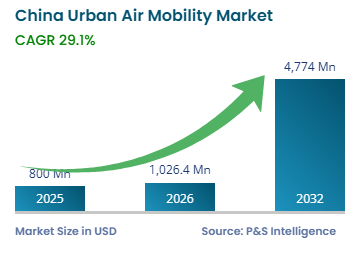
China's urban air mobility (UAM) market valued USD 800.0 million in 2025, and it is expected to reach USD 4,774.0 million by 2032, at a CAGR of 29.1% between 2026 and 2032.
The market is driven by the national designation of the low-altitude economy as a strategic emerging industry, with the Civil Aviation Administration of China (CAAC)’s regulatory architecture enabling fast aircraft certification. China's UAM sector encompasses electric vertical takeoff and landing (eVTOL) aircraft operating across passenger air taxi, airport shuttle, air ambulance, and cargo delivery applications below 3,000 meters of altitude.
Key Market Insights
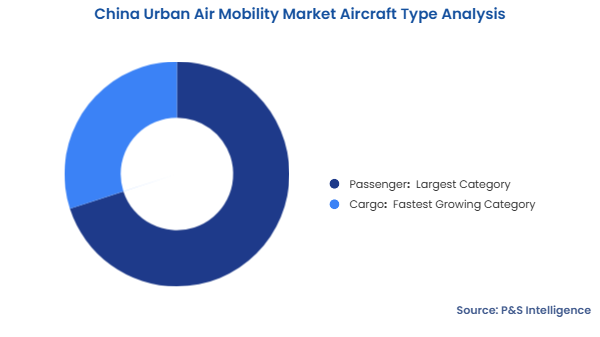
The passenger category held the largest share of China's urban air mobility market in 2025, of 70%.
Intercity operations are anticipated to demonstrate the fastest growth over 2026–2032, at 29.4% CAGR.
Piloted operations represented the largest share of China's urban air mobility market in 2025, of 70%.
E-commerce companies are expected to register the fastest growth during 2026–2032, at 29.5% CAGR.
Guangdong Province commands the largest share of China's urban air mobility market, of 40%.
Sichuan Province is China's fastest-growing UAM market, with 29.2% CAGR.
EHang Holdings Limited achieved full commercial eVTOL certification suite—type certificate in October 2023 and the production certificate and Air Operator Certificate in April 2025—enabling revenue-generating autonomous passenger flights in Guangzhou and Hefei. China possesses proprietary battery supply chains inherited from EV expertise and automotive manufacturing ecosystems repurposed for eVTOL production.
The CAAC projects China's broader low-altitude economy will reach CNY 1.5 trillion (USD 211 billion) by end-2025 and CNY 3.5 trillion by 2035, with eVTOL operations forming the highest-value segment within this framework. The convergence of accelerated CAAC certification pathways, automotive industry vertical integration, and coordinated infrastructure investment across 752 planned vertiport facilities positions China's UAM market for sustained commercial scaling through the forecast period.
China Urban Air Mobility Market Emerging Trends
Automotive Overcapacity and Vertical Integration Are Major Market Trends
China's automotive manufacturing sector produces approximately 55 million vehicles annually against domestic absorption of around 27 million units. The resulting severe overcapacity is redirecting engineering capital, battery supply chains, and production tooling toward eVTOL development. Automotive manufacturers, including Geely Aerofugia Technology Co. Ltd., Guangzhou Xiaopeng AeroHT Technology Co. Ltd., and Guangzhou Automobile Group Co. Ltd., are transferring proven EV battery management, lightweight composite manufacturing, and autonomous driving sensor integration directly into aircraft development programs. These capabilities that would require years and billions in investment to develop from scratch in a traditional aerospace context.
GAC Group launched the GOVY AirCab pre-orders in June 2025 at CNY 1.68 million, which reflects automotive cost structures rather than aerospace economics. Aerofugia's Chengdu manufacturing facility, integrating R&D and production under one roof adjacent to Chengdu Tianfu International Airport, is targeting 40 to 50 initial production units annually from 2026 onward. ARIDGE's Guangzhou intelligent flying car factory commenced trial production in November 2025, with a target of 10,000 detachable aircraft modules annually from 2026. This automotive cadence—compressing prototype-to-certification cycles to 24–36 months against the traditional aerospace decade—is structurally accelerating China's UAM market maturation.
State-Led Policies and Multi-Provincial Investment Drive Market
China's government designated the low-altitude economy as a national growth engine in the 2024 Government Work Report, placing it alongside biomanufacturing and commercial space as strategic emerging industries. The National Development and Reform Commission (NDRC) formalized institutional coordination with the establishment of the Low-Altitude Economy Development Division in December 2024. This provides a centralized policy direction across all 31 provincial governments, which had incorporated low-altitude economy into their official development plans by early 2025.
Shenzhen's municipal government has pledged CNY 12 billion (USD 1.7 billion) for low-altitude infrastructure development over 2024–2026, targeting 1,200 takeoff and landing platforms by 2026. Similarly, Sichuan Province has established a USD 420-million investment fund dedicated to eVTOL industrial ecosystem development. CAAC has a flexible, aircraft-first philosophy of certifying simpler autonomous platforms before establishing comprehensive market-wide rules. This enabled EHang's full commercial certification in under 31 months versus the 5–7 years required under FAA and EASA frameworks.
Intercity Cargo, Tourism, and Medical Supply Applications Offer Opportunities
Intercity cargo, low-altitude tourism, and medical supplies are among the foremost opportunities for the market, which is targeting diversification beyond urban ridesharing. Low-altitude tourism corridors are operational in Sichuan, Zhejiang, and Guangdong, the where natural topography and established domestic tourism infrastructure align with eVTOL range capabilities.
Cargo operations represent the most immediately scalable opportunity. In China’s urban air mobility (UAM) and drone logistics development, services are being used to deliver a range of goods including e‑commerce parcels, food and meals, retail products, and express deliveries for logistics companies, especially in dense cities like Shenzhen and Wuhan where drone routes have been approved for cargo transport. These services often connect urban launch pads to pickup hubs or distribution points rather than direct door‑to‑door delivery.
Emergency medical services in the mountainous western provinces—where road transit times to provincial hospitals can exceed 90 minutes—represent another opportunity with strong institutional procurement support from provincial health authorities. Vertaxi Technology Co. Ltd.'s CNY 260 million (USD 36 million) procurement agreement signed in July 2024 with Yunnan-based Dongshan Xiyang Cultural Tourism Technology Co. Ltd. explicitly covered tourism, cargo, and emergency rescue applications.
Absence of Comprehensive Regulatory Framework Hampers Market Growth
The CAAC currently issues Air Operator Certificates on a case-by-case basis rather than through a standardized, rule-based commercial operations framework. As of early 2025, only EHang Holdings Limited and Shanghai TCab Technology Co. Ltd. hold commercial operation licenses for eVTOL services. This narrow authorization base reflects the regulatory gap between aircraft certification and market-level operational rules. The absence of standardized inter-city route approval processes, passenger liability frameworks, airspace conflict resolution protocols between eVTOL and conventional aviation, and autonomous system pilot licensing pathways hampers funding from institutional investors and aviation insurers.
Shenzhen's February 2024 Low-Altitude Economy regulations are widely considered the likely template for a forthcoming national CAAC operational framework. They established a layered airspace management model, with the SILAS flight management platform approving 203 municipal routes and 121 landing points. Until comprehensive rules are promulgated, however, each operator must negotiate individual authorization. This limits market-driven network scaling and creates unequal competitive conditions between first-authorized operators and subsequent entrants regardless of aircraft capability.
China Urban Air Mobility Market Segmentation Analysis
Aircraft Type Analysis
The passenger category held the largest share of China's urban air mobility market in 2025, of 70%, driven by the concentration of active commercial certifications and revenue-generating operations around passenger-configured eVTOL platforms. EHang Holdings Limited's EH216-S eVTOL has generated commercial tourism and sightseeing revenue in Guangzhou, Hefei, and Shenzhen. Passenger air taxis and airport shuttle applications benefit from China's dense urban populations, were, intracity travel distances align with current eVTOL ranges of 35–250 kilometers. Air ambulance operations are additionally supported by institutional procurement channels through provincial health authorities and emergency response agencies.
The cargo category is expected to register the fastest growth during 2026–2032, at 29.3% CAGR, propelled by the maturity of cargo-first certification strategies among multiple manufacturers. Shanghai Fengfei Aviation Technology Co. Ltd. (AutoFlight) delivered the world's first certified ton-class cargo eVTOL—the CarryAll—to the logistics firm Heli Chuangxing Intelligent in August 2025. Shenzhen's 203 operational commercial drone cargo routes provide an established airspace management template that eVTOL cargo operators can directly transition onto, compressing the regulatory pathway compared to passenger services. The State Administration for Market Regulation (SAMR) confirms that mandatory drone reliability standards effective June 1, 2024, reduced urban failure rates by 50% and shortened test flight periods by 20%.
The market segments into the following aircraft types:
Passenger (Largest Category)
Air Taxi
Airport Shuttle
Air Ambulance
Cargo (Fastest Growing Category)
Range Analysis
Intracity operations constituted the largest share of China's urban air mobility market in 2025, of 75%. EHang Holdings Limited's EH216-S has a maximum flight range of 35 kilometers, which is suited exclusively to intracity routes within dense municipal areas, such as Guangzhou and Shenzhen. This category also leads due to the concentration of vertiport infrastructure within single metropolitan zones and the CAAC's case-by-case route authorization process.
Intercity operations are anticipated to demonstrate the fastest growth over 2026–2032, at 29.4% CAGR, as longer-range platforms advance through certification. AutoFlight's Prosperity delivers a 250-kilometer range and flew for 50 km during an intercity demonstration flight from Shenzhen to Zhuhai in February 2024. The Greater Bay Area's regional government has approved 100 intercity air corridors, such as Aerofugia's Chengdu–Leshan tourism corridor. The CAAC notes that eVTOL operations under its flexible low-altitude airspace framework can extend to altitudes up to 3,000 meters, enabling longer intercity corridors beyond densely managed urban airspace.
The market segments into the following ranges:
Intracity (Largest Category)
Intercity (Fastest Growing Category)
Operation Type Analysis
Piloted operations represented the largest share of China's urban air mobility market in 2025, of 70%. Much of the commercial pipeline—including Geely Aerofugia Technology Co. Ltd.'s AE200, Shanghai Fengfei Aviation Technology Co. Ltd.'s Prosperity, and Guangzhou Automobile Group Co. Ltd.'s GOVY AirCab—are designed around piloted configurations. The CAAC certifies simpler autonomous aircraft first, before moving to piloted platforms. Thus, the larger, higher-capacity aircraft being developed for commercial revenue operations are predominantly piloted. Institutional procurement by airlines, charter operators, and corporate buyers also favors piloted configurations for passenger liability and public acceptance during the early commercial phase.
Autonomous operations are projected to accelerate at the fastest rate over 2026–2032, of 29.6%. Chinese eVTOL manufacturers have collectively accumulated over 100,000 autonomous flight hours, generating training data that directly informs AI-based flight control system improvement. Shanghai TCab Technology Co. Ltd. received a commercial operation license in April 2025 for autonomous air taxi services, alongside EHang. The CAAC’s CCAR-92 Rules for the Safety Management of Civil Unmanned Aerial Vehicle Operations provide the regulatory foundation for scaled autonomous commercial flight.
The market segments into the following operation types:
Piloted (Largest Category)
Autonomous (Fastest Growing Category)
End User Analysis
Ridesharing companies held the largest end-user share in China's urban air mobility market in 2025, of 40%, targeting low-altitude tourism and point-to-point urban passenger services. EHang Holdings Limited's commercial experience-based aerial sightseeing operations in Guangzhou and Shenzhen are structured around a ridesharing model.
E-commerce companies are expected to register the fastest growth during 2026–2032, at 29.5% CAGR, driven by China's established e-commerce infrastructure and the validated commercial viability of drone cargo operations. Meituan had launched 53 commercial drone delivery routes across Beijing, Shanghai, Guangzhou, and Shenzhen by December 2024. This established the demand framework and customer acceptance that eVTOL cargo platforms will expand upon as certified ton-class aircraft enter fleet service. China's Ministry of Transport released 21 highway inspection pilot projects for low-altitude aircraft in 2025, signaling the accelerating institutional integration of aerial cargo services into national logistics infrastructure.
The market segments into the following end users:
Ridesharing Companies (Largest Category)
Scheduled Operators
E-Commerce Companies (Fastest Growing Category)
Hospitals & Medical Agencies
Private Operators
Drive strategic growth with comprehensive market analysis
China Urban Air Mobility Market Geographical Analysis
Guangdong Urban Air Mobility Market Analysis
Guangdong Province commands the largest share of China's urban air mobility market, of 40%. Multiple certified operators conduct commercial flights in the Greater Bay Area—comprising Shenzhen, Guangzhou, Zhuhai, and seven additional cities. Further, large-scale infrastructure investment is actively underway, and the regulatory framework is being stress-tested in real commercial conditions here.
EHang Holdings Limited conducts commercial EH216-S operations in Guangzhou, while Shenzhen's municipal government has committed CNY 12 billion to low-altitude infrastructure over 2024–2026, targeting 1,200 vertiport platforms by 2026. The Shenzhen Integrated Low-Altitude Airspace System (SILAS) approved 203 active UAM routes and 121 dedicated takeoff and landing points during 2024. AutoFlight demonstrated the first inter-city eVTOL crossing between Shenzhen and Zhuhai in February 2024, validating the commercial viability of cross-sea routes that leverage the Greater Bay Area's unique multi-city geography.
Sichuan Urban Air Mobility Market Share
Sichuan Province is China's fastest-growing UAM market, with 29.2% CAGR, supported by a USD 420-million provincial investment fund and Chengdu's designation as one of China's first pilot areas for joint low-altitude airspace management. Geely Aerofugia Technology Co. Ltd., headquartered in Chengdu's Low-Altitude Economy Industrial Park adjacent to Tianfu International Airport, received a CCAR-135 commercial operator certificate from the CAAC Southwest Regional Administration in May 2025. Trial commercial operations along the Chengdu–Leshan scenic tourism corridor began in 2025. In February 2026, Aerofugia received CNY 1-billion Series B fundraise, led by CITIC Securities Investment.
The market covers the following provinces and municipalities:
Guangdong Province (Largest Province)
Shanghai Municipality
Sichuan Province (Fastest-Growing Province)
Anhui Province
Hubei Province
Beijing Municipality
Rest of China
China Urban Air Mobility Market Competitive Landscape
China's urban air mobility market exhibits a severe consolidation, shaped by the extraordinary capital intensity of eVTOL development, the multi-year CAAC certification process, and the technological barriers inherent in electric propulsion, autonomous flight control systems, and composite airframe manufacturing. Automotive-backed challengers leverage parent company manufacturing ecosystems to compress development timelines and reduce unit costs. Independent developers are pursuing sequential certification pathways—cargo authorization before passenger—to generate early revenue, while building toward full commercial deployment. State-owned entities remain in pre-commercial technology demonstrator phases, with COMAC's CE-4VT hydrogen-electric hybrid platform targeting intercity urban mobility but without current commercialization timelines.
Commercial Aircraft Corporation of China Ltd. (COMAC)
Guangzhou Automobile Group Co. Ltd. (GAC Group)
China Urban Air Mobility Market News & Updates
In February 2026, Geely Aerofugia Technology Co. Ltd. closed a near-CNY 1 billion (approximately USD 140 million) Series B funding round led by CITIC Securities Investment, with Union Capital and Xiang Feng Capital participating. The capital will fund completion of full airworthiness certification for the AE200-100 piloted eVTOL and ramp production at its Chengdu manufacturing facility targeting 40 to 50 units annually from 2026.
In November 2025, Guangzhou Xiaopeng AeroHT Technology Co. Ltd. (ARIDGE) commenced the trial production of its intelligent flying car at its Guangzhou factory, targeting annual delivery capacity of 10,000 detachable aircraft modules beginning in 2026.
In November 2025, Shanghai TCab Technology Co. Ltd. raised RMB 300 million (approximately USD 41 million) in a Series B funding round, bringing total capital raised to over RMB 1 billion. The funding accelerates CAAC type certification for the E20 tiltrotor eVTOL targeted for late 2026 and supports the August 2025-commenced manufacturing facility in Wuhu City, Anhui Province, with two-line assembly capacity of 200 aircraft annually.
In August 2025, Shanghai Fengfei Aviation Technology Co. Ltd. (AutoFlight) delivered the first certified heavy-lift eVTOL aircraft to Heli Chuangxing Intelligent.
In March 2025, EHang Holdings Limited received Air Operator Certificates from the CAAC, authorizing commercial pilotless passenger-carrying eVTOL operations in Guangzhou and Hefei, for its subsidiaries Guangdong EHang General Aviation and Hefei HeYi Aviation.
Frequently Asked Questions About This Report
What was the China urban air mobility market size in 2025?+
In 2025, the urban air mobility market in the China size was USD 800.0 million.
Which aircraft type has largest the China urban air mobility industry share?+
Passenger aircraft have the largest the China urban air mobility industry share, of 70%.
Which end user has the highest the China urban air mobility market CAGR?+
E-commerce firms have the highest CAGR in urban air mobility market of the China, of 29.5%.
What are the key the China urban air mobility industry drivers?+
The major drivers for the China urban air mobility market are the high urban congestion, government support, advances in eVTOL and autonomous flight systems, growing demand for urban passenger and cargo transport, and backing from automotive and aerospace manufacturers.
What is the China urban air mobility market nature?+
The urban air mobility market in the China is consolidated.
Want a report tailored exactly to your business need?
Leading companies across industries trust us to deliver data-driven insights and innovative solutions for their most critical decisions. From data-driven strategies to actionable insights, we empower the decision-makers who shape industries and define the future. From Fortune 500 companies to innovative startups, we are proud to partner with organisations that drive progress in their industries.
Client Testimonials
Working with P&S Intelligence and their team was an absolute pleasure – their awareness of timelines and commitment to value greatly contributed to our project's success. Eagerly anticipating future collaborations.
McKinsey & Company
India
Unmatched Standards
Our insights into the minutest levels of the markets, including the latest trends and competitive landscape, give you all the answers you need to take your business to new heights
Complete Data Security
We take a cautious approach to protecting your personal and confidential information. Trust is the strongest bond that connects us and our clients, and trust we build by complying with all international and domestic data protection and privacy laws