UV Curing System Market Size & Share Analysis - Trends, Drivers, Competitive Landscape, and Forecasts (2026 - 2032)
This Report Provides In-Depth Analysis of the UV Curing System Market Report Prepared by P&S Intelligence, Segmented by Type (Spot Curing, Flood Curing, Hand-Held Curing, Conveyor Curing), Technology (Conventional Ultraviolet, Ultraviolet Light-Emitting Diode), Pressure (Low, Medium, High), Application (Printing, Coating, Adhesive), End User (Aerospace and Defense, Industrial Manufacturing, Electronics, Automotive, Healthcare), and Geographical Outlook for the Period of 2021 to 2032
Explore the market potential with our data-driven report
UV Curing System Market Key Insights
The conveyor curing category will have the highest CAGR, of approximately 13.7%, driven by high-throughput industrial production requirements.
The medium-pressure systems category holds the largest market share, of 60%, in 2025, driven by their optimal balance of high intensity and operational flexibility, making them widely used in coatings and printing applications.
The printing category holds the largest market share in 2025, of 45%, supported by the rapid expansion of packaging and labeling industries.
The adhesives category will have the highest CAGR, of approximately 13.8%, driven by increasing use in electronics, automotive, and medical devices.
Asia-Pacific will grow at the highest CAGR, of approximately 14.0%, driven by industrial expansion and electronics manufacturing growth.
UV Curing System Market Analysis
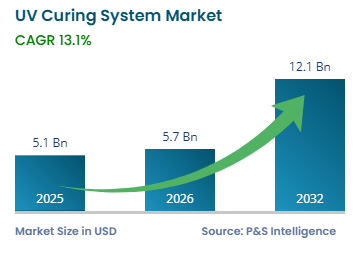
The global UV curing system market size was USD 5.1 billion in 2025, and it will grow at a CAGR of 13.1% during 2026–2032, to reach USD 12.1 billion by 2032. This growth is driven by the increasing demand for energy-efficient and high-speed curing technologies across industrial manufacturing, electronics, and printing applications. UV curing systems enable rapid polymerization of coatings, inks, and adhesives without the need for high thermal input, thereby reducing processing time and energy consumption while improving product quality and throughput. According to the International Energy Agency (IEA), improvements in industrial energy efficiency could significantly reduce global energy demand by 2030, reinforcing the shift toward low-energy technologies such as UV systems.
The expansion of the electronics and semiconductor industries is a key contributor to market growth. Governments globally are increasing investments in semiconductor manufacturing; for instance, the U.S. CHIPS and Science Act allocates over USD 52 billion to strengthen domestic semiconductor production, while India’s Semicon India Programme has a financial outlay exceeding USD 10 billion. These initiatives are strengthening semiconductor manufacturing ecosystems, indirectly increasing demand for precision curing technologies used in PCB manufacturing, encapsulation, and microelectronics assembly.
UV Curing System Market Trends and Drivers
Shift toward UV LED Technology Is Key Trend
A major trend in the UV curing system market is the transition from conventional mercury-based UV systems to UV LED technology, driven by energy efficiency, longer operational life, and environmental compliance. UV LED systems eliminate mercury usage, aligning with global regulatory frameworks such as the Minamata Convention on Mercury, which aims to phase out mercury-based products. Governments across Europe and North America are enforcing restrictions on mercury lamps, accelerating the shift toward LED-based curing solutions. Regional frameworks such as RoHS in Europe and environmental oversight by the U.S. Environmental Protection Agency are further restricting hazardous substances, reinforcing the transition toward mercury-free curing technologies.
Technological advancements are improving UV LED output intensity and wavelength customization, enabling their use across a wider range of applications, including adhesives and coatings. For instance, industrial manufacturers are increasingly integrating UV LED systems into automated production lines due to their instant on/off capability and reduced maintenance requirements. In 2024, Excelitas Technologies introduced advanced UV LED curing solutions designed to enhance output efficiency and support high-speed industrial applications. This transition is enhancing production efficiency, reducing downtime, and supporting sustainability goals, making UV LED systems a central growth driver in the market.
Rising Demand from Electronics Manufacturing Is Biggest Driver
The rapid expansion of the electronics manufacturing sector is the primary driver for the UV curing system market. UV curing plays a critical role in semiconductor packaging, PCB assembly, and display panel manufacturing, where precision, speed, and reliability are essential. Governments worldwide are heavily investing in electronics manufacturing capabilities. For example, in 2024, Taiwan Semiconductor Manufacturing Company increased its planned investment in its Japan semiconductor facility to over USD 20 billion, reflecting the scale of advanced electronics production expansion.
According to the International Telecommunication Union, global internet penetration reached approximately 68% in 2024, driving demand for consumer electronics such as smartphones, laptops, and IoT devices. This surge in electronics production is increasing the need for high-performance curing technologies that can ensure product durability and miniaturization. From an industry perspective, SEMI reported that global semiconductor manufacturing equipment sales exceeded USD 100 billion in 2023, highlighting strong capital investment in fabrication facilities and advanced packaging lines. UV curing systems provide rapid processing and high bonding strength, which are essential for modern electronic components. The increasing scale and complexity of electronics manufacturing are significantly boosting the adoption of UV curing systems across production facilities.
High Initial Investment and System Compatibility Limitations Are Key Restraints
The high initial cost of UV curing systems and compatibility constraints with certain substrates act as a major restraint for market growth. Advanced UV LED systems require significant upfront investment, including specialized equipment and integration into automated production lines, which can limit adoption among small and medium-sized enterprises.
From a regulatory standpoint, compliance with worker safety standards related to UV exposure, as defined by agencies such as the Occupational Safety and Health Administration (OSHA), necessitates additional protective infrastructure and training. These requirements increase capital and operational costs, particularly in developing economies, thereby slowing adoption in cost-sensitive environments.
Expansion of Industrial Automation and Smart Manufacturing Is Biggest Opportunity
The increasing adoption of industrial automation and smart manufacturing presents a significant opportunity for the UV curing system market. Industry 4.0 initiatives across developed and emerging economies are driving the integration of automated curing systems into production lines, improving efficiency, consistency, and throughput. UV curing systems are inherently suited for automation due to their rapid curing cycles and minimal process variability.
Government-backed programs such as Germany’s Industry 4.0 initiative and China’s Made in China 2025 strategy are accelerating the adoption of advanced manufacturing technologies. According to the International Federation of Robotics, global industrial robot installations reached approximately 542,000 units in 2024, more than doubling over the past decade, with Asia accounting for around 74% of new installations. This shift is increasing the demand for high-speed, automated curing technologies, positioning UV systems as critical enablers of next-generation manufacturing environments.
UV Curing System Market Segmentation Analysis
Type Analysis
The spot curing category holds the largest market share, of 45%, in 2025, driven by its extensive use in precision applications such as medical device assembly and microelectronics, where targeted curing is essential. The ability to deliver high-intensity UV light to specific areas minimizes material waste and enhances product quality, making it highly suitable for high-value manufacturing processes. This is further supported by the growth of the medical device sector, according to India Brand Equity Foundation, India’s medical devices market is projected to reach USD 50 billion by 2030, increasing demand for precision manufacturing technologies such as spot UV curing. Additionally, companies like Dymax Corporation are continuously developing light-curable adhesives specifically designed for medical and electronic assembly, reinforcing the dominance of spot curing systems.
The conveyor curing category will have the highest CAGR, of approximately 13.7%, supported by the increasing adoption of automated production lines in industries such as automotive and packaging. High-speed conveyor systems enable continuous curing processes, significantly improving throughput and reducing operational costs. According to the Packaging Industry Association of India, India’s packaging industry is growing at around 22–25% annually, driven by rising consumption and e-commerce expansion.
The types analyzed in this report are:
Spot Curing (Largest Category)
Flood Curing
Hand-Held Curing
Conveyor Curing (Fastest-Growing Category)
Technology Analysis
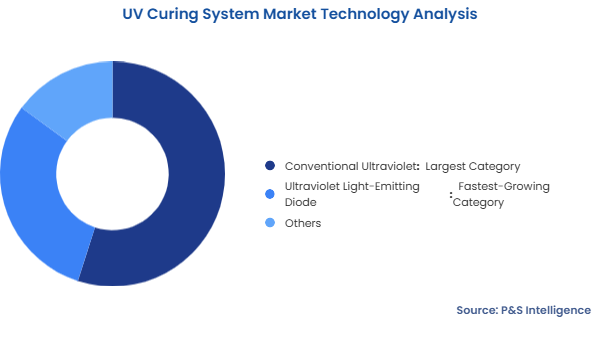
The conventional UV technology category holds the largest market share, of 55%, in 2025, due to its established presence, lower initial cost, and widespread industrial compatibility. These systems are extensively used in printing and coating applications where high-intensity curing is required. Regulatory actions restricting mercury-containing lamps are gradually encouraging a shift away from conventional UV systems.
The UV LED technology category will have the highest CAGR, of approximately 13.3%, driven by regulatory pressure to eliminate mercury-based systems and the need for energy-efficient solutions. The European Commission’s Eco-design Directive promotes energy-efficient industrial equipment, encouraging the adoption of LED-based curing systems. This shift is improving sustainability while reducing lifecycle costs. This transition is further supported by technology benefits, as companies like Phoseon Technology report that UV LED systems can reduce energy consumption by up to 50–70% compared to conventional mercury lamps, improving sustainability while lowering lifecycle costs.
The medium-pressure systems category holds the largest market share, of 60%, in 2025, due to their balance between intensity and operational flexibility, making them suitable for a wide range of industrial applications, including coatings and printing. According to the European Commission, coatings and surface treatment industries are among the key sectors regulated for emissions and efficiency, encouraging the use of reliable and adaptable curing technologies such as medium-pressure UV systems across manufacturing processes.
The high-pressure systems category will have the highest CAGR, of approximately 13.4%, driven by their ability to deliver high-intensity UV radiation required for specialized industrial processes. These systems are increasingly used in heavy industrial manufacturing where faster curing cycles are essential for productivity. According to the United Nations Industrial Development Organization, global manufacturing value added grew by around 3.3%, reflecting continued expansion in industrial production.
The pressures analyzed in this report are:
Low
Medium (Largest Category)
High (Fastest-Growing Category)
Application Analysis
The printing category holds the largest market share in 2025, supported by the rapid expansion of packaging and labeling industries. UV curing is extensively used in printing inks and coatings due to its ability to deliver instant drying, high gloss finish, and improved durability. This dominance is reinforced by the scale of the global packaging sector, according to the World Packaging Organisation, the global packaging industry is valued at over USD 1 trillion, reflecting substantial demand for high-performance printing technologies.
The adhesives category will have the highest CAGR, driven by increasing use in electronics, automotive, and medical devices. UV-curable adhesives provide strong bonding and rapid curing, making them ideal for high-precision applications. Regulatory standards in healthcare manufacturing, such as those from the U.S. Food and Drug Administration, require high-performance, reliable bonding technologies, encouraging the adoption of UV-curable adhesives in medical device production.
The applications analyzed in this report are:
Printing (Largest Category)
Coating
Adhesive (Fastest-Growing Category)
Others
End User Analysis
The electronics category holds the largest market share in 2025, driven by the rapid growth of semiconductor and consumer electronics manufacturing. Government-backed investments and increasing global demand for electronic devices are significantly boosting the need for UV curing technologies. For instance, the European Commission has introduced the European Chips Act, mobilizing over EUR 43 billion in public and private investments to strengthen the region’s semiconductor ecosystem.
The automotive category will have the highest CAGR, of approximately 13.9%, supported by increasing vehicle production and the adoption of advanced materials and coatings. According to the International Organization of Motor Vehicle Manufacturers, global vehicle production reached approximately 94 million units in 2023, reflecting continued recovery and expansion of the automotive sector.
The end users analyzed in this report are:
Aerospace and Defense
Industrial Manufacturing
Electronics (Largest Category)
Automotive (Fastest-Growing Category)
Healthcare
Others
Drive strategic growth with comprehensive market analysis
UV Curing System Market Geographical Analysis
Asia-Pacific UV Curing System Market Forecast
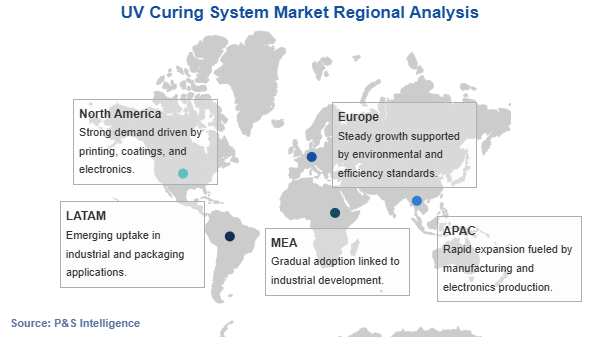
The Asia-Pacific region holds the largest market share, of 40%, in 2025, and it will have the highest CAGR, of approximately 14.0%, supported by an extensive manufacturing base, a well-established electronics supply chain, and ongoing industrial modernization across China, India, Japan, and South Korea. Strong government support continues to accelerate adoption of advanced curing technologies. According to the Organisation for Economic Co-operation and Development, over 30 countries have introduced targeted policies to support advanced technologies, including manufacturing and next-generation industrial systems, reflecting a sustained global shift toward high-tech production ecosystems.
The rapid expansion of the automotive sector, particularly electric vehicle production in China and South Korea, has increased demand for UV-curable adhesives in battery assembly and structural bonding applications. Industrial modernization across the region is gaining momentum, supported by initiatives such as Australia's Modern Manufacturing Initiative, which includes an AUD 1.5 billion investment commitment to strengthen priority manufacturing sectors and accelerate adoption of advanced production technologies. According to the Organisation for Economic Co-operation and Development, governments worldwide have announced approximately USD 55.7 billion in public funding for advanced technologies since 2013, reflecting the depth of policy-driven industrial transformation supporting manufacturing upgrades across the region. Increasing automation across ASEAN manufacturing hubs is reinforcing Asia-Pacific's dominance in the UV curing system market.
China UV Curing System Market
China is the largest market in Asia-Pacific, supported by its dominant position in global electronics manufacturing and strong state-backed industrial policies. The country accounts for a significant share of global electronics exports, with exports of electrical and electronic equipment reaching approximately USD 927 billion in 2024, according to international trade data. This export volume reflects the scale of precision manufacturing activity driving demand for UV curing systems across semiconductor and industrial applications. Initiatives such as Made in China 2025 are promoting high-tech manufacturing, increasing demand for precision UV curing systems in semiconductor and industrial applications.
North America UV Curing System Market Outlook
North America holds the second-largest market share, driven by industrial infrastructure, strong regulatory enforcement, and high adoption of energy-efficient technologies. The U.S. Department of Energy promotes energy-efficient manufacturing through programs such as the Better Plants initiative, which has helped industrial partners achieve energy intensity reductions of over 25% on average, encouraging the adoption of efficient technologies such as UV LED curing systems. The U.S. Environmental Protection Agency highlights that UV-curable formulations can be low- or zero-VOC, helping facilities reduce emissions and comply with air-quality regulations.
Established demand from the electronics and automotive sectors, supported by the region's mature manufacturing ecosystem, sustains consistent market growth. Workplace safety guidelines issued by the American Industrial Hygiene Association related to UV radiation exposure have reinforced the adoption of certified UV LED systems, contributing to ongoing equipment upgrades and replacement demand across the region.
The regions and countries analysed in this report are:
North America
U.S. (Larger Country)
Canada (Faster-Growing Country)
Europe
Germany (Largest Country)
U.K.
France
Italy (Fastest-Growing Country)
Spain
Rest of Europe
Asia-Pacific (Largest and Fastest-Growing Regional Market)
China (Largest Country)
India (Fastest-Growing Country)
Japan
South Korea
Australia
Rest of APAC
Latin America
Brazil (Largest Country)
Mexico (Fastest-Growing Country)
Rest of LATAM
Middle East & Africa
Saudi Arabia (Fastest-Growing Country)
South Africa
U.A.E. (Largest Country)
Rest of MEA
UV Curing System Market Competitive Landscape
The market is fragmented due to the presence of numerous specialized players operating across diverse application areas such as electronics, printing, medical devices, and automotive manufacturing. Each segment requires tailored solutions, allowing niche companies to compete effectively alongside larger firms. Companies like Heraeus, Phoseon Technology, and Dymax Corporation focus on specific technologies or end-use industries rather than dominating the entire market. Additionally, rapid technological advancements, particularly in UV LED systems, continue to create entry opportunities for new players. Regional manufacturers also play a significant role by offering cost-competitive and customized solutions, while varying industry requirements and evolving application needs maintain a highly competitive landscape with multiple active participants.
Key Players in the UV Curing System Market:
Dymax Corporation
Nordson Corporation
Excelitas Technologies Corp.
IST METZ GmbH & Co. KG
Heraeus Holding GmbH
Dr. Hoenle AG
Phoseon Technology Inc.
American Ultraviolet Company
Baldwin Technology Company Inc.
GEW (EC) Limited
IST INTECH
Panasonic Corporation
UV Curing System Market News & Updates
In March 2026, Dr. Hoenle AG launched new UV-curable liquid gasket solutions for electronics manufacturing, enabling fast, precise, and solvent-free sealing for sensitive electronic components while improving production efficiency and process reliability.
In November 2025, Phoseon Technology Inc. introduced the FireLine UV LED platform, offering high-intensity output and enhanced thermal management for faster curing in industrial printing.
In September 2025, Excelitas Technologies Corp. introduced the Phoseon Nexus II UV LED curing platform for flexographic printing, featuring advanced monitoring capabilities and improved system reliability.
In June 2024, IST METZ GmbH & Co. KG, in collaboration with Fujifilm, unveiled SMARTcure, an AI-supported curing assistant at drupa 2024, enabling cloud-based optimization of UV curing processes, reducing energy consumption, and supporting predictive maintenance through real-time data integration.
Frequently Asked Questions About This Report
What are the key factors driving adoption of UV curing systems?+
The adoption of UV curing systems is driven by instant curing speed energy efficiency and reduced production time.
How does UV LED technology improve UV curing performance?+
UV LED technology improves performance by offering longer lifespan lower energy consumption and stable instant output.
What are the main challenges in UV curing systems?+
The main challenges include high initial cost material compatibility limitations and shallow curing penetration.
Why is UV curing considered environmentally sustainable?+
UV curing is considered sustainable because it produces low emissions consumes less energy and eliminates the need for solvents.
How is automation impacting UV curing system demand?+
Automation is increasing demand by enabling integration with high speed and precision controlled production lines.
How does UV curing improve product quality?+
UV curing improves product quality by ensuring uniform curing better surface finish and stronger material adhesion.
Want a report tailored exactly to your business need?
Leading companies across industries trust us to deliver data-driven insights and innovative solutions for their most critical decisions. From data-driven strategies to actionable insights, we empower the decision-makers who shape industries and define the future. From Fortune 500 companies to innovative startups, we are proud to partner with organisations that drive progress in their industries.
Client Testimonials
Working with P&S Intelligence and their team was an absolute pleasure – their awareness of timelines and commitment to value greatly contributed to our project's success. Eagerly anticipating future collaborations.
McKinsey & Company
India
Unmatched Standards
Our insights into the minutest levels of the markets, including the latest trends and competitive landscape, give you all the answers you need to take your business to new heights
Complete Data Security
We take a cautious approach to protecting your personal and confidential information. Trust is the strongest bond that connects us and our clients, and trust we build by complying with all international and domestic data protection and privacy laws