U.S. Snacks Food Market Size & Share Analysis - Trends, Drivers, Competitive Landscape, and Forecasts (2025 - 2032)
This Report Provides In-Depth Analysis of the U.S. Snacks Food Market Report Prepared by P&S Intelligence, Segmented by Product (Salty Snacks, Sweet Snacks, Healthy & Functional Snacks, Savory Snacks, Frozen & Refrigerated Snacks), Distribution Channel (Supermarkets & Hypermarkets, Convenience Stores & Gas Stations, Online Retailers & Direct-to-consumer, Vending Machines, Specialty Stores, Wholesale Retailers), Packaging (Single Serve Packets, Sharable Bags, Multipacks, Eco-Friendly & Reusable), Age Groups (Kids & Teens, Millennials & GenZ, Gen X & Boomers), and Geographical Outlook for the Period of 2019 to 2032
Explore the market potential with our data-driven report
U.S. Snacks Food Market Future Outlook
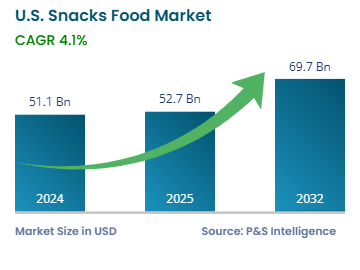
The U.S. snacks food market size was USD 51.1 billion in 2024, and it will grow by 4.1% during 2025–2032, to reach USD 69.7 billion by 2032.
This is because of the diverse consumer preferences and the rising demand for convenient, healthy, and innovative snacks. Primarily, the hectic lifestyle in the country increases on-the-go food consumption; therefore, there is a huge demand for quick-to-eat and portable products. Furthermore, health-conscious consumers are seeking organic, gluten-free, high-protein, and plant-based snacks.
The market is also driven by the growing population, urbanization, changing preferences for quick nibbles, influence of social media, and rising number of young consumers. Moreover, there is a rich culture of having snacks at bars, restaurants, pubs, and home with drinks, with nachos and potato chips being loved by people of all ages.
U.S. Snacks Food Market Trends & Drivers
Rising Demand for Plant-Based and Protein-Rich Snacks Is Key Trend
The increasing desire of consumers for something healthier has hurried the development of plant-based snacks and snacks rich in proteins.
Apart from their health, consumers are now also more concerned about sustainability, which has impelled the players to rethink their ingredient sourcing and processing approaches.
Consumers following vegan, vegetarian, and flexitarian diets drive the development of pea protein snacks, nuts, and dairy alternatives.
As per studies, 4% of the country’s population is vegan, while 6% is vegetarian, with both these percentages increasing every year.
This growing market trend has led several leading brands to launch plant-based jerky bars, protein bars, and cheese alternatives to dairy.
Additionally, the demand for functional snacks that are enriched with vitamins, fiber, and probiotics propels the intake of plant-based snacks.
Better-for-you snacks are becoming popular among consumers concerned about nutrition and preventive health.
The millennials and Gen-Z now want snacks that are natural, organic, minimally processed, and as far from synthetic additives as possible.
This drives the demand for more-plant-based, low-sugar, and high-protein snacks.
Customers are seeking snacks that provide a functional benefit and contain a lot of protein, fiber, and ingredients that enhance immunity.
Snacks with less sugar, sodium, and artificial additives are witnessing huge sales.
Supermarkets, convenience stores, and internet shopping websites have filled their shelves with broader selections of healthy snacks to cater to this new environment.
Rising Convenience Food Demand Amid Hectic Lifestyles Is Key Driver
The rising demand for convenient, ready-to-eat food options, driven by the increasingly busy with less time to get a proper meal, is a key driver of the market.
The growth in the number of dual-income households has minimized the frequency of home-cooked meals and thus, increased the usage of prepackaged snack foods.
According to the U.S. Census Bureau, the share of dual-income households in the U.S. exceeded 62% in 2022, which means over half the people have less time for cooking and a greater reliance on convenience snacks.
Consumers often have to skip breakfast, lunch, and dinner and rely on convenient food options in their active routines.
This behavior is especially common among Millennials and Gen Z, who prefer flexibility over routine.
As per reports, more than 154,000 U.S. convenience stores provide readily available snacks.
These stores are affordable, easily accessible, and more economical than takeout meals.
According to the U.S. Bureau of Labor Statistics, the average American dedicates 37 minutes or less per day on meal preparation and clean-up, highlighting the intensifying time crunch around food.
The IFIC Food & Health 2023 report disclosed that around 49% of the Americans snack at least twice a day, nearly 27% of the consumers snack due to busy life schedules, and 73% consider convenience important.
As per reports, 56% of Americans swap traditional meals with snacks.
According to another survey, 80% of the Americans are too fatigued to cook after work, and 77% lack the motivation for full meal preparation.
U.S. Snacks Food Market Segmentation Analysis
Product Analysis
The salty category held the largest market share of about 35% in 2024 due to their fairly wide acceptance by consumers, good brand loyalty for excellent products, and convenience. Classics, such as potato chips and tortilla chips, fill the larders at homes.
The healthy & functional category will have the highest CAGR because health consciousness is becoming more paramount among the Millennials and Gen Z. More attention is now focused on protein-packed, low-sugar, plant-based, and gut-health-promoting snacks. This is because consumers are prioritizing wellness without compromising on convenience. Over 40% of the country’s population is obese, and around 10% is severely obese. As per government sources, over 38 million people in the U.S. have diabetes, and more than 28 million suffer from heart attacks, strokes, ischemic heart diseases, and other CVDs.
The supermarkets and hypermarkets category held the largest market share of around 35% in 2024. This is because consumers appreciate convenience and the ease of comparison of products themselves. Hence, supermarkets and hypermarkets continue to be the first option for buying snacks as they provide a multitude of options under one building.
The online retailers & direct-to-consumer category will have the highest CAGR of 4.5%, because of the rise of e-commerce, subscription snack services, and increasing demand for convenience. As per the Census Bureau, e-commerce retail sales in the U.S. grew by 0.4% from the fourth quarter of 2024, reaching USD 1,858.5 billion in the first quarter of 2025.
The distribution channels analyzed in this report are:
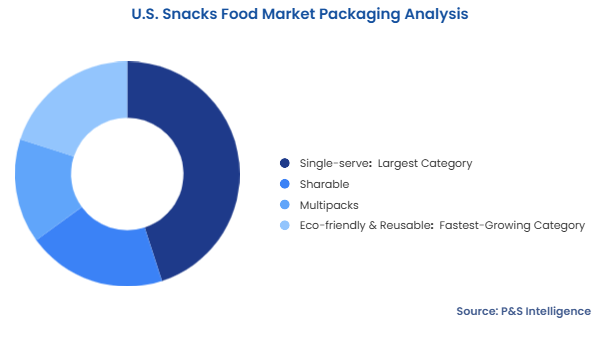
The single-serve category held the largest market share of approx. 45% in 2024 because consumers’ primary demand with snacks is for convenience and portion management. Single-serve packets are especially popular for on-the-go snacking.
The eco-friendly and reusable category will have a higher CAGR because of the growing concern over environmental issues and shift toward sustainable packaging. More than 35 million tonnes of plastic waste in generated in the U.S. every day, most of it in the form of packaging. Moreover, as per the Department of State, 11 million tonnes of plastic waste enter the coastal waters of the U.S. each year.
The packaging analyzed in this report is:
Single-serve (Larger Category)
Sharable
Multipacks
Eco-friendly & Reusable (Faster-Growing Category)
Age Groups Analysis
The gen X & boomers category held the largest market share in 2024, due to their high disposable income, tendency to buy larger pack sizes, and preference for value-based choices. They often use snacks to substitute a meal, especially during occasions of solo eating or to eliminate the need to prepare a meal.
The millennials & Gen Z category will have the highest CAGR because these generations tend to snack frequently, prioritize convenience, and seek new health-conscious options. According to a survey, 70% of the millennials and Gen Z snack to satisfy their hunger between meals or for energy boosts.
As per reports, the average number of snack occasions for baby boomers is about 1,200 per person per year, compared to 1,000 for millennials, making them the most frequent adult snackers.
The age groups analyzed in this report are as follows:
Kids & Teens
Millennials & Gen Z (Faster-Growing Category)
Gen X & Boomers (Larger Category)
Drive strategic growth with comprehensive market analysis
U.S. Snacks Food Market Regional Outlook
The South region holds the largest market share of about 35% due to its high population growth rate, broad regional retail distribution channels, and strong Hispanic consumer population driving demand for pungent and traditional flavor profiles. Around 20% of the population of Texas, Florida, and New Mexico is Hispanic and Latino, which prefers bold and spicy flavors, such as tajin, habanero, tamarind, chili–lime, and chipotle. These flavors are prominent in many snack products, such as Takis Fuego, Doritos Dinamita, and Sabritas chips.
The West category will have the highest CAGR as consumers here are increasingly seeking plant-based, high-protein, and sustainable snacks. This trend is especially visible in the wellness-oriented states of California, Oregon, and Washington. Approximately 688 vegans per million people in Oregon and 838 per million in California demand plant-based options. This leads snack brands to offer plant-based protein chips, pea protein bars, and non-dairy yogurt crisps.
The geographical breakdown of the market is as follows:
Northeast
Midwest
South (Largest Category)
West (Fastest-Growing Category)
U.S. Snacks Food Market Competitive Landscape
The market is fragmented due to the presence of local and regional players providing a wide variety of products, such as cookies, crackers, plant-based, and protein-rich options. The consumer demand for variety, health-related items, and ethnic flavors drives the growth of niche brands. Moreover, the easy access to the market via social media and e-commerce allows niche and emerging companies to compete with the established brands. Another key factor for the market fragmentation is the presence of a huge number of European, Latin American, and Asian brands, which diversify the product offerings.
Key U.S. Snacks Food Companies:
PepsiCo Inc.
Jack Link's Protein Snacks, Inc.
General Mills, Inc.
Kellogg Company
Conagra Brands, Inc.
Mars, Inc.
The Hershey Company
Utz Brands, Inc.
Hormel Foods Corporation
Campbell Soup Company
SpartanNash
TreeHouse Foods
U.S. Snacks Food Market News
In June 2025, Alpha Wave Global LP received the permission of the Competition Commission of India to acquire a stake of 6% in Haldiram Snacks Food Private Limited for USD 10 billion (INR 85,000 crore).
In January 2025, PepsiCo Inc. finalized its USD1.2-billion acquisition of the Tex-Mex-themed, grain-free Siete Foods, to enhance its Hispanic-snack portfolio.
In October 2024, Walmart Inc. announced plans to offer products from Britannia, Bikano, and Jayanti Spices in the U.S. ahead of Diwali. The retail giant also announced plans to source USD 10 billion worth of food products from India for its U.S. customers by 2027.
In September 2024, Lunchly LLC launched as a joint snack-kit project involving YouTubers MrBeast, WWE superstar Logan Paul, and KSI, as a healthier version of Lunchables. Each kit contains a main item, such as pizza or nachos; a Prime Hydration drink, and a Feastables chocolate bar, aimed at Gen Z consumers, mixing nutrition, branding, and influencer appeal.
In August 2024, Mars Inc. acquired Kellanova Inc. to extend its presence in the savory snacks segment.
In March 2023, The Hershey company and NCAA extended its agreement to include SkinnyPop and Dot’s Homestyle Pretzels as official NCAA popcorn/pretzel partners across big college sports events.
Want a report tailored exactly to your business need?
Leading companies across industries trust us to deliver data-driven insights and innovative solutions for their most critical decisions. From data-driven strategies to actionable insights, we empower the decision-makers who shape industries and define the future. From Fortune 500 companies to innovative startups, we are proud to partner with organisations that drive progress in their industries.
Client Testimonials
Working with P&S Intelligence and their team was an absolute pleasure – their awareness of timelines and commitment to value greatly contributed to our project's success. Eagerly anticipating future collaborations.
McKinsey & Company
India
Unmatched Standards
Our insights into the minutest levels of the markets, including the latest trends and competitive landscape, give you all the answers you need to take your business to new heights
Complete Data Security
We take a cautious approach to protecting your personal and confidential information. Trust is the strongest bond that connects us and our clients, and trust we build by complying with all international and domestic data protection and privacy laws