Key Highlights
| Study Period | 2021 - 2032 |
| Market Size in 2025 | USD 23.3 Billion |
| Market Size in 2026 | USD 23.9 Billion |
| Market Size by 2032 | USD 29.2 Billion |
| Projected CAGR | 3.3% |
| Largest Region | South |
| Fastest-Growing Region | West |
| Market Structure | Fragmented |

| Study Period | 2021 - 2032 |
| Market Size in 2025 | USD 23.3 Billion |
| Market Size in 2026 | USD 23.9 Billion |
| Market Size by 2032 | USD 29.2 Billion |
| Projected CAGR | 3.3% |
| Largest Region | South |
| Fastest-Growing Region | West |
| Market Structure | Fragmented |
Explore the market potential with our data-driven report
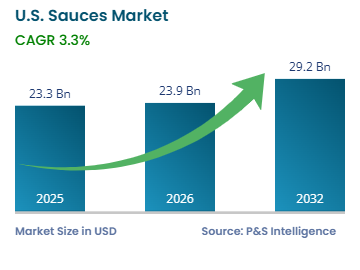
The U.S. sauces market size was USD 23.3 billion for 2025, and it will grow by 3.3% during 2026–2032, to reach USD 29.2 billion by 2032.
The three major factors responsible for the increase in demand for sauces include a rise in the number of people purchasing convenience foods, an increase in interest in international cuisine, and a rise in the number of people cooking at home due to changing lifestyles and as a result of new product offerings in health-focused formulations.
Ready-to-use culinary solutions continue to be the largest drivers for the U.S. sauces market growth. National dietary and consumer behavior surveys indicate that a large share of U.S. consumers regularly consume snacks and fast food, supporting demand for sauces and condiments. The U.S. sauces market continues to evolve as clean-label, organic and reduced-sodium versions become increasingly available to meet the demands of health-conscious consumers.
Additionally, the proliferation of ethnic food establishments across the major metropolitan cities in the U.S., particularly those located in the Northeast and Western parts of the country, has continued to expand the U.S. sauces market through increased exposure to a wide variety of sauces. The U.S. sauces market has also seen significant improvement in terms of access to products, thanks to the evolving retail landscape which now includes omnichannel distribution methods and widespread online shopping options.
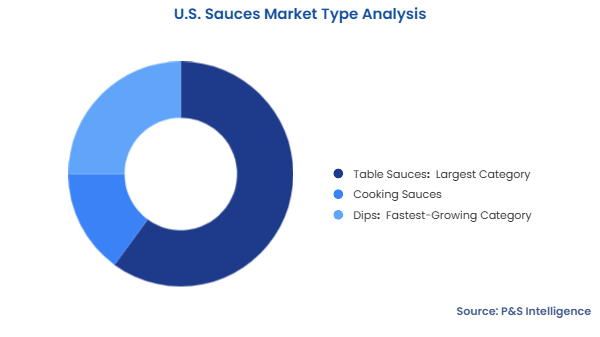
The table sauces category holds the largest market share, of 60%, in 2025, because all of the common household condiments such as ketchup, mustard, mayonnaise, BBQ sauce, etc., are table sauces and that they are used in virtually every meal occasion—whether it be breakfast, lunch or dinner, snacks or after-dinner drinks. Additionally, these types of products have a broad range of uses which helps drive consistent levels of demand.
The dips category will have the highest CAGR, of 3.5%, fueled by increasing popularity of snacking and social eating occasions. The growth in the dip category has been fueled by innovative flavor profiles, texture options and "better for you" formulations of traditional dips that provide healthy alternatives to traditional snack foods. Plant-based dips, protein-enriched dips and globally-inspired flavors have evolved beyond just being a complement to chips, but have become alternative meal components.
The types analyzed in this report are:
The supermarkets/hypermarkets category holds the largest market share, of 50%, in 2025, because of their ability to carry a wide variety of sauce products, price competitively using private label products and strategically place sauce products in locations where customers are likely to see them and make impulse buys. Many of the major supermarket chains such as Walmart, Kroger and Albertsons have a strong relationship with manufacturers to negotiate prices on behalf of their customers, and use their size and scale to carry a wide assortment of ethnic food items that highlight the diversity of sauces offered by various manufacturers.
The online category will have the highest CAGR, of 3.4%, as it provides unlimited shelf space for small, niche, and artisanal sauce manufacturers that would otherwise be unable to obtain placement in traditional retail channels. Consumers are able to browse and purchase sauce products directly from manufacturers through subscription services, bulk purchasing options, and algorithms that recommend products based on previous purchases.
The distribution channels analyzed in this report are:
Drive strategic growth with comprehensive market analysis
Southern U.S. holds the largest market share, of 40%, in 2025, due to its large and rapidly growing population base. With Texas, Florida, and Georgia all growing significantly, the South has experienced tremendous demographic growth. In addition to the large population, the South has a great cultural background with many regional and ethnic sauces being consumed on many occasions. Hot sauces and BBQ sauces are two examples of regional sauces that have been a part of this culture for years.
Hispanic and African Americans make up a large portion of the South's demographics which increases the demand for ethnic and regional sauces. Also, several large food manufacturers are located in the South, specifically in North Carolina and Tennessee, provide us with a competitive advantage regarding logistics and distribution. The Southern United States Trade Association (SUSTA), supports Southern U.S. food and agriculture exporters, including manufacturers of condiments and sauces with global market access through SUSTA's Trade Missions, Cost-Share Programs, and International Trade Shows and Events; thus helping to develop new export opportunities for value-added products internationally.
The South has a number of growing metropolitan areas, such as Atlanta, Miami and Houston, which serve as the center for new and emerging food trends. These metropolitan areas create a demand for premium sauces due to the increasing disposable income of the residents. Additionally, these metropolitan areas allow for a large value segment in the rural areas of the South.
Western U.S. will have the highest CAGR, supported by strong demand for Asian and Pacific–inspired sauces and rapid adoption of new flavor trends. Specifically, California, Washington and Hawaii are three of the most prominent states that drive demand for Asian/Pacific style sauces. In addition to the demand for Asian/Pacific style sauces, the Western region is also driving demand for organic, clean-label and plant-based sauces. Therefore, these types of sauces fit perfectly with the lifestyles of many consumers in cities such as Los Angeles, San Francisco, and Seattle.
California's agricultural industry is one of the largest in the world, and this allows for a variety of farm-to-table sauces to be produced using locally sourced ingredients. The Western region also has a thriving startup environment and this environment has allowed for a variety of innovative sauce companies to emerge. Many of these companies use e-commerce and direct to consumer models to disrupt the traditional market dynamics of the sauces industry. For example, the demand for Asian, Mexican, and fusion sauces is driven by the multicultural population of the Western region. The tech industry has a significant presence in Silicon Valley and Seattle and this presence creates a demand for premium sauces for busy professionals who seek convenient meal solutions.
The regions studied in the market are as follows:
The market is fragmented with large national brands and smaller regional and artisanal players all competing for customer dollars. The concentration of the U.S. sauces market is relatively competitive as the largest players account for a limited share of the U.S. sauces market, and therefore, there are opportunities for new entrants to differentiate their offerings and establish themselves within certain niches. The competitive nature of this market results from the diversity of customer preferences among different U.S. geographies, the differing needs associated with various distribution channels, and the relative ease of entry into many of the specialty sauce categories.
Smaller regional manufacturers and private-label producers have been able to increase their market share in the U.S. sauces market through lower prices and through the ability to tailor products to local preferences. With the advent of co-packing facilities, smaller brands can now produce larger quantities of their products at a much lower cost than was previously possible, resulting in increased competition throughout the entire price spectrum. As a result of the reduced costs associated with selling products directly to the end-user, craft sauce manufacturers can now build national presence through e-commerce platforms without the need to partner with retailers.
Want a report tailored exactly to your business need?
Request CustomizationLeading companies across industries trust us to deliver data-driven insights and innovative solutions for their most critical decisions. From data-driven strategies to actionable insights, we empower the decision-makers who shape industries and define the future. From Fortune 500 companies to innovative startups, we are proud to partner with organisations that drive progress in their industries.

Working with P&S Intelligence and their team was an absolute pleasure – their awareness of timelines and commitment to value greatly contributed to our project's success. Eagerly anticipating future collaborations.
McKinsey & Company
India
Our insights into the minutest levels of the markets, including the latest trends and competitive landscape, give you all the answers you need to take your business to new heights

We take a cautious approach to protecting your personal and confidential information. Trust is the strongest bond that connects us and our clients, and trust we build by complying with all international and domestic data protection and privacy laws


Customize the Report to Align with Your Business Objectives

Request the Free Sample Pages