Solar Street Lighting Market Size & Share Analysis - Emerging Trends, Growth Opportunities, Competitive Landscape, and Forecasts (2026 - 2032)
This Report Provides In-Depth Analysis of the Solar Street Lighting Market Report Prepared by P&S Intelligence, Segmented by Structure Type (Standalone, Centralized, Portable), Component (Lamp, Solar Panel, Battery, Controller), Installation (New Installation, Retrofit), Application (Highway & Roadway, Bridge, Airport Runway, Park & Playground, Manufacturing Site, Parking Lot), and Geographical Outlook for the Period of 2021 to 2032
Explore the market potential with our data-driven report
Solar Street Lighting Market Analysis
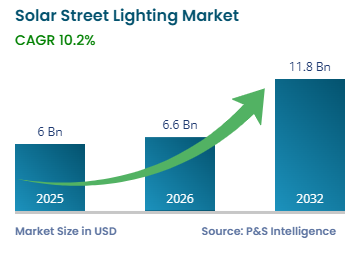
The solar street lighting market size was USD 6.0 billion for 2025, and it will grow by 10.2% during 2026–2032, to reach USD 11.8 billion by 2032.
This growth is supported by the accelerating global transition toward renewable energy systems, declining photovoltaic module and LED luminaire costs, and increasing government commitments to smart city infrastructure, rural electrification, and carbon emission reduction across developed and emerging economies. Solar street lighting systems integrate photovoltaic panels, battery storage, LED luminaires, and controllers to deliver reliable off-grid illumination while reducing municipal electricity and maintenance costs.
The macroeconomic environment for solar energy continues to reinforce underlying demand conditions. The International Energy Agency reports that global solar PV installations grew 30% year-on-year in 2024, reaching 553 GW of new capacity additions, bringing total installed global solar capacity to approximately 2.2 terawatts. This sustained momentum in solar energy deployment directly reinforces investment in solar-powered public infrastructure.
Key Market Insights
The standalone category holds the largest market share, of 55%, in 2025. This dominance reflects the fundamental value proposition of solar street lighting, independence from grid infrastructure.
The portable category will have the highest CAGR, of 10.4%, driven by expanding applications in temporary infrastructure including construction sites, disaster response deployments, military installations, and seasonal event venues.
The lamp category holds the largest market share, of 40%, in 2025, driven by its role as the most visible and performance-critical system component in any solar street lighting configuration.
The retrofit segment is expected to grow at a 10.6% CAGR, driven by the replacement of aging conventional street lighting systems across North America, Europe, and East Asia.
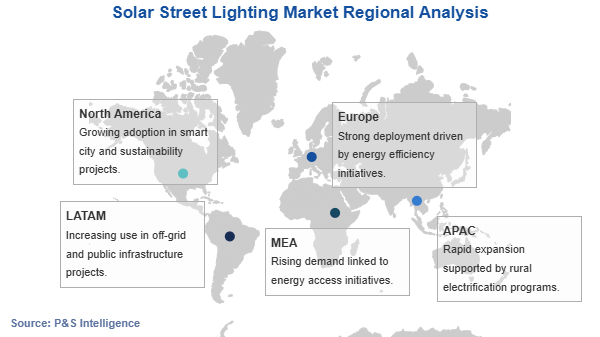
Asia-Pacific holds the largest share of 40% in 2025 and is projected to grow at a CAGR of 10.3%, supported by rapid urbanization, strong solar potential, rural electrification programs, and large PV and LED manufacturing bases in China and India.
Solar Street Lighting Market Trends & Drivers
Smart Technology Integration and IoT Connectivity Are Key Trends
The solar street lighting market is undergoing a structural technology evolution from simple standalone photovoltaic systems to intelligent, connected infrastructure integrating IoT sensors, remote monitoring platforms, motion-responsive adaptive lighting, and data analytics capabilities. Cloud-connected platforms enable centralized monitoring, fault detection, and performance optimization across large solar lighting networks.
Vendors, including Signify N.V. and SOKOYO Solar Group are embedding Zigbee and 4G/5G connectivity modules directly into luminaire designs to support smart city platform integration. The International Energy Agency (IEA) projects that solar PV will account for around 80% of the growth in global renewable power capacity through 2030, with distributed solar applications representing a growing share of this expansion. In Europe, the European Union’s Green Deal and REPowerEU framework, including the 600 GW solar capacity ambition for 2030, are reinforcing long-term structural momentum toward renewable-integrated public lighting systems.
Declining Solar PV Costs and Government Policy Incentives Are Biggest Drivers
The sustained decline in solar photovoltaic module prices represents one of the most significant demand catalysts for the solar street lighting market. According to the International Energy Agency (IEA), global solar PV module prices experienced a significant cost reduction of nearly 50% in 2023, driven by manufacturing scale expansion and increased industry competition, improving affordability and accelerating adoption of solar-powered infrastructure. These cost reductions directly lower system-level procurement costs for municipal governments and project developers, compressing payback periods and improving lifecycle economics of solar street lighting installations relative to grid-connected alternatives.
Simultaneously, government financial incentives, including capital subsidies, viability gap funding, production-linked incentive schemes, and import duty exemptions, are amplifying purchasing power across both developed and emerging markets. Government incentive programs, such as India's Ministry of New and Renewable Energy, the U.S. Department of Energy through IRA-linked municipal programs, and the European Union's Green Deal financing mechanisms are collectively channeling into solar-powered public infrastructure. In addition, Gulf Cooperation Council countries, particularly Saudi Arabia and United Arab Emirates, are integrating solar-powered public lighting into large-scale smart city and infrastructure programs aligned with Saudi Vision 2030 and the UAE Net Zero 2050 strategy, reinforcing long-term procurement pipelines for renewable-powered municipal infrastructure.
Underlit Rural Communities Across Africa and Asia Is Biggest Opportunity
Limited electricity access across rural regions of Africa and Asia creates opportunities for decentralized solar street lighting systems, as around 600 million people in sub-Saharan Africa still lack electricity access, while many communities in South and Southeast Asia experience unreliable grid supply. The World Bank further estimates that nearly 80% of those without electricity globally reside in sub-Saharan Africa, highlighting the geographic concentration of access deficits. In addition, the International Energy Agency (IEA) reports that achieving universal energy access by 2030 will require a rapid scale-up of decentralized solutions, particularly off-grid solar systems and mini-grids, which represent the most cost-effective pathway for electrifying remote communities.
This electrification gap creates a major deployment opportunity for standalone solar street lighting systems, where off-grid capability eliminates the primary barrier to public lighting access. International development finance institutions including the World Bank, African Development Bank, and Asian Development Bank are actively expanding concessional lending and grant-based financing programs supporting off-grid solar and decentralized infrastructure. The African Development Bank, for example, has committed significant investments under its New Deal on Energy for Africa, supporting the High-5 priority to Light Up and Power Africa, aimed at accelerating electricity access across the continent.
Vendors capable of offering bundled financing, turnkey installation, and remote maintenance services are particularly well-positioned to capture this opportunity as development bank programs shift toward output-based disbursement models that reduce procurement execution risks for in-country implementing agencies.
Solar Street Lighting Market Segmentation Analysis
Structure Type Analysis
The standalone category holds the largest market share, of 55%, in 2025, driven by the fundamental value proposition of solar street lighting and its independence from grid infrastructure. Standalone systems embed all components, PV panel, battery, LED luminaire, and controller, into a single self-sufficient unit, enabling rapid deployment in off-grid rural communities, remote highways, and underserved peri-urban areas without requiring costly grid extension or trenching. Governments across sub-Saharan Africa, South Asia, and Southeast Asia have deployed standalone systems at scale under national electrification programs precisely because of this installation simplicity and zero grid-dependency.
The portable category will have the highest CAGR, of 10.4%, driven by expanding applications in temporary infrastructure including construction sites, disaster response deployments, military installations, and seasonal event venues. The portability advantage eliminates installation costs entirely, enabling rapid relocation and redeployment. According to the EM-DAT International Disaster Database, 399 disasters were recorded globally in 2023, highlighting the recurring need for rapidly deployable infrastructure such as portable lighting systems during emergency response operations.
The structure types analyzed in this report are:
Standalone (Largest Category)
Centralized
Portable (Fastest-Growing Category)
Component Analysis
The lamp category holds the largest market share, of 40%, in 2025, driven by its role as the most visible and performance-critical system component in any solar street lighting configuration. Within this segment, LED technology has achieved near-universal adoption as the luminaire of choice, displacing conventional CFL, metal halide, and sodium vapor lamps due to its lower energy consumption, operational lifespans exceeding 50,000 hours, and rapidly declining manufacturing costs. According to the International Energy Agency (IEA), LED lighting has become the dominant technology in new lighting sales globally, with momentum toward achieving nearly 100% LED lighting sales by 2025 under cost-effective and policy-supportive scenarios. This trend reflects the substantial efficiency advantages and lifecycle benefits of LEDs, as well as regulatory phase-outs of inefficient lighting technologies in many countries.
The battery category will have the highest CAGR, of 10.5%, supported by dramatic cost reductions in lithium-ion chemistry and improvements in energy density and cycle life. IRENA confirms that total installed battery storage costs declined by 93% between 2010 and 2024, from USD 2,571 to USD 192 per kilowatt-hour, with costs declining further in 2024, significantly improving the economic viability of lithium-ion battery-integrated solar street lighting systems.
The components analyzed in this report are:
Lamp (Largest Category)
Compact Fluorescent Light (CFL)
Light-Emitting Diode (LED)
Metal Halide
Sodium Vapor
Others
Solar Panel
Battery (Fastest Growing Category)
Lead Acid
Lithium-Ion
Others
Controller
Others
Installation Analysis
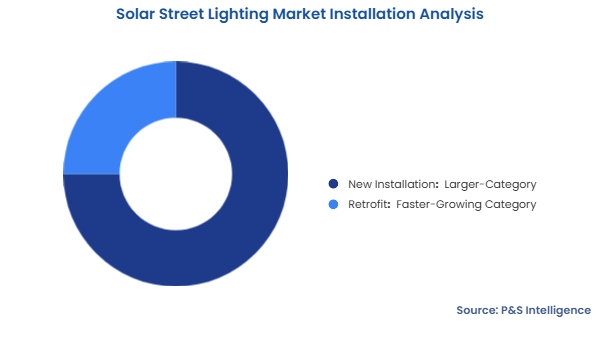
The new installation category holds the larger market share, of 75%, in 2025, driven by global infrastructure expansion, particularly across rapidly urbanizing Asia-Pacific, sub-Saharan Africa, and Latin America, where entire new communities, roads, and public spaces require solar street lighting infrastructure built from the ground up. According to the United Nations, around 55% of the global population lived in urban areas in 2023, and this share is projected to reach nearly 68% by 2050, driving large-scale infrastructure development including urban lighting systems. Smart city developments across China, India, the Gulf Cooperation Council states, and Southeast Asia are generating large-scale new installation procurement volumes as municipalities integrate solar street lighting into master-planned urban districts.
The retrofit category will have the higher CAGR, of 10.6%, driven by the large installed base of aging conventional street lighting infrastructure across North America, Europe, and East Asia that is approaching end-of-service-life and requires replacement. European Union energy efficiency policies encourage the phase-out of inefficient lighting technologies, creating significant retrofit opportunities across member states through the late 2020s. The EU’s updated Ecodesign Regulation and Restriction of Hazardous Substances (RoHS) Directive are phasing out inefficient fluorescent lighting technologies, accelerating the transition toward LED-based lighting solutions across public infrastructure.
The installation analyzed in this report are:
New Installation (Larger-Category)
Retrofit (Faster-Growing Category)
Application Analysis
The highway & roadway category holds the largest market share in 2025, driven by the extensive global road network and the critical need for continuous outdoor lighting to ensure traffic safety and regulatory compliance. Road networks represent the largest concentration of public outdoor lighting demand globally, with highways and arterial roads requiring consistent illumination over long distances. The scale of individual highway projects, often involving thousands of luminaires per corridor, concentrates revenues significantly in this segment relative to smaller-volume applications.
The parking lot category will have the highest CAGR, reflecting the rapid expansion of commercial real estate, logistics hubs, electric vehicle charging stations, and retail complexes in emerging markets where developers are mandating solar-powered infrastructure from inception. The convergence of solar street lighting with EV charging infrastructure in commercial parking facilities is creating a new high-value application sub-segment. According to the International Energy Agency (IEA), the global electric car fleet exceeded 40 million vehicles in 2023, driving rapid expansion of public charging infrastructure worldwide.
The applications analyzed in this report are:
Highway & Roadway (Largest Category)
Bridge
Airport Runway
Park & Playground
Manufacturing Site
Parking Lot (Fastest-Growing Category)
Others
Drive strategic growth with comprehensive market analysis
Solar Street Lighting Market Regional Market Performance
Asia-Pacific Solar Street Lighting Market Size
Asia-Pacific holds the largest market share, of 40%, in 2025, and it will have the highest CAGR, of 10.3%, driven by rapid urbanization, high solar irradiance across most geographies, large-scale government rural electrification programs, and robust domestic manufacturing ecosystems for PV modules and LED components concentrated in China and India. Japan, South Korea, and Australia contribute through smart city and commercial solar lighting programs, while Southeast Asian markets, including Vietnam and the Philippines are emerging as significant growth contributors through rural off-grid electrification projects.
According to IRENA reports, solar and wind energy together accounted for approximately 96.6% of all net renewable capacity additions in 2024, underscoring the dominant role of these technologies in global renewable expansion. In Asia-Pacific (excluding China), renewable energy capacity, including solar, is projected to almost double between 2025 and 2030, adding nearly 670 GW of new capacity, led by India and key Southeast Asian markets. This rapid expansion aligns with fast-growing electricity demand in the region, exceeding 7% in 2024 in Southeast Asia alone, further reinforcing solar deployment across urban and off-grid applications.
China Solar Street Lighting Market Size
China represents the largest national market within Asia-Pacific, supported by the world’s most extensive domestic solar manufacturing base and comprehensive government-led deployment programs. China’s 14th Five-Year Plan prioritizes renewable energy integration and clean energy expansion, supported by national programs that incentivize energy-efficient technologies such as LED lighting in infrastructure projects. Large-scale smart city projects across Tier 1 and Tier 2 cities have accelerated adoption of IoT-enabled solar street lighting systems with remote monitoring and adaptive control capabilities. Rural electrification programs in western and central China continue to deploy standalone solar street lights in off-grid communities at scale. According to the International Energy Agency, China is on track to exceed its national target of 1,200 GW of combined wind and solar capacity by 2030, highlighting the country’s dominant role in global renewable energy expansion.
India Solar Street Lighting Market Size
India represents the fastest-growing country market for solar street lighting globally, driven by national policy programs, rural electrification mandates, and rapid urban infrastructure development. The Ministry of New and Renewable Energy’s Atal Jyoti Yojana has deployed over 2.72 lakh (≈272,000) solar street lights across underserved states including Assam, Bihar, Jharkhand, Odisha, and Uttar Pradesh. The Smart Cities Mission, covering over 100 cities, incorporates solar street lighting as a core sustainable urban infrastructure component. Several state governments promote deployment of solar street lights in highways, public spaces, and municipal projects, supported by substantial central financial assistance under MNRE schemes.
The Ministry of New and Renewable Energy (MNRE) confirms that India's cumulative installed solar capacity reached 94.17 GW as of November 2024, with renewable energy tender activity exceeding 69 GW in FY 2023–24, establishing a robust national solar infrastructure pipeline.
The regions and countries of the market are as follows:
North America
U.S. (Larger and Faster-Growing Country Market)
Canada
Europe
Germany
U.K. (Largest Country Market)
France
Italy
Spain (Fastest-Growing Country Market)
Rest of Europe
Asia-Pacific (Largest and Fastest-Growing Regional Market)
China (Largest Country Market)
India (Fastest-Growing Country Market)
Japan
South Korea
Australia
Rest of APAC
Latin America
Brazil (Largest Country Market)
Mexico (Fastest-Growing Country Market)
Rest of LATAM
Middle East and Africa
Saudi Arabia (Largest Country Market)
South Africa
U.A.E. (Fastest-Growing Country Market)
Rest of MEA
Solar Street Lighting Market Share Analysis
The market is fragmented, with no single company commanding a dominant share of global revenues. This fragmentation stems from the market's inherently decentralized nature, as procurement is driven by thousands of independent municipal governments, national electrification agencies, and private developers across more than 100 countries, making it structurally resistant to consolidation by any single player. Low technology barriers at the assembly level, combined with widely available PV module and LED luminaire supply chains concentrated in China, have enabled a large number of regional and domestic manufacturers to compete effectively on price. Additionally, barriers to entry at the global level remain moderate, as the absence of significant network effects or proprietary technology platforms limits incumbent protection. However, established players maintain competitive advantages through type-approved product certifications, track records of large-scale deployment.
Solar Street Lighting Manufacturers:
Sunna Design SA
Leadsun Inc.
Sokoyo Solar Lighting Co. Ltd.
Solar Electric Power Company
Solar Lighting International Inc.
Clear Blue Technologies International Inc.
Fonroche Lighting
HeiSolar Co. Ltd.
Jiawei Renewable Energy Co. Ltd.
Halonix Technologies Pvt. Ltd.
Urja Global Ltd.
Signify N.V.
Greenshine New Energy
Dragons Breath Solar
Hangzhou ZGSM Technology Co. Ltd.
Solar Street Lighting Market Developments
In September 2025, Signify N.V. launched the SunStay Pro gen2 and SunStay Pro gen2 mini, next-generation connected solar street lighting systems designed for modular applications with integrated intelligence.
In June 2025, Sunna Design SA launched EverGen 3, the third generation of its high-power autonomous solar street lighting range, incorporating native Bluetooth connectivity, synchronized motion detection across adjacent poles, hybrid grid/off-grid switching, and a cloud-based remote monitoring platform via its Sunna Cloud service.
In April 2025, Signify N.V. partnered with Cornerstone, the United Kingdom's leading mobile infrastructure services company, to deploy BrightSites smart street lighting infrastructure embedding 4G and 5G small cell connectivity across three major UK cities, commencing with Oxford.
Frequently Asked Questions About This Report
What is the size of the solar street lighting market?+
The solar street lighting market was valued at USD 6.0 billion in 2025.
What is the CAGR of the solar street lighting market?+
The market is growing at a CAGR of 10.2% during the forecast period.
Which region dominates the solar street lighting market?+
Asia-Pacific dominates the solar street lighting market.
What are the key components of a solar street lighting system?+
The key components include a solar panel, battery, LED lamp, controller, and mounting structure, enabling autonomous off-grid lighting operation.
What is the market nature of the solar street lighting market?+
The solar street lighting market is fragmented.
Want a report tailored exactly to your business need?
Leading companies across industries trust us to deliver data-driven insights and innovative solutions for their most critical decisions. From data-driven strategies to actionable insights, we empower the decision-makers who shape industries and define the future. From Fortune 500 companies to innovative startups, we are proud to partner with organisations that drive progress in their industries.
Client Testimonials
Working with P&S Intelligence and their team was an absolute pleasure – their awareness of timelines and commitment to value greatly contributed to our project's success. Eagerly anticipating future collaborations.
McKinsey & Company
India
Unmatched Standards
Our insights into the minutest levels of the markets, including the latest trends and competitive landscape, give you all the answers you need to take your business to new heights
Complete Data Security
We take a cautious approach to protecting your personal and confidential information. Trust is the strongest bond that connects us and our clients, and trust we build by complying with all international and domestic data protection and privacy laws