This Report Provides In-Depth Analysis of the Sodium Sulphate Market Report Prepared by P&S Intelligence, Segmented by Type (Natural, Synthetic), Product Form (Anhydrous, Decahydrate), Purity Grade (<95%, 95%-99%, >99%), Application (Soaps & Detergents, Pulp & Paper, Textiles, Glass), and Geographical Outlook for the Period of 2021 to 2032
Explore the market potential with our data-driven report
Sodium Sulphate Market Overview
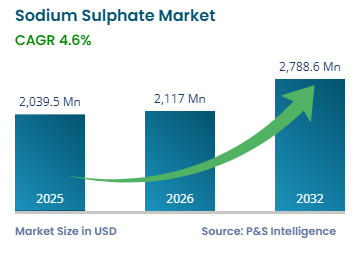
The sodium sulphate market size was USD 2,039.5 million for 2025, and it will grow by 4.6% during 2026–2032, to reach USD 2,788.6 million by 2032.
The market growth is primarily driven by the increasing demand for sodium sulphate across detergents, glass manufacturing, and textile processing industries, where it functions as a filler, fining agent, and dye-leveling compound. Its cost efficiency, chemical stability, and compatibility with high-volume industrial processes make it a critical input material, particularly in large-scale manufacturing environments across emerging economies.
The structural demand for sodium sulphate is reinforced by expanding industrial production and consumption patterns. According to the U.S. Geological Survey, sodium sulphate is produced from both natural deposits and chemical process byproducts, with China accounting for a dominant share due to its extensive natural reserves and chemical manufacturing capacity. The World Bank reports that the global urban population has surpassed 4.4 billion, indicating a growing concentration of consumers in urban areas where demand for cleaning products, packaged goods, and textiles is comparatively higher.
Key Market Insights
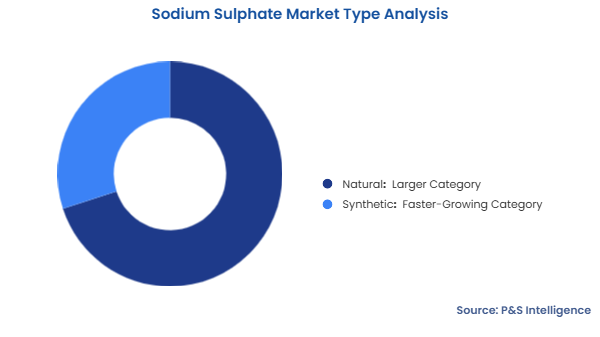
Natural holds the larger share, of 70% in 2025, due to abundant availability and lower production costs.
Synthetic will witness the faster growth, with a CAGR of approximately 4.8%, driven by purity control and industrial demand.
Anhydrous dominates with a share of 75%, supported by its widespread industrial applicability.
Soaps & detergents hold the largest application share, of 40% in 2025, driven by high-volume consumption.
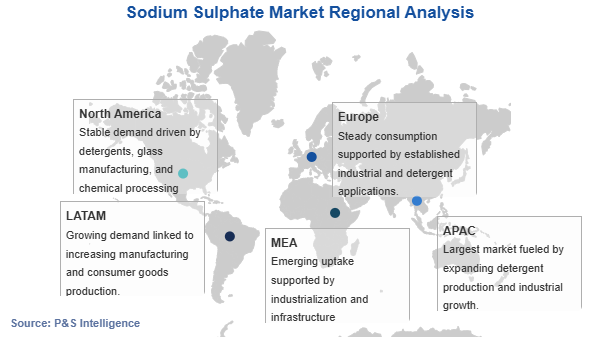
Asia-Pacific is both the largest and fastest-growing region, with a CAGR of approximately 5.5%, supported by industrial expansion and population growth.
Sodium Sulphate Market Trends and Drivers
Circular Economy and Byproduct Recovery Is Key Trend
A gradual shift is influencing how sodium sulphate is supplied across global markets. Traditionally, the compound has been sourced primarily from natural mineral deposits such as mirabilite and thenardite, particularly in countries including China, Canada, Spain, Mexico, and Turkey. An accelerating trend toward circular economy manufacturing is elevating the role of byproduct sodium sulphate, recovered as an industrial residue from processes such as viscose rayon production, hydrochloric acid synthesis, resorcinol manufacturing, and battery acid recycling. In May 2024, Grasim Industries Ltd. launched EcoSodium, a sodium sulphate grade sustainably recovered from viscose staple fiber production, positioned to supply the textile, glass, and detergent industries as a lower-carbon alternative to conventionally mined products. This trend is gaining regulatory and commercial attention in line with sustainability initiatives.
In particular, the European Union's Circular Economy Action Plan emphasizes waste minimization and resource efficiency across industrial value chains, encouraging recovery and reuse of industrial byproducts. Manufacturing industries face increasing pressure to valorize waste streams and reduce industrial effluent. Investment in byproduct recovery is expected to expand across Europe and Asia, contributing to a more diversified supply structure and reducing reliance on conventional natural extraction sources.
Rising Detergent Consumption and Urban Demand Patterns Are Biggest Drivers
The primary driver of the sodium sulphate market is the sustained increase in detergent consumption across both developed and emerging economies. Increasing hygiene awareness, population growth, and urbanization are accelerating the consumption of cleaning products globally, particularly in regions experiencing rapid economic development. According to the United Nations, the global population has exceeded 8 billion, while the urban population is projected to approach 5 billion by 2030, reflecting continued expansion of concentrated consumer bases. This demographic shift is supporting higher consumption of household cleaning products, particularly in urban environments where demand intensity is greater.
The rising demand is further reinforced by the expansion of commercial and institutional infrastructure, including hospitality, healthcare facilities, and public services, which require large-scale cleaning and sanitation solutions. According to the Ministry of Statistics and Programme Implementation, Private Final Consumption Expenditure (PFCE) is expected to grow by 7.6% in FY 2024–25, compared to 5.6% in FY 2023–24, reflecting strengthening household spending across essential consumer goods. Powdered detergents continue to dominate in cost-sensitive, high-volume markets across Asia-Pacific, Africa, and Latin America, where sodium sulphate is widely used as a filler material to optimize formulation costs and ensure product consistency. Although detergent manufacturers are introducing innovative laundry formats to address evolving consumer preferences, powdered detergents still account for the majority of consumption volumes, thereby sustaining strong demand for sodium sulphate across industrial supply chains.
Structural Shift toward Liquid Detergents Is Key Restraint
The progressive substitution of powdered detergents by liquid and gel-based formulations in developed markets represents a key structural restraint on long-term sodium sulphate demand growth. Sodium sulphate is primarily used as a filler and flow agent in powdered detergents, and its functionality is largely absent in liquid formulations. The increasing adoption of liquid detergents reduces demand for sodium sulphate within the detergent segment.
In North America and Western Europe, liquid detergents account for a significant share of household laundry consumption, reflecting changing consumer preferences toward convenience, product concentration, and ease of use. This shift is gradually extending to urban markets in Asia and Latin America, supported by rising disposable incomes and evolving retail distribution channels. While powdered detergents continue to dominate in cost-sensitive markets, the steady transition toward liquid formats is expected to moderate the growth trajectory of sodium sulphate demand over the long term, without fully offsetting overall market expansion driven by emerging economies.
Accelerating Solar PV Glass Manufacturing Is Biggest Opportunity
The global energy transition is creating a structurally new and rapidly expanding demand channel for sodium sulphate through the growth of solar photovoltaic (PV) glass manufacturing. Sodium sulphate functions as a key fining agent in the float glass process, helping remove entrapped gas bubbles from molten glass to achieve the optical clarity required for solar module cover glass. According to the International Energy Agency, the world is expected to add more than 5,500 GW of new renewable energy capacity between 2024 and 2030, with solar PV accounting for a dominant share of this growth. In addition, the IEA PVPS Snapshot 2025 highlights that global cumulative solar PV capacity has exceeded 2.2 terawatts, with more than 600 GW of new installations added in 2024 alone, reflecting the rapid expansion of solar deployment worldwide.
This expansion in solar energy is increasing demand for photovoltaic modules and associated materials, including flat glass used in panel manufacturing. The resulting increase in glass production is creating incremental demand for sodium sulphate used in glass processing. This opportunity is particularly prominent in Asia, where large-scale solar deployment and manufacturing capacity expansion continue to support demand for raw materials, with China leading global installations and India emerging as a key high-growth market.
Sodium Sulphate Market Segmentation Analysis
Type Analysis
The natural category holds the larger market share, of 70%, in 2025, driven by the compound’s long-standing reliance on mineral extraction from mirabilite and thenardite deposits, which provide cost advantages through direct extraction processes. Producers in China, Spain, Turkey, Canada, and Mexico supply large industrial customers at competitive costs. According to the U.S. Geological Survey, natural sodium sulphate is commercially recovered from large evaporite deposits and saline lakes, with countries such as China and the United States hosting considerable natural reserves and production capacity. This widespread availability supports its extensive use in high-volume applications such as detergents and pulp processing.
The synthetic category will have the higher CAGR, of approximately 4.8%, driven by the expanding industrial base of byproduct-generating manufacturing sectors, including viscose rayon, hydrochloric acid, and lithium carbonate production. According to the International Energy Agency, global electric car sales exceeded 14 million units in 2023, reflecting rapid expansion in battery manufacturing, which is driving increased production of lithium carbonate and associated chemical byproducts such as sodium sulphate.
The types analyzed in this report are:
Natural (Larger Category)
Synthetic (Faster-Growing Category)
Product Form Analysis
The anhydrous category holds the larger market share, of 75%, in 2025, and it will have the higher CAGR, driven by its widespread use as the standard industrial-grade form in detergents, glass, pulp, and textile applications. The moisture-free composition ensures better storage stability and consistent performance in large-scale industrial processes. Its compatibility with high-temperature and bulk manufacturing operations further supports both its current dominance and faster growth outlook. Anhydrous sodium sulphate exhibits a high melting point of approximately 884°C, enabling stable performance in high-temperature industrial processes such as glass manufacturing.
The product forms analyzed in this report are:
Anhydrous (Larger and Faster-Growing Category)
Decahydrate
Purity Grade Analysis
The 95%-99% category holds the largest market share, of 60%, in 2025, driven by its optimal balance between cost efficiency and functional performance across bulk applications such as detergents and glass manufacturing. This grade meets industrial requirements without requiring additional purification, making it the preferred choice for high-volume consumption.
The >99% category will have the highest CAGR, driven by increasing demand from pharmaceutical, specialty glass, and high-performance chemical applications that require stringent purity standards. Sodium sulphate used in pharmaceutical formulations must comply with pharmacopeial specifications established by the United States Pharmacopeia, ensuring controlled purity levels and regulatory compliance in critical applications.
The purity grades analyzed in this report are:
<95%
95%–99% (Largest Category)
>99% (Fastest-Growing Category)
Application Analysis
The soaps & detergents category holds the largest market share in 2025, due to high-volume consumption in powdered detergent manufacturing. Strong demand from large-scale detergent manufacturing hubs across Asia-Pacific, including China, India, Indonesia, and Vietnam, continues to sustain high-volume consumption, particularly in cost-sensitive markets where powdered detergents remain widely used.
The glass category will have the highest CAGR, of approximately 5.2%, driven by expanding demand from solar photovoltaic glass, construction-related flat glass, and automotive applications. Sodium sulphate is used as a refining agent in float glass production to improve clarity and remove impurities. According to the International Energy Agency, global solar PV capacity additions are recorded at 666 GW in 2024, reflecting rapid expansion in solar deployment. This growth in solar installations is supporting increased demand for photovoltaic glass, thereby contributing to rising consumption of sodium sulphate in the glass segment.
The applications analyzed in this report are:
Soaps & Detergents (Largest Category)
Pulp & Paper
Textiles
Glass (Fastest-Growing Category)
Others
Drive strategic growth with comprehensive market analysis
Sodium Sulphate Market Geographical Analysis
Asia-Pacific Sodium Sulphate Market Size
Asia-Pacific holds the largest market share, of 40%, in 2025, and it will have the highest CAGR, of approximately 5.5%. The region’s growth is supported by India’s expanding industrial base and the continued development of detergent, glass, and textile manufacturing across Southeast Asia. India is the fastest-growing market, supported by rising construction activity, expanding textile processing industries, and increasing consumption of household cleaning products. Government-led infrastructure and housing initiatives are further contributing to material demand across end-use industries. Under the Pradhan Mantri Awas Yojana Urban (PMAY-U), over 1.18 crore houses had been sanctioned as of September 2024, according to the Ministry of Housing and Urban Affairs. This large-scale housing development is supporting demand for construction materials such as flat glass, thereby indirectly contributing to sodium sulphate consumption.
In addition, countries such as Japan and Australia are contributing to regional demand through infrastructure and industrial investments. According to Japan’s Ministry of Finance, public works-related expenditures in the FY2026 draft budget totaled approximately JPY 6.1 trillion, supporting construction activity and associated demand for industrial materials. In Australia, the government’s Infrastructure Investment Program is expected to exceed AUD 120 billion over a 10-year period, driving large-scale construction activity and associated demand for industrial chemicals across the region.
China Sodium Sulphate Market Size
China represents the largest country market for sodium sulphate within Asia-Pacific, driven by extensive mirabilite deposits, well-established byproduct recovery from chemical production, and a large detergent and textile manufacturing sector, collectively underpinning strong domestic supply and consumption. China's powdered detergent manufacturing industry remains one of the largest globally, driving consistent demand for sodium sulphate as a filler and flow agent in formulations.
The glass segment is emerging as one of the fastest-growing applications in China, driven by expanding solar photovoltaic glass production and construction-related demand. According to the National Energy Administration of China, China added over 216 GW of new solar capacity in 2023, reinforcing demand for photovoltaic glass and associated raw materials. China also plays a key role as an export hub within Asia-Pacific, supplying sodium sulphate to Southeast Asia, the Middle East, and Africa. This export position influences regional supply dynamics and global pricing trends.
North America Sodium Sulphate Market Size
North America holds a considerable share of the sodium sulphate market, driven by stable demand from detergents, glass, and pulp & paper industries, supported by well-established manufacturing infrastructure across the region. The U.S. dominates regional consumption, driven by high usage of household cleaning products and industrial chemicals. The region is also benefiting from clean energy investments. The Inflation Reduction Act supports approximately USD 370 billion in climate and energy-related spending, accelerating domestic manufacturing and solar supply-chain expansion. This spending is supporting demand for glass and associated industrial chemicals used in photovoltaic applications.
Canada remains an important regional supplier due to its extensive natural sodium sulphate resources in Saskatchewan. Saskatchewan has five operating sodium sulphate facilities with an annual productive capacity of approximately 530,000 tonnes. This productive capacity positions the province as one of the leading natural sodium sulphate production hubs in North America. Rising construction activity and regulatory focus on sustainable manufacturing continue to support sodium sulphate demand across the North American market.
The regions and countries analysed in this report are:
North America
U.S. (Larger and Faster-Growing Country)
Canada
Europe
Germany (Largest Country)
U.K.
France (Fastest-Growing Country)
Italy
Spain
Rest of Europe
Asia-Pacific (Largest and Fastest-Growing Regional Market)
China (Largest Country)
India (Fastest-Growing Country)
Japan
South Korea
Australia
Rest of APAC
Latin America
Brazil (Largest Country)
Mexico (Fastest-Growing Country)
Rest of LATAM
Middle East and Africa
Saudi Arabia (Largest Country)
South Africa
U.A.E. (Fastest-Growing Country)
Rest of MEA
Sodium Sulphate Market Competitive Landscape
The market is fragmented due to its commodity nature and geographically dispersed production base. The product exhibits limited differentiation. Competition is primarily based on cost, availability, and logistics. Key companies such as Nafine Chemical Industry Group Co., Ltd., Alkim Alkali Kimya A.Ş., and Saskatchewan Mining and Minerals Inc. operate across regional markets. No dominant global player commands the supply landscape. Natural reserves are geographically distributed, encouraging localized production and regional supply chains due to high transportation costs. Numerous mid-scale producers operate across different geographies, reflecting this distributed and regionally driven market structure.
Key Players in the Sodium Sulphate Market:
China Nafine Group International Co., Ltd.
Grupo Industrial Crimidesa SL
Alkim Alkali Kimya AS
Searles Valley Minerals Inc.
Saskatchewan Mining and Minerals Inc.
Cooper Natural Resources Inc.
Elementis Plc
Minera de Santa Marta, S.A.
Nippon Chemical Industrial Co., Ltd.
Borden & Remington Corp.
Cinis Fertilizer AB
Jiangsu Yinzhu Chemical Group Co., Ltd.
Sodium Sulphate Market News
In February 2026, Saskatchewan Mining and Minerals Inc. acquired Compass Minerals Wynyard Inc., an operating sulphate of potash (SOP) production facility in Saskatchewan, expanding its sulphate-based production portfolio.
In April 2025, Camber Pharmaceuticals launched a Sodium Sulfate, Potassium Sulfate, and Magnesium Sulfate Oral Solution for adult colonoscopy preparation. The formulation acts as an osmotic laxative and is supplied in a split-dose regimen to improve bowel cleansing effectiveness prior to diagnostic procedures. Camber Pharmaceuticals announced the product as part of its expanding generic portfolio in gastrointestinal care.
In December 2024, Cinis Fertilizer AB announced a USD 109.2 million fertilizer plant in Kentucky, supported by a long-term agreement with Ascend Elements to recycle up to 240,000 tonnes per year of sodium sulphate waste from battery manufacturing into potassium sulphate, reinforcing its use in circular economy and EV supply chains.
Frequently Asked Questions About This Report
How is sodium sulphate produced commercially?+
Sodium sulphate is produced either through natural extraction from mineral deposits such as mirabilite or as a by-product of chemical manufacturing processes including hydrochloric acid and viscose fiber production.
What industries primarily drive demand for sodium sulphate?+
Demand is mainly driven by detergents, glass manufacturing, textiles, and pulp and paper industries, where sodium sulphate is used as a processing aid, filler, or fining agent.
How does the growth of the glass industry impact sodium sulphate consumption?+
Increased glass production, especially in construction and automotive sectors, raises the demand for sodium sulphate as it is used to improve glass clarity and remove impurities during manufacturing.
What environmental considerations are associated with sodium sulphate production?+
Key concerns include water usage, energy consumption, and waste management during mining or chemical processing, prompting companies to adopt more sustainable and energy-efficient production methods.
How does sodium sulphate improve efficiency in textile processing?+
Sodium sulphate is used in dyeing processes to enhance dye absorption and uniformity on fabrics, resulting in better color consistency and reduced chemical wastage.
Want a report tailored exactly to your business need?
Leading companies across industries trust us to deliver data-driven insights and innovative solutions for their most critical decisions. From data-driven strategies to actionable insights, we empower the decision-makers who shape industries and define the future. From Fortune 500 companies to innovative startups, we are proud to partner with organisations that drive progress in their industries.
Client Testimonials
Working with P&S Intelligence and their team was an absolute pleasure – their awareness of timelines and commitment to value greatly contributed to our project's success. Eagerly anticipating future collaborations.
McKinsey & Company
India
Unmatched Standards
Our insights into the minutest levels of the markets, including the latest trends and competitive landscape, give you all the answers you need to take your business to new heights
Complete Data Security
We take a cautious approach to protecting your personal and confidential information. Trust is the strongest bond that connects us and our clients, and trust we build by complying with all international and domestic data protection and privacy laws