Silicon on Insulator Market Size Estimation
Key Highlights
| Study Period | 2021 - 2032 |
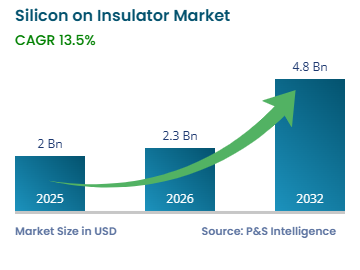
| Market Size in 2025 | USD 2.0 Billion |
| Market Size in 2026 | USD 2.3 Billion |
| Market Size by 2032 | USD 4.8 Billion |
| Projected CAGR | 13.5% |
| Largest Region | Asia-Pacific |
| Fastest-Growing Region | Asia-Pacific |
| Market Structure | Semi-Consolidated |
Market Size
Explore the market potential with our data-driven report
Silicon on Insulator Market Key Insights
- The 200 mm category holds the largest market share, of 60%, in 2025, supported by cost-efficient RF-SOI and MEMS production on mature fabrication infrastructure.
- The RF-SOI category holds the largest market share, of 35%, in 2025, driven by its critical role in the global smartphone supply chain.
- The smart cut category holds the largest market share, of 65%, in 2025, and it will have the highest CAGR, of 13.7%, driven by its critical role in enabling high-performance SOI wafer production.
- The RF FEM category holds the largest market share, of 40%, in 2025, driven by its key role in multi-band signal processing for advanced wireless devices.
- Asia-Pacific holds the largest market share, of 40%, in 2025, and it will have the highest CAGR, of 13.8%, driven by strong semiconductor ecosystems across China, Japan, South Korea, and Taiwan.
Silicon on Insulator Market Overview
The silicon on insulator market size was USD 2.0 billion for 2025, and it will grow by 13.5% during 2026–2032, to reach USD 4.8 billion by 2032.
The market growth is driven by the accelerating deployment of fully depleted and radio-frequency SOI architectures across 5G wireless infrastructure and automotive electronics. High-performance computing applications are extending adoption further, establishing SOI wafer technology as a foundational enabler of next-generation semiconductor design.
Silicon on insulator technology improves upon conventional bulk silicon fabrication by placing a thin active silicon layer atop a buried oxide. RF front-end modules in smartphones and radar systems in electric vehicles are among the applications where this performance profile is most commercially consequential.
According to the International Telecommunication Union, approximately 67% of the global population, or about 5.4 billion people, were using the internet in 2023. This scale of digital connectivity underpins demand for advanced semiconductor technologies, including RF-SOI, with mobile network infrastructure densification acting as a primary channel through which this demand reaches the wafer supply chain.
Silicon on Insulator Market Dynamics
Silicon Photonics and FD-SOI Convergence Is Key Trend
The silicon on insulator market is undergoing a structural technology transition as two historically distinct SOI application domains, silicon photonics and fully depleted CMOS logic, converge on shared substrate platforms. Data centers requiring 400G and 800G optical interconnects are adopting SOI-based photonic integrated circuits that exploit the high refractive index contrast between crystalline silicon and buried oxide to confine light with minimal loss, enabling the co-integration of optical modulators, photodetectors, and electronic switching logic on a single SOI wafer.
Fabless chip designers specifying FD-SOI for advanced low-power logic nodes are leveraging the buried oxide architecture to reduce leakage current and improve energy efficiency in transistor performance. This architectural alignment is expanding the application scope of SOI substrates beyond traditional RF and power domains into artificial intelligence accelerator interconnects and co-packaged optics for hyperscale infrastructure. According to Intel, its silicon photonics technology is already deployed in high-volume data center interconnect solutions supporting 400G optical transceivers. This deployment demonstrates the commercial scalability of SOI-based photonic integration.
Accelerating Electric Vehicle and 5G Network Deployment Are Biggest Drivers
Two independent but intensifying demand forces are propelling the silicon on insulator market from a niche substrate category into a high-volume semiconductor material. The global electrification of passenger vehicles is driving adoption of Power-SOI wafers, which support higher breakdown voltages and superior thermal dissipation compared to bulk silicon, making them essential for inverter control units, onboard chargers, and ADAS radar systems. According to the International Energy Agency, electric car sales exceeded 17 million units in 2024, representing over 20% of global new car sales.
In parallel, global 5G network expansion is sustaining elevated demand for RF-SOI wafers, which deliver the linearity and isolation characteristics required by front-end modules handling multiple simultaneous frequency bands in 5G handsets and base stations. The CHIPS and Science Act allocates approximately USD 52 billion in federal funding to strengthen domestic semiconductor manufacturing and advanced technology development, which also supports infrastructure relevant to SOI-based applications.
Defense and Aerospace Radiation-Hardening Requirements Are Biggest Opportunities
A structurally distinct growth pathway exists within the defense and aerospace sector, where SOI technology's inherent radiation tolerance provides performance advantages unavailable through bulk silicon alternatives. Transistors fabricated on SOI substrates experience reduced single-event upset rates when exposed to ionizing radiation, as the buried oxide layer prevents charge generated by cosmic ray strikes from migrating across device junctions. This is a critical reliability requirement for satellite electronics, missile guidance systems, and avionics.
Government-mandated domestic sourcing provisions embedded in defense appropriations frameworks across North America and Europe are compelling military contractors to qualify SOI supply chains that originate within allied-nation borders. This creates a parallel government-addressable market segment that operates largely independently of commercial pricing pressures and demand cycles. According to NASA, its total budget was approximately USD 24.875 billion in FY2024. A portion of this funding supports space exploration, satellite systems, and missions that require radiation-hardened electronics for operation in high-radiation environments.
The European Space Agency has ongoing programs supporting radiation-hardened semiconductor development for space missions, including the European Component Initiative (ECI) and activities under the Advanced Research in Telecommunications Systems (ARTES) program. Both programs focus on developing radiation-tolerant electronic components for space applications. This reinforces demand for SOI-based technologies in aerospace applications.
High Manufacturing Cost Premium and Design Transition Complexity Are Biggest Restraints
SOI technology adoption faces a structural constraint due to its elevated substrate costs compared to conventional bulk silicon wafers. The specialized fabrication processes required to produce SOI substrates, including the Smart Cut ion implantation and controlled exfoliation process used for FD-SOI and RF-SOI wafers, require precision equipment and stringent process control, resulting in a price premium over bulk silicon. This cost differential limits SOI penetration in high-volume consumer applications where cost sensitivity is high.
Transitioning from bulk CMOS to SOI process nodes requires modifications in device models, layout design rules, and electrostatic discharge protection strategies to account for SOI-specific characteristics such as floating body effects. This increases design complexity and slows adoption in cost-sensitive segments such as commodity IoT devices and entry-level consumer electronics. According to the U.S. Department of Commerce, semiconductor fabrication facility costs can exceed USD 10 billion due to advanced process requirements, reflecting the high capital intensity associated with technologies such as SOI.
Silicon on Insulator Market Segmentation Analysis
Wafer Size Analysis
The 200 mm category holds the largest market share, of 60%, in 2025, driven by the continued cost-effective operation of RF-SOI and MEMS applications on established 200 mm fabrication infrastructure. A substantial portion of RF front-end module production for smartphones and base stations relies on fully depreciated 200 mm SOI fabs, enabling competitive unit economics. The long qualification cycles required by automotive and defense customers for existing 200 mm SOI process nodes further reinforce demand continuity. Device redesigns for larger wafer diameters require extensive requalification investment.
The 300 mm category will have the highest CAGR, of 13.6%, driven by foundry-level migration toward larger diameter substrates to reduce die cost per unit for high-density logic, advanced RF, and automotive SoC applications. The transition to 300 mm wafer production is being supported by new capacity additions, including GlobalWafers Co., Ltd.'s USD 3.5 billion Sherman, Texas facility, which produces advanced silicon wafers including epitaxial and specialty substrates. The National Institute of Standards and Technology is supporting this expansion under the CHIPS program.
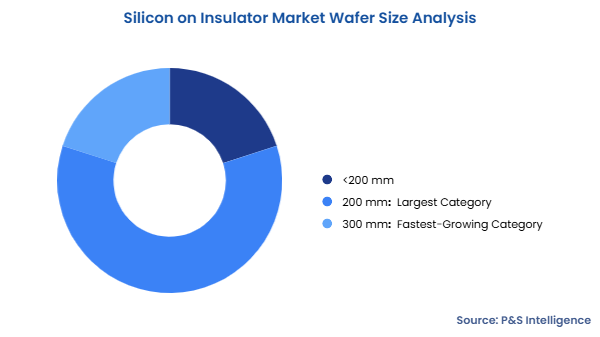
The wafer sizes analyzed in this report are:
- <200 mm
- 200 mm (Largest Category)
- 300 mm (Fastest-Growing Category)
Wafer Type Analysis
The RF-SOI category holds the largest market share, of 35%, in 2025, driven by its critical role in the global smartphone supply chain. Front-end modules built on RF-SOI manage transmit, receive, and switching functions across multiple frequency bands required by 5G devices, with the high-resistivity buried oxide suppressing substrate loss and cross-talk between closely packed RF components. Switches and low-noise amplifiers can be integrated onto a single die. This reduces module complexity and footprint in compact device architectures.
The FD-SOI category will have the highest CAGR, driven by demand for ultra-low power consumption in battery-operated and connected devices. FD-SOI addresses the energy efficiency and performance requirements that conventional bulk CMOS cannot meet at advanced nodes, with back-bias tunability enabling dynamic voltage and frequency optimization at the transistor level. The architecture is well-suited for wearable and connected device applications. Leading foundry platforms such as GlobalFoundries' 22FDX technology operate at lower power consumption compared to traditional bulk CMOS nodes. This supports energy-efficient designs in IoT and mobile applications.
The wafer types analyzed in this report are:
- Radio-Frequency Silicon on Insulator (RF-SOI) (Largest Category)
- Fully Depleted Silicon on Insulator (FD-SOI) (Fastest-Growing Category)
- Partially Depleted Silicon on Insulator (PD-SOI)
- Power-Silicon on Insulator
- Photonics-Silicon on Insulator
- Imager-Silicon on Insulator
Technology Analysis
The smart cut category holds the largest market share, of 65%, in 2025, and it will have the highest CAGR, of 13.7%, driven by its critical role in enabling high-performance SOI wafer production. Smart Cut, developed and commercialized by Soitec S.A., achieves controlled exfoliation of a precisely defined silicon layer through ion implantation followed by hydrogen-induced cleaving, producing wafer-thin silicon films with high thickness uniformity across large wafer diameters.
The technologies analyzed in this report are:
- Smart Cut (Largest and Fastest-Growing Category)
- Bonding
- Layer Transfer
Product Analysis
The RF FEM category holds the largest market share, of 40%, in 2025, driven by its critical role in enabling signal conditioning for multi-band communication in advanced wireless devices. RF FEMs integrate switches and low-noise amplifiers on SOI-based platforms, delivering the signal conditioning performance required by multi-band 5G smartphones, Wi-Fi 6E/7 access points, and vehicle-to-everything communication modules.
The MEMS category will have the highest CAGR, driven by demand for high-precision sensing technologies across automotive, industrial, and healthcare applications. MEMS devices fabricated on SOI wafers benefit from the buried oxide layer as both a precise etch-stop and an acoustic isolation layer. This enables pressure sensors, accelerometers, gyroscopes, and ultrasonic transducers with high dimensional accuracy and sensitivity. Growing ADAS integration in vehicles is contributing to increasing utilization of SOI-based MEMS technologies. Industrial IoT deployments and rising adoption of biomedical devices are adding to this demand. Modern vehicles can incorporate over 100 sensors per vehicle, many of which are MEMS-based. These sensors support functions such as safety, navigation, and automation.
The products analyzed in this report are:
- Radio-Frequency Front-End Module (RF FEM) (Largest Category)
- Optical Communication
- Microelectromechanical Systems (MEMS) (Fastest-Growing Category)
- Image Sensing
- Others
Application Analysis
The consumer electronics category holds the largest market share, in 2025, driven by large-scale production of smartphones, tablets, smartwatches, and wearable devices sustaining SOI wafer demand. SOI wafers are widely used in smartphones through RF front-end modules that manage cellular and Wi-Fi connectivity. Their low-power characteristics support always-on sensing functions in wearable devices requiring extended battery life. High consumer device shipment volumes and increasing RF complexity associated with multi-band communication technologies reinforce the segment's prominence.
The automotive category will have the highest CAGR, of 13.9%, driven by the transition toward electric and software-defined vehicles. Semiconductor content per vehicle is increasing across power management systems, ADAS radar, battery management, and vehicle-to-everything communication modules. SOI technology offers high-voltage capability and thermal stability across these systems. The material also maintains reliable operation across wide temperature ranges. The European Chips Act aims to mobilize over EUR 43 billion in public and private investments to strengthen semiconductor manufacturing and innovation across Europe, including automotive semiconductor supply chains. This supports increased demand for advanced materials such as SOI.
The applications analyzed in this report are:
- Consumer Electronics (Largest Category)
- Automotive (Fastest-Growing Category)
- Communication
- Entertainment & Gaming
- Others
Drive strategic growth with comprehensive market analysis
Silicon on Insulator Market Geographical Analysis
Asia-Pacific Silicon-on-Insulator Market Size
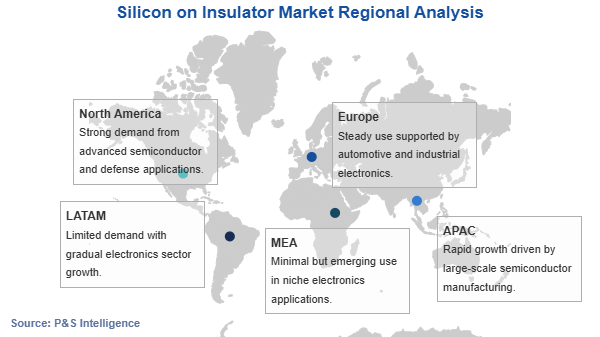
Asia-Pacific holds the largest market share, of 40%, in 2025, and it will have the highest CAGR, of 13.8%, driven by the presence of integrated device manufacturers and foundries operating alongside fabless design houses across China, Japan, South Korea, and Taiwan.
This proximity creates a vertically integrated ecosystem that accelerates SOI adoption from substrate fabrication through end-product assembly. The region's telecommunications sector continues to expand 5G infrastructure at an unmatched pace. RF-SOI front-end module demand tracks directly with this infrastructure buildout rate.
Rapid electrification of passenger vehicles across China and emerging Southeast Asian markets is intensifying consumption of power-management and ADAS-related SOI devices. Government-backed semiconductor investment programs across multiple APAC economies reinforce manufacturing capacity and R&D capability, such as South Korea’s K-Semiconductor Belt strategy which includes tax incentives and aims to mobilize over USD 450 billion in private-sector investment by 2030 and China’s National Integrated Circuit Industry Investment Fund (Big Fund) to strengthen domestic chip production. The International Energy Agency reports that China's electric car sales exceeded 11 million in 2024. This figure surpassed the entire global total recorded just two years prior. Automotive SOI demand is concentrated in this region at a scale with no global equivalent.
India Silicon-on-Insulator Market Size
India is the fastest-growing country in the Asia-Pacific market, driven by the India Semiconductor Mission, which acts as the structural catalyst behind this acceleration, and includes an outlay of approximately INR 76,000 crore (≈ USD 9–10 billion) to support semiconductor fabrication, packaging, and design infrastructure. Financial incentives under the Mission are attracting wafer fabrication and ATMP investment into the country, while chip design operations are establishing alongside manufacturing capacity as the ecosystem matures. Smartphone penetration is expanding rapidly in parallel with 5G rollout, widening the demand base for SOI-based components. The nascent domestic EV industry adds a further consumption vector as vehicle electrification accelerates.
India's large and cost-competitive engineering talent pool is enabling a vibrant fabless chip design ecosystem, with these design houses specifying SOI processes for power-sensitive IoT and mobile applications. The government's Production Linked Incentive Scheme for electronics manufacturing is accelerating integration of SOI chips into domestically assembled devices. Import dependence is compressing as domestic assembly capacity scales. According to the International Energy Agency, electric car sales in India reached around 100,000 units in 2024, accounting for about 2% of total car sales. Adoption of electric mobility in the country remains gradual but is on a consistent upward trajectory.
North America Silicon-on-Insulator Market Size
The region's position is anchored by its concentration of leading fabless semiconductor companies. A mature foundry base is undergoing capacity expansion under the CHIPS and Science Act. Superior radiation tolerance compared to bulk silicon creates a stable procurement floor that supports premium pricing and sustained R&D investment. Cloud infrastructure growth is generating additional demand for silicon photonics and high-speed interconnects built on SOI platforms.
CHIPS Act funding is enabling domestic SOI wafer capacity additions that reduce lead-time risk, with the Semiconductor Industry Association reporting that companies have announced more than 140 semiconductor projects across the United States totaling over USD 640 billion in investments since 2020. A portion of this supports SOI-compatible fabrication infrastructure.
The regions and countries studied are as follows:
- North America
- U.S. (Larger Country)
- Canada (Faster-Growing Country)
- Europe
- Germany (Largest Country)
- U.K. (Fastest-Growing Country)
- France
- Italy
- Spain
- Rest of Europe
- Asia-Pacific (Largest and Fastest-Growing Regional Market)
- China (Largest Country)
- India (Fastest-Growing Country)
- Japan
- South Korea
- Australia
- Rest of APAC
- Latin America
- Brazil (Largest Country)
- Mexico (Fastest-Growing Country)
- Rest of LATAM
- Middle East and Africa
- Saudi Arabia (Largest Country)
- South Africa
- U.A.E. (Fastest-Growing Country)
- Rest of MEA
Silicon on Insulator Market Share Analysis
The market is semi-consolidated, with a limited number of major manufacturers controlling the majority of global supply, supported by high technological complexity and capital-intensive production processes. Strong entry barriers, including specialized fabrication techniques and intellectual property requirements, restrict new entrants. However, the market is not fully consolidated, as it serves diverse application segments including RF, FD-SOI, and photonics across multiple end-use industries. The presence of various foundries, design firms, and application-specific demand drivers contributes to a broader competitive environment. This sustains moderate competition despite supplier concentration.
Key Players in the Silicon on Insulator Market:
- Soitec S.A.
- Shin-Etsu Chemical Co., Ltd.
- SUMCO Corporation
- GlobalWafers Co., Ltd.
- Shanghai Simgui Technology Co., Ltd.
- GlobalFoundries Inc.
- STMicroelectronics N.V.
- Tower Semiconductor Ltd.
- NXP Semiconductors N.V.
- Infineon Technologies AG
- Skyworks Solutions, Inc.
- Qorvo, Inc.
Silicon on Insulator Market News
- In March 2026, Soitec S.A. secured a multi-year agreement to supply Piezoelectric-on-Insulator (POI) wafers to Skyworks Solutions, Inc. for its Sky5 platform used in 5G smartphone RF front-end modules.
- In October 2025, GlobalWafers Co., Ltd. opened a EURO 450 million 300 mm semiconductor wafer plant in Novara, Italy. The facility received EURO 103 million in IPCEI funding. This strengthens Europe's semiconductor supply chain.
- In May 2025, GlobalWafers Co., Ltd. inaugurated a USD 3.5 billion 300 mm wafer facility in Sherman, Texas, and announced a USD 4 billion expansion. Total U.S. investment reached USD 7.5 billion.
- In December 2024, Soitec S.A. collaborated with GlobalFoundries Inc. to supply 300 mm RF-SOI substrates for RF platforms supporting 5G and Wi-Fi applications.
- In September 2024, Tower Semiconductor Ltd., in partnership with Broadcom Inc., began production of Wi-Fi 7 RF front-end module devices using 300 mm RF-SOI technology. This enables highly integrated single-die solutions.