Saudi Arabia Blockchain Technology Market Size & Opportunities Analysis - Growth Strategies, Competitiveness, and Forecasts (2026 - 2032)
This Report Provides In-Depth Analysis of the Saudi Arabia Blockchain Technology Market Report Prepared by P&S Intelligence, Segmented by Component (Applications & Solutions, Infrastructure & Protocols, Middleware), Deployment Mode (Public Cloud, Private Cloud, Hybrid Cloud), Application (Digital Identity, Exchanges, Payments, Smart Contracts, Supply Chain Management), Industry (BFSI, Government & Public Services, Energy & Utilities, Manufacturing, Healthcare & Life Sciences, IT & Telecommunications, Media & Entertainment, Travel & Hospitality, Retail & Consumer Goods), Enterprise Size (Large Enterprises, Small and Medium Enterprises), and Geographical Outlook for the Period of 2019 to 2032
Saudi Arabia Blockchain Technology Market Growth Potential
Key Highlights
Study Period
2019 - 2032
Market Size in 2025
USD 11.2 Billion
Market Size in 2026
USD 21.2 Billion
Market Size by 2032
USD 996.4 Billion
Projected CAGR
89.9%
Largest Province
Al-Riyadh
Fastest-Growing Region Province
Eastern Province
Market Structure
Fragmented
Market Size
Explore the market potential with our data-driven report
Saudi Arabia Blockchain Technology Market Outlook
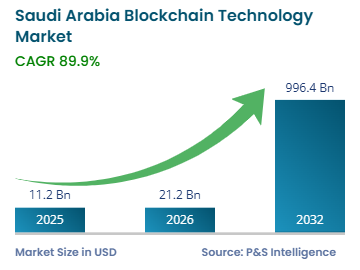
The Saudi Arabia blockchain technology market value is estimated at USD 11.2 billion in 2025, which is projected to progress at a CAGR of 89.9% during 2026–2032, reaching USD 996.4 billion by 2032. The market growth is driven by strong government backing through Vision 2030, rising digital transformation across industries, and increasing adoption of blockchain solutions in banking, government services, and supply chain management.
Saudi Arabia recorded a 51% year-on-year increase in business registrations for blockchain technologies by the end of the second quarter of 2025, with the number of active blockchain business records rising to 4,005, reflecting surging entrepreneurial interest in this transformative technology. The government's strategic focus on becoming a regional blockchain leader is evident through multiple partnerships and pilot programs across public and private sectors. The Saudi Arabian Monetary Authority deployed blockchain technology in June 2020 to deposit a part of the SR50 billion liquidity package into the banking sector, marking a significant milestone in institutional blockchain adoption.
Vision 2030 serves as the primary catalyst for blockchain expansion in Saudi Arabia. The government has digitised over 97% of the government services under the National Transformation Program, creating an ideal environment for blockchain integration across municipal services, identity management, and cross-border payments. The kingdom's commitment to building smart cities like NEOM and implementing advanced digital infrastructure positions blockchain as a foundational technology for achieving economic diversification and reducing oil dependency. The technology's ability to enhance transparency, automate government processes, and secure data aligns perfectly with the nation's broader digital governance objectives.
Saudi Arabia Blockchain Technology Market Emerging Trends
Financial Services Modernization Is Accelerating Blockchain Implementation
The financial services sector is experiencing rapid blockchain adoption driven by the need for secure, efficient, and transparent transactions.
The number of fintech companies in Saudi Arabia reached 224 by the end of Q2 2024, surpassing the Financial Sector Development Program's target of 168 companies.
This fintech boom creates substantial demand for blockchain infrastructure to support digital payments, cross-border transactions, and decentralized finance applications.
The Saudi Arabian Monetary Authority has been at the forefront of blockchain experimentation.
Saudi Arabia has joined the Bank for International Settlements' mBridge Project in 2024, which focuses on the development of a multi-CBDC system.
This is aimed at enhancing cross-border payments between commercial banks across different jurisdictions.
This participation signals a strategic shift towards digital currencies and demonstrates how blockchain technology is being explored to revolutionize monetary systems and international financial transactions.
Traditional banks are also embracing blockchain to enhance their operations, paving the way for broader blockchain integration across banking operations, from settlements to regulatory compliance.
The technology's ability to reduce transaction times, lower costs, and increase security makes it particularly attractive to financial institutions seeking competitive advantages in a rapidly digitalizing economy.
Strong Government Support through Vision 2030 Offers Opportunities
The Saudi government's unwavering commitment to blockchain technology through Vision 2030 stands as the most significant driver for market expansion.
The initiative prioritizes digital transformation to diversify the economy and improve efficiency across government and private sectors.
The Digital Government Strategy aims to position Saudi Arabia among the top 3 countries globally in digital government maturity by 2030, with an estimated SAR 11.4 billion contribution to GDP and the creation of more than 26,000 new jobs.
This governmental support manifests through concrete partnerships and implementations.
Riyadh Municipality has partnered with IBM and Elm Company to develop an implementation strategy for integrating blockchain technology into government services and transactions, demonstrating the practical application of blockchain at the municipal level.
The partnership aims to transform how services are provided to citizens, residents, businesses, and visitors, directly supporting Vision 2030's transformational objectives.
The regulatory framework has evolved to encourage blockchain adoption while maintaining security and compliance.
Digital transactions are expected to constitute 70% of all financial transactions by 2025, reflecting a significant shift towards a cashless economy.
The government has established clear guidelines for blockchain adoption through the Digital Government Authority, providing businesses with the confidence needed to invest in blockchain solutions.
This supportive regulatory environment extends across multiple agencies, from the Saudi Arabian Monetary Authority to the Ministry of Commerce, creating a coordinated approach to blockchain integration.
Saudi Arabia Blockchain Technology Market Segmentation Analysis
Component Insights
The applications & solutions category holds the largest share in 2025, of 45%, driven by the increasing deployment of ready-to-use blockchain applications across finance, logistics, government services, and healthcare. This dominance reflects the market's transition from experimental blockchain pilots to practical, production-ready applications that deliver immediate business value. Organizations are prioritizing blockchain solutions that address specific pain points such as supply chain traceability, secure payments, and digital identity management, leading to accelerated adoption of packaged blockchain applications.
Infrastructure & protocols will witness the highest CAGR during 2026–2032, fuelled by the massive investments in smart city projects and digital transformation initiatives. The development of NEOM and other smart cities requires robust blockchain infrastructure to support millions of IoT devices, secure data exchanges, and automated governance systems. As organizations move beyond initial application deployments to building comprehensive blockchain ecosystems, demand for scalable infrastructure and interoperable protocols intensifies. The growing need for private and hybrid blockchain networks that can handle enterprise-scale transactions while maintaining security and compliance standards drives infrastructure category growth.
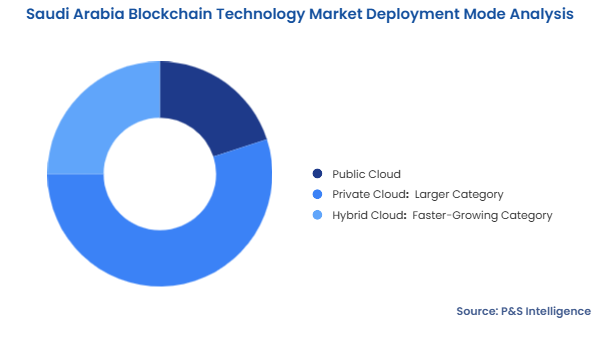
Private cloud holds the largest share in 2025, of 55%, as organizations prioritize data security and regulatory compliance. Saudi enterprises, particularly in banking and government sectors, prefer private cloud deployments to maintain complete control over sensitive data while leveraging blockchain's distributed ledger benefits. The kingdom's data protection regulations and the need for customized blockchain solutions aligned with specific business requirements reinforce private cloud preference. Financial institutions and government agencies deploy private blockchain networks to ensure transaction privacy while achieving the transparency and immutability benefits of blockchain technology.
Hybrid cloud is projected to register the highest CAGR of 90.2% during the forecast period, driven by the search of organizations for the combined benefits of public and private blockchain features. Hybrid deployments allow businesses to keep sensitive data on private networks while leveraging public blockchain capabilities for specific use cases like supply chain transparency and cross-organizational collaboration. The flexibility to adjust deployment models based on workload requirements and regulatory considerations makes hybrid cloud increasingly attractive. As Saudi enterprises mature in their blockchain journey, they recognize the strategic value of hybrid architectures that balance security, scalability, and cost-efficiency.
These deployment modes are covered:
Public Cloud
Private Cloud (Larger Category)
Hybrid Cloud (Faster-Growing Category)
Enterprise Size Analysis
Large enterprises accounted for the larger market share in 2025, of 70%, due to their greater financial resources, technical capabilities, and strategic focus on digital transformation. Major corporations in oil and gas, banking, and telecommunications sectors are implementing enterprise-scale blockchain solutions for supply chain optimization, cross-border payments, and data security. These organizations possess dedicated IT teams and budgets to develop custom blockchain applications that integrate with existing enterprise systems. Large enterprises also benefit from government blockchain initiatives through public–private partnerships that accelerate technology deployment.
Small and medium enterprises will register faster growth during the forecast period, supported by increasing availability of affordable blockchain-as-a-service platforms and government programs to promote SME digital adoption. Cloud-based blockchain solutions reduce entry barriers for smaller companies by eliminating the need for expensive infrastructure investments. SMEs are adopting blockchain for specific use cases like inventory management, customer loyalty programs, and secure document sharing, where the technology delivers tangible benefits without requiring extensive technical expertise. The growing ecosystem of blockchain service providers in Saudi Arabia makes the technology more accessible to resource-constrained smaller businesses.
These enterprise sizes are covered:
Large Enterprises (Larger Category)
Small and Medium Enterprises (Faster-Growing Category)
Application Insights
Payments dominate the market in 2025 with 35% share, supported by the kingdom's aggressive push towards a cashless economy and digital payment adoption. Blockchain-based payment solutions offer faster settlement times, reduced transaction costs, and enhanced security compared to traditional payment systems. The surge in digital wallets, mobile payments, and contactless transactions creates substantial demand for blockchain infrastructure that can handle high-volume, low-latency payment processing. Financial institutions and fintech companies are deploying blockchain to enable instant cross-border remittances and streamline payment reconciliation processes.
Smart contracts will experience the fastest growth during 2026–2032, propelled by government initiatives to automate bureaucratic processes and the private sector's desire to reduce manual intervention in contractual agreements. The Ministry of Justice is testing smart contracts for real estate transactions, demonstrating government commitment to blockchain automation. Smart contracts eliminate intermediaries, reduce transaction times, and minimize disputes through self-executing agreements based on predefined conditions. The technology finds applications across insurance claims processing, supply chain milestone payments, and regulatory compliance, driving adoption across multiple industries seeking operational efficiency.
These applications are covered:
Digital Identity
Exchanges
Payments (Larger Category)
Smart Contracts (Faster-Growing Category)
Supply Chain Management
Others
Industry Insights
BFSI holds the largest share in 2025, of 40%, driven by the sector's early blockchain adoption for enhancing transaction security, reducing fraud, and streamlining financial processes. Banks and financial institutions leverage blockchain's decentralized ledger to improve transparency and efficiency in operations ranging from trade finance to regulatory reporting. The technology's ability to provide immutable audit trails and real-time settlement capabilities makes it particularly valuable for banking operations. Insurance companies are also adopting blockchain to automate claims processing and reduce fraudulent activities, further strengthening BFSI sector dominance.
The government & public services category is expected to witness the highest CAGR of 90.0% during the forecast period, fuelled by Vision 2030's emphasis on digital governance and the government's role as a blockchain adoption champion. The sector is deploying blockchain across municipal services, land registries, licensing systems, and identity management platforms. The Saudi Food and Drug Authority conducted a Proof of Concept study to explore blockchain use in tracking the movement of food products from farm to point of sale, showcasing government experimentation with blockchain for public service enhancement. The technology's potential to eliminate corruption, reduce bureaucratic delays, and improve service delivery aligns perfectly with the kingdom's governance modernization objectives.
These industries are covered:
BFSI (Largest Industry)
Government & Public Services (Fastest-Growing Industry)
Energy & Utilities
Manufacturing
Healthcare & Life Sciences
IT & Telecommunications
Media & Entertainment
Travel & Hospitality
Retail & Consumer Goods
Others
Drive strategic growth with comprehensive market analysis
Saudi Arabia Blockchain Technology Market Regional Growth Dynamics
Al-Riyadh Blockchain Technology Market Size
Al-Riyadh holds the largest share in the Saudi Arabia blockchain technology market in 2025, of 50%, and is expected to maintain its dominant position throughout the forecast period. This leadership stems from the province's status as the political and economic capital, hosting the majority of government institutions, financial headquarters, and technology companies. Riyadh led all regions with 2,463 registered blockchain businesses by Q2 2025, demonstrating the capital's central role in driving blockchain innovation and entrepreneurship.
The concentration of Vision 2030 initiatives in Riyadh accelerates blockchain adoption across government services. Riyadh Municipality partnered with IBM and Elm to develop blockchain roadmap for transforming municipal services, setting a precedent for other provinces to follow. The capital's advanced digital infrastructure, availability of skilled technical talent, and proximity to decision-makers create an ideal environment for blockchain experimentation and deployment. Major blockchain conferences and industry events held in Riyadh further strengthen the ecosystem by facilitating knowledge exchange and partnership formation.
The financial sector's concentration in Riyadh drives substantial blockchain demand. The presence of the Saudi Arabian Monetary Authority, major commercial banks, and fintech startups creates a cluster effect where blockchain solutions developed for one organization quickly proliferate across the sector. The King Abdullah Financial District serves as a hub for financial innovation, with companies deploying blockchain for payments, trade finance, and regulatory compliance. This financial ecosystem generates continuous demand for blockchain developers, consultants, and infrastructure providers, reinforcing Riyadh's leadership position.
Eastern Province Blockchain Technology Market Outlook
The Eastern Province is projected to register the highest CAGR of 90.1% during 2026–2032, driven by the region's energy sector dominance and growing focus on industrial digitalisation. The Eastern Province recorded 430 blockchain business registrations by Q2 2025, reflecting rising entrepreneurial activity in the region. The province hosts Saudi Aramco headquarters and numerous oil and gas operations, creating substantial demand for blockchain solutions in supply chain management, procurement, and asset tracking.
The energy sector's digital transformation initiatives position the Eastern Province for rapid blockchain growth. Companies are implementing blockchain to enhance transparency in oil trading, automate contract execution, and secure critical infrastructure data. The region's industrial base, including petrochemicals and manufacturing facilities, benefits from blockchain applications in quality assurance, inventory management, and logistics optimization. As these industries modernize their operations to align with Vision 2030's sustainability goals, blockchain adoption accelerates.
The Eastern Province's proximity to other Gulf Cooperation Council countries facilitates cross-border blockchain initiatives. The region serves as a gateway for blockchain-enabled trade and logistics solutions connecting Saudi Arabia with Bahrain, Kuwait, and the UAE. This strategic position encourages investments in blockchain infrastructure that supports international transactions and regulatory compliance across multiple jurisdictions. The combination of industrial demand, strategic location, and government support for regional development drives the Eastern Province's rapid blockchain market expansion.
These provinces are covered:
Al-Riyadh (Largest Province)
Makkah
Eastern Province (Fastest-Growing Province)
Madinah
Qassim
Asir
Tabuk
Ha'il
Northern Borders
Jazan
Najran
Al-Baha
Al-Jouf
Saudi Arabia Blockchain Technology Market Share
The Saudi Arabia blockchain technology market is moderately fragmented, with a mix of global technology giants, regional solution providers, and emerging local startups competing across different segments. The presence of both international corporations and specialized blockchain companies creates a dynamic competitive environment where innovation, government partnerships, and sector-specific expertise determine market success. Global players leverage their established relationships with government entities and large enterprises, while local startups focus on developing solutions tailored to Saudi-specific requirements and cultural contexts.
This structure reflects the relatively nascent stage of blockchain adoption in Saudi Arabia, where no single player has achieved dominant market control. The fragmentation benefits customers through competitive pricing, diverse solution offerings, and continuous innovation as companies compete to establish themselves in this rapidly growing market.
The competitive landscape is characterized by strategic partnerships between technology providers and government entities, which serve as powerful market entry and expansion mechanisms. Companies that successfully collaborate with government agencies on pilot projects often gain significant competitive advantages through credibility enhancement and reference case development. The market also witnesses increasing participation from international blockchain platforms establishing local presence to capitalize on Vision 2030 opportunities. These companies typically partner with Saudi entities to navigate regulatory requirements and cultural nuances while bringing global best practices and technical expertise.
Key Saudi Arabia Blockchain Technology Companies:
IBM Corporation
STC Group
ConsenSys
R3 LLC
Ripple Labs Inc.
Microsoft Corporation
Oracle Corporation
SAP SE
Huawei Technologies Co. Ltd.
Amazon Web Services Inc.
Alibaba Group Holding Ltd.
Wipro Limited
Tata Consultancy Services Limited
Accenture plc
Infosys Limited
Saudi Arabia Blockchain Technology Market News
In May 2025, Nvidia Corporation announced multiple strategic partnerships with Saudi Arabia to advance blockchain and AI infrastructure in the kingdom, aiming to boost decentralized computing and blockchain adoption across government and private sectors.
In March 2025, the Ministry of Education deployed blockchain-based credential verification across 25,000 schools and universities, creating tamper-proof academic records for students and enabling instant verification of educational qualifications.
In March 2025, Dubai Land Department launched a pilot program exploring real estate tokenization.
In February 2025, The Web3 Alliance of Saudi Arabia was launched by The Sandbox, Animoca Brands, and Outlier Ventures to foster blockchain and Web3 technology adoption.
In February 2025, Saudi Telecom Company launched its 5G-powered smart factory initiative, connecting 150 manufacturing facilities with blockchain-enabled predictive maintenance systems to reduce downtime and improve operational efficiency.
Want a report tailored exactly to your business need?
Leading companies across industries trust us to deliver data-driven insights and innovative solutions for their most critical decisions. From data-driven strategies to actionable insights, we empower the decision-makers who shape industries and define the future. From Fortune 500 companies to innovative startups, we are proud to partner with organisations that drive progress in their industries.
Client Testimonials
Working with P&S Intelligence and their team was an absolute pleasure – their awareness of timelines and commitment to value greatly contributed to our project's success. Eagerly anticipating future collaborations.
McKinsey & Company
India
Unmatched Standards
Our insights into the minutest levels of the markets, including the latest trends and competitive landscape, give you all the answers you need to take your business to new heights
Complete Data Security
We take a cautious approach to protecting your personal and confidential information. Trust is the strongest bond that connects us and our clients, and trust we build by complying with all international and domestic data protection and privacy laws