This Report Provides In-Depth Analysis of the Product Analytics Market Report Prepared by P&S Intelligence, Segmented by Offering (Software, Service), Solution (Web-Based, Mobile-Based), Deployment Type (Cloud-Based, On-Premises), Enterprise Size (Large Enterprises, Small & Medium Enterprises), Industry (Retail, Media & Entertainment, BFSI, Manufacturing, Automotive, Healthcare, Energy & Utilities, Government), End-User (Manufacturers, Marketing Professionals, Designers, Sales Professionals, Finance and Risk Professionals), and Geographical Outlook for the Period of 2021 to 2032
Explore the market potential with our data-driven report
Product Analytics Market Future Outlook
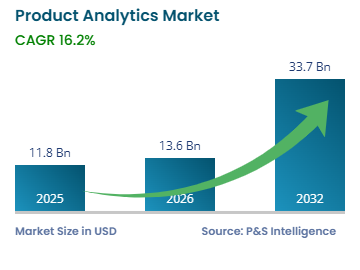
The product analytics market size was USD 11.8 billion for 2025, and it will grow by 16.2% during 2026–2032, to reach USD 33.7 billion by 2032.
This growth is driven by the increasing need for data-driven product development, rising adoption of digital platforms, and the growing importance of user behavior insights across web and mobile applications. Organizations are increasingly leveraging product analytics solutions to optimize customer journeys, improve product performance, and enhance user retention in highly competitive digital environments. The expansion of SaaS platforms, mobile applications, and e-commerce ecosystems is further accelerating the demand for real-time analytics and actionable insights.
The International Data Corporation reports that global data creation is expected to exceed 180 zettabytes by 2025, highlighting the exponential growth of data generated across digital platforms and the need for advanced analytics tools. Additionally, according to the Organisation for Economic Co-operation and Development, over 70% of businesses in developed economies have adopted data-driven decision-making processes, reinforcing the role of analytics as a core business function. This growing data ecosystem is positioning product analytics as a critical component of digital transformation strategies across industries.
Key Market Insights
The software category holds the larger market share, of 75%, in 2025, driven by widespread adoption of analytics platforms for real-time user behavior tracking and product optimization.
The mobile-based category will have the higher CAGR, of 16.7%, driven by rapid growth in mobile app usage and mobile-first business strategies.
The cloud-based category holds the larger market share, of 70%, in 2025, and will also have the highest CAGR, of %, due to its scalability and flexibility.
The manufacturers category holds the largest market share, of 35%, in 2025, due to rising adoption of product analytics for design optimization, performance monitoring, and lifecycle management.
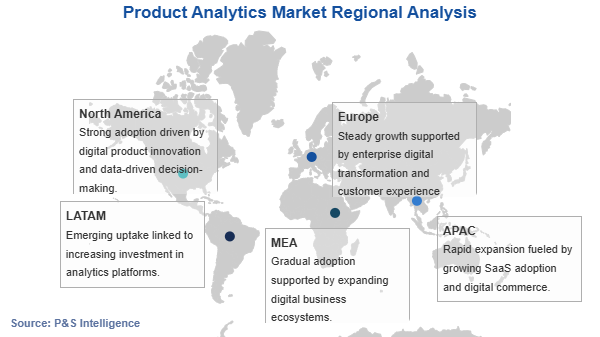
North America holds the largest market share, of 40%, in 2025, while Asia-Pacific will have the highest CAGR, of approximately 17.1%, driven by rapid digitalization.
Product Analytics Market Trends and Drivers
Integration of AI and Predictive Analytics into Product Intelligence Platforms Is Key Trend
A major trend in the product analytics market is the integration of artificial intelligence (AI) and predictive analytics into product intelligence platforms, enabling organizations to transition from descriptive analytics to proactive and prescriptive decision-making. Modern product analytics solutions are increasingly embedding machine learning algorithms to identify user behavior patterns, forecast churn risks, and recommend product enhancements in real time. This advancement is transforming analytics platforms into intelligent systems that not only track user activity but also deliver actionable, data-driven insights for product teams, marketing professionals, and designers.
This trend is further reinforced by growing global government support for AI adoption. For instance, the U.S. government’s National AI Initiative and the European Union’s Digital Europe Programme are investing billions in AI innovation, data infrastructure, and advanced analytics capabilities, while initiatives in India and China are accelerating enterprise adoption of AI-powered analytics across industries. According to the World Economic Forum, over 75% of enterprises are expected to adopt AI-driven analytics tools by 2027, reflecting the growing dependence on intelligent data systems for business optimization. Supporting this trend, Amplitude, Inc. has introduced advanced AI-powered capabilities within its platform to enhance behavioral insights and predictive analytics functions. This shift toward AI-enabled product analytics is significantly increasing platform intelligence and driving competitive differentiation among market players.
Rapid Expansion of Digital Platforms and User-Centric Product Strategies Is Biggest Driver
Rapid expansion of digital platforms and the increasing emphasis on user-centric product development are the primary drivers of the product analytics market. Organizations across industries are prioritizing customer experience and personalization, creating a strong need for deep insights into user behavior, engagement patterns, and product performance. Product analytics solutions enable companies to analyze user activity, identify friction points, and continuously refine digital products, supporting improved customer retention and revenue outcomes.
This growth is strongly supported by global digital economy expansion and government-led digitalization initiatives. According to the United Nations Conference on Trade and Development, global e-commerce sales, including both B2B and B2C transactions, have surpassed USD 26 trillion, highlighting the massive scale of digital transactions and the increasing need for advanced analytics to manage user interactions. Additionally, the International Telecommunication Union estimates that approximately 6 billion people, representing nearly 74% of the global population, are using the internet worldwide in 2025, driven by broadband expansion programs and digital infrastructure investments across regions such as Asia-Pacific, Europe, and North America. Governments in countries such as India, China, and members of the European Union are actively promoting digital adoption through large-scale initiatives, further expanding the global user base. Reflecting this momentum, Mixpanel, Inc. has collaborated with platforms such as Snowflake Inc. to enhance data integration and analytics capabilities, enabling organizations to derive deeper insights from user data across platforms. This growing focus on digital engagement, combined with rapid expansion of online ecosystems, is significantly accelerating the adoption of product analytics solutions.
Data Privacy Concerns and Complex Regulatory Compliance Are Key Restraints
Data privacy concerns and complex regulatory frameworks represent a significant restraint on the growth of the product analytics market. Product analytics platforms rely heavily on the collection and analysis of user data, including behavioral patterns and interaction histories, raising critical concerns related to data protection, user consent, and transparency. Regulations such as the General Data Protection Regulation in Europe, along with evolving data privacy laws across multiple regions, impose stringent requirements on organizations, increasing operational complexity and compliance burdens.
To address these challenges, companies must invest in advanced data governance frameworks, anonymization techniques, and consent management systems, which can significantly increase costs and extend implementation timelines. Moreover, the fragmented nature of regulatory requirements across regions creates additional barriers for global deployment of analytics platforms, limiting scalability and complicating cross-border data operations. These challenges are particularly restrictive for small and medium enterprises, which often lack the resources and expertise required to effectively manage complex compliance environments.
Growing Adoption Among SMEs and Emerging Markets Is Biggest Opportunity
The increasing adoption of product analytics solutions among small and medium enterprises (SMEs) and across emerging markets presents a significant growth opportunity in the product analytics market. As digital tools become more accessible and cost-effective through cloud-based deployment models, SMEs are increasingly leveraging analytics platforms to compete with larger enterprises by optimizing product performance, improving operational efficiency, and enhancing customer experiences.
Governments are increasingly prioritizing SME-specific programs to promote the adoption of cloud technologies, digital tools, and analytics solutions. For instance, Brazil’s digital transformation initiatives and SEBRAE programs support technology integration among small businesses, while European initiatives focused on SME digital transformation are providing funding and infrastructure to accelerate adoption among smaller enterprises. Furthermore, rising investments in startup ecosystems, particularly in the form of venture capital funding, accelerator programs, and cloud infrastructure expansion, across Asia-Pacific, Latin America, and Africa are accelerating the adoption of scalable analytics solutions. For instance, Sequoia Capital has been actively investing in early-stage SaaS and analytics startups across India and Southeast Asia, supporting the development of scalable, data-driven platforms that enable businesses to leverage advanced analytics capabilities.
Product Analytics Market Segmentation Analysis
Offering Analysis
The software category holds the larger market share, of 75%, in 2025, driven by the widespread deployment of product analytics platforms that enable real-time tracking of user behavior, product performance monitoring, and insight-driven decision-making. Organizations are increasingly adopting SaaS-based analytics solutions to enhance customer engagement and streamline product development processes, which is strengthening the dominance of this category. In addition, continuous product innovation and seamless integration with cloud ecosystems are further supporting its growth.
The service category will have the higher CAGR, of approximately 16.6%, driven by the increasing need for consulting, implementation, and managed services as organizations seek specialized expertise in deploying and optimizing analytics solutions. The growing complexity of data environments and integration requirements is further accelerating demand for professional and managed services.
The offerings analyzed in this report are:
Software (Larger Category)
Service (Faster-Growing Category)
Professional
Managed
Solution Analysis
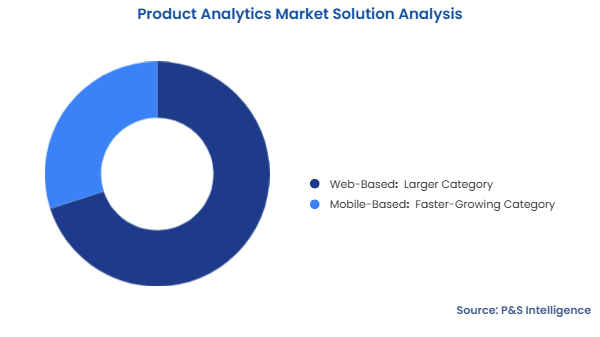
The web-based category holds the larger market share, of 70%, in 2025, due to the dominance of web applications across industries such as e-commerce, SaaS, and enterprise platforms. Businesses rely heavily on web analytics to monitor user activity, optimize conversion rates, and enhance overall digital experience, reinforcing the role of web-based product analytics solutions. According to the U.S. Census Bureau, e-commerce sales in the United States surpassed USD 1 trillion, highlighting the scale of web-based commercial activity.
The mobile-based category will have the higher CAGR, driven by the rapid increase in smartphone usage and the growing importance of mobile-first business strategies. Organizations are increasingly focusing on understanding user behavior within mobile applications to improve engagement and retention.
The solutions analyzed in this report are:
Web-Based (Larger Category)
Mobile-Based (Faster-Growing Category)
Deployment Type Analysis
The cloud-based category holds the larger market share, of 70%, in 2025, and it will have the higher CAGR, of approximately 16.8%, supported by its scalability, flexibility, and cost-efficiency. Cloud-based deployment enables real-time data processing, seamless integration with digital platforms, and remote accessibility, making it well-suited for modern enterprise environments. According to the European Commission, 45.2% of enterprises in the EU have adopted cloud computing services, highlighting the rapid shift toward cloud-based infrastructure.
The deployment types analyzed in this report are:
Cloud-Based (Largest and Fastest-Growing Category)
On-Premises
Enterprise Size Analysis
The large enterprises category holds the larger market share, in 2025, due to their substantial investments in advanced analytics infrastructure and digital transformation initiatives. These organizations require sophisticated analytics tools to manage large volumes of user data and optimize complex product ecosystems.
The small & medium enterprises category will have the higher CAGR, supported by the increasing availability of cost-effective cloud-based analytics solutions. SMEs are adopting product analytics to strengthen competitiveness and improve operational decision-making capabilities. According to the Organisation for Economic Co-operation and Development, SMEs account for over 90% of businesses globally, highlighting their significant potential for analytics adoption.
The enterprise sizes analyzed in this report are:
Large Enterprises (Larger Category)
Small & Medium Enterprises (SMEs) (Faster-Growing Category)
Application Analysis
The retail category holds the largest market share, of 25%, in 2025, driven by the widespread adoption of product analytics solutions across digital retail platforms. Retailers use these tools to analyze customer journeys, track user interactions, and optimize conversion funnels. The high volume of online user activity makes product analytics essential for enhancing customer experience and supporting data-driven revenue growth.
The media & entertainment category will have the highest CAGR, of approximately 17.0%, supported by the increasing demand for content personalization and user engagement analytics across streaming platforms and digital services. According to Eurostat, 78% of internet users in the European Union engage in online purchases or digital content consumption, highlighting the strong demand for analytics-enabled platforms.
The applications analyzed in this report are:
Retail (Largest Category)
Media & Entertainment (Fastest-Growing Category)
Banking, Financial Services, and Insurance (BFSI)
Manufacturing
Automotive
Healthcare
Energy & Utilities
Government
Others
End User Analysis
The manufacturers category holds the largest market share, of 35%, in 2025, as they increasingly adopt product analytics to optimize product design, monitor performance, and improve lifecycle management. The growing need for data-driven product innovation, coupled with the integration of IoT-enabled devices and smart manufacturing systems, is enabling real-time performance tracking and predictive maintenance. This allows manufacturers to enhance product quality, reduce operational costs, and accelerate time-to-market.
The market professionals category will have the highest CAGR, supported by the rising demand for performance-driven marketing strategies and customer engagement optimization. Product analytics tools enable marketers to track campaign performance, analyze user interactions across multiple channels, and deliver highly personalized experiences. The increasing adoption of omnichannel marketing and digital advertising platforms is further strengthening the demand for advanced analytics solutions among marketing teams. According to the U.S. Bureau of Economic Analysis, digital economy activities account for over 10% of the U.S. GDP, highlighting the expanding role of analytics-driven operations across business functions.
Drive strategic growth with comprehensive market analysis
Product Analytics Market Regional Outlook
North America Product Analytics Market Size
North America holds the largest market share, of 40%, in 2025, supported by the strong presence of technology companies, advanced digital infrastructure, and high adoption of analytics solutions across industries. The region benefits from early adoption of AI, cloud computing, and big data technologies, which are critical for product analytics deployment. Additionally, strong investments in digital transformation and the presence of leading analytics providers are further strengthening market growth.
Furthermore, widespread enterprise cloud adoption, supported by federal cloud-first policies, is enabling organizations to deploy scalable product analytics solutions efficiently. In Canada, the government has allocated up to CAD 2 billion under its Sovereign AI Compute Strategy to expand AI computing capacity, cloud infrastructure, and data center development. Additionally, the Canada Digital Adoption Program (CDAP) is supporting SMEs in adopting cloud technologies and analytics solutions, while the Digital Charter strengthens the broader digital policy environment.
U.S. Product Analytics Market Size
The U.S. is the largest country market in North America, supported by widespread adoption of analytics platforms across sectors such as e-commerce, media, and SaaS. The country’s advanced digital ecosystem and strong focus on data-centric business strategies are supporting the demand for product analytics solutions. According to the U.S. Bureau of Economic Analysis, the digital economy contributes over 10% to the national GDP, highlighting the scale of digital activity supporting analytics adoption.
This growth is further supported by strong federal investments in data and AI innovation. The U.S. government, through initiatives such as the National Artificial Intelligence Initiative Act and funding from agencies like the National Science Foundation, is investing heavily in AI, big data, and advanced computing research. Additionally, federal cloud adoption policies and programs such as FedRAMP (Federal Risk and Authorization Management Program) are accelerating the deployment of secure cloud-based analytics platforms across enterprises
Asia-Pacific Product Analytics Market Size
Asia-Pacific will have the highest CAGR, of approximately 17.1%, supported by the increasing adoption of mobile applications and the rapid expansion of digital business models across industries. Governments across the region are promoting innovation and advanced technologies, creating a favorable environment for analytics adoption. This growth is strongly supported by country-level policy initiatives and investments. In Japan, the government’s Society 5.0 vision is promoting the integration of AI, IoT, and data analytics across industries to enhance digital capabilities, while South Korea’s Digital New Deal includes significant investments in big data platforms, AI, and cloud infrastructure to accelerate economic modernization.
Moreover, in Australia, the government’s Digital Economy Strategy 2030 aims to position the country as a leading digital economy, with a strong emphasis on cloud adoption and data utilization across enterprises. In India, according to the India Brand Equity Foundation, the country’s internet user base is expected to exceed 900 million by 2025, driven by expanding digital access and increasing adoption of Indic-language content, which is supporting the growth of digital platforms and analytics-driven solutions. Meanwhile, increasing investments in digital public infrastructure and startup ecosystems across emerging economies in the region are enabling large-scale adoption of analytics solutions among businesses and startups.
China Product Analytics Market Size
China is the largest country market in the Asia-Pacific, driven by its massive digital user base and strong e-commerce ecosystem. The country’s advanced mobile infrastructure and widespread use of digital platforms are supporting the adoption of product analytics solutions. This dominance is further reinforced by large-scale government initiatives and the rapid expansion of the digital economy. Under the Next Generation Artificial Intelligence Development Plan, China aims to build a USD 150 billion AI industry by 2030, significantly accelerating investments in data analytics, machine learning, and intelligent platforms. Additionally, the 14th Five-Year Plan prioritizes the development of big data, cloud computing, and digital infrastructure, strengthening the foundation for analytics adoption across industries. According to the China Academy of Information and Communications Technology, China’s digital economy contributes over 40% of the country’s GDP, reflecting the scale of technology-enabled economic activity.
Furthermore, the Ministry of Industry and Information Technology (MIIT) has been actively promoting industrial digitalization and enterprise cloud adoption, with millions of enterprises migrating to cloud platforms. The strong presence of large-scale e-commerce platforms and super apps, combined with increasing investments in AI and big data, is generating vast volumes of user interaction data, strengthening the demand for advanced product analytics solutions.
The regions and countries analysed in this report are:
North America (Largest Regional Market)
U.S. (Larger Country)
Canada (Faster-Growing Country)
Europe
Germany (Fastest-Growing Country)
U.K. (Largest Country)
France
Italy
Spain
Rest of Europe
Asia-Pacific (Fastest-Growing Regional Market)
China (Largest Country)
India (Fastest-Growing Country)
Japan
South Korea
Australia
Rest of APAC
Latin America
Brazil (Largest Country)
Mexico (Fastest-Growing Country)
Rest of LATAM
Middle East and Africa
Saudi Arabia (Fastest-Growing Country)
South Africa
U.A.E. (Largest Country)
Rest of MEA
Product Analytics Market Share Analysis
The market is fragmented, characterized by the presence of numerous global, regional, and niche players offering a wide range of solutions. Companies such as Google, Adobe, Mixpanel, and Amplitude compete alongside emerging startups that provide specialized, AI-driven analytics tools. The market’s fragmentation is driven by rapid technological innovation, low entry barriers for cloud-based platforms, and diverse customer requirements across industries such as retail, media, and SaaS. Additionally, continuous product differentiation, integration capabilities, and customization needs encourage the entry of new vendors, preventing market consolidation and maintaining a highly competitive and dynamic ecosystem.
Top Companies in Product Analytics Market:
Amplitude, Inc.
Mixpanel, Inc.
Pendo.io, Inc.
PostHog, Inc.
FullStory, Inc.
Contentsquare SAS
Heap Inc.
Quantum Metric, Inc.
LogRocket, Inc.
Glassbox Ltd.
Adobe Inc.
Google LLC
Product Analytics Market News & Updates
In January 2026, Amplitude, Inc. acquired InfiniGrow, a revenue analytics platform, to strengthen its AI-native product analytics capabilities by integrating marketing attribution and revenue intelligence into its platform, enabling businesses to better connect product usage with revenue outcomes.
In October 2025, Mixpanel, Inc. acquired DoubleLoop, a data analytics platform, to enhance its analytics offering with advanced metric modeling and real-time data exploration capabilities, enabling product teams to derive deeper and faster insights from complex datasets.
In July 2024, Pendo.io, Inc. acquired Zelta AI, a customer intelligence startup, to automate customer feedback analysis and enhance AI-driven insights, helping enterprises improve product experience and user engagement through advanced behavioral analytics.
In June 2024, Contentsquare SAS announced its new Experience Intelligence platform with AI embedded across the solution to help enterprises better understand customer behavior, automatically identify friction points, and improve digital experiences across web and mobile channels.
Frequently Asked Questions About This Report
Why is product analytics important for businesses?+
Product analytics helps businesses understand user behavior, improve product features, enhance customer experience, and increase retention and revenue through data-driven decision-making.
What are the key trends in the product analytics market?+
The key trends include the adoption of AI and machine learning, integration with cloud data platforms, real-time analytics, increased focus on customer journey analysis, and growth of product-led growth strategies.
How does AI impact product analytics platforms?+
AI enhances product analytics by automating insights, predicting user behavior, detecting anomalies, and providing recommendations, enabling faster and more accurate decision-making.
Which industries use product analytics the most?+
Industries such as SaaS, e-commerce, fintech, healthcare, and media & entertainment widely use product analytics to optimize digital products and improve user engagement.
What are the benefits of product analytics software?+
The benefits include improved product development, better user retention, enhanced personalization, faster decision-making, optimized customer journeys, and increased business performance.
Want a report tailored exactly to your business need?
Leading companies across industries trust us to deliver data-driven insights and innovative solutions for their most critical decisions. From data-driven strategies to actionable insights, we empower the decision-makers who shape industries and define the future. From Fortune 500 companies to innovative startups, we are proud to partner with organisations that drive progress in their industries.
Client Testimonials
Working with P&S Intelligence and their team was an absolute pleasure – their awareness of timelines and commitment to value greatly contributed to our project's success. Eagerly anticipating future collaborations.
McKinsey & Company
India
Unmatched Standards
Our insights into the minutest levels of the markets, including the latest trends and competitive landscape, give you all the answers you need to take your business to new heights
Complete Data Security
We take a cautious approach to protecting your personal and confidential information. Trust is the strongest bond that connects us and our clients, and trust we build by complying with all international and domestic data protection and privacy laws