This Report Provides In-Depth Analysis of the Pre-Insulated Pipes Market Report Prepared by P&S Intelligence, Segmented by Installation (Below Ground, Above Ground), Type (Metals, Polymers), Application (District Heating and Cooling, Oil and Gas, Utilities), Layer (Carrier Pipe, Insulation Layer, Outer Jacket), Medium (Liquid, Gas), End User (Industrial, Commercial, Residential), and Geographical Outlook for the Period of 2021 to 2032
Explore the market potential with our data-driven report
Pre-Insulated Pipes Market Future Outlook
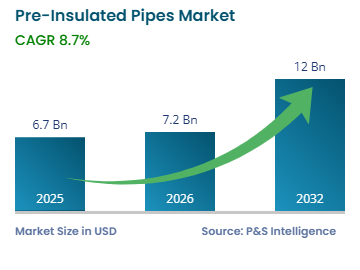
The pre-insulated pipes market size was USD 6.7 billion for 2025, and it will grow by 8.7% during 2026–2032, to reach USD 12.0 billion by 2032.
This growth is driven by increasing demand for energy-efficient thermal distribution systems and rising investments in infrastructure modernization. Pre-insulated pipes are widely used for transporting hot and cold fluids with minimal thermal loss, making them essential in energy, industrial, and utility applications. Their ability to improve system efficiency and reduce operational costs is accelerating adoption, particularly in regions with established and expanding district energy infrastructure.
Additionally, the European Commission emphasizes energy efficiency as a core priority, with policies supporting the reduction of energy losses and the development of sustainable infrastructure. According to the European Commission’s Joint Research Centre, heat losses in district heating networks represented around 16% of heat generation in Europe, highlighting the importance of efficient insulated pipeline infrastructure. These factors are driving the deployment of advanced piping systems, including pre-insulated pipes, across multiple sectors.
Key Market Insights
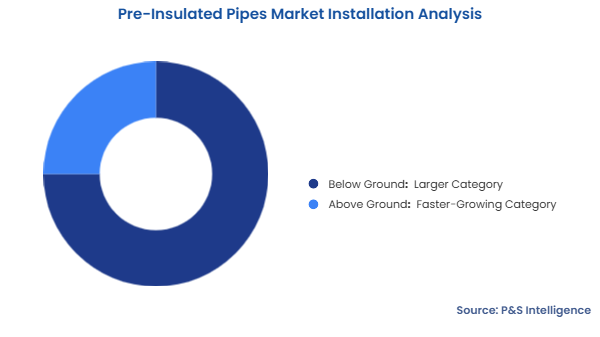
The below ground category holds the larger market share, of 75%, in 2025, due to better insulation, protection, and long-term stability in buried pipelines.
The polymers category will have the higher CAGR, of approximately 9.5%, driven by increasing demand for lightweight, corrosion-resistant, and cost-efficient piping solutions.
The outer jacket category will have the highest CAGR, of approximately 9.4%, driven by increasing focus on pipeline protection, environmental resistance, and system longevity.
The liquid category holds the larger market share, of 75% in 2025, driven by its dominant use in water supply, district heating, and industrial fluid transport systems.
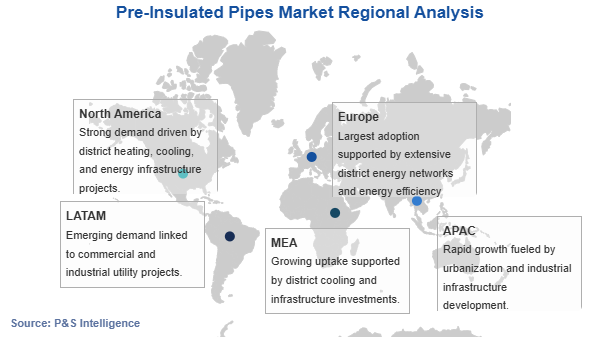
Europe holds the largest market share, of 40%, in 2025, supported by extensive retrofit and modernization of aging thermal distribution infrastructure across established district energy networks.
Pre-Insulated Pipes Market Dynamics
Expansion of District Heating Networks and Energy Efficiency Initiatives Are Key Trends
A major trend in the pre-insulated pipes market is the expansion of district heating and cooling networks, driven by the growing policy focus on improving energy efficiency and reducing carbon emissions. Pre-insulated pipes play a critical role in these systems by minimizing heat loss during transmission, while governments are increasingly investing in centralized heating infrastructure to replace less-efficient individual systems, particularly in urban and densely populated areas. The International Energy Agency highlights that district heating is a well-established solution in Europe and is expanding steadily across parts of Asia.
Additionally, the European Commission is promoting the modernization and expansion of district energy systems under its climate and energy transition framework, accelerating the adoption of advanced thermal distribution solutions, including pre-insulated pipes, while supporting hybrid and low-carbon energy systems that require efficient heat distribution infrastructure, positioning these pipes as a critical component of sustainable and energy-efficient thermal systems. In India, the India Cooling Action Plan targets a 20–25% reduction in cooling demand by 2037–38 through the adoption of efficient and centralized cooling infrastructure, supporting the development of district cooling networks and increasing demand for advanced piping systems.
Expanding LNG Infrastructure and Upstream Oil and Gas Investment Is Biggest Driver
Global oil and gas investment continues to support demand for industrial-grade pre-insulated pipe systems used in temperature-sensitive fluid transport, corrosion protection, and flow assurance across onshore and offshore pipeline networks. The International Energy Agency, in its World Energy Investment 2025 report, highlights that investment in new LNG facilities is increasing, with major projects in the U.S., Qatar, and Canada preparing to come online and global LNG capacity expected to grow between 2026 and 2028. New LNG terminals and regasification facilities each require dedicated pipeline networks. These assets demand pre-insulated pipe systems designed to maintain cryogenic and high-temperature fluid integrity over long distances.
Beyond LNG, ongoing investments in upstream oil and gas operations, including the maintenance of existing fields and the development of deepwater and ultra-deepwater projects in regions such as the Gulf of Mexico, West Africa, and Brazil. These applications require specialized pre-insulated pipe systems capable of withstanding extreme pressure conditions, temperature variations, and subsea corrosion. Energy security concerns continue to drive investment in oil and gas infrastructure, reinforcing the role of pre-insulated pipes in industrial applications.
Raw Material Price Volatility and Installation Complexity Are Key Restraints
The pre-insulated pipes market faces cost-related challenges driven by volatility in key raw materials, including polyurethane foam, high-density polyethylene, and steel or cross-linked polyethylene. Crude oil price fluctuations, global supply chain disruptions, and trade policies collectively drive variability in production costs and pricing. Such fluctuations place pressure on manufacturer margins and can impact project viability in cost-sensitive markets.
Below-ground installation, which represents the dominant deployment mode, requires extensive civil works such as trenching, excavation, and integration with existing utility networks. These activities increase overall project complexity and capital requirements, especially in dense urban environments. The higher upfront investment, however, continues to limit adoption in budget-constrained municipal projects and developing regions.
Emerging Economy Urban Infrastructure Programmes Opening Growth Pathways in Asia-Pacific and Latin America
Rapidly urbanizing economies across Asia-Pacific and Latin America represent a relatively underpenetrated opportunity for pre-insulated pipe manufacturers. According to the United Nations, nearly 68% of the global population is projected to live in urban areas by 2050, with a large share of this growth concentrated in Asia. This urbanization trajectory is generating sustained long-term infrastructure demand across both regions. Unlike mature European markets, where procurement centers on network renovation, demand in emerging economies is rooted in new infrastructure development, including urban districts, industrial parks, and residential complexes.
India's Smart Cities Mission, which targets the development of 100 urban centers, and China's continued expansion of urban heating infrastructure are key near-term growth drivers. Similar developments are gaining momentum in Vietnam, Indonesia, Brazil, and Mexico as industrial corridor expansion proceeds. Manufacturers offering polymer-based, corrosion-resistant pre-insulated pipe systems designed for district cooling applications are aligned with ongoing infrastructure deployment and system formalization across these regions.
Pre-Insulated Pipes Market Segmentation Analysis
Installation Analysis
The below ground category holds the larger market share, of 75%, in 2025, driven by its ability to provide enhanced thermal insulation, environmental protection, and long-term operational stability in buried pipeline systems. Underground installation minimizes heat loss, protects pipelines from environmental exposure, and ensures long-term operational stability. It is widely preferred in large-scale infrastructure projects due to enhanced durability and reduced maintenance requirements.
The above ground category will have the higher CAGR, driven by increasing adoption in industrial plants, energy facilities, and temporary infrastructure projects. These systems offer easier inspection, maintenance, and faster installation compared to underground networks. Above-ground pipelines are particularly preferred in refineries, power plants, and modular industrial setups. In addition, the Energy Performance of Buildings Directive (EU/2024/1275), which entered into force in May 2024, promotes efficient district heating connections as part of zero-emission building targets, supporting the expansion of district energy systems.
The installations analyzed in this report are:
Below Ground (Larger Category)
Above Ground (Faster-Growing Category)
Type Analysis
The metals category holds the larger market share, of 70%, in 2025, driven by its superior mechanical strength, high-pressure tolerance, and suitability for high-temperature applications. Metal pipes, with steel foremost among them, are extensively used in district heating networks, oil and gas pipelines, and industrial process systems where structural integrity and thermal resistance are critical. The widespread use of steel in pre-insulated piping systems aligns with established standards such as EN 253, which defines performance requirements for factory-made insulated pipe systems used in district heating applications. Their ability to operate under extreme temperature and pressure conditions makes them indispensable for large-scale and mission-critical infrastructure.
The polymers category will have the higher CAGR, driven by increasing demand for lightweight, corrosion-resistant, and cost-efficient piping solutions. Polymer-based pipes offer flexibility and ease of handling. Installation requirements are less complex than those of metal systems. Lower susceptibility to chemical corrosion provides additional operational advantage. Materials such as high-density polyethylene and cross-linked polyethylene are increasingly used in pre-insulated systems due to their durability and resistance to scaling and chemical degradation. These properties align with requirements in water distribution systems, district cooling networks, and other low- to medium-temperature applications where lifecycle cost optimization is a procurement priority.
The types analyzed in this report are:
Metals (Larger Category)
Polymers (Faster-Growing Category)
Application Analysis
The district heating and cooling category holds the largest market share, of 60%, in 2025, driven by large-scale deployment of centralized heating systems across Europe and Asia. The European Commission continues to support the expansion and modernization of district energy systems under its energy efficiency and decarbonization framework, contributing to sustained demand for insulated pipeline infrastructure.
The utilities category will have the highest CAGR, of approximately 9.2%, driven by the rapid expansion of water supply, energy distribution, and urban cooling infrastructure. Increasing investments in smart cities and integrated utility networks are accelerating the deployment of advanced piping systems that improve operational efficiency and reduce energy losses. The World Bank estimates that global infrastructure investment needs will exceed USD 90 trillion by 2040, with a significant share allocated to energy and utility systems, supporting long-term growth in this segment.
The applications analyzed in this report are:
District Heating and Cooling (DHC) (Largest Category)
Oil and Gas
Utilities (Fastest-Growing Category)
Layer Analysis
The carrier pipe category holds the largest market share in 2025, as it serves as the core structural component responsible for fluid transport under pressure and temperature conditions. It determines the system’s mechanical strength and operational performance, making it a critical layer in pre-insulated pipe systems. Carrier pipes are typically manufactured using materials such as steel, cross-linked polyethylene (PEX), and high-density polyethylene (HDPE), enabling their use across district heating, oil & gas, and industrial applications.
The outer jacket category will have the highest CAGR, of approximately 9.4%, driven by increasing focus on pipeline protection, environmental resistance, and system longevity. Advanced outer materials, particularly high-density polyethylene (HDPE), improve resistance to moisture ingress, corrosion, and mechanical damage, reducing maintenance costs. Growing demand for durable and long-life infrastructure is accelerating innovation in this segment, including the development of enhanced protective coatings and multilayer jacket systems.
The layers analyzed in this report are:
Carrier Pipe (Largest Category)
Insulation Layer
Outer Jacket (Fastest-Growing Category)
Medium Analysis
The liquid category holds the larger market share in 2025, driven by its dominant use in water supply, district heating, and industrial fluid transport systems. These applications require effective temperature control and energy-efficient distribution, supporting the adoption of pre-insulated pipes to reduce thermal losses and ensure reliable operation. Liquid-based systems are widely deployed across urban infrastructure due to their critical role in heating and water distribution.
The gas category will have the higher CAGR, of approximately 9.0%, driven by the rapid expansion of natural gas distribution networks and increasing demand for cleaner energy sources. Gas pipelines require effective thermal management to maintain fluid temperature, prevent condensation, and ensure safe transmission over long distances. The International Energy Agency highlights that natural gas demand continues to grow across urban and industrial sectors as a transition fuel, supporting ongoing investments in pipeline infrastructure and contributing to increased demand for insulated pipe systems.
The medium analyzed in this report are:
Liquid (Larger Category)
Gas (Faster-Growing Category)
End User Analysis
The industrial category holds the largest market share, of 55%, in 2025, supported by the need for precise temperature-controlled fluid transport and high operational reliability in continuous process environments. These operations require stable thermal conditions and reliable fluid transport to maintain process efficiency and system performance. Pre-insulated pipes support these requirements by enabling controlled temperature distribution and enhancing system durability in demanding industrial environments.
The residential category will have the highest CAGR, driven by increasing urbanization and expansion of district heating systems in residential developments. Rising population density and growing demand for energy-efficient and sustainable heating solutions are supporting the adoption of advanced piping systems in housing infrastructure.
The end users analyzed in this report are:
Industrial (Largest Category)
Commercial
Residential (Fastest-Growing Category)
Drive strategic growth with comprehensive market analysis
Pre-Insulated Pipes Market Geographical Analysis
Europe Pre-Insulated Pipes Market Size
Europe holds the largest market share, of 40%, in 2025, supported by extensive retrofit and modernization of aging thermal distribution infrastructure across established district energy networks. The region's district heating networks, particularly well-established in Scandinavia, Germany, Poland, and the Baltic states, extensively rely on pre-insulated pipe systems for thermal distribution, creating a stable and recurring demand base. The Energy Performance of Buildings Directive (EU/2024/1275) continues to support energy efficiency improvements and building renovation activities across EU member states, accelerating retrofit and expansion of district energy infrastructure. The European Commission reported in June 2025, based on Eurostat data, that approximately 85% of EU buildings were constructed before 2000, and a significant share has low energy performance ratings, creating a substantial renovation pipeline that supports demand for upgraded thermal distribution systems, including pre-insulated pipes.
Germany Pre-Insulated Pipes Market Size
Germany is the largest country market within Europe, supported by a federal policy framework that is actively expanding district heating penetration nationwide. The Wärmeplanungsgesetz (Heat Planning Act), enacted in 2023 and effective from January 2024, requires municipalities with populations above 100,000 to prepare binding heat plans by 2026, creating a structured pipeline for district energy infrastructure development. German district heating networks already serve a large share of urban households in major cities such as Berlin, Hamburg, and Munich. Federal funding under the Bundesförderung effiziente Wärmenetze (BEW) programme is supporting the modernization and expansion of district heating systems through multi-billion-euro investment support.
The International Energy Agency, in its December 2025 analysis on district heating, highlights Germany's heat planning framework as a strong example of coordinated national-level infrastructure planning. The country is targeting carbon neutrality by 2045, five years ahead of the EU's 2050 target, and the long-term outlook for pre-insulated pipe systems remains robust. Strong regulatory momentum and sustained public funding mechanisms underpin this trajectory. Established engineering and manufacturing capabilities, concentrated in industrial regions such as the Rhine-Ruhr and Bavaria corridors, reinforce Germany's structural position in the market.
Asia-Pacific Pre-Insulated Pipes Market Size
Asia-Pacific will have the highest CAGR, of approximately 9.6%, driven by the first-time deployment of district cooling systems and the expanding use of polymer-based pre-insulated piping in new infrastructure projects. According to the United Nations, Asia is projected to add over 1.2 billion urban residents by 2050, significantly increasing demand for infrastructure and utility networks.
Governments across the region are embedding energy efficiency requirements into building codes and urban planning frameworks, creating structural tailwinds for pre-insulated pipe adoption across both residential and commercial construction segments, with countries such as Japan promoting energy-efficient district heating and cooling systems under its national energy efficiency policies, while Australia’s National Construction Code incorporates building performance standards aimed at reducing energy consumption and improving thermal efficiency in urban infrastructure.
China Pre-Insulated Pipes Market Size
China is one of the largest country markets within Asia-Pacific region with extensive district heating infrastructure across the Northern Urban Heating Area. The International Energy Agency highlights that China accounts for more than one-quarter of global heat demand and operates one of the largest district heating systems globally, with continued expansion in urban regions. This centralized heating deployment is supporting strong demand for pre-insulated piping systems used in thermal distribution.
The World Bank-financed Heating Sector Decarbonization project in Shaanxi province (2024–2026) includes the development of geothermal heating wells, heat pump stations, and primary distribution pipe networks in urban redevelopment areas of Xi'an, incorporating advanced piping infrastructure. China's dual decarbonization targets, peaking carbon emissions before 2030 and achieving carbon neutrality by 2060, are driving sustained government investment in district heating modernization and energy-efficient infrastructure.
The regions and countries analyzed in this report include:
North America
U.S. (Larger Country Market)
Canada (Faster-Growing Country Market)
Europe (Largest Region)
Germany (Largest Country Market)
U.K.
France (Fastest-Growing Country Market)
Italy
Spain
Rest of Europe
Asia-Pacific (Fastest-Growing Region)
China (Largest Country Market)
India (Fastest-Growing Country Market)
Japan
South Korea
Australia
Rest of APAC
Latin America
Brazil (Largest Country Market)
Mexico (Fastest-Growing Country Market)
Rest of LATAM
Middle East & Africa
Saudi Arabia (Largest Country Market)
South Africa
U.A.E. (Fastest-Growing Country Market)
Rest of MEA
Pre-Insulated Pipes Market Competitive Landscape
The market is fragmented, characterized by the presence of numerous global and regional players operating across different geographic regions and application segments. No single company holds a dominant share globally, as demand is largely driven by region-specific infrastructure projects such as district heating in Europe, industrial pipelines in North America, and urban development in Asia-Pacific. The market also involves diverse end-use sectors, including utilities, oil & gas, and industrial applications, which encourages participation from specialized manufacturers. Additionally, project-based procurement and customization requirements favor local and regional suppliers, further dispersing market share. While a few established companies have strong regional presence, the overall competitive landscape remains distributed, with market share spread across multiple global and regional players.
Key Players in the Pre-Insulated Pipes Market:
Kingspan LOGSTOR
Set Pipes GmbH
Perma-Pipe International Holdings, Inc.
Georg Fischer AG
REHAU Group
Isoplus Group
Thermacor Process Inc.
BRUGG Rohrsystem AG
Watts Water Technologies, Inc.
Aalberts N.V.
Genuit Group plc
Geberit AG
Pre-Insulated Pipes Market News & Updates
In July 2025, BRUGG Rohrsystem AG and Rovanco Piping Systems Inc. commenced production at their joint-venture manufacturing facility in Joliet, Illinois, producing CALPEX PUR-KING flexible pre-insulated PEX pipe systems. The facility supports growing demand for district heating and cooling applications in North America by improving supply availability and reducing delivery timelines.
In January 2025, Perma-Pipe International Holdings Inc. secured a major contract in the GCC region, with project execution from its Abu Dhabi facility utilizing the TRACE-THERM insulation system. The award reflects continued demand for pre-insulated piping solutions in oil & gas and district cooling infrastructure across the Middle East.
In July 2024, REHAU Group launched RAUVIPEX, a high-performance pre-insulated PE-Xa carrier pipe featuring advanced polyurethane insulation and enhanced water-tightness design, targeting district heating and heat pump applications in Europe and the U.K.
Frequently Asked Questions About This Report
What factors are driving the growth of the pre-insulated pipes market?+
The growth is driven by expansion of district heating and cooling networks, increasing focus on energy efficiency, rapid urbanization, and government initiatives aimed at reducing carbon emissions and improving sustainable infrastructure.
Why is Asia-Pacific experiencing rapid growth in the pre-insulated pipes market?+
The region is witnessing strong growth due to rising infrastructure development, increasing energy demand, expansion of district cooling systems, and supportive government investments in urban and industrial projects.
How do pre-insulated pipes enhance energy efficiency in infrastructure systems?+
They minimize heat loss through integrated insulation, maintain consistent temperature during fluid transport, reduce energy consumption, and improve overall operational efficiency in heating and cooling networks.
What role do government regulations play in the pre-insulated pipes market?+
Regulations promote energy efficiency, emission reduction, and adoption of sustainable infrastructure, encouraging the use of advanced piping systems such as pre-insulated pipes in public and private projects.
What challenges are associated with the installation of pre-insulated pipes?+
Installation involves technical complexity, especially in underground systems, requiring skilled labor, precise engineering, and higher initial investment, which can impact project timelines and costs.
How do raw material price fluctuations impact the pre-insulated pipes market?+
Volatility in materials like steel, polyethylene, and polyurethane affects production costs, pricing strategies, and profit margins, creating uncertainty for manufacturers and project developers.
Want a report tailored exactly to your business need?
Leading companies across industries trust us to deliver data-driven insights and innovative solutions for their most critical decisions. From data-driven strategies to actionable insights, we empower the decision-makers who shape industries and define the future. From Fortune 500 companies to innovative startups, we are proud to partner with organisations that drive progress in their industries.
Client Testimonials
Working with P&S Intelligence and their team was an absolute pleasure – their awareness of timelines and commitment to value greatly contributed to our project's success. Eagerly anticipating future collaborations.
McKinsey & Company
India
Unmatched Standards
Our insights into the minutest levels of the markets, including the latest trends and competitive landscape, give you all the answers you need to take your business to new heights
Complete Data Security
We take a cautious approach to protecting your personal and confidential information. Trust is the strongest bond that connects us and our clients, and trust we build by complying with all international and domestic data protection and privacy laws