This Report Provides In-Depth Analysis of the Palm Methyl Ester Derivatives Market Report Prepared by P&S Intelligence, Segmented by Type (Crude Palm Oil (CPO), Palm Kernel Oil (PKO)), Product Type (Methyl Caprylate, Methyl Laurate, Methyl Myristate, Methyl Palmitate, Methyl Stearate, Methyl Oleate, Methyl Linoleate), Application (Soaps & Detergents, Personal Care Products & Cosmetics, Food & Beverages, Lubricants & Additives, Solvents), and Geographical Outlook for the Period of 2021 to 2032
Explore the market potential with our data-driven report
Palm Methyl Ester Derivatives Market Outlook
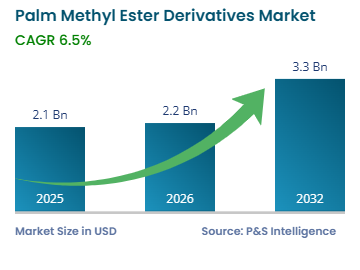
The palm methyl ester derivatives market size was USD 2.1 billion for 2025, and it will grow by 6.5% during 2026–2032, to reach USD 3.3 billion by 2032.
This growth is supported by the expanding integration of bio-based ingredients across personal care formulations, biodiesel blending, and industrial applications, positioning these derivatives as commercially viable alternatives to petroleum-based intermediates. Demand growth is particularly evident in emerging economies, where palm-based oleochemicals benefit from established feedstock availability, cost efficiency, and vertically integrated production structures spanning plantations, refining, and downstream oleochemical processing. According to the Food and Agriculture Organization, global palm oil production exceeds 75 million metric tons annually, providing a large and stable raw material base that underpins the scalability and commercial viability of palm methyl ester derivatives.
The versatility of palm methyl ester derivatives spans multiple industrial applications, from surfactants and emulsifiers in soaps and detergents to lubricants, solvents, and plasticizers used in manufacturing and process industries. In addition, palm methyl esters serve as important intermediates for fatty alcohols and specialty esters used in industrial cleaning, metalworking fluids, and polymer processing aids, where compliance with occupational safety, wastewater discharge, and product stewardship standards increasingly favors bio-based, readily biodegradable feedstocks.
Sustainable Formulation Preferences Are Key Trends
The global palm methyl ester derivatives market is experiencing fundamental transformation as consumer preferences shift decisively toward natural, biodegradable ingredients in personal care formulations. Global consumer surveys show that a majority of personal care consumers prefer products marketed as natural or environmentally friendly and are increasingly willing to pay a premium for such formulations. This behavioral shift creates cascading effects throughout the value chain, compelling manufacturers to reformulate existing products and develop new offerings centered on palm-based ingredients.
Personal care brands are replacing petroleum-derived surfactants and emulsifiers with palm methyl laurate and oleate derivatives, leveraging their superior skin compatibility and biodegradability profiles. Industry formulation data indicates that bio-based surfactants now account for a growing share of new skincare and haircare product launches globally, reflecting a steady transition away from fossil-based inputs.
This substitution trend is reinforced by tightening cosmetic ingredient safety and disclosure requirements in key markets, particularly under the EU Cosmetics Regulation, which increasingly favors low-toxicity, biodegradable raw materials in both rinse-off and leave-on formulations. The trend extends beyond ingredient substitution to encompass entire product development philosophies, with companies establishing dedicated research facilities for bio-based formulation development. In parallel, government-led bioeconomy and downstream value-addition policies in major palm-producing countries, such as Indonesia and Malaysia, are supporting increased R&D investment in specialty oleochemicals, enabling formulators to access a broader portfolio of palm methyl ester derivatives tailored for personal care applications.
Environmental Regulations and Biodiesel Mandates Are Biggest Drivers
Regulatory frameworks worldwide are creating compulsory demand mechanisms that fundamentally reshape palm methyl ester derivative markets through biodiesel mandates and circular economy policies. Indonesia’s implementation of the B40 biodiesel mandate in 2025 raises the mandatory biodiesel blending rate to 40%, increasing national biodiesel allocation from around 13 million kiloliters under the B35 program to approximately 15.6 million kiloliters, thereby significantly expanding domestic demand for palm oil–based fatty acid methyl esters and tightening exportable supply.
In the United States, the Renewable Fuel Standard mandated fuel makers to mix about 5 billion gallons of biodiesel every year by the middle of the 2020s, based on the recommendations of the Environmental Protection Agency. In the European Union, the Renewable Energy Directive (RED II) requires member states to meet a minimum renewable energy share in transport, which biodiesel contributes to through national blending obligations and quotas. India has set an indicative target of 5% biodiesel blending in diesel by 2030 under its National Policy on Biofuels. These mandates are underpinned by government-administered pricing and stabilization mechanisms that limit producer exposure to crude oil price volatility and ensure continuity of palm methyl ester production across market cycles.
This policy mechanism creates guaranteed offtake for palm methyl esters, while generating foreign exchange savings of approximately USD 1.55 billion annually through reduced diesel imports. Complementary policy support is also visible in Malaysia through nationwide B10 deployment and phased B20 rollouts across selected transport and industrial segments, reinforcing Southeast Asia as a structurally supported demand center for palm-based methyl esters. These regulatory pressures cascade through supply chains as multinational corporations adapt procurement strategies to ensure compliance across jurisdictions.
Additionally, regulatory frameworks in developed markets, particularly the European Union, apply indirect land-use change (ILUC) criteria that restrict the eligibility of palm-based biodiesel, effectively redirecting palm methyl ester demand toward non-fuel applications such as personal care, detergents, and industrial chemicals rather than energy blending. European bio-based content requirements are expanding to additional product categories through 2030.
As per the Food and Agriculture Organization and the United Nations, liquid biofuels, such as biodiesel and ethanol, provided up about 4.4 Exajoules of the energy people used around the world in 2023. This is 11% of all the bioenergy people used. Moreover, the World Bioenergy Association (WBA) reports that global biodiesel output reached nearly 50 billion liters in 2024.
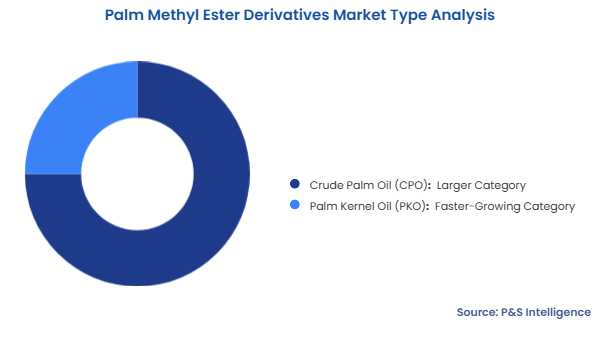
The crude palm oil category holds the largest market share, of 75%, in 2025, due to its abundant availability, cost efficiency, and suitability for producing high-volume esters such as oleates, palmitates, and stearates. CPO-based esters account for the majority of global palm methyl ester output, supported by Asia-Pacific’s concentration of palm oil refining and oleochemical capacity.
At a global level, palm oil is the world’s most produced vegetable oil, providing a large and stable raw material base for esterification and downstream chemical processing. The United States Department of Agriculture says that palm oil production was 79 to 80 million tonnes from 2023 to 2025. In contrast, soybean oil production was 68 to 71 million tonnes, rapeseed oil production was 34 to 35 million tonnes, while sunflower oil production was 21 to 22 million tonnes.
Government policies in major producing countries continue to favor integrated palm oil value chains, enabling consistent feedstock supply for downstream esterification. According to international agricultural outlooks, palm oil offers one of the lowest production costs per ton among major vegetable oils, reinforcing its economic advantage for high-volume methyl ester production compared with soybean or rapeseed oil.
The palm kernel oil category will have the highest CAGR, of 6.7%, due to rising demand for lauric-based methyl esters used in soaps, detergents, and personal care products. PKO-derived esters are increasingly favored for applications requiring high foaming, cleansing efficiency, and mildness. Furthermore, rising global consumption of personal care and hygiene products, particularly in emerging economies, is accelerating PKO utilization, making it the most dynamic feedstock segment despite its smaller absolute volume compared to CPO.
The types analyzed in this report are:
Crude Palm Oil (CPO) (Larger Category)
Palm Kernel Oil (PKO) (Faster-Growing Category)
Product Type Analysis
The methyl oleate category holds the largest market share, of 55%, in 2025, due to its broad functional versatility and strong alignment with both industrial and regulatory requirements. According to the industry estimates, C18-based methyl esters, dominated by oleates, account for over one-third of global palm methyl ester consumption, reflecting their wide acceptance across mature end-use sectors. Their compatibility with existing formulation infrastructure further reinforces oleate’s dominant position, particularly in high-volume detergent and lubricant formulations.
The methyl laurate category will have the highest CAGR, of 6.6%, driven by its increasing penetration in soaps, detergents, personal care products, and specialty chemical applications. The category growth is supported by accelerating demand for sulfate-free and bio-based surfactants, especially in Asia-Pacific, where personal care consumption growth outpaces global averages. Government-led bioeconomy and downstream oleochemical development programs in Indonesia and Malaysia are encouraging increased processing of palm kernel fractions into higher-value laurate derivatives rather than bulk exports.
The product types analyzed in this report are:
Methyl Caprylate
Methyl Laurate (Fastest-Growing Category)
Methyl Myristate
Methyl Palmitate
Methyl Stearate
Methyl Oleate (Largest Category)
Methyl Linoleate
Others
Application Analysis
The soaps & detergent category holds the largest market share, of 40%, in 2025, due to the high-volume use of esters as surfactants, emulsifiers, and processing aids. Rapid urbanization, population growth, and hygiene awareness in Asia-Pacific and Africa continue to drive detergent consumption. Government sanitation and public health initiatives such as India’s Swachh Bharat Mission and WHO- and UNICEF-led water, sanitation, and hygiene (WASH) programs across Africa and Southeast Asia in emerging economies have indirectly supported sustained demand growth for household and institutional cleaning products, reinforcing the dominance of this segment. Palm-based methyl esters remain cost-competitive and technically proven in detergent formulations.
The personal care products & cosmetics category will have the highest CAGR, driven by rising disposable incomes, premiumization trends, and regulatory pressure to replace petroleum-derived ingredients with biodegradable alternatives. Palm methyl esters are increasingly used in skin cleansers, shampoos, creams, and cosmetic formulations due to their favorable toxicity profiles and skin compatibility. Regulatory frameworks governing cosmetic safety and ingredient transparency, particularly in Europe under the EU Cosmetics Regulation; and parts of Asia, such as Japan and South Korea, are accelerating the shift toward bio-based esters. The global spending on bio-based cosmetics and personal care ingredients stood at USD 5,163.2 million in 2024, which is expected to reach USD 7,316.4 million by 2030.
The applications analyzed in this report are:
Soaps & Detergents (Largest Category)
Personal Care Products & Cosmetics (Fastest-Growing Category)
Food & Beverages
Lubricants & Additives
Solvents
Others
Drive strategic growth with comprehensive market analysis
Asia-Pacific holds the largest market share, of 45%, in 2025, and will have the highest CAGR, supported by its dominance in palm oil production, refining, and oleochemical manufacturing. The region accounts for the majority of global palm oil processing capacity, enabling vertically integrated production from plantation to finished ester derivatives.
Southeast Asia alone contributes approximately 80–85% of global palm oil output, with Indonesia and Malaysia serving as the primary production and processing hubs, supported by additional supply from Thailand and the Philippines. As per the USDA, Indonesia’s palm oil production is around 47–50 million tonnes annually, with estimates projecting about 47 million tonnes for the 2025/26 crop year. Similarly, Malaysia’s production is roughly 19–19.5 million tonnes per year.
Government-mandated biodiesel blending programs in countries such as Indonesia and Malaysia provide structural demand for methyl esters, with Indonesia operating one of the world’s highest biodiesel blending mandates at 40% absorbing a significant share of domestic palm oil output into fuel-grade methyl esters. Asia-Pacific also represents over half of global oleochemical production capacity, supported by large-scale investments in downstream esterification and specialty chemical manufacturing, reinforcing the region’s leadership in palm methyl ester derivatives.
China Palm Methyl Ester Derivates Market Size
China remains the largest country market in Asia-Pacific for palm methyl ester derivatives, underpinned by the scale of its downstream detergent, surfactant, and oleochemical manufacturing base and its reliance on imported palm-based feedstocks. Official Malaysian palm oil industry trade data shows that China’s palm oil imports increased from 4.94 million metric tons in 2022 to 5.64 million metric tons in 2023, reflecting a 14.0% year-on-year rise.
As demand recovered across food, oleochemical, and industrial sectors, palm-linked input flows also rose to support fatty ester and surfactant value chains. Moreover, Malaysia exported 1.39 million tonnes of palm oil to China in 2024, down 5.3% year on year, while total palm-related exports to China were valued at RM 10.57 billion (US$2.39 billion), highlighting the scale of the bilateral palm trade.
Furthermore, China’s cosmetics and personal care pull-through is increasingly influenced by the National Medical Products Administration (NMPA) supervision regime. The filing/registration and inspection provisions under its cosmetics governance framework raise compliance expectations across ingredient sourcing and product stewardship for surfactant- and ester-containing formulations.
India Palm Methyl Ester Derivates Market Size
India is the fastest-growing country market in Asia-Pacific for palm methyl ester derivatives, driven by rapid expansion in household/home-care usage, rising personal care consumption, and a policy-driven push to strengthen edible oil and oil palm supply chains. Data from the Solvent Extractors’ Association showing that India’s palm oil imports declined to 7.58 million metric tons in the 2024/25 marketing year (ended October 2025), representing a 15.9% year-on-year decrease. This still reflects a massive baseline volume that supports downstream oleochemical availability and pricing linkages.
Solvent Extractors’ Association also reports that India imported 507,204 metric tonnes of palm oil in December 2025, an eight-month low and a 20% month-on-month decline. This highlights how pricing and seasonal factors can shift monthly input availability for derivative production and blending economics.
India’s government’s NMEO–OP aims to bring 6.5 lakh hectares under oil palm cultivation by 2025–26 and raise crude palm oil output to 11.20 lakh tonnes by 2025–26 and, further, to 28 lakh tonnes by 2029–30. This long-term policy initiative intends to reduce import exposure and support domestic downstream processing over time. This combination of high consumption-linked import volumes and government-backed domestic supply expansion targets positions India as the fastest-growing country market for palm methyl ester derivatives across personal care, homecare, and industrial applications). The policy acts as a medium-term stabilizer for feedstock security.
The regions and countries of the market are as follows:
North America
U.S. (Larger and Faster-Growing Country Market)
Canada
Europe
Germany (Largest Country Market)
U.K.
France (Fastest-Growing Country Market)
Italy
Spain
Rest of Europe
Asia-Pacific (Largest and Fastest-Growing Region)
China (Largest Country Market)
India (Fastest-Growing Country Market)
Japan
South Korea
Australia
Rest of Asia-Pacific
Latin America
Brazil (Largest Country Market)
Mexico (Fastest-Growing Country Market)
Rest of Latin America
Middle East & Africa
Saudi Arabia (Largest Country Market)
South Africa (Fastest-Growing Country Market)
U.A.E.
Rest of MEA
Palm Methyl Ester Derivatives Market Share
The market is semi-consolidated, with a small number of large, vertically integrated oleochemical producers operating alongside many regional and mid-sized suppliers. Major producers, mainly in Southeast Asia, dominate high-volume and standardized derivatives such as methyl oleate and methyl palmitate due to their secure access to palm oil feedstock, large-scale processing, and established sustainability compliance. These suppliers are typically preferred for bulk supply to multinational customers, limiting competition at the higher end of the market. At the same time, smaller and regional manufacturers serve specialty and application-specific segments, competing through customization, local production, and closer customer relationships, particularly in personal care, detergents, and industrial applications.
In July 2024, KLK OLEO announced strategic investments to expand its specialty oleochemicals and ester derivatives production capacity in China, aimed at supporting rising demand from personal care, home care, and industrial applications.
In May 2024, Emery Oleochemicals announced an exclusive distribution partnership with LEHVOSS Functional Fluids for its ester and biogenic products across Europe, aimed at expanding market reach for high-performance methyl ester derivatives and related oleochemical products.
Frequently Asked Questions About This Report
What is the market size for palm methyl ester derivatives market in 2025?+
The palm methyl ester derivatives market was valued at USD 2.1 billion in 2025.
What factors are driving demand for palm methyl ester derivatives?+
The factors driving the demand include rising preference for bio-based and sustainable chemicals, regulatory pressure to reduce petrochemical usage, cost competitiveness of palm oil derivatives, and growing consumption of personal care and cleaning products.
What is the regional outlook for the palm methyl ester derivatives market?+
Asia-Pacific represents the largest market and is also the fastest-growing region
Who are the major players in the palm methyl ester derivatives market?+
The market includes integrated palm oil producers, oleochemical manufacturers, and specialty chemical companies with strong presence in Southeast Asia and global supply networks.
Want a report tailored exactly to your business need?
Leading companies across industries trust us to deliver data-driven insights and innovative solutions for their most critical decisions. From data-driven strategies to actionable insights, we empower the decision-makers who shape industries and define the future. From Fortune 500 companies to innovative startups, we are proud to partner with organisations that drive progress in their industries.
Client Testimonials
Working with P&S Intelligence and their team was an absolute pleasure – their awareness of timelines and commitment to value greatly contributed to our project's success. Eagerly anticipating future collaborations.
McKinsey & Company
India
Unmatched Standards
Our insights into the minutest levels of the markets, including the latest trends and competitive landscape, give you all the answers you need to take your business to new heights
Complete Data Security
We take a cautious approach to protecting your personal and confidential information. Trust is the strongest bond that connects us and our clients, and trust we build by complying with all international and domestic data protection and privacy laws