Middle East and Africa Marketing Automation Software Market Size & Share Analysis - Emerging Trends, Growth Opportunities, Competitive Landscape, and Forecasts (2026 - 2032)
This Report Provides In-Depth Analysis of the Middle East and Africa Marketing Automation Software Market Report Prepared by P&S Intelligence, Segmented by Solution (Cross-Channel Campaign Management (CCCM), Real-Time Interaction Management, Lead-to-Revenue Management (L2RM), Marketing Resource Management, Customer Marketing Platforms (CMP), Through-Channel Marketing Automation (TCMA)), Enterprise Size (Large Enterprises, Small and Medium Enterprises (SMEs)), Deployment (On-Premises, Cloud), Industry (Banking, Financial Services, and Insurance (BFSI), Telecom & IT, Retail, Automotive, Manufacturing, Hospitality, Healthcare, Government, Media & Entertainment, Education), and Geographical Outlook for the Period of 2021 to 2032
Middle East and Africa Marketing Automation Software Market Size Estimation
Key Highlights
Study Period
2021 - 2032
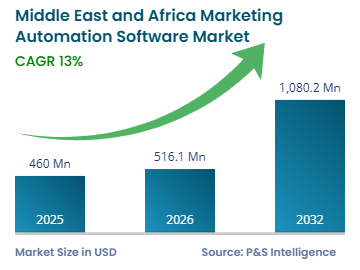
Market Size in 2025
USD 460.0 Million
Market Size in 2026
USD 516.1 Million
Market Size by 2032
USD 1080.2 Million
Projected CAGR
13%
Largest Country
Turkey
Fastest-Growing Country
Saudi Arabia
Market Structure
Fragmented
Market Size
Explore the market potential with our data-driven report
Middle East and Africa Marketing Automation Software Market Analysis
The Middle East and Africa marketing automation software market size was USD 460.0 million for 2025, and it will grow by 13.0% during 2026–2032, to reach USD 1,080.2 million by 2032.
The growth is driven by the rapid digitalization, high social media usage, increased adoption of e-commerce and digital transactions, and expanded investment in digital infrastructure by large enterprises and small to medium size enterprises. All of this is enabled by national digital economy development strategies, such as Saudi Arabia's vision 2030, the United Arab Emirates' Digital Government Strategy, and Smart Africa initiatives. In addition, the significant investments in broadband and cloud infrastructure by regional telecommunications regulatory bodies and information communication technology (ICT) ministries drive the market.
In particular, SMEs are significantly driving the pace of adoption through heavy investment in cloud-based automation platforms which provide scalable marketing operations at minimal capital expenditure. They are supported by government SME digitization programs, cloud adoption incentives, and startup support frameworks across the region.
Key Market Insights
Cloud-based deployment dominated the market in 2025 with a share of 55%, supported by expanding regional digital infrastructure and cloud-first policies.
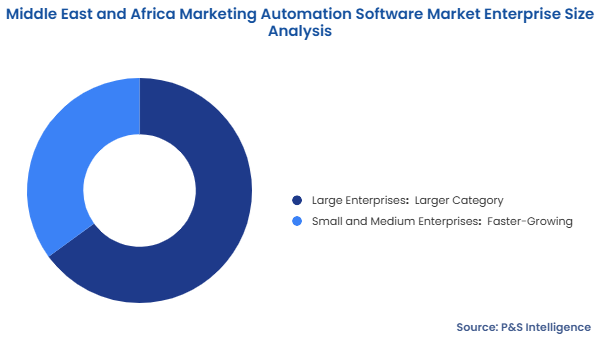
Large enterprises accounted for the largest share of 65% of total market revenue, driven by complex, multi-channel marketing requirements.
SMEs represent the fastest-growing segment, registering a CAGR of 13.3% during the forecast period.
E-commerce is the fastest-growing vertical, driven by rapid growth in online transactions, rising mobile commerce adoption, and strong demand for automated, personalized customer engagement.
Middle East and Africa Marketing Automation Software Market Dynamics
Cloud-Based Deployment Models Are Key Trends
Marketing automation platforms experience a fundamental shift in their business models, due to the impact of cloud-based technology on how these businesses reach markets, especially those with limited resources. The cloud model removes the high upfront costs for the purchase of the necessary infrastructure and automatically updates the marketing automation platform. This offers organization access to new capabilities without having to invest in IT staff or infrastructure. As per reports, Middle East data center capacity is projected to expand from 1 Gigawatts in 2025 to 3.3 Gigawatts within five years, creating robust foundation for cloud-based marketing automation adoption.
Regional governments report high levels of readiness for cloud computing, with Saudi Arabia reporting an Internet penetration rate of over 98% and the UAE reporting an Internet penetration rate of over 99%. This represents a solid foundation for the first wave of cloud-based enterprise applications. E-commerce and digital payment adoption is accelerated by the initiatives of the Ministry of Communications and Information Technology (MCIT) and the Digital Government Authority (DGA), such as promoting cloud-based services, digital platforms, and data-driven service delivery.
A significant portion of consumers use smartphones and mobile internet, creating increasing demand for automated and omnichannel customer engagement solutions. Additionally, the regulations, such as the Personal Data Protection Law (PDPL), issued by the Saudi Data and Artificial Intelligence Authority (SDAIA), are forcing companies to adopt marketing automation platforms that meet regulatory standards related to customer consent, secure data handling, and analytics-based personalization.
Government Digital Transformation Mandates and E-Commerce Expansion Are Biggest Drivers
The national digital transformation initiatives in Saudi Arabia, the UAE, and South Africa, the Technology Innovation Agency, and Turkey's ICT Strategy drive the market with their emphasis on modernized business processes, a digital economy, and new technologies.
The Saudi Vision 2030 implementation programs prioritize digital transformation of a significant proportion of all government services and government workflows. The UAE Digital Government Strategy reports that more than 96% of priority government services have been completely digitized, creating a strong signal of private sector digital engagement and use of marketing automation solutions. In addition to providing long-term procurement contracts for these solutions, these government-led initiatives emphasize multi-year digital skills development programs and public–private partnerships to minimize the hurdles to adoption.
At the same time, growth in e-commerce as well as digital payments across the region is increasing marketing automation needs within the retail, consumer goods, and financial services sectors. Publications from governments and central banks in the GCC show that digital payments make up over 70% of total payment volume in the UAE and Saudi Arabia. This shows an increase in usage of online and mobile commerce and creates an increased need to use automated and data-driven platforms for engaging with customers.
As a result, financial institutions, retail companies, and hotel chains are implementing CCCM and L2RM technologies to minimize customer acquisition costs, drive successful conversions from leads, and increase the overall value of each customer throughout their lifetime. This is done by using dynamic data driven campaign optimization based on customers' behavior.
Middle East and Africa Marketing Automation Software Market Segmentation Analysis
Solution Analysis
The cross-channel campaign management category holds the largest market share, of 30%, in 2025. This is due to government-led digital service delivery mandates and digital banking frameworks that have been implemented in the Middle East and Africa. Moreover, over 90% of priority public services being provided through digital means in the UAE, which has increased the need for an Omnichannel approach to Communications.
The real-time interaction management category will have the highest CAGR, due to the increasing demand for dynamic and context-sensitive customer engagement which responds immediately to customer behaviors, locations, and/or other behavioral triggers. Customers now interact with businesses in real time via web, mobile app or other on an ever-growing number of occasions in e-commerce, mobile banking, and digital service platforms in the region.
The large enterprises category holds the largest market share, of 65%, in 2025. These firms invest significantly in marketing automation platforms to support their overall CRM, ERP, and data warehouse systems. Large companies have full-time marketing operations staff to manage the complex automated workflow processes. They also need enhanced security and compliance features to meet data protection requirements. Additionally, economies of scale allow them to spend the necessary amounts implementing the system, as well as ongoing licensing fees.
The SMEs category will have the highest CAGR, as a result of increased access to cloud-based platforms. Cloud eliminates the need for traditional IT infrastructure, requires less technical expertise, and allows for seamless integration into day-to-day operations. A subscription model ties costs directly to growth of the business, rather than an upfront, large capital expenditure. Government and international government sources indicate that SMEs account for greater than 90% of all registered businesses in the MEA.
The enterprise sizes analyzed in this report are:
Large Enterprises (Largest Category)
Small and Medium Enterprises (SMEs) (Fastest-Growing Category)
Deployment Analysis
The cloud category holds the largest market share, of 55%, in 2025, and it will have the highest CAGR, of 13.3%. This is due to the substantially lower total cost of ownership from no hardware purchases or data center operations. Automatic platform upgrades enable continuous access to the most0recent features without the need for a large-scale manual update project. Additionally, inherent scalability allows organizations to scale their capacity instantly. The government and ICT authorities in the region indicate approximately 15–25% annual rise in the adoption of cloud-based business applications by enterprises of all sizes.
The deployments analyzed in this report are:
On-Premises
Cloud (Larger and Faster-Growing Category)
Industry Analysis
The BFSI category holds the largest market share, in 2025, as BFSI companies compete intensely for customer acquisition and retention and, therefore, need advanced segmentation and personalization capabilities. There is too much regulatory burden on this sector that requires detailed audit trails and detailed consent management. There is a large customer lifetime value associated with each customer within the BFSI sector. This justifies large marketing technology expenditures as customers are increasingly using digital channels for their interaction with BFSI companies.
Healthcare is the fastest-growing category, with 13.2% CAGR. Healthcare organizations across the Middle East and Africa are rapidly adopting marketing automation to improve patient engagement, streamline communication, and enhance digital outreach. The sector’s push toward digital transformation, telemedicine, and personalized care has accelerated demand for tools that can manage campaigns, automate patient reminders, and deliver targeted health information. Unlike traditional industries, healthcare’s growth is fueled by both necessity and innovation, making it a standout adopter of automation solutions. This trend reflects the region’s broader shift toward technology-driven service delivery.
The industries analyzed in this report are:
Banking, Financial Services, and Insurance (BFSI) (Largest Category)
Telecom & IT
Retail
Automotive
Manufacturing
Hospitality
Healthcare (Fastest-Growing Category)
Government
Media & Entertainment
Education
Others
Drive strategic growth with comprehensive market analysis
Middle East and Africa Marketing Automation Software Market Regional Outlook
Turkey Marketing Automation Software Market Size
Turkey holds the largest market share, of 25%, in 2025, as a result of the growth of its e-commerce industry, advancement of its telecommunications systems, and the rapid development of its digital economy. The total value of e-commerce sales in the nation was over TRY 3 trillion, as reported by the Ministry of Trade of Türkiye in 2024. E-commerce's contribution to GDP has continued to rise since the pandemic, thereby generating continued demand for digital marketing & automation platforms.
According to the Turkish Statistical Institute (TÜİK), over 50% of the individuals 16–74 years old in Turkey have purchased goods online. Internet penetration continues to grow throughout the nation, creating an increased need for multi-channel campaign management and customer analytic tools due to the growing use of digital commerce.
Saudi Arabia Marketing Automation Software Market Size
Saudi Arabia will have the highest CAGR, of 13.1%, due to the massive investments in Cloud and Data Infrastructure from the government's vision 2030, national and private-sector digitization programs and services across all sectors. All of these are a result of focus on the Digital Transformation Program within Vision 2030's Implementation Framework. Additionally, the increasing use of digital services, rising adoption of AI solutions by the public and private sectors, and customer-focused digital engagement and interactions drive the market.
The rapid development of e-commerce and digital payments in the Kingdom of Saudi Arabia will be further accelerated through various programs launched by the Ministry of Communications and Information Technology (MCIT) and the Digital Government Authority to promote cloud adoption, digital platforms, and data-driven service delivery solutions. Due to the high smartphone penetration rates and widespread mobile internet usage, demand for automated omnichannel customer engagement solutions is expected to grow rapidly.
Government regulations, such as the Personal Data Protection Law (PDPL) implemented by the Saudi Data and AI Authority (SDAIA), drive businesses to utilize marketing automation solutions for consent management, data handling, and analytics-based personalization. Increasingly, SMEs are utilizing cloud-based marketing automation solutions through digitization and entrepreneurship programs backed by the government.
The countries studied in the market are as follows:
Turkey (Largest Country Market)
Saudi Arabia (Fastest-Growing Country Market)
UAE
South Africa
Egypt
Nigeria
Rest of MEA
Middle East and Africa Marketing Automation Software Market Share
The market has a fragmented structure, with several large global enterprise software companies and specialized vendors. Moreover, new regional players are entering the marketplace to meet the various needs of various industries across the MEA. This fragmentation is primarily due to structural differences between the different countries, which create different demand profiles for marketing solutions based upon each country's level of enterprise technology maturity, data sovereignty requirements, and applications.
Salesforce.com Inc., Oracle Corporation, Adobe Systems Incorporated, Microsoft Corporation, and SAP SE have significant positions marketplace because they offer complete Enterprise Suites that combine marketing automation with their overall CRM, analytics, and customer experience platform offerings. On the other hand, HubSpot Inc. and Act-On Software Inc. target the mid-market and SMEs with affordable pricing and easy-to-use interfaces. Further, their limited feature sets allow for quicker implementations rather than offering complete enterprise-level functionality.
The market continues to evolve through technology partnerships, regional expansions, and feature developments that focus on mobile-first architectures, social media integration, and meeting emerging data protection regulations in the Middle East and Africa. This will drive competition further and make the market more fragmented.
Key Middle East and Africa Marketing Automation Software Companies:
Oracle Corporation
IBM Corporation
Adobe Systems Incorporated
Salesforce.com Inc.
SAP SE
SAS Institute Inc.
HubSpot Inc.
Teradata Corporation
Act-On Software Inc.
Infusionsoft Inc.
Cognizant Technology Solutions Corporation
Liana Technologies
Netcore Solutions Pvt. Ltd.
Zoho Corporation
Microsoft Corporation
Middle East and Africa Marketing Automation Software Market News
In November 2024, Microsoft Corporation introduced Copilot and a number of other AI-based tools into its customer engagement and marketing software suite. Updates to these tools were introduced at Microsoft Ignite 2024 and provide support for a variety of AI-based tasks such as data-driven campaign management, personalization, and analytics for businesses using enterprise-level solutions.
In October 2024, Salesforce.com Inc. released Agentforce, a platform for autonomous AI agents that was announced at Dreamforce 2024. It enables large enterprises to deploy AI agents to marketing, sales and service workflows allowing them to execute campaigns, engage with customers and make decisions based on data using AI enabled automated solutions.
In September 2024, HubSpot Inc. launched Breeze AI at its annual INBOUND conference, including AI Copilots and AI Agents that will allow for the automation of marketing workflows, improve analytics, and unify marketing, sales, and customer support data.
In March 2024, Adobe Inc. added more AI-driven personalization, advanced analytics, and cross-channel campaign planning to Adobe’s Marketing Cloud, including Adobe Campaign and Marketo Engage. The updated platform allows for automation of multi-step, multi-channel marketing campaigns that are currently manually performed by employees of larger companies.
In May 2024, SAP SE announced an improved version of its SAP CX product suite at SAP Sapphire 2024. The improvements are focused on the ability to use AI to analyze customer behavior and integrate data from all channels for real-time customer interaction. This is important for large companies using ERP systems and/or CRM systems.
Frequently Asked Questions About This Report
What is the Middle East and Africa marketing automation software market in 2025?+
The MEA marketing automation software market was valued at USD 460.0 million.
What factors are driving growth of the MEA marketing automation software market?+
Key growth drivers include rising e-commerce activity, increasing internet and smartphone penetration, demand for personalized customer engagement, and government-led digitalization initiatives.
Which deployment model dominates the MEA marketing automation software market?+
The cloud-based deployment dominates the MEA marketing automation software market.
What trends are shaping the future of the MEA marketing automation software market?+
Key trends include growing adoption of AI-driven analytics, increased focus on omnichannel marketing strategies, expanding use of customer journey automation, and wider SME adoption.
Want a report tailored exactly to your business need?
Leading companies across industries trust us to deliver data-driven insights and innovative solutions for their most critical decisions. From data-driven strategies to actionable insights, we empower the decision-makers who shape industries and define the future. From Fortune 500 companies to innovative startups, we are proud to partner with organisations that drive progress in their industries.
Client Testimonials
Working with P&S Intelligence and their team was an absolute pleasure – their awareness of timelines and commitment to value greatly contributed to our project's success. Eagerly anticipating future collaborations.
McKinsey & Company
India
Unmatched Standards
Our insights into the minutest levels of the markets, including the latest trends and competitive landscape, give you all the answers you need to take your business to new heights
Complete Data Security
We take a cautious approach to protecting your personal and confidential information. Trust is the strongest bond that connects us and our clients, and trust we build by complying with all international and domestic data protection and privacy laws