Middle East and Africa Compressor Market Size & Share Analysis - Emerging Trends, Growth Opportunities, Competitive Landscape, and Forecasts (2026 - 2032)
This Report Provides In-Depth Analysis of the Middle East and Africa Compressor Market Report Prepared by P&S Intelligence, Segmented by Type (Positive Displacement), Lubrication Type (Oil-flooded, Oil-free), Portability (Stationary, Portable), Pressure (Low, Medium, High, Hyper, Ultra-Low), Application (Oil and Gas, Automotive, HVAC-R, Chemical and Cement, Industrial Manufacturing, Power, Construction, Food and Beverage, Textile), and Geographical Outlook for the Period of 2021 to 2032
Middle East and Africa Compressor Market Revenue Insights
Key Highlights
Study Period
2021 - 2032
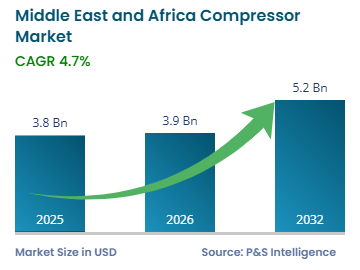
Market Size in 2025
USD 3.8 Billion
Market Size in 2026
USD 3.9 Billion
Market Size by 2032
USD 5.2 Billion
Projected CAGR
4.7%
Largest Country
Saudi Arabia
Fastest-Growing Country
Saudi Arabia
Market Structure
Fragmented
Market Size
Explore the market potential with our data-driven report
Middle East and Africa Compressor Market Overview
The Middle East and Africa compressor market size was USD 3.8 billion for 2025, and it will grow by 4.7% during 2026–2032, to reach USD 5.2 billion by 2032.
This growth is driven by expanding oil & gas exploration activities and increasing industrial infrastructure development across key regional economies. Compressors are experiencing heightened demand for applications ranging from gas compression and pipeline transportation to petrochemical processing and power generation, positioning the market as a critical component of the region's industrial transformation.
The International Energy Agency (IEA) reports that the Middle East invested approximately USD 130 billion in oil & gas supply in 2025, reinforcing the sector's infrastructure requirements for compression equipment. Additionally, technological advancement in energy-efficient compressor designs and the adoption of variable speed drives are reshaping market dynamics, particularly as industrial facilities pursue operational efficiency amid rising energy costs.
Middle East and Africa Compressor Market Growth Factors
Rising Adoption of Energy-Efficient and Electrically Optimized Compressors Is Key Trend
Energy-efficient compressor adoption is expanding across multiple priority industrial sectors in the Middle East and Africa, driven by rising electricity costs, industrial modernization programs, and stronger expectations around operational efficiency. Industries are increasingly shifting toward variable-speed drive compressors, high-efficiency IE3 and IE4 motors, and digitally controlled systems that adjust output to real operating demand rather than running continuously at full load.
This trend is reinforced by policy direction rather than short-term incentives. Regional governments are placing greater emphasis on measurable reductions in industrial energy intensity, particularly within national transformation agendas. Saudi Vision 2030 and the UAE’s Net Zero 2050 framework both prioritize efficiency improvements at the equipment and process level, especially in energy-intensive industries. The UN Industrial Development Organization estimates that optimized compressed-air systems can reduce energy consumption by 25–40%, a level of savings that has accelerated retrofit decisions even in mature industrial facilities. In several African economies, programs supported by the World Bank emphasize lowering industrial power demand to ease grid constraints, further strengthening demand for efficient, electrically optimized compressor technologies across the MEA region.
Sustained Expansion of Oil, Gas, and Industrial Infrastructure Investment Is Biggest Driver
Large-scale investment in oil, gas, and associated industrial infrastructure continues to be a primary driver of compressor demand across the Middle East and Africa, as countries prioritize production capacity, processing reliability, and export resilience. The region accounts for over 30% of global crude oil production and nearly 20% of global natural gas output, according to the International Energy Agency, which inherently requires extensive compression for gas gathering, pressure boosting, reinjection, and processing operations.
Beyond hydrocarbons, industrial infrastructure development is reinforcing this driver across both the Middle East and Africa. Governments are accelerating investments in manufacturing zones, power generation, cement production, and large-scale construction, creating steady demand for compressors used in processing, utilities, and site operations.
The World Bank estimates that Africa alone requires over USD 100 billion per year in infrastructure investment to meet growth and urbanization needs, much of which is directed toward energy, transport, and industrial projects. At the same time, OPEC highlights that Middle Eastern countries are increasingly focusing on natural gas monetization and downstream value addition, further expanding compressor requirements.
In August 2025, Saudi Aramco entered into a lease-and-leaseback agreement valued at approximately USD 11 billion with an international consortium led by Global Infrastructure Partners for midstream assets associated with the Jafurah unconventional gas field. This agreement resulted in the establishment of a dedicated midstream company and explicitly monetized gas infrastructure to facilitate further expansion and downstream integration.
In January 2026, Aramco took another step forward in gas monetization by finalizing a long-term LNG supply agreement with Commonwealth LNG, which represents a strategic entry into the global LNG trading and downstream gas markets.
Additionally, in January 2026, Qatar announced that the total value of gas-sector contracts awarded in 2025 amounted to around USD 12.3 billion, more than double the amount recorded in 2024. This surge was primarily driven by the expansion of LNG and related gas processing projects under QatarEnergy’s North Field development.
Furthermore, in January 2026, TotalEnergies and Bahrain’s Bapco Energies initiated a joint trading venture aimed at enhancing downstream value addition through refined products and energy trading. This initiative complements Bahrain’s recently expanded refinery capacity and supports the region’s broader transition towards gas monetization and downstream integration.
South Africa's industrial policy framework supports sustained compressor market growth through infrastructure investment programs and manufacturing competitiveness initiatives. South African Department of Trade, Industry and Competition outlined in its Strategic Plan 2025-2030 the focus on diversification, decarbonization, and digitalization as core strategies for industrial development.
Middle East and Africa Compressor Market Segmentation and Category Analysis
Type Analysis
The positive displacement category holds the largest market share, of 60%, in 2025. This is due to their extensive deployment in oil & gas production, refining, petrochemicals, and industrial manufacturing, where stable flow rates and high-pressure reliability are essential. Rotary screw compressors alone account for a significant portion of this demand due to their suitability for continuous-duty industrial operations. National oil companies, such as Saudi Aramco, ADNOC, and QatarEnergy, continue to expand gas compression, enhanced oil recovery, and refinery throughput capacity, reinforcing the large installed base of reciprocating and screw compressors across the region.
The dynamic compressors category will have the highest CAGR, of 4.9%. This is due to large-scale natural gas processing plants, LNG export terminals, petrochemical complexes, and power generation projects, where centrifugal compressors are preferred for handling high volumetric flow rates. The IEA and OPEC both highlight natural gas as the fastest-growing fossil fuel in the Middle East energy mix, driven by power generation and export demand. Mega-projects, such as Saudi Arabia’s Jafurah gas field, Qatar’s North Field expansion, and Mozambique LNG developments, require high-efficiency, large-capacity compression systems aligned with regional energy diversification strategies.
The types analyzed in this report are:
Positive Displacement (Larger Category)
Reciprocating
In-line
V-shaped
Tandem-piston
Single-acting
Double-acting
Diaphragm
Rotary
Screw
Vane
Lobe and scroll
Dynamic (Faster-Growing Category)
Centrifugal
Axial flow
Lubrication Type Analysis
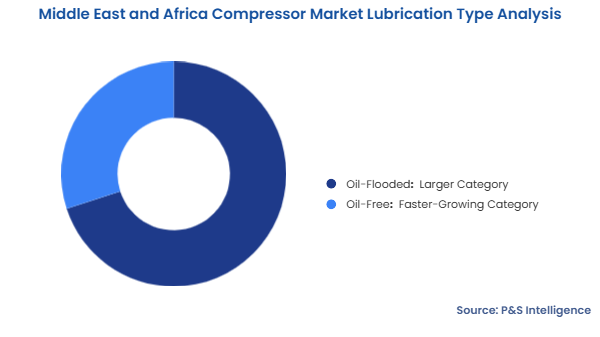
The oil-flooded category holds the largest market share, of 70%, in 2025, driven by its cost-effectiveness, durability, and widespread industrial acceptance. These compressors are extensively used in oil & gas, construction, mining, cement, and general manufacturing, where air purity standards are less restrictive. According to the World Bank, industrial energy consumption in the Middle East and Africa continues to rise due to expanding manufacturing bases and infrastructure projects, particularly in Saudi Arabia, the UAE, Egypt, and South Africa. Oil-flooded rotary screw compressors are favored in these applications due to lower upfront costs and easier maintenance under harsh operating conditions typical of MEA climates.
The oil-free category will have the highest CAGR, of 5.0%, driven by stricter quality and safety regulations. Growth is concentrated in food & beverage, pharmaceuticals, electronics, healthcare, and hydrogen-related applications. Government-led industrial quality frameworks such as Saudi Vision 2030, the UAE Industrial Strategy 300bn, and ISO 8573-1 Class 0 air standards adoption are pushing industries toward contamination-free compressed air systems. Additionally, the UN Industrial Development Organization (UNIDO) has highlighted increasing compliance with global manufacturing standards across Africa and the Middle East, accelerating the transition toward oil-free compression technologies.
The lubrication types analyzed in this report are:
Oil-Flooded (Larger Category)
Oil-Free (Faster-Growing Category)
Portability Analysis
The stationary category holds the largest market share, of 75%, in 2025, supported by their integration into fixed industrial facilities, refineries, power plants, cement kilns, and manufacturing units. These systems are essential for continuous, high-capacity operations and long operational lifecycles. Large-scale infrastructure projects under Saudi Arabia’s Vision 2030, Egypt’s industrial expansion programs, and Nigeria’s gas monetization initiatives continue to drive sustained demand for stationary compressors.
The portable category will have the highest CAGR, due to rapid growth in construction, mining, utilities, and rental equipment markets. Governments across the region are heavily investing in infrastructure. Portable compressors are increasingly used in road construction, pipeline maintenance, water utilities, and off-grid industrial operations, particularly in Africa where decentralized infrastructure projects are expanding rapidly.
The portability analyzed in this report are:
Stationary (Larger Category)
Portable (Faster-Growing Category)
Pressure Analysis
The medium-pressure category holds the largest market share, of 45%, in 2025, as they are widely used across manufacturing, HVAC-R, automotive assembly, food processing, and general industrial applications. Their versatility and compatibility with standard industrial processes make them the preferred choice across both developed and emerging MEA economies. According to the United Nations Industrial Development Organization, manufacturing output in Arab countries has grown steadily in recent years, with industrial diversification and expansion of medium- and higher-technology manufacturing sectors.
The high-pressure category will have the highest CAGR, driven by natural gas compression, hydrogen production, LNG processing, and petrochemical feedstock applications. The IEA Hydrogen Roadmap identifies the Middle East as a key future hub for low-carbon hydrogen production, requiring high-pressure compression for storage and transport. Saudi Arabia, the UAE, and Oman have announced multiple green and blue hydrogen projects, directly increasing demand for high-pressure and hyper-pressure compressor systems.
The pressure ratings analyzed in this report are:
Low
Medium (Largest Category)
High (Fastest-Growing Category)
Hyper
Ultra-Low
Application Analysis
The oil & gas category holds the largest market share, of 40%, in 2025. Compressors are critical across upstream gas gathering, midstream pipeline transmission, LNG liquefaction, and downstream refining operations. According to the IEA, the Middle East accounts for over 30% of global oil production and nearly 20% of global natural gas output, ensuring sustained compressor demand. National oil companies continue to invest heavily in capacity expansion, sour gas processing, and EOR technologies, all of which rely extensively on advanced compression equipment. The enhanced oil recovery market in Saudi Arabia is expected to produce an estimated revenue of USD 3,843.1 million by the year 2030.
The HVAC-R category will have the highest CAGR, of 4.8%, driven by urbanization, extreme climate conditions, population growth, and commercial real estate expansion. Government-led energy efficiency programs such as the Saudi Energy Efficiency Program and the UAE’s Estidama and Net Zero 2050 strategy are accelerating the replacement of legacy HVAC systems with high-efficiency compressor technologies.
The International Finance Corporation and the United Nations Environment Programme project that the sustainable cooling market in developing economies, including parts of the Middle East and Africa, will grow from about USD 300 billion today to at least USD 600 billion annually by 2050. Moreover, the HVAC market value in the Middle East and Africa is projected to grow to USD 13,267.7 million by 2030.
The applications analyzed in this report are:
Oil & Gas (Largest Category)
Automotive
HVAC-R (Fastest-Growing Category)
Chemical & Cement
Industrial Manufacturing
Power
Construction
Food & Beverage
Textile
Others
Drive strategic growth with comprehensive market analysis
Middle East and Africa Compressor Market Regional Outlook
Saudi Arabia Compressor Market Size
Saudi Arabia holds the largest market share, of 25%, in 2025, and it will have the highest CAGR during the forecast period. This dominance stems from possessing the region's largest oil & gas production infrastructure, requiring extensive compression systems, and industrial diversification program under Vision 2030. The convergence of traditional hydrocarbon processing expansion and new industrial facility development creates sustained demand for both positive displacement and dynamic compressor technologies.
Saudi Arabia's industrial transformation has accelerated compression equipment requirements through strategic infrastructure investments and localization mandates. Saudi Arabia's Ministry of Industry and Mineral Resources reports that industrial establishments increased by 60% from 7,206 in 2016 to 11,549 in 2023, driven by Vision 2030 initiatives. The National Industrial Development and Logistics Program has catalyzed demand through the development of 40 industrial cities and specialized clusters focusing on petrochemicals, automotive, and food processing sectors.
The kingdom's compressor market trajectory strengthens through 2032 as mega-projects, including NEOM's industrial facilities and expanded petrochemical complexes at Jubail and Yanbu, require advanced compression systems. Energy efficiency mandates and the transition toward Industry 4.0 technologies are driving adoption of smart compressors with digital monitoring capabilities, positioning Saudi Arabia at the forefront of regional compression technology advancement.
UAE Compressor Market Size
The United Arab Emirates is the second-largest market through strategic positioning as a manufacturing and logistics hub connecting global markets. The UAE's compressor demand benefits from the industrial strategy targeting an AED 300-billion manufacturing contribution to GDP by 2031. This will create substantial requirements for compressed air systems across 12 priority industrial sectors, including aerospace, pharmaceuticals, and advanced electronics. This, combined with sustained oil & gas infrastructure investments, drives diversified compressor adoption across multiple end-use segments.
The UAE's manufacturing sector transformation accelerates compressor deployment through coordinated federal and emirate-level initiatives. UAE Ministry of Industry and Advanced Technology confirms that industrial sector contribution to GDP reached AED 205 billion in 2023, representing 11% of national GDP with continued growth trajectory. The National In-Country Value Program has redirected over AED 73 billion into the domestic economy, stimulating local manufacturing facilities requiring advanced compression systems.
Future growth prospects remain robust as the UAE advances its position as the regional hub for Industry 4.0 adoption and sustainable manufacturing. The Emirates Development Bank's allocation of AED 30 billion for priority industrial sectors over five years ensures continued investment in manufacturing infrastructure requiring state-of-the-art compression equipment, particularly in clean energy manufacturing and pharmaceutical production facilities.
The countries covered in the market are as follows:
Saudi Arabia (Largest and Fastest-Growing Country)
UAE
Kuwait
Qatar
Bahrain
Egypt
South Africa
Rest of MEA
Middle East and Africa Compressor Market Share Analysis
The market is fragmented, with the presence of major global and regional manufacturers alongside a large number of local suppliers serving different capacity ranges and end-use applications. The market exhibits fragmentation as no single supplier dominates across all capacity classes or application segments. Large, technically complex projects, such as oil & gas processing facilities, LNG terminals, petrochemical plants, large power stations, and major industrial complexes, are typically supplied by manufacturers with strong engineering capabilities, extensive reference projects, and the ability to meet stringent performance, safety, and reliability requirements. This creates barriers and limits the entry of small, niche, and emerging players.
Additionally, medium- and small-capacity compressor demand is addressed by a wider pool of suppliers across construction, HVAC-R, utilities, and general manufacturing. In many African and non-GCC Middle Eastern markets, purchasing decisions are strongly influenced by price competitiveness, local service availability, and faster delivery timelines. Variations in climate conditions, regulatory requirements, and localized procurement practices further shape competitive dynamics across the region.
Top Middle East and Africa Compressor Producers:
Atlas Copco AB
Ingersoll Rand plc
Burckhardt Compression Holding AG
MAN SE
Mitsubishi Heavy Industries Ltd.
General Electric Company
Flowserve Corporation
Kaeser Kompressoren SE
Kobe Steel Ltd.
ANEST IWATA Corporation
Siemens Energy AG
Baker Hughes Company
Middle East and Africa Compressor Market News & Updates
In July 2025, Ingersoll Rand acquired United Air Power, a UK-based compressed air services provider, strengthening its compressor systems and service business across Europe, the Middle East, Africa, and India with enhanced installation, maintenance, and distribution capabilities.
In July 2025, Ingersoll Rand completed a major acquisition of Termomeccanica Industrial Compressors S.p.A. and Adicomp, enhancing its engineered air and gas compression technologies and positioning it for growth in renewable natural gas and industrial gas-handling markets.
In December 2023, Cummins Inc. and Sullivan Palatek formed a strategic alliance to distribute Sullivan Palatek’s diesel-driven portable air compressors in the UAE, expanding product availability and after-sales support through Cummins Arabia’s established network in the region.
Frequently Asked Questions About This Report
What is the current market size of the Middle East & Africa compressor market?+
The Middle East & Africa compressor market was valued at USD 3.8 billion in 2025.
What is the expected CAGR of the MEA compressor market during the forecast period?+
The MEA compressor market is growing CAGR of 4.7% during 2026
Which countries dominate the compressor market in the Middle East & Africa region?+
Saudi Arabia is the largest and fastest-growing market.
What are the key industries driving compressor demand in the MEA region?+
The key demand comes from oil & gas, power generation, petrochemicals, mining, water & wastewater treatment, manufacturing, and large commercial HVAC applications.
Which compressor type holds the largest market share in the Middle East & Africa?+
Positive displacement dominates the Middle East and Africa compressor market.
What are the major growth drivers and challenges impacting the MEA compressor market?+
The major growth drivers include energy infrastructure expansion, industrial diversification, and efficiency regulations, while challenges include high capital costs, energy price volatility, and maintenance constraints in remote operating environments.
Want a report tailored exactly to your business need?
Leading companies across industries trust us to deliver data-driven insights and innovative solutions for their most critical decisions. From data-driven strategies to actionable insights, we empower the decision-makers who shape industries and define the future. From Fortune 500 companies to innovative startups, we are proud to partner with organisations that drive progress in their industries.
Client Testimonials
Working with P&S Intelligence and their team was an absolute pleasure – their awareness of timelines and commitment to value greatly contributed to our project's success. Eagerly anticipating future collaborations.
McKinsey & Company
India
Unmatched Standards
Our insights into the minutest levels of the markets, including the latest trends and competitive landscape, give you all the answers you need to take your business to new heights
Complete Data Security
We take a cautious approach to protecting your personal and confidential information. Trust is the strongest bond that connects us and our clients, and trust we build by complying with all international and domestic data protection and privacy laws