Middle East and Africa (MEA) Commercial Refrigeration Equipment Market Size & Share Analysis - Emerging Trends, Growth Opportunities, Competitive Landscape, and Forecasts (2026 - 2032)
This Report Provides In-Depth Analysis of the Middle East and Africa Commercial Refrigeration Equipment Market Report Prepared by P&S Intelligence, Segmented by Product Type (Walk-In Coolers, Beverage Refrigeration Equipment, Display Showcases, Ice Merchandizers & Ice Vending Equipment), Application (Food Service, Food & Beverage Production, Food & Beverage Retail), End User (Hospitality, Department Stores, Healthcare, Offices & Buildings, Convenience Stores, Government), and Geographical Outlook for the Period of 2021 to 2032
Explore the market potential with our data-driven report
Middle East and Africa Commercial Refrigeration Equipment Market Outlook
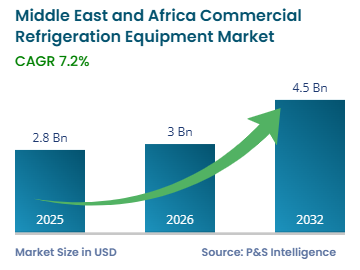
The Middle East and Africa (MEA) commercial refrigeration equipment market size was USD 2.8 billion for 2025, and it will grow by 7.2% during 2026–2032, to reach USD 4.5 billion by 2032.
This growth is supported by the expansion of hospitality infrastructure, rising demand for walk-in coolers in food service establishments, and expanding cold chain networks in a region where hot and humid climate conditions accelerate the need for reliable refrigeration across hotels, restaurants, supermarkets, and food distribution facilities. According to official data from the United Arab Emirates Ministry of Economy, hotel establishment revenues surpassed AED 24.6 billion in the first half of 2024, reflecting a 7% year-on-year increase. While, hotel guest numbers reached approximately 15.3 million during the same period, marking a 10.5% growth.
Middle East and Africa Commercial Refrigeration Equipment Market Dynamics
IoT Integration Is Key Trend Transforming Refrigeration Management Systems
The commercial refrigeration equipment market is undergoing a structural transformation as IoT technologies enable real-time monitoring, predictive maintenance, and energy optimization across walk-in coolers and display cases. Hotels, restaurants, and supermarkets in the MEA region are adopting smart refrigeration systems that provide automated inventory management, alert staff of approaching product expiration, and enable remote diagnostics to minimize downtime during peak tourist seasons. This digital transformation is particularly pronounced in Gulf Cooperation Council countries, where hospitality chains deploy IoT sensors to ensure food safety compliance while reducing operational costs through automated compressor speed adjustment and predictive component replacement.
This adoption is reinforced by government-mandated food safety and temperature monitoring requirements enforced by municipal health authorities across GCC countries, which increasingly recognize digital temperature logging and remote monitoring as compliant tools for refrigerated food storage oversight. Additionally, national energy efficiency programs, such as Saudi Energy Efficiency Center and Dubai Municipality, are promoting smart controls and connected equipment as part of broader digital energy management initiatives for commercial buildings, indirectly supporting IoT-enabled refrigeration deployment.
Tourism and Hospitality Infrastructure Expansion Is Biggest Driver
The unprecedented expansion of tourism and hospitality infrastructure across Saudi Arabia, UAE, and South Africa is creating sustained demand for commercial refrigeration equipment in hotels, restaurants, food service establishments, and catering facilities. This hospitality boom, is driven by Vision 2030 initiatives in Saudi Arabia and the National Tourism Strategy 2031 in the UAE. Additionally, recovery momentum in South Africa following international arrival growth to 8.9 million visitors in 2024 requires operators to procure walk-in coolers for back-of-house storage, beverage refrigeration units for bars and lounges, display cases for breakfast buffets, and transportation refrigeration for event catering across expanding hotel portfolios.
Additionally, public-sector investment programs supporting tourism infrastructure development, such as Saudi Ministry of Tourism–led Vision 2030 hospitality initiatives, the UAE Ministry of Economy National Tourism Strategy 2031, and government-backed tourism recovery programs in South Africa, directly translate into new hotel openings and refurbished hospitality assets, each requiring multiple commercial refrigeration systems across kitchens, food service zones, and catering operations.
In the MEA region, the hotel construction pipeline reached record levels with over 650 projects totaling approximately 161,500–163,800 rooms, led by Saudi Arabia with around 342 projects and over 92,000 rooms, followed by Egypt with 127 projects and over 28,000 rooms, and the UAE with 100 projects and around 25,400 rooms. Middle East outbound travel spending is projected to surpass USD 60 billion by 2030, while international visitor spending in the region is forecast at around USD 194 billion, and domestic tourism spending at approximately USD 113 billion in 2025.
Governments are driving infrastructure growth through initiatives such as Saudi Arabia’s goal of 150 million annual tourist arrivals by 2030 and Egypt’s target of 30 million international visitors by 2028, alongside large-scale investment programs like a USD 6 billion UAE–Africa tourism development initiative. Diversification efforts include medical tourism and emerging destination development, supported by improved airline connectivity and new low-cost carriers, while a regional Tourism Readiness Index highlights Southern African countries as potential growth markets. The expansion is predominantly concentrated in luxury, mid-market, and lifestyle segments, with policy support aimed at employment generation, sustainability, and long-term destination competitiveness.
Middle East and Africa Commercial Refrigeration Equipment Market Segmentation Analysis
Product Type Analysis
The walk-in coolers category holds the largest market share, of 40%, in 2025, driven by their essential role in bulk perishable storage across hotels, restaurants, catering operations, and food distribution facilities. Self-contained walk-in units offering plug-and-play installation prove especially popular among independent restaurants and mid-sized hotels seeking lower upfront investment compared to remote condensing systems. Walk-in cooler deployment is reinforced by national food safety regulations, such as the Saudi Food and Drug Authority Food Safety Law, the Dubai Municipality Food Code, and the South African Department of Health Regulations Governing General Hygiene Requirements for Food Premises. They mandate defined cold-storage segregation and continuous refrigeration for commercial food handling facilities.
In 2024, commercial foodservice and hospitality sales across GCC countries exceeded USD 120 billion, according to combined national tourism, hospitality, and foodservice revenue disclosures, underpinning sustained capital expenditure on high-value refrigeration assets such as walk-in coolers across hotels, catering facilities, and food distribution centers.
The ice merchandizers and ice vending equipment category will have the highest CAGR, propelled by rising demand from convenience stores, quick-service restaurants, and retail fuel stations expanding across urban centers to serve growing populations and changing consumption patterns. The rapid proliferation of convenience store formats across Gulf markets creates sustained procurement demand for compact ice merchandisers at store fronts for impulse purchases.
Automated outdoor ice vending machines enable 24/7 revenue generation at fuel stations and parking facilities serving late-night customers. Fuel station and convenience store networks are expanding rapidly to capture growing motorist traffic and consumer spending on grab-and-go purchases, with each new location requiring ice merchandising capabilities to serve beverage consumers and support foodservice operations.
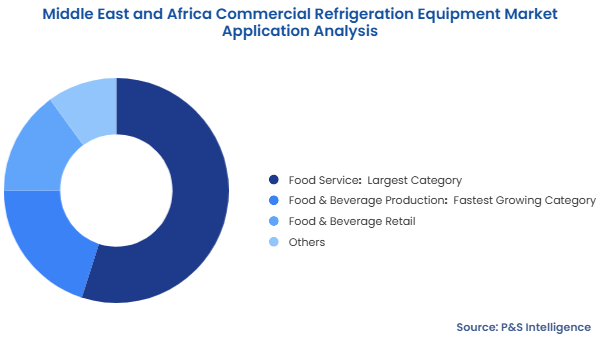
The food service category holds the largest market share, of 55%, in 2025, encompassing commercial refrigeration demand from restaurants, hotels, catering companies, institutional cafeterias, and quick-service establishments that require diverse equipment types including walk-in coolers for bulk ingredient storage, reach-in refrigerators for prep station access, display cases for dessert presentation, and beverage coolers for bar operations. In the UAE, hotel occupancy rates reached around 79.3% in 2025 across more than 216,000 hotel rooms, increasing food preparation volumes and cold storage throughput across hotel kitchens, restaurants, and catering operations, thereby reinforcing food service refrigeration demand.
The food & beverage production category will have the highest CAGR, of 7.4%, accelerated by expanding domestic food processing capacity as Gulf nations pursue food security strategies reducing import dependency through local manufacturing of dairy products, processed meats, bakery goods, and packaged meals. Regional governments are incentivizing food processing investments through favorable industrial land allocations and utility subsidies, catalyzing facility construction that requires comprehensive refrigeration infrastructure from receiving docks through production lines to distribution staging areas. These developments align with national food security and agri-industrial strategies across the Middle East and Africa, which explicitly identify cold storage and industrial refrigeration as critical infrastructure for domestic food manufacturing and supply resilience.
The applications analyzed in this report are:
Food Service (Largest Application)
Food & Beverage Production (Fastest Growing Application)
Food & Beverage Retail
Others
End User Analysis
The hospitality category holds the largest market share, of 50%, in 2025, driven by intensive refrigeration requirements across hotels, resorts, serviced apartments, and resort facilities that deploy commercial refrigeration equipment throughout guest-facing food and beverage outlets, back-of-house kitchen operations, banquet facilities, room service operations, and minibar provisioning systems. Hospitality refrigeration requirements are governed by hotel classification and licensing standards.
The Saudi Ministry of Tourism, the Department of Economy and Tourism Dubai, and provincial tourism regulators in South Africa, which prescribe minimum back-of-house food storage and refrigeration infrastructure for graded hotel properties. The UAE hospitality sector alone comprises 1,243 hotel establishments, welcoming more than 16 million guests in the first half of 2025, which translates into high refrigeration equipment density and sustained replacement demand across hotel properties.
The convenience stores category will have the highest CAGR, of 7.5%, propelled by rapid store network expansion across urban centers and transportation corridors to serve increasing demand for grab-and-go food items, cold beverages, and ready-to-eat meals among consumers with busy lifestyles and longer working hours. Convenience store refrigeration demand is influenced by urban retail zoning and mixed-use development regulations administered by municipal planning authorities across Saudi Arabia and the UAE, which permit small-format food retail and refrigerated beverage sales within residential towers, transit hubs, and fuel station developments.
The end users analyzed in this report are:
Hospitality (Largest End User)
Department Stores
Healthcare
Offices & Buildings
Convenience Stores (Fastest Growing End User)
Government
Others
Drive strategic growth with comprehensive market analysis
Middle East and Africa Commercial Refrigeration Equipment Market Geographical Analysis
Saudi Arabia Commercial Refrigeration Equipment Market Size
Saudi Arabia holds the largest market share, of 30%, in 2025, sustained by unprecedented hospitality sector expansion driven by Vision 2030 initiatives and religious tourism infrastructure development. Saudi Arabia's General Authority for Statistics (GASTAT) revealed that the total number of licensed tourism hospitality facilities reached 5,622 establishments during Q3 2025, representing a 40.6 percent increase compared to 3,998 establishments in the corresponding quarter of 2024.
This dramatic expansion in hospitality infrastructure, combined with hotel room occupancy rates reaching 63% during Q1 2025 and the development of giga-projects including NEOM, the Red Sea Project, and Diriyah Gate, is generating sustained demand for walk-in coolers, beverage refrigeration. This demand is further supported by Saudi Arabia’s enforcement of energy efficiency and conformity regulations for commercial refrigeration equipment under the Saudi Standards, Metrology and Quality Organization (SASO).
It requires imported and locally manufactured commercial refrigerators and freezers to meet defined efficiency and performance criteria. The Kingdom’s strategic positioning as a hub for Hajj and Umrah pilgrims, with arrivals exceeding 18.5 million in 2024, creates concentrated seasonal demand that requires operators to deploy high-capacity refrigeration systems capable of handling peak-period food storage and distribution.
South Africa Commercial Refrigeration Equipment Market Size
South Africa will have the highest CAGR, of 7.3%, driven by tourism recovery, retail infrastructure modernization, and hotel sector revitalization. Statistics South Africa data indicates that total income for the tourist accommodation industry increased by 11.1% in July 2025 compared to July 2024. Additionally, income from accommodations rose by 10.4% year-on-year, and hotels serving as the main contributors to this growth.
International tourist arrivals reached 8.9 million in 2024, reflecting a 5.1% increase from 2023, while hotel occupancy rates climbed to 57.4 percent in February 2025, the highest since the pandemic began, creating robust demand for commercial refrigeration across expanding hotel properties, restaurants, and supermarket chains in key provinces including Gauteng, Western Cape, and KwaZulu-Natal. South Africa’s enforcement of Minimum Energy Performance Standards (MEPS) for commercial refrigeration equipment under national energy efficiency regulations requires compliance for refrigerators, freezers, and display cabinets sold in the domestic market.
Moreover, growth is also reinforced by visa regime enhancements, including the digital Trusted Tour Operator Scheme targeting Indian and Chinese markets, which is an official government initiative aimed at increasing tourist inflows and hospitality utilization, indirectly supporting demand for refrigeration equipment across hotels and food service establishments.
The countries analyzed in the market are as follows:
Saudi Arabia (Largest Country Market)
UAE
Egypt
Kuwait
Qatar
South Africa (Fastest-Growing Country Market)
Rest of MEA
Middle East and Africa Commercial Refrigeration Equipment Market Share
The market exhibits a moderately fragmented structure, with global multinational manufacturers competing alongside regional players across equipment categories. This structure reflects the technical complexity and capital intensity of commercial refrigeration manufacturing, which creates barriers favoring established players with extensive distribution networks, technical service capabilities, and brand recognition among hospitality and retail operators. This allows regional specialists to compete effectively in specific equipment categories or countries where localized service support provides competitive advantage.
The competitive landscape is experiencing gradual evolution as sustainability requirements, IoT integration capabilities, and energy efficiency standards increasingly influence purchasing decisions, potentially favoring manufacturers with advanced technology portfolios over pure-cost competitors, though local service networks and parts availability remain critical differentiators determining long-term customer relationships in markets characterized by extended equipment lifecycles and high replacement costs.
Key Middle East and Africa Commercial Refrigeration Equipment Companies:
Frigoglass S.A.I.C.
Dover Corporation
Epta Group
Arneg Group
Hussmann Corporation
Daikin Industries Ltd.
Hoshizaki Corporation
True Manufacturing Co., Inc.
Liebherr Group
Turbo Air Inc.
Haier Group
Danfoss A/S
Middle East and Africa Commercial Refrigeration Equipment Market News
In October 2024, Danfoss A/S showcased advanced refrigeration and cold-chain solutions at Chillventa 2024, highlighting its latest energy-efficient technologies for commercial and industrial refrigeration systems, including CO₂ transcritical solutions and IoT-enabled controls, reinforcing its engagement with food retail and cold storage stakeholders from the Middle East and Africa.
In February 2024, Carrier Global Corporation announced plans to establish a manufacturing and R&D facility in Saudi Arabia in partnership with Alat to produce VRF systems, chillers, AHUs, and rooftop units for Middle East and North Africa markets.
In November 2023, Rheem Manufacturing Company (Middle East) launched the SAVR-D series of VRF units featuring energy-efficient compressors and advanced refrigerant management for hot-climate commercial applications.
Frequently Asked Questions About This Report
What is the current market size and growth rate of the MEA commercial refrigeration equipment market?+
The MEA commercial refrigeration equipment market was valued at USD 2.8 billion in 2025 and is growing at CAGR of 7.2% during the forecast period.
Which country dominate the commercial refrigeration equipment market in the Middle East and Africa?+
Saudi Arabia dominate the Middle East commercial refrigeration equipment market.
What are the key drivers and trends shaping the MEA commercial refrigeration equipment market?+
Key drivers include rapid expansion of supermarkets and convenience stores, growth in food service and hospitality, rising cold chain investments, and increasing adoption of energy-efficient and natural refrigerant-based refrigeration systems.
Which product types and end-use segments hold the largest share in the MEA commercial refrigeration equipment market?+
Walk-in coolers represent the largest product segment, while hospitality remain the leading end-use segment.
Who are the major companies operating in the MEA commercial refrigeration equipment market?+
The market features global and regional players focusing on energy-efficient systems, including manufacturers of display cases, walk-in coolers, beverage refrigeration, and cold storage solutions serving retail and hospitality customers.
Want a report tailored exactly to your business need?
Leading companies across industries trust us to deliver data-driven insights and innovative solutions for their most critical decisions. From data-driven strategies to actionable insights, we empower the decision-makers who shape industries and define the future. From Fortune 500 companies to innovative startups, we are proud to partner with organisations that drive progress in their industries.
Client Testimonials
Working with P&S Intelligence and their team was an absolute pleasure – their awareness of timelines and commitment to value greatly contributed to our project's success. Eagerly anticipating future collaborations.
McKinsey & Company
India
Unmatched Standards
Our insights into the minutest levels of the markets, including the latest trends and competitive landscape, give you all the answers you need to take your business to new heights
Complete Data Security
We take a cautious approach to protecting your personal and confidential information. Trust is the strongest bond that connects us and our clients, and trust we build by complying with all international and domestic data protection and privacy laws