Live Laser Based Training and Simulation Platforms Market Size & Opportunities Analysis - Growth Strategies, Competitiveness, and Forecasts (2025 - 2032)
This Report Provides In-Depth Analysis of the Live Laser Based Training and Simulation Platforms Market Report Prepared by P&S Intelligence, Segmented by Component (Hardware, Software), Application (Flight Simulation, Battlefield Simulation & Defense, Medic Training, Vehicle Simulation, Naval Simulation, Ground Simulation), End-User (Defense Security, Civil Aviation, Education, E-learning, Game-based Learning, Entertainment, Healthcare), and Geographical Outlook for the Period of 2019 to 2032
Live Laser Based Training and Simulation Platforms Market Valuation
Key Highlights
Study Period
2019 - 2032
Market Size in 2024
USD 1191.9 Million
Market Size in 2025
USD 1263.4 Million
Market Size by 2032
USD 2024.8 Million
Projected CAGR
7%
Largest Region
North America
Fastest Growing Region
APAC
Market Structure
Fragmented
Market Size
Major Companies
Important Takeaways
Market Size and Forecast
Industry Trend
Regulatory Landscape
Demand Trend Analysis
Companies Recent Strategical Developments
Key Stakeholders
Voice of Industry Experts/KOLs
Future Opportunity
Explore the market potential with our data-driven report
Live Laser Based Training and Simulation Platforms Market Outlook
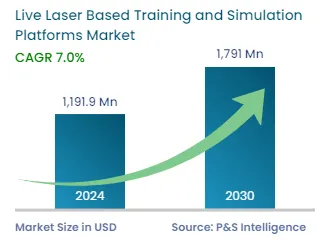
The global live laser-based training and simulation platforms market size was USD 1191.9 million in 2024, and the market size is predicted to reach USD 2024.8 million by 2032, advancing at a CAGR of 7% during 2025–2032.
The market is growing because of the increasing military spending due to the rising global tensions and being ready. This way more money means more investment in advanced and modern training systems. Training with real weapons is risky and can cause accidents which is why laser systems lets people train without danger, and still feel like real combat. Soldiers need advanced training tools as nowadays wars involve drones, cyber-attacks, and high-tech weapons. Moreover, it cuts real ammo, fuel, and equipment costs that are expensive and then it can be used again.
Technologies like AI, VR, AR, and sensors are making training more real and smarter and these tools are now being added to laser training systems. Also, many countries are now focusing on joint military exercises with other nations. Modern wars involve drones, cyberattacks, and smart weapons which is why soldiers now need advanced training systems that match the new techniques. Furthermore, the need to train soldiers for urban combat is important, as modern battles often happen in cities so laser systems are great for this because they can simulate fighting in small, crowded spaces, like buildings and streets.
Live Laser Based Training and Simulation Platforms Market Emerging Trends
Use of Artificial Intelligence in Training Systems Is a Trend
In traditional training, soldiers get feedback only after the session ends, which delays improvement therefore with AI, the system tracks performance live like aim accuracy, movement, and decisions which gives instant feedback.
This real-time guidance helps soldiers improve faster which is now expected in modern training environments.
In February 2024, the Indian government allocated INR 1 lakh crore for long-term financing of research and innovation in deep defense technologies, including AI.
Moreover, training systems can automatically adjust the difficulty of missions, suggest drills based on past performance, and also create customized training paths.
It improves results, keeps soldiers engaged, and makes training time more productive.
In medical VR training environments that use similar AI-driven feedback, error rates have been reduced by roughly 40%, suggesting similar potential in live laser-based platforms.
Training programs enhanced by wearable AI systems in industrial and athletic contexts have reported 20–30% improvements in task efficiency and precision, pointing to similar performance gains in tactical laser simulations.
The Brazilian Army is investing USD 5.6 million in constructing a realistic urban training facility in Campinas, which includes 66 buildings across 12 blocks, that are designed to improve urban crises and enhance tactical training.
Rising Demand for Safer and Cost-Effective Training Is a Growth Driver
A key driver for the growing demand for affordable training systems across industries is the urgent need to upskill large, distributed workforces without disrupting operations or overextending budgets.
As industries such as manufacturing, logistics, defense, and healthcare adopt more complex technologies including automation, AI, and robotics the skills gap is widening, especially in emerging markets and mid-tier enterprises. Traditional training methods are often too costly, time-consuming, or geographically limited to scale effectively.
Affordable training systems particularly those leveraging simulation, virtual environments, or AI-driven modules offer scalable, repeatable, and customizable solutions that reduce training costs per employee while improving retention and safety.
This shift is especially critical in sectors where high employee turnover, compliance requirements, or hazardous work environments demand frequent and efficient training cycles.
In India’s industrial sector alone, millions of new workers are expected to enter semi-skilled technical roles by 2030, fueling a strong push for cost-effective digital training platforms that can be deployed rapidly and at scale.
Using real weapons, bullets, and vehicles for training is very expensive and laser training is cheaper, militaries can train and more soldiers without worrying about the high costs.
They also eliminate the risks of injury or accidents from live ammunition, ensuring safety.
The U.S. Marine Corps implemented the Indoor Simulated Marksmanship Trainer (IMST), saving over USD 500 million in 5 years by reducing ammunition use and maintenance costs.
Moreover, laser training does not produce harmful pollution, which makes it better for the environment.
The U.K. Ministry of Defence developed the DragonFire laser system, which offers low long-term costs compared to traditional munitions.
Live Laser Based Training and Simulation Platforms Market Segmentation Analysis
Component Analysis
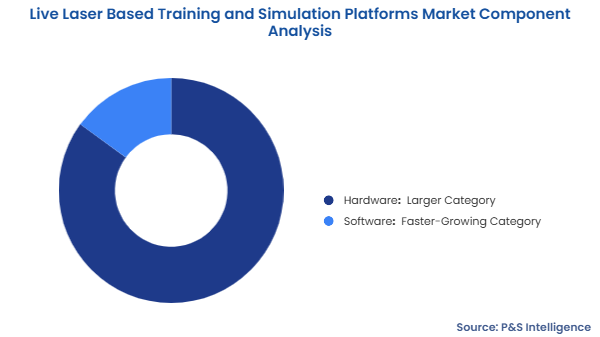
The hardware category held the larger market share, of 85%, in 2024. This is because hardware like laser guns, target systems, and sensors are the basic tools needed for any laser-based training system. They are the foundation of the entire system, that makes them a big part of the market.
The cost of hardware is mostly high because it involves complex equipment like laser projectors and advanced sensors. It lasts for a long time, sometimes even up to 10 years or more which means that the need for frequent replacements is less. Moreover, it is used in many types of training, like individual soldier practice, team coordination, or even large-scale military exercises which leads to this huge demand.
The software category will grow at the higher CAGR, during the forecast period. This is because it helps to create realistic virtual environments, where soldiers can simulate real-life battle scenes without the risk of combat. As the need for realistic training increases, software solutions are also growing. With the rise of AI, software can now provide personalized training and adjust the difficulty level, by giving each soldier a special learning experience.
The components analyzed here are:
Hardware (Larger Category)
Software (Faster-Growing Category)
Application Analysis
The battlefield simulation & defense category held the largest market share, of 45%, in 2024, because every military needs to prepare their soldiers for combat. It includes things like laser guns, sensors, and virtual battlefields, so it is a complete training setup. It is used by the Army, Air Force, and Navy, so it is needed in many different ways. Moreover, it is ideal for training many soldiers together, like in military drills or missions, which makes it very popular. In 2024, Saab SA signed a contract with the U.K. Ministry of Defence to support live simulation systems, including the Instrumented Live Training, Direct Fire (ILT-D) system, that enhances training realism through its laser and geometric pairing technology.
The flight simulation category will grow at a higher CAGR, during the forecast period. This is because of the high demand for trained pilots in military and commercial aviation, so more flight simulators are being used. It is safe for training and pilots can practice dangerous situations like engine failure or bad weather without any real danger. Moreover, it is not just for the military as even civil aviation schools and airlines use flight simulators to train new pilots.
The defense security category held the largest market share, of 30%, in 2024. This is because military forces use laser-based systems to simulate real combat without using live weapons. It helps soldiers practice safely while also still feeling the pressure of a real mission. The military uses the same systems for a long time; hence, it is a big part of the market. The realistic and high-tech training to be ready for real combat is very important. According to the Stockholm International Peace Research Institute, global defense spending rose by 9.4% from 2023 and reached USD 2,718 billion in 2024.
The e-learning category will grow at the highest CAGR, of approx. 7.5%, during the forecast period. This is because more people around the world are learning from home or through online courses, mostly after COVID-19. This is further increasing the use of training systems that are virtual or simulation-based. These systems can be used anywhere with a laptop or VR headset. Moreover, schools or companies can train many people at the same time without needing a real classroom. The size of the worldwide market for educational technology was estimated at USD 298.5 billion in 2023 and is projected to increase at a compound annual growth rate (CAGR) of 17.4% from 2024 to 2030, reaching USD 911.9 billion.
The end users analyzed here are:
Defense Security (Largest Category)
Civil Aviation
Education
E-learning (Fastest-Growing Category)
Game-based Learning
Entertainment
Healthcare
Drive strategic growth with comprehensive market analysis
Live Laser Based Training and Simulation Platforms Market Regional Growth Dynamics
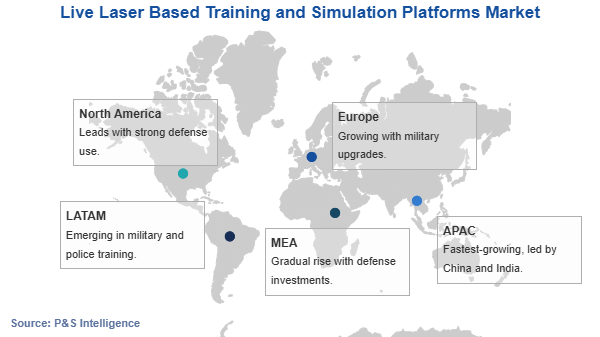
North America held the largest market share, of 40%, in 2024, because it spends the most on defense, uses advanced technology, and has many big defense companies. The U.S. Department of Defense plans to invest USD 26 billion annually in military simulation and training systems by 2028. This includes programs like the Synthetic Training Environment (STE), that integrates live, and constructive simulations to improve combat readiness. The U.S. uses laser-based simulations to train soldiers, pilots, and even police forces. Programs like the Synthetic Training Environment and Joint Simulation Environment show how serious the U.S. is about the tech-based training. Whereas, Canada, uses laser-based training in its armed forces and peacekeeping missions.
In Europe, Germany has one of the biggest military budgets in Europe as it invests in modernizing training, especially for land forces. With the help of projects like the British Army Collective Training Transformation Programme, U.K. is adopting live and AI-enhanced simulation systems.
The APAC region will grow at the highest CAGR, of approx. 7%, during the forecast period. This is because of the rising geopolitical tensions, a young defense tech ecosystem, and big military size. China’s military uses dual-use technologies like innovations from civilian tech are quickly applied to the defense. Moreover, it is building simulation cities for urban combat training, where live laser-based systems are needed. India is moving away from basic drills to tech-enabled, safe, and repeatable training.
In LATAM, the Brazilian army also uses simulations for sports-style competitive training.
Live Laser-Based Training and Simulation Platforms Market Share
The market is fragmented as the companies in this market specialize in different components of the training ecosystem like live laser engagement systems, VR &AR platforms, analytics software, and instrumentation hardware. This leads to a variety of providers. Many countries have local defense procurement rules, that are in favor of domestic firms or requiring foreign contractors to partner with local suppliers e.g., Buy American, make in India, and EU defense sovereignty rules which encourages the presence of regional players and avoids complete dominance by global giants. Moreover, armies, navies, and air force all train differently and even two countries may need very different training tools. Because of this, companies make custom products and no one-size-fits-all company exists. Furthermore, there is no universal standard for simulation platforms, and integration with real-time weapons systems which creates space for custom, standalone solutions, and supporting more players in the ecosystem.
Key Live Laser Based Training and Simulation Platforms Companies:
BAE Systems PLC
CAE Inc.
Cubic Corporation
Lockheed Martin Corporation
L3Harris Technologies, Inc.
Northrop Grumman Corporation
Thales Group
SAAB AB
RTX Corporation
Rheinmetall AG
Elbit Systems Ltd.
Leonardo S.p.A.
Live Laser Based Training and Simulation Platforms Market News
In March 2025, Skiftech won a contract from the U.S. Department of Defense to manufacture laser-based simulation equipment for the army, which aims to enhance the usefulness of its current Tactical Engagement Simulation Systems (TESS) by using laser transmitters for live weapons training rather than ammunition. Skiftech and the Army Contracting Command in Orlando, Florida, will collaborate on the project until March 2035. A USD 921.1-million framework agreement will provide funding for this endeavor.
In September 2024, Elbit Systems UK Limited announced that its Joint Fires Synthetic Trainer (JFST) achieved Initial Operating Capability (IOC), delivering over 4,700 training hours to over 300 personnel from the British Army, Royal Navy, and Royal Air Force since its deployment in 2022.
In September 2024, BAE Systems plc and Hadean Supercomputing LTD renewed their partnership to advance the future of military training by integrating AI and large language models into scalable, immersive, and interoperable simulation platforms for multi-domain and allied force use.
In December 2023, Thales SA showcased upgraded Gladiator indoor and live training and tactical engagement simulation system at the Interservice/Industry Training, Simulation and Education Conference (I/ITSEC) 2023 in Orlando. A laser-capable surrogate pistol allows individuals who carry a handgun as a primary or secondary weapon to fully engage in live laser-based TESS training.
In May 2023, Thales SA signed a contract with SIMAERO holding SASU for the latter to shift one H225 Reality H Level D full-flight simulator to the China Sky-Wings training center in the Chinese megapolis of Shanghai.
Want a report tailored exactly to your business need?
Leading companies across industries trust us to deliver data-driven insights and innovative solutions for their most critical decisions. From data-driven strategies to actionable insights, we empower the decision-makers who shape industries and define the future. From Fortune 500 companies to innovative startups, we are proud to partner with organisations that drive progress in their industries.
Client Testimonials
Working with P&S Intelligence and their team was an absolute pleasure – their awareness of timelines and commitment to value greatly contributed to our project's success. Eagerly anticipating future collaborations.
McKinsey & Company
India
Unmatched Standards
Our insights into the minutest levels of the markets, including the latest trends and competitive landscape, give you all the answers you need to take your business to new heights
Complete Data Security
We take a cautious approach to protecting your personal and confidential information. Trust is the strongest bond that connects us and our clients, and trust we build by complying with all international and domestic data protection and privacy laws