Laboratory Information System Market Size Estimation
Key Highlights
| Study Period | 2021 - 2032 |
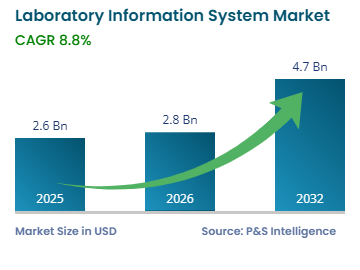
| Market Size in 2025 | USD 2.6 Billion |
| Market Size in 2026 | USD 2.8 Billion |
| Market Size by 2032 | USD 4.7 Billion |
| Projected CAGR | 8.8% |
| Largest Region | North America |
| Fastest-Growing Region | Asia-Pacific |
| Market Structure | Fragmented |
Market Size
Explore the market potential with our data-driven report
Laboratory Information System Market Key Insights
- Integrated variants accounted for the larger share, of 70%, in 2025, and they also have the higher CAGR of approximately 9.0% during 2026–2032.
- Services are expected to register the higher CAGR of approximately 9.2% during 2026–2032.
- The on-premises category accounted for the largest share, of 60%, in 2025.
- Molecular diagnostics will register the highest CAGR of approximately 9.5% during 2026–2032.
- Hospital laboratories accounted for the largest share, of 45%, in 2025.
- North America accounted for the largest share, of 40%, in 2025.
- Asia-Pacific is the fastest-growing region, at a CAGR of approximately 9.7% during 2026–2032.
Laboratory Information System Market Future Outlook
The global laboratory information system market stood at USD 2.6 billion in 2025 and is projected to reach USD 4.7 billion by 2032, expanding at a compound annual growth rate of 8.8% over 2026–2032. Laboratory digitalization is accelerating across hospital networks, independent diagnostic centers, and physician office laboratories. LIS platforms increasingly serve as the operational backbone for specimen tracking, order management, result validation, and interoperability with electronic health records (EHRs) across clinical chemistry, hematology, microbiology, blood bank, pathology, and molecular diagnostics workflows.
Mounting regulatory compliance requirements and rising diagnostic test volumes are sustaining demand globally. The U.S. Office of the Assistant Secretary for Technology Policy (ASTP) Data Brief No. 74 (September 2024) confirms that in 2023, hospital-based laboratories shared test results with health information exchange organizations at the highest rates among all laboratory types. Over one-third of health information organizations report that laboratories have limited or refused to provide access to electronic health information. This infrastructure gap sustains demand for standards-compliant, interoperable LIS platforms capable of structured LOINC-coded result exchange.
Cloud-based architectures, AI-assisted result interpretation, and FHIR-enabled interoperability are reshaping deployment preferences. An increasing share of new installations is shifting toward subscription-based SaaS models, which reduce capital barriers for mid-sized and smaller laboratories.
Laboratory Information System Market Trends and Drivers
Cloud Migration and AI Integration Are Major Trends in Market
Laboratories across all segments are progressively transitioning from on-premises perpetual license models toward cloud-based and SaaS subscription architectures. Falling cloud infrastructure costs, tightening interoperability mandates requiring real-time data exchange between LIS platforms and EHRs, and growing demand for multi-site deployment are accelerating this shift. Buyer preference is moving fastest among mid-tier independent laboratories and multi-location hospital networks, where capital expenditure constraints previously limited enterprise-grade adoption.
AI integration is transitioning from pilot programs to production-level deployment within LIS environments. AI is being embedded for autoverifying routine chemistry and hematology results, predictive instrument maintenance, anomaly detection in quality control data, and image analysis in pathology and molecular diagnostics workflows. Vendors are delivering pre-integrated AI modules within their core LIS platforms to gain competitive advantage in procurement evaluations. Pre-configured interfaces for hematology, chemistry, and middleware analyzers are reducing full-scale deployment projects from nine months to as few as twelve weeks. Adoption barriers are falling for smaller facilities, and replacement cycles in the installed base are compressing.
Rising Chronic Disease Burden Propelling LIS Adoption
The escalating global prevalence of noncommunicable diseases is driving demand for laboratory information systems. WHO reports that noncommunicable diseases killed at least 43 million people in 2021, equivalent to 75% of all non-pandemic-related deaths globally. Cardiovascular diseases, cancers, chronic respiratory diseases, and diabetes collectively account for 80% of all premature NCD deaths. This disease burden generates consistent demand for lipid panels and metabolic chemistry for cardiovascular monitoring, complete blood counts and tumor markers for oncology, HbA1c and glucose tolerance tests for diabetes management, and pulmonary function biomarkers for respiratory disease.
Diagnostic test volumes processed globally are rising in line with disease prevalence. Laboratory workflows are under sustained pressure, strengthening the operational case for automated, interoperable LIS platforms capable of managing high-throughput specimen tracking, result reporting, and longitudinal patient data management. As populations age, per-capita testing frequency rises, compressing manual workflows further. This pressure is most concentrated in high-income and upper-middle-income economies, where the NCD burden is heaviest. LIS vendors are responding by supporting multi-panel chronic disease monitoring workflows, auto-verification rules, and EHR-linked result delivery.
Precision Medicine and Molecular Diagnostics Offer Market Opportunities
The rapid expansion of molecular diagnostics and precision medicine workflows is driving demand for advanced LIS capabilities. Legacy clinical chemistry-focused platforms are ill-equipped to address these requirements, creating a structural opportunity for market players. Next-generation sequencing, liquid biopsy for cancer monitoring, companion diagnostics, and pharmacogenomics testing are transitioning from research settings into routine clinical laboratory operations. These workflows require LIS platforms capable of managing complex genomic data structures, bioinformatics pipeline integration, and multi-analyte result interpretation.
Clinical laboratories are investing in NGS-based oncology profiling, minimal residual disease surveillance, and infectious disease pathogen identification. These workflows require LIS platforms with embedded bioinformatics integration, structured variant reporting, and regulatory audit trail capabilities. Standard clinical chemistry LIS architectures do not provide these capabilities. Reference laboratories, academic medical centers, and specialized oncology and genomics facilities are procuring advanced solutions accordingly. Vendors are offering modular molecular diagnostics LIS extensions and purpose-built molecular informatics platforms as genomic testing volumes continue to expand through the forecast period.
Data Security Requirements and Implementation Complexity Hamper Market Growth
Stringent cybersecurity investment requirements and implementation cost burdens limit LIS adoption and upgrade cycles among small and mid-sized independent laboratories and physician office laboratories. Laboratory Information System (LIS) costs vary widely, with entry-level systems typically starting from approximately USD 15,000–30,000 for smaller laboratories, while full-scale implementations can reach several hundred thousand dollars or more, depending on system complexity, customization, and integration requirements. For smaller laboratories lacking internal IT teams, integration consulting expenses frequently double headline price tags, while data migration, validation, and staff training extend project timelines to six to nine months.
These barriers suppress procurement and create persistent headroom for SaaS-oriented vendors offering subscription pricing, pre-configured interfaces, and managed deployment services. As cloud-native models with consumption-based billing proliferate, this restraint is expected to moderate gradually, though it will continue to influence procurement behavior among facilities below a certain scale threshold.
Laboratory Information System Market Segmentation Analysis
Type Analysis
Integrated variants accounted for the larger share, of 70%, in 2025, and are also expected to register the higher CAGR of approximately 9.0% during 2026–2032. Unified informatics environments eliminate redundant order entry, automate result routing across clinical specialties, and maintain a single longitudinal patient data record accessible across disciplines within the same facility. Integrated LIS platforms remove the manual interfaces that standalone systems require when communicating with hospital information systems, EHR platforms, and radiology information systems. Reductions in transcription errors and turnaround time follow, strengthening procurement preference among hospital procurement committees and health system CIOs.
The accelerating interoperability mandate environment structurally disadvantages standalone platforms. The U.S. Office of the National Coordinator for Health Information Technology (ONC) data shows that over 96% of non-federal acute care hospitals possess a certified EHR system. An installed base of this scale requires tightly integrated laboratory data pipelines feeding results directly into the clinical record, a capability standalone systems do not possess. Emerging interoperability frameworks, including TEFCA and HL7 FHIR, further reinforce this trajectory, as hospitals and health systems prioritize LIS platforms capable of bidirectional structured data exchange across care settings.
The market segments into the following types:
- Integrated (Larger and Faster-Growing Category)
- Standalone
Component Analysis
Software accounted for the larger share, of 75%, in 2025. The LIS application layer is the core operational system around which all laboratory workflows are organized, managing specimen tracking, order management, result validation, autoverification, and report generation. The clinical and operational complexity accommodated by modern LIS software sustains high per-seat licensing values and drives recurring upgrade cycles as compliance mandates evolve. Multi-panel molecular result structuring, AI-assisted autoverification, FHIR-based interoperability modules, and regulatory audit trail functionalities are the primary licensing and subscription drivers.
ASTP Data Brief No. 75 (October 2024) on standards adoption among health information exchange organizations reveals that 46% of HIOs map from non-standard laboratory test codes to LOINC codes. This standards gap can only be resolved at scale by sophisticated LIS software platforms.
Services are expected to register the higher CAGR of approximately 9.2% during 2026–2032. Demand for LIS implementation, validation, interface configuration, and ongoing managed support is rising as laboratories — particularly mid-tier independent facilities and those in emerging markets — lack the internal IT resources to deploy and maintain complex clinical informatics platforms without vendor support engagement. The shift toward SaaS models reinforces service demand, as subscription deployments require continuous managed service arrangements for system updates, security monitoring, and interface maintenance.
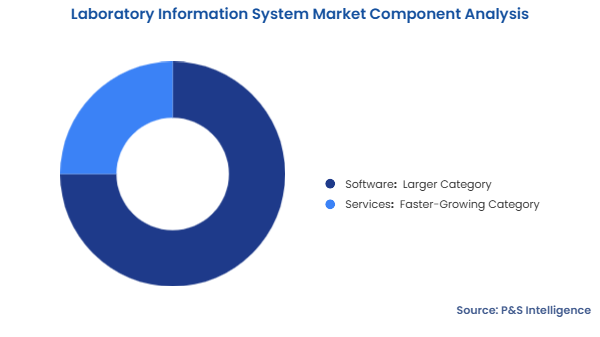
The market segments into the following components:
- Software (Larger Category)
- Services (Faster-Growing Category)
Delivery Mode Analysis
The on-premises category accounted for the largest share, of 60%, in 2025. Large hospital networks and reference laboratory operators make substantial capital investments in server infrastructure and must comply with strict data sovereignty requirements for sensitive patient diagnostic records. Validated, fully controlled environments meeting clinical laboratory regulatory standards, including ISO 15189, are a procurement requirement in these settings. Extended replacement cycles characteristic of enterprise clinical IT reinforce this position further. Validated LIS deployments are typically maintained for seven to ten years, creating a large incumbent installed base that suppresses near-term churn even as cloud economics improve.
Cloud-based delivery is expected to register the highest CAGR during 2026–2032. Subscription-model economics eliminate large upfront capital expenditures, while pre-configured analyzer interfaces compress implementation timelines. On-premises software does not offer multi-site connectivity or anytime, anywhere data access. Laboratories in Asia-Pacific and Latin America are active adopters, as cloud-native LIS platforms allow them to access enterprise-grade functionality without server infrastructure investment.
The market segments into the following delivery modes:
- On-Premises (Largest Category)
- Cloud-Based (Fastest-Growing Category)
- Web-Based
Application Analysis
Clinical chemistry accounted for the largest share, of 35%, in 2025. Hospital laboratories, independent diagnostic centers, and physician office laboratories worldwide conduct thousands of metabolic panels, lipid profiles, liver and renal function tests, glucose, HbA1c, and thyroid assays every day. The rising global burden of chronic noncommunicable diseases drives routine biochemistry monitoring requirements across hundreds of millions of patients under long-term clinical management.
Molecular diagnostics is expected to register the highest CAGR during 2026–2032. The rapid transition of next-generation sequencing, liquid biopsy, and companion diagnostics from research settings into routine clinical laboratory workflows is the primary demand driver. These applications require LIS platforms with embedded bioinformatics integration, structured genomic variant reporting, and multi-analyte result management capabilities. Standard clinical chemistry-oriented platforms do not support these applications, driving solution demand across oncology, genomics, and precision medicine laboratories.
The growing demand for molecular diagnostics reflects advances in precision medicine and the need for early, accurate disease detection. These techniques identify pathogens, genetic mutations, and cancers, improving treatment decisions and outcomes. Biomarkers — measurable indicators like genes or proteins — play a key role by enabling early diagnosis, monitoring, and personalized therapies, strengthening modern healthcare and public health management.
The market segments into the following applications:
- Clinical Chemistry (Largest Category)
- Hematology
- Microbiology
- Blood Bank
- Pathology
- Molecular Diagnostics (Fastest-Growing Category)
- Others
End User Analysis
Hospital laboratories accounted for the largest share, of 45%, in 2025. Clinical chemistry, hematology, microbiology, blood banking, anatomic pathology, and molecular diagnostics require a comprehensive, integrated LIS to manage multi-disciplinary workflows within a regulated clinical environment. Hospital laboratories also operate under the most stringent compliance obligations, including CLIA certification, CAP accreditation requirements, and EHR interoperability mandates. Enterprise-grade LIS platforms with validated audit trails, auto-verification rule engines, and bidirectional EHR interfaces are the procurement response to these obligations. ASTP Data Brief No. 79 (August 2025) on electronic public health reporting confirms that in 2024, nearly all U.S. hospitals were engaged in electronic laboratory result reporting as a core data requirement.
Independent laboratories are expected to register the highest CAGR during 2026–2032. Expanding diagnostic outsourcing by hospitals and health systems, rising multi-site laboratory network formation, and the availability of cloud-native LIS platform subscriptions are reducing barriers to enterprise-grade LIS adoption. Independent diagnostic operators that previously relied on simpler or manual systems are now procuring cost-effective LIS platforms to process growing test volumes.
The market segments into the following end users:
- Hospital Laboratories (Largest Category)
- Independent Laboratories (Fastest-Growing Category)
- Physician Laboratories
- Others
Drive strategic growth with comprehensive market analysis
Laboratory Information System Market Geographical Analysis
North America Laboratory Information System Market Outlook
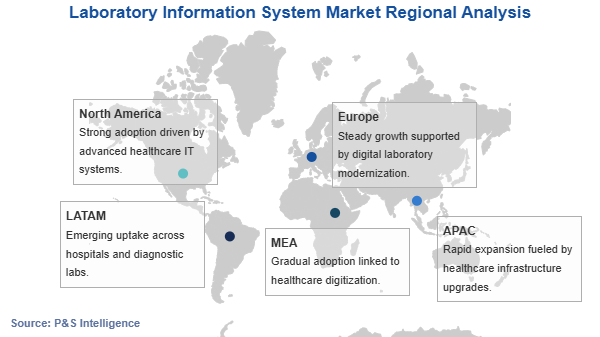
North America accounted for the largest share, of 40%, in 2025. Advanced healthcare infrastructure, strict regulatory requirements, and widespread adoption of automation and interoperability solutions underpin this position. Expanding genomic research, biobanking, and precision medicine initiatives are accelerating adoption further, while cloud-based platforms and system integration continue to shape the competitive landscape. Canada's single-payer health system is channeling provincial funding into laboratory modernization programs, sustaining steady adoption growth. The U.S. sets global benchmarks for interoperability mandates and regulatory compliance requirements that continuously pull procurement toward enterprise-grade LIS platforms.
U.S. Laboratory Information System Market Growth
The U.S. held the largest country market position within North America in 2025. The CLIA regulatory framework mandates quality standards across all facilities performing diagnostic testing on human specimens, creating a sustained compliance obligation for validated, audit-capable LIS platforms. According to the Centers for Medicare & Medicaid Services, over 317,000 CLIA-certified laboratory entities were operating in the United States as of March 2024, spanning hospitals, physician offices, independent laboratories, and other testing facilities.
The CDC's Laboratory Systems division estimates that more than 33,000 Certificate of Accreditation and Certificate of Compliance laboratories operate across the country, each subject to biennial inspection schedules requiring documented LIS validation.
New FDA mandates for laboratory-developed tests are propelling LIS replacements as older platforms lack e-quality-management functions, pre-built design-control records, and CAP checklist mappings. Pricing models are evolving as legacy perpetual licenses transition toward SaaS subscriptions. Procurement cycles are compressing, enabling mid-tier independent laboratories to access enterprise-grade functionality.
Europe Laboratory Information System Market Analysis
Europe’s market is driven by the strong public healthcare systems, GDPR data privacy requirements, and a growing emphasis on interoperability across national and cross-border health networks. European laboratories are increasingly adopting cloud-based and automated LIS solutions to enhance efficiency, reduce errors, and support advanced diagnostics including molecular testing. According to Eurostat, healthcare expenditure in the European Union reached approximately EUR 1.72 trillion in 2023, reflecting sustained growth over recent years. Laboratory services represent a structurally embedded share of that investment.
Germany leads the regional market. High laboratory density, stringent data protection requirements under GDPR, and strong molecular diagnostics adoption within public hospital networks and private reference laboratory chains collectively underpin this position. The U.K. is the fastest-growing European market, with NHS digitalization investments and laboratory consolidation programs under integrated care systems driving procurement. France, Italy, and Spain are governed by public health system procurement cycles. European countries are increasingly prioritizing interoperability with national EHR frameworks, favoring vendors with demonstrated HL7 FHIR compliance. The European Health Data Space initiative is expected to generate additional LIS replacement demand as legacy systems fail to meet new cross-border data exchange standards.
Asia-Pacific Laboratory Information System Market Forecast
Asia-Pacific is the fastest-growing region in the global LIS market, registering a CAGR of 9.7% during 2026–2032. Government-funded digital health infrastructure programs, expanding private diagnostic laboratory networks, and a rapidly growing insured patient population across China, India, Japan, and South Korea are the structural drivers. Rising cloud-native LIS adoption among tier-3 and county-level hospitals in China and India will accelerate the region's growth through the forecast period.
China dominates the regional market. National e-health mandates and substantial pharmaceutical and biotechnology R&D activity underpin this position. India is the fastest-growing market, with government digital health investment creating direct interoperability demand. South Korea's smart-hospital initiatives, exemplified by integrated LIS, radiology, and pharmacy platforms aligned through FHIR exchanges, are setting regional benchmarks replicated across Singapore and Australia.
China Laboratory Information System Market Landscape
China holds the largest share within Asia-Pacific. IT modernization of large public hospitals and substantial pharmaceutical and biotechnology R&D underpin this position. National policy mandates directly link hospital performance appraisals to healthcare information system standards. The National Health Commission of China has implemented electronic medical record (EMR) grading systems alongside hospital performance evaluation frameworks, supporting the digitalization of healthcare delivery, with laboratory information systems forming an important component of hospital information infrastructure. EMR coverage reached 90% in tertiary hospitals and 60% in secondary hospitals by 2022. The deployment of 125 national regional medical centers in second- and third-tier cities is extending LIS procurement beyond major urban centers. Continued public hospital IT investment cycles and rising diagnostic test volumes from a rapidly aging population sustain the market.
India Laboratory Information System Market Expansion
India is the fastest-growing country within Asia-Pacific during 2026–2032. Government digital health infrastructure programs, rapid expansion of private diagnostic laboratory chains, and increasing integration requirements imposed by national interoperability frameworks are the demand drivers. The Ministry of Health and Family Welfare’s Ayushman Bharat Digital Mission (ABDM) has registered over 230,000 health facilities and integrated more than 350 million health records into the national digital ecosystem as of March 2024. This interoperability layer creates direct compliance demand for LIS platforms capable of linking diagnostic laboratory data to the central health record infrastructure.
The Digital Health Incentive Scheme (DHIS) provides financial incentives to hospitals, clinics, and diagnostic centers to adopt and link records to the national ecosystem, stimulating LIS procurement by public and private laboratories. Private diagnostic laboratory chains are adopting LIS as they scale multi-site operations requiring centralized data management and standardized reporting.
The regions and countries analyzed in this report include:
- North America (Largest Region)
- U.S. (Largest Country Market)
- Canada (Fastest-Growing Country Market)
- Europe
- Germany (Largest Country Market)
- U.K. (Fastest-Growing Country Market)
- France
- Italy
- Spain
- Rest of Europe
- Asia-Pacific (Fastest-Growing Region)
- China (Largest Country Market)
- India (Fastest-Growing Country Market)
- Japan
- South Korea
- Australia
- Rest of APAC
- Latin America
- Brazil (Largest Country Market)
- Mexico (Fastest-Growing Country Market)
- Rest of LATAM
- Middle East & Africa
- Saudi Arabia (Largest Country Market)
- South Africa
- U.A.E. (Fastest-Growing Country Market)
- Rest of MEA
Laboratory Information System Market Share
The global laboratory information system market is fragmented, with no vendor holding a commanding position across all end-user segments, geographies, and application disciplines. The structural diversity of the LIS buyer base explains this absence of market concentration. Large hospital systems, independent reference laboratories, physician office laboratories, specialty diagnostics centers, public health laboratories, and molecular genomics facilities each carry distinct workflow requirements, regulatory compliance obligations, and integration priorities that resist standardization around a single platform. This diversity supports both large healthcare IT companies embedding LIS within broader clinical suite offerings and purpose-built specialists serving specific disciplines.
Established healthcare IT organizations compete primarily within large hospital system accounts by bundling LIS functionality into broader clinical information ecosystems encompassing electronic health records, pharmacy, and radiology. Integration depth and switching cost advantages, rather than standalone LIS superiority, are the source of their competitive strength. Dedicated LIS specialists draw their competitive position from application-specific workflow depth, discipline coverage breadth, and long-standing laboratory customer relationships built over decades of domain expertise in pathology, hematology, and complex reference lab operations. Cloud-native entrants and regional vendors offer faster deployment, subscription pricing, and modern API-first architectures that appeal to independent laboratories and emerging market buyers previously underserved by legacy enterprise platforms.
Leading Companies in the Laboratory Information System Market:
- Oracle Corporation
- Epic Systems Corporation
- Sunquest Information Systems Inc.
- Medical Information Technology Inc.
- McKesson Corporation
- CompuGroup Medical SE
- SCC Soft Computer
- Orchard Software Corporation
- Computer Programs and Systems Inc.
- XIFIN Inc.
- LabWare Inc.
- LabVantage Solutions Inc.
- TECHNIDATA SAS
- Cirdan Ltd.
- Thermo Fisher Scientific Inc.
- Abbott Laboratories
- Agilent Technologies Inc.
- PerkinElmer Inc.
Laboratory Information System Market News
- In September 2025, LabWare Inc. released Clinical Health Solution version 5.06, an updated clinical LIS platform delivering enhanced capabilities for managing clinical diagnostics and public health laboratory operations, including improved compliance frameworks for CLIA and CAP accreditation requirements.
- In August 2025, Oracle Health launched an AI-powered EHR platform, expanding clinical data integration and supporting advanced healthcare IT workflows, including lab data interoperability.
- In July 2025, Clinisys acquired Orchard Software Corporation from Francisco Partners. The acquisition combined two LIS providers to serve over 6,000 laboratories across 39 countries with an expanded portfolio spanning hospital, reference, physician office, veterinary, and public health laboratory settings. Clinisys's delivery of cloud-based, scalable LIS solutions is accelerated by the expanded platform footprint.