This Report Provides In-Depth Analysis of the Industrial Brakes Market Report Prepared by P&S Intelligence, Segmented by Type (Disc Brakes, Drum Brakes, Caliper Brakes), Actuation (Hydraulic Braking System, Mechanical Braking System, Electrical Braking System, Pneumatic Braking System), Application (Manufacturing, Metal & Mining, Marine & Shipping, Construction, Power Generation), and Geographical Outlook for the Period of 2021 to 2032
Explore the market potential with our data-driven report
Industrial Brakes Market Analysis
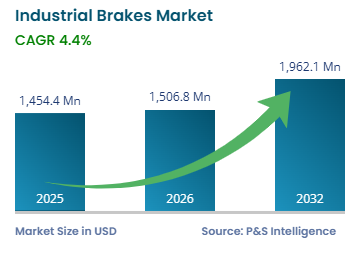
The industrial brakes market size was USD 1,454.4 million for 2025, and it will grow by 4.4% during 2026–2032, to reach USD 1,962.1 million by 2032.
This growth is driven by accelerating industrial automation adoption, rising infrastructure construction activity, and the expanding deployment of braking systems across wind energy installations, heavy-duty machinery, and rail transportation networks worldwide.
Industrial brakes serve as critical safety and motion-control components across a broad spectrum of capital-intensive industries, from cranes, hoists, and earthmoving equipment in construction to conveyors, rolling mills, and press systems in manufacturing. As industrial facilities modernize toward Industry 4.0 frameworks, demand for precision-engineered braking solutions equipped with condition-monitoring capabilities and advanced friction materials is intensifying. According to the UNIDO report, in Q2 2025, global manufacturing production increased by 1.1 % compared to the previous quarter, marking the fifth consecutive quarter of steady growth despite trade tensions and supply-chain disruptions.
Key Market Insights
Disc brakes dominate the market with a 45% share in 2025, and are the fastest-growing category during the forecast period, driven by superior heat dissipation, easier maintenance, and strong suitability for safety-critical industrial applications.
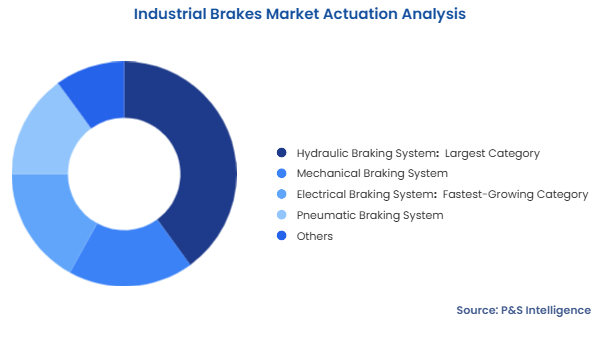
Hydraulic braking systems lead the market with a 40% share in 2025, supported by their proven reliability and high-force performance in demanding industrial applications such as offshore platforms, mining hoists, steel mills, and port cranes.
The electric braking system category will have the highest CAGR, of 4.7%, driven by Industry 4.0 integration, regenerative capabilities, and compatibility with advanced digital control systems.
Manufacturing leads the market with approximately 35% share in 2025, driven by extensive use of industrial brakes in automated production lines, presses, conveyors, and robotic systems requiring high precision and reliability.
China represents the largest country market in the industrial brakes industry, while India is the fastest-growing country market.
Industrial Brakes Market Emerging Trends
Industry 4.0 Adoption and IoT Integration Are Key Trends
The global industrial brakes market is undergoing a structural technology transition, driven by the broad-based adoption of Industry 4.0 frameworks across manufacturing, mining, marine, and power generation sectors. Conventional mechanical and hydraulic brake assemblies are progressively being replaced or augmented by intelligent braking systems equipped with embedded sensors, real-time condition monitoring modules, and IIoT-enabled diagnostic interfaces. This shift allows operators to monitor brake pad wear, thermal load, hydraulic pressure variance, and actuator response times remotely, moving maintenance from reactive to predictive paradigms. According to the International Federation of Robotics (IFR) in its World Robotics 2025 report, 542,000 industrial robots were installed globally in 2024, representing the second-highest annual total on record and the fourth consecutive year exceeding 500,000 units. The total global operational stock reached 4,664,000 units in 2024, reflecting a 9% year-over-year increase, with each robotic cell and automated production line requiring integrated braking and motion-control solutions. Additionally, Asia accounted for 74% of global industrial robot installations in 2024, underscoring the concentration of smart factory expansion in highly automated manufacturing economies.
As smart factories scale across China, Germany, South Korea, and the United States, braking components are increasingly specified with digital communication protocols, condition-logging firmware, and remote-override capabilities that align with wider automation architecture. Germany’s Plattform Industrie 4.0, part of the federal digitalization strategy outlined under its Digital Strategy 2025, supports cross-industry deployment of smart manufacturing technologies and funding for advanced digital processes. This technological evolution is reshaping procurement standards across original equipment manufacturers and end users alike, favoring suppliers capable of delivering connected braking systems over commodity mechanical alternatives.
Global Renewable Energy Expansion and Infrastructure Investment Are Biggest Drivers
The accelerating global build-out of wind energy infrastructure represents one of the most direct structural demand drivers for the industrial brakes market, particularly for disc brake and caliper brake assemblies deployed in turbine pitch-control and yaw-drive systems. The Global Wind Energy Council (GWEC) reported that the wind industry installed a record 117 GW of new capacity in 2024, bringing cumulative global wind capacity to 1,136 GW across 55 countries. GWEC further forecasts annual additions to rise to 138 GW in 2025 and approximately 194 GW by 2030. Each megawatt of wind capacity requires multiple high-specification braking units per turbine, creating direct and quantifiable demand linkage between renewable energy deployment targets and industrial brake procurement.
The International Energy Agency (IEA) projects that global wind capacity is expected to approach 2,000 GW by 2030 under stated policy scenarios, with onshore wind accounting for the majority of additions. Beyond wind, the IEA projects total global capital flows to the energy sector to reach USD 3.3 trillion in 2025, with clean energy commanding the majority share, further reinforcing demand for braking components across solar thermal, hydropower, and conventional power generation assets under modernization.
Emerging economies are playing an increasingly important role in renewable capacity deployment. The European Union installed nearly 12.9 GW of new wind capacity in 2024. Wind installations across Africa and the Middle East doubled in 2024, and Brazil ranked among the top five global markets for new wind installations, highlighting the geographically diversified expansion of renewable infrastructure that directly supports industrial brake demand.
Electrification of Rail and Heavy Industrial Equipment Is Key Opportunity
The accelerating electrification of rail transport systems worldwide presents a major opportunity for advanced industrial braking systems, particularly electric and regenerative-compatible brake assemblies. According to the International Energy Agency, rail transports around 7% of global passenger-km and 6% of freight tonne-km, while accounting for about 1% of transport-related CO₂ emissions, reinforcing policy-driven momentum toward rail electrification. In India, the Ministry of Railways announced that approximately 99% of the broad-gauge network has been electrified, covering over 69,000 route kilometers as of 2025. Electrified locomotives require integrated disc and electromagnetic braking systems that interface with onboard electronic control systems and regenerative braking modules, thereby increasing demand for high-performance, electronically actuated industrial brakes.
Beyond India, large-scale rail modernization programs across Europe and Asia are reinforcing long-term procurement visibility for industrial brake manufacturers. The European Commission has committed to doubling high-speed rail traffic by 2030 and tripling it by 2050 under its Sustainable and Smart Mobility Strategy, accelerating investments in electrified rolling stock and rail infrastructure upgrades. Meanwhile, China operates the world’s largest high-speed rail network, exceeding 50,000 kilometers of operational lines, with plans to expand to around 60,000 kilometers by 2030, expanding the world’s largest electrified rail network. Each new electric locomotive and metro trainset integrates multiple high-specification braking assemblies, including axle-mounted disc brakes and electronically controlled pneumatic systems, creating sustained original equipment and long-term maintenance demand within the industrial brakes market.
Industrial Brakes Market Segmentation Analysis
Type Analysis
The disc brakes category holds the largest market share, of 45%, in 2025, and it will have the highest CAGR, of 4.5%, during the forecast period, driven by superior heat dissipation capabilities, ease of inspection and maintenance, compatibility with advanced condition-monitoring technologies, and rising deployment across safety-critical industrial applications. These characteristics make disc brakes the preferred choice for demanding applications, including wind turbine pitch and yaw control, overhead crane hoisting mechanisms, and rolling mill drive systems, where braking reliability is safety-critical and unplanned downtime carries severe operational cost penalties. The International Energy Agency projects that global onshore wind capacity additions will accumulate 732 GW between 2025 and 2030, with each turbine requiring multiple disc brake assemblies per pitch and yaw axis, directly reinforcing sustained demand for disc braking systems throughout the forecast period.
The types analyzed in this report are:
Disc Brakes (Largest and Fastest-Growing Category)
Drum Brakes
Caliper Brakes
Others
Actuation Analysis
The hydraulic braking system category holds the largest market share, of 40%, in 2025, supported by its proven reliability and high-force performance in demanding industrial applications such as offshore platforms, mining hoists, steel mills, and port cranes. Hydraulic systems also benefit from the widest global installed base across heavy machinery OEM platforms, ensuring strong replacement and aftermarket demand independent of new equipment sales cycles. According to the U.S. National Institute of Standards and Technology, U.S. manufacturing contributed USD 2.3 trillion to GDP in 2023, accounting for approximately 10.2% of total U.S. economic output, underscoring the scale of industrial activity supporting demand for heavy-duty braking systems.
The electrical braking system category will have the highest CAGR, of 4.7%, driven by accelerating integration with Industry 4.0 automation architectures, energy recovery through regenerative braking functions, and compatibility with variable frequency drives and IIoT control platforms. The electrically actuated brakes enable precise torque modulation, programmable stopping profiles, and seamless integration with digital control systems, making them increasingly suitable for automated intralogistics, robotics, and precision manufacturing environments. According to global energy data, electricity accounted for approximately 21% of total final energy consumption in 2024, up from about 17.8% in 2010, reflecting the steady electrification of industrial and commercial systems worldwide.
The actuations analyzed in this report are:
Hydraulic Braking System (Largest Category)
Mechanical Braking System
Electrical Braking System (Fastest-Growing Category)
Pneumatic Braking System
Others
Application Analysis
The manufacturing category holds the largest market share, of 35%, in 2025, driven by the breadth and capital intensity of industrial braking deployments across automated production lines, precision press systems, conveyor networks, and robotic assembly cells, environments where emergency stopping performance, repeatable positioning accuracy, and sustained high-cycle endurance are non-negotiable operational requirements. The demand from manufacturing has been further reinforced by the parallel trends of industrial automation expansion and manufacturing capacity reshoring, particularly across North America and Asia Pacific.
The power generation category will have the highest CAGR, of 4.6%, driven by the historic scale of global renewable energy capacity additions, particularly onshore and offshore wind installations, alongside ongoing modernization of conventional hydropower and thermal power generation assets. Wind turbines require multiple high-specification brake assemblies per unit for pitch-axis control, rotor locking during maintenance, and yaw-drive positioning, creating a direct and measurable procurement linkage between energy infrastructure buildout and brake system demand. According to the IEA 2024 analysis, global annual renewable electricity capacity additions are expected to continue rising through 2030, increasing from an estimated 666 GW in 2024 to nearly 935 GW by 2030, with solar PV and wind together forecast to account for 95 % of all renewable capacity additions during that period.
The applications analyzed in this report are:
Manufacturing (Largest Category)
Metal & Mining
Marine & Shipping
Construction
Power Generation (Fastest-Growing Category)
Others
Drive strategic growth with comprehensive market analysis
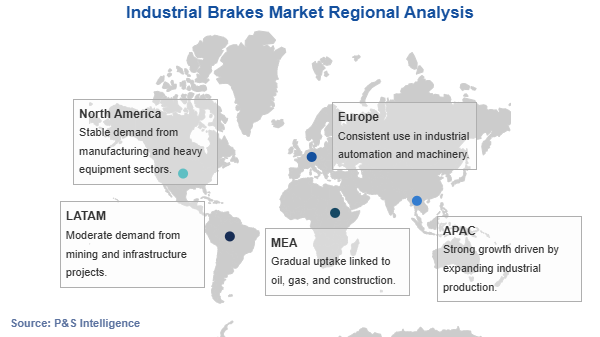
Asia-Pacific holds the largest market share, of 40%, in 2025, and it will have the highest CAGR, supported by high manufacturing intensity, rapid energy transition investment, and sustained government-backed industrialization programs that collectively create outsized demand for industrial braking systems across cranes, conveyors, wind turbines, and heavy processing equipment. India is scaling aggressively, with the government targeting 500 GW of renewable energy capacity by 2030 under its National Electricity Plan, a program that places significant procurement demand on pitch-control brake systems deployed in utility-scale wind turbines. The Global Wind Energy Council reported that Asia accounted for 75.7% of all new grid-connected wind power capacity installed globally in 2024, up from 70.3% in 2023, a trajectory that directly amplifies demand for industrial disc and caliper brakes in turbine drivetrains.
China Industrial Brakes Market Size
China represented the largest single country market for industrial brakes in Asia Pacific in 2025, driven by the world's highest manufacturing intensity among major economies at 24.9% of GDP and a cumulative installed wind power capacity exceeding 520 GW by end-2024. China's National Development and Reform Commission approved 92.8 GW of new onshore wind under its grid-parity mechanism in 2024 alone, creating sustained demand for brake systems integrated into turbine pitch-and-yaw control mechanisms. Beyond renewable energy expansion, broader national industrial policy continues to reinforce long-term demand fundamentals. The country's 14th Five-Year Plan continues to prioritize advanced manufacturing, robotics, and smart infrastructure, sectors where precision braking technologies play a critical operational role. The World Wind Energy Association confirmed that China added 86,892 MW of new wind capacity in 2024, accounting for 72% of all global wind turbine installations.
North America Industrial Brakes Market Size
North America is the second-largest regional market for industrial brakes, driven by the U.S.’s expansive and rapidly reindustrializing manufacturing base. The U.S. is experiencing a historic surge in manufacturing construction investment, driven by the CHIPS and Science Act, Inflation Reduction Act, and Infrastructure Investment and Jobs Act. The U.S. Congress Joint Economic Committee reported that U.S. manufacturing construction investment exceeded USD 223 billion in annualized terms as of February 2024, reflecting a substantial year-over-year increase supported by federal industrial policy initiatives. Moreover, Canada contributes incrementally through mining and oil and gas extraction operations, industries that accounted for 5.1% of the nation’s GDP in 2024, and heavily rely on hydraulic and caliper brake systems for hoisting, conveyor, and heavy-equipment applications.
The regions and countries of the market are as follows:
North America
U.S. (Larger Country Market)
Canada (Faster-Growing Market)
Europe
Germany (Largest Country Market)
U.K. (Fastest-Growing Country Market)
France
Italy
Spain
Rest of Europe
Asia-Pacific (Largest and Fastest-Growing Regional Market)
China (Largest Country Market)
India (Fastest-Growing Country Market)
Japan
South Korea
Australia
Rest of APAC
Latin America
Brazil (Largest Country Market)
Mexico (Fastest-Growing Country Market)
Rest of LATAM
Middle East and Africa
Saudi Arabia (Fastest-Growing Country Market)
South Africa (Largest Country Market)
U.A.E.
Rest of MEA
Industrial Brakes Market Competitive Landscape
The market exhibits a fragmented competitive structure, with no single player commanding a dominant share across all product types, actuation technologies, and end-use verticals simultaneously. This structural characteristic reflects the inherent diversity of the market, spanning disc brakes for wind turbines, drum brakes for mining hoists, hydraulic systems for offshore platforms, and electromagnetic assemblies for automated manufacturing lines, each sub-application demanding engineering specializations that favor niche-focused suppliers over horizontally integrated conglomerates. Additionally, the presence of multiple regional and application-specific manufacturers further intensifies competition and limits large-scale consolidation across the industry. Barriers to entry are meaningful, encompassing precision manufacturing tolerances, application-specific safety certifications, and long customer qualification cycles that reinforce established player positions, yet the breadth of vertical demand continues to sustain a diversified and competitive supplier landscape.
Key Industrial Brakes Market Companies:
Regal Rexnord Corporation
Eaton Corporation plc
Carlisle Brake & Friction
COREMO OCMEA S.p.A.
RINGSPANN GmbH
SIBRE
Magnetek LLC
Huawu Solutions Co., Ltd.
Dellner Bubenzer AB
Wabtec Corporation
The Hilliard Corporation
Miki Pulley Co., Ltd.
Industrial Brakes Market News
In October 2024, Dellner Bubenzer AB completed its acquisition of Antec Group, a Spain-based industrial braking company with a majority of its revenues linked to wind energy applications.
In May 2024, Wabtec Corporation inaugurated its new manufacturing campus in Rohtak, Haryana, India, representing a USD 18 million (INR 150 crore) investment to produce axle-mounted disc brake systems, brake calipers, distributor valves, and actuators for the Indian Railways and global transit markets.
In January 2024, Wabtec Corporation secured a USD 157 million brake system order from Siemens India Private Limited to supply high-performance ILS-series braking systems for 1,200 electric locomotives on the prestigious 9,000 HP Indian Railways project, with a supply term of 11 years and maintenance services extending to 35 years.
Frequently Asked Questions About This Report
What is the size of the global industrial brakes market?+
The global industrial brakes market was valued at USD 1,454.4 million in 2025.
What is the CAGR of the industrial brakes market during the forecast period?+
The industrial brakes market is growing at a CAGR of 4.4% during 2026-2032.
Which industries use industrial brakes the most?+
Key end-use industries include mining, construction, marine & shipping, power generation, manufacturing, oil & gas, and material handling.
What are the main types of industrial brakes?+
Major types include disc brakes, drum brakes, and caliper brakes.
What are the key drivers of the industrial brakes market?+
Market growth is driven by increasing industrial automation, expansion of mining and construction activities, stricter workplace safety regulations, growth in renewable energy installations (wind turbines), and rising demand for high-performance braking systems in heavy machinery.
Want a report tailored exactly to your business need?
Leading companies across industries trust us to deliver data-driven insights and innovative solutions for their most critical decisions. From data-driven strategies to actionable insights, we empower the decision-makers who shape industries and define the future. From Fortune 500 companies to innovative startups, we are proud to partner with organisations that drive progress in their industries.
Client Testimonials
Working with P&S Intelligence and their team was an absolute pleasure – their awareness of timelines and commitment to value greatly contributed to our project's success. Eagerly anticipating future collaborations.
McKinsey & Company
India
Unmatched Standards
Our insights into the minutest levels of the markets, including the latest trends and competitive landscape, give you all the answers you need to take your business to new heights
Complete Data Security
We take a cautious approach to protecting your personal and confidential information. Trust is the strongest bond that connects us and our clients, and trust we build by complying with all international and domestic data protection and privacy laws