India Electric Rickshaw Motor and Controller Market Size & Share Analysis - Trends, Drivers, Competitive Landscape, and Forecasts (2026 - 2032)
This Report Provides In-Depth Analysis of the India Electric Rickshaw Motor and Controller Market Report Prepared by P&S Intelligence, Segmented by Vehicle (Battery Rickshaw, E-Auto, Retrofitted Rickshaw), Motor Power (<800 W, 800, 1,001, 1,501, >2,000 W), End Use (Original Equipment Manufacturer (OEM), Aftermarket), and Geographical Outlook for the Period of 2021 to 2032
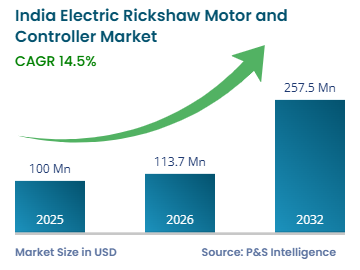
India Electric Rickshaw Motor and Controller Market Size Forecast
Key Highlights
Study Period
2021 - 2032
Market Size in 2025
USD 100.0 Million
Market Size in 2026
USD 113.7 Million
Market Size by 2032
USD 257.5 Million
Projected CAGR
14.5%
Largest State
Uttar Pradesh
Fastest-Growing State
Bihar
Market Structure
Fragmented
Market Size
Explore the market potential with our data-driven report
India Electric Rickshaw Motor and Controller Market Overview
The Indian electric rickshaw motor and controller market size was USD 100.0 million for 2025, and it will grow by 14.5% during 2026–2032, to reach USD 257.5 million by 2032.
This growth is driven by the expanding electric rickshaw fleet across urban and semi-urban areas, supported by government-led demand incentives and policy frameworks under initiatives such as PM E-DRIVE. The market encompasses motors ranging from sub-800W units serving light passenger applications to high-performance >2000W systems for cargo variants, while controllers integrate advanced features including regenerative braking, cruise control, and battery management systems.
Market dynamics reflect the rapid consolidation following GST implementation, with organized manufacturers capturing increased share through superior product reliability and extended warranties that reduce aftermarket replacement frequency. Ministry of Heavy Industries data shows that 2,54,676 e-3W L5 units received support through October 2025 under the PM E-DRIVE framework, creating sustained OEM demand for motors and controllers.
India Electric Rickshaw Motor and Controller Market Trends & Drivers
Technology Transfer Partnerships Are Key Trends
Chinese-Indian joint ventures are a key trend revolutionizing component manufacturing through structured technology transfer arrangements, bringing advanced motor winding techniques, controller programming expertise, and quality testing protocols to Indian facilities.
These partnerships typically include on-site technical training and process guidance for Indian workers, supporting improvements in precision welding, electronic assembly, and diagnostic capabilities.
The technology ecosystem extends beyond manufacturing to include shared research and development for India-specific adaptations such as enhanced dust sealing for motors operating in high-particulate environments and modified controller algorithms for stop-start traffic patterns.
It also includes reinforced components designed for higher commercial load usage.
Market observations indicate that products developed through technology-backed partnerships often achieve higher perceived value and improved reliability compared to purely domestic alternatives, reflecting the impact of technology transfer.
Automotive Industry Standards (AIS) notified under the Central Motor Vehicles Rules (MoRTH) require compliance with defined performance and safety norms for electric three-wheelers, driving OEMs and component suppliers to leverage advanced controller software, testing protocols, and design methodologies.
GST Implementation and PM E-DRIVE Scheme Are Biggest Drivers
The rollout of Goods and Services Tax (GST) in 2017 fundamentally restructured India's electric rickshaw component market by forcing unorganized manufacturers to formalize operations or exit the market.
This regulatory shift created opportunities for organized players offering standardized motors and controllers with documented warranties, quality certifications, and after-sales support networks spanning service centers nationally.
The PM E-DRIVE scheme amplifies this consolidation by requiring OEMs to meet phased manufacturing requirements and quality standards to access subsidies, effectively raising entry barriers for substandard component suppliers.
The Phased Manufacturing Programme (PMP) under central EV policy frameworks encourages gradual localization of critical EV components, including motors and controllers, pushing OEMs and suppliers to increase domestic value addition.
State-level EV policies across major markets such as Delhi, Uttar Pradesh, Maharashtra, and Karnataka offer road tax exemptions, registration fee waivers, and purchase incentives for electric three-wheelers, indirectly boosting demand for compliant and certified motor and controller suppliers.
The replacement of FAME-II with PM E-DRIVE marks a structural policy transition, ensuring continuity of demand incentives for electric three-wheelers while placing greater emphasis on localization, quality compliance, and long-term ecosystem development.
India Electric Rickshaw Motor and Controller Market Segmentation Analysis
Vehicle Analysis
The battery rickshaws category holds the largest market share, of 60%, in 2025, supported by its lower acquisition cost, operational simplicity, and suitability for short-distance urban and semi-urban mobility. The dominance stems from established manufacturing ecosystems concentrated in Delhi-NCR and Kolkata, where assemblers source standardized motors and controllers, creating economies of scale that reduce component costs compared to e-auto variants. This segment also benefits from long-term policy support under the National Electric Mobility Mission Plan (NEMMP), which identifies electric three-wheelers as a priority category for affordable urban and last-mile transport, supporting sustained adoption of compliant vehicles and components.
The e-autos category will have the highest CAGR, of 14.7%, driven by evolving urban mobility patterns where increased average trip distances of 8-12 kilometers and rising consumer expectations for enhanced comfort push operators toward higher-specification vehicles. According to SIAM, sales of three-Wheelers rose from 6.95 lakh units in the fiscal year 2023-24 to 7.41 lakh units in the fiscal year 2024-25, with adoption concentrated in metropolitan areas where ride-hailing platforms mandate vehicle standards.
The vehicles analyzed in this report are:
Battery Rickshaw (Largest Category)
E-Auto (Fastest Growing Category)
Retrofitted Rickshaw
Motor Power Analysis
The 800-1000W category holds the largest market share, in 2025, establishing dominance through their widespread adoption by organized manufacturers who standardize around this power rating to optimize the cost-performance equation for urban passenger applications. The category benefits from mature supply chains, while modular designs enable standardized controllers compatible across multiple OEM platforms, reducing inventory complexity and service requirements.
Motor and controller design across this segment is influenced by Bureau of Indian Standards (BIS) certification requirements and Automotive Industry Standards (AIS) notified under the Central Motor Vehicles Rules, which govern safety, performance, and electrical system compliance for electric three-wheelers.
The 1001-1500W category will have the highest CAGR of 14.6%, propelled by the transition toward cargo applications and premium passenger variants where increased payload requirements and performance expectations necessitate higher power outputs. The demand for e-rickshaws with motors of power consumption between 1001-1500W in the Indian market is steadily increasing, as the power consumption of the motors is appropriate.
The power consumption of the motors is enough to cope with the passenger capacity in the urban areas as well as with the hilly regions. The incentives of the government in the form of the electric mobility policy, along with the rising fuel prices, are also encouraging the use of e-rickshaws in the Indian market. The capacity of the motors, with the reduced downtime of the batteries, has led to the rapid growth of the market.
The motor powers analyzed in this report are:
<800 W
800–1,000 W (Largest Category)
1,001–1,500 W (Fastest Growing Category)
1,501–2,000 W
>2,000 W
End User Analysis
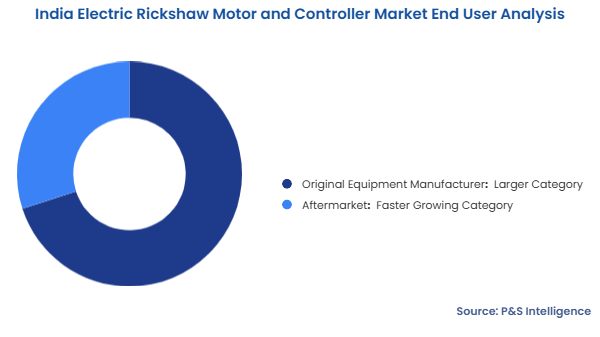
The original equipment manufacturer category holds the largest market share, of 70%, in 2025, reflecting the fundamental shift from unorganized assembly toward integrated manufacturing where established players provide complete drivetrains with matched motor-controller specifications, comprehensive warranties, and nationwide service networks. Financial institutions' preference for OEM-equipped vehicles, offering lower interest rates and extended loan tenures based on proven durability data, further reinforces this market structure where standardized components enable predictable total cost of ownership calculations.
The aftermarket category will have the highest CAGR, of 14.8%, driven by the aging electric rickshaw fleet operating beyond original warranty periods and the growing need for component replacement and performance upgrades. Growth catalysts include the emergence of organized service chains offering controller upgrades with battery management systems that extend vehicle life by 18-24 months, and regulatory pressures in pollution-critical cities mandating efficiency improvements achievable through modern motor-controller combinations.
The aftermarket evolution from simple replacement to value-added upgradation creates opportunities for specialized retailers and service providers targeting the vast unorganized fleet requiring modernization to remain commercially viable. In addition, digitization initiatives by State Transport Authorities are reducing informal vehicle operations, increasing demand for compliant replacement motors and controllers in the aftermarket.
The end users analyzed in this report are:
Original Equipment Manufacturer (OEM) (Largest Category)
Aftermarket (Fastest Growing Category)
Drive strategic growth with comprehensive market analysis
India Electric Rickshaw Motor and Controller Market Geographical Analysis
Uttar Pradesh Electric Rickshaw Motor & Controller Market Size
Uttar Pradesh holds the largest market share, of 25%, in 2025, supported by its large population base, high dependence on shared and last-mile mobility, and widespread adoption of electric rickshaws across Tier-1 and Tier-2 cities such as Lucknow, Kanpur, and Agra. The state’s leadership is reinforced by a substantial operating fleet, which drives sustained demand for replacement motors and controllers as vehicles age.
Additionally, the presence of assembly and trading hubs in regions such as Noida and Greater Noida supports localized sourcing and distribution of components. State-level policy support, including streamlined registration processes and EV-friendly measures, further strengthens adoption of electric three-wheelers across urban agglomerations. Urban mobility frameworks promoted by NITI Aayog further support electrification of shared and last-mile transport in large states such as Uttar Pradesh, reinforcing long-term demand for electric rickshaw components.
Bihar Electric Rickshaw Motor & Controller Market Size
Bihar has the highest growth rate of the electric rickshaw motor and control market because it is reliant on affordable transportation to meet its last-mile mobility needs. The state also has a large number of densely populated cities with limited access to conventional public transit. This is especially true for people living in Tier 2 and Tier 3 cities. There are many factors driving the rapid transition from fossil fuels to electricity for shared passenger vehicles. These include the lower cost of purchasing an e-rickshaw compared to traditional rickshaws, increasing fuel costs, and high daily usage rates. The state’s large informal transport sector is steadily transitioning toward electric alternatives, supported by road tax exemptions, simplified registration processes, and improving electricity access.
Punjab Electric Rickshaw Motor & Controller Market Size
Punjab has moderate growth, driven by unique dual-demand dynamics where agricultural market-yard logistics in districts like Ludhiana and Amritsar combine with rising urban commute needs in cities experiencing annual population growth. The state’s EV policy support, including registration and road tax exemptions, concessional electricity tariffs, and simplified approval mechanisms for charging infrastructure, is improving adoption economics for electric three-wheelers. The availability of EV-specific electricity tariffs notified by the state power distribution utility, along with charging infrastructure guidelines issued by the Ministry of Power, is supporting higher vehicle utilization and accelerating component replacement demand in the state.
The states of the market are as follows:
Madhya Pradesh
Uttar Pradesh (Largest State Market)
Delhi
West Bengal
Rajasthan
Bihar (Fastest-Growing State Market)
Haryana
Chhattisgarh
Uttarakhand
Punjab
Jharkhand
Assam
Tripura
Rest of India
India Electric Rickshaw Motor and Controller Market Share
The market is fragmented due to the presence of a large number of small, unorganized manufacturers, regional assemblers, and aftermarket suppliers operating across different states. Low entry barriers, limited capital requirements, and historically weak regulatory enforcement enabled local players to source imported components and assemble motors and controllers at low cost. Demand for low-priced replacement parts in the aftermarket further supports numerous informal suppliers. Additionally, the absence of a single dominant domestic brand and wide variation in product quality, pricing, and warranty practices contribute to a dispersed supplier base, resulting in a fragmented competitive landscape despite growing consolidation pressures.
Key India Electric Rickshaw Motor and Controller Companies:
CY International Private Limited
Changzhou Yufeng Vehicles Co., Ltd.
Changzhou Xieheng Power Technology Co., Ltd.
Hangzhou Yuyang Technology Co., Ltd.
Wuxi Weiyun Motor Co., Ltd.
Xuzhou Hongsengmeng Group Co., Ltd.
Nanya Airconn Pvt. Ltd.
Changzhou Joint Trading Co., Ltd.
Kelly Controls Limited
India Electric Rickshaw Motor and Controller Market News
In July 2025, Kinetic Communications Ltd. inaugurated a fully automated motor controller unit (MCU) production line in Pune, incorporating Industry 4.0 principles, including SMT lines placing 40,000 components per hour. The facility produces smart MCUs supporting advanced features like regenerative braking, cruise control, and hill-hold assist, addressing demand for next-generation controllers in India's electric rickshaw market.
In January 2025, Hyundai Motor Company announced a partnership with TVS Motor Company to develop advanced electric three-wheelers tailored for India's last-mile mobility market, with Hyundai providing design and engineering expertise while TVS explores local manufacturing.
In December 2024, Kinetic Communication Limited opened a 3,000 square meter motor manufacturing facility in Chinchwad, Pune, capable of producing high-efficiency BLDC and PMSM motors for electric two-, three-, and four-wheelers. The plant features dedicated assembly lines for stators and rotors, advanced testing laboratories, and in-house winding capabilities.
In February 2024, Attron Automotive launched its alpha series motors (RM14530, RM16070, RM16045) and advanced controller CTR072500 at Bharat Mobility Expo 2024, targeting the electric rickshaw segment with locally-designed components.
Frequently Asked Questions About This Report
What is the market size of the electric rickshaw motor & controller market in India?+
The India electric rickshaw motor & controller market was valued at USD 100.0 million in 2025.
Which motor type is most commonly used in Indian electric rickshaws?+
The BLDC motors are the most commonly used in Indian electric rickshaws due to their higher efficiency, low maintenance, and compatibility with lithium-ion batteries.
How does the motor controller impact electric rickshaw performance?+
The motor controller regulates power delivery, improves acceleration control, enhances energy efficiency, and extends battery life in electric rickshaws.
What is the price range of electric rickshaw motors and controllers in India?+
The pricing varies based on power rating, technology, and quality, with BLDC motors and controllers positioned as affordable components for mass-market e-rickshaws.
How do government policies influence demand for e-rickshaw motors and controllers?+
The favorable EV policies, state-level incentives, and regulations promoting electric mobility are significantly boosting demand for e-rickshaw motors and controllers in India.
Want a report tailored exactly to your business need?
Leading companies across industries trust us to deliver data-driven insights and innovative solutions for their most critical decisions. From data-driven strategies to actionable insights, we empower the decision-makers who shape industries and define the future. From Fortune 500 companies to innovative startups, we are proud to partner with organisations that drive progress in their industries.
Client Testimonials
Working with P&S Intelligence and their team was an absolute pleasure – their awareness of timelines and commitment to value greatly contributed to our project's success. Eagerly anticipating future collaborations.
McKinsey & Company
India
Unmatched Standards
Our insights into the minutest levels of the markets, including the latest trends and competitive landscape, give you all the answers you need to take your business to new heights
Complete Data Security
We take a cautious approach to protecting your personal and confidential information. Trust is the strongest bond that connects us and our clients, and trust we build by complying with all international and domestic data protection and privacy laws