This Report Provides In-Depth Analysis of the Healthcare Analytics Market Report Prepared by P&S Intelligence, Segmented by Component (Solutions, Services), Type (Descriptive, Prescriptive, Predictive), Deployment Model (On-Premises, Cloud-Based, Hybrid), Application (Financial, Clinical Management, ), Organization Size (Large Enterprises, Small & Medium Enterprises), End User (Healthcare Providers, Pharmaceutical & Biotechnology Companies, Healthcare Payers, Government & Public Health Agencies, Healthcare IT & Third-Party Service Providers), and Geographical Outlook for the Period of 2021 to 2032
Explore the market potential with our data-driven report
Healthcare Analytics Market Key Insights
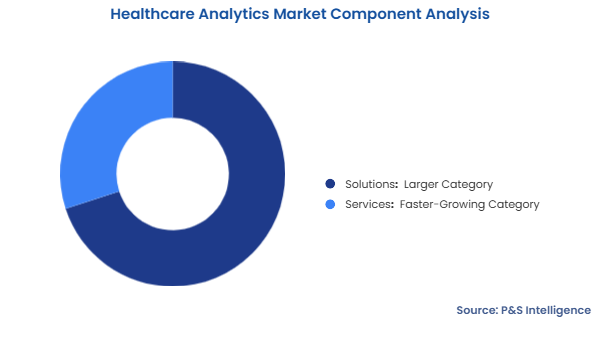
Solutions are the larger component with 70% share, as virtually all healthcare organisations invest in software platforms for data.
Services are the faster-growing component with 22.4% CAGR, because many healthcare organisations lack internal data science and complex integration expertise.
Financial applications lead the market with 60% share, driven by the constant pressure to control costs and minimise fraud.
Clinical management applications will grow the fastest, at 22.7% CAGR, as hospitals are increasingly using analytics to improve patient health outcomes and treatment planning.
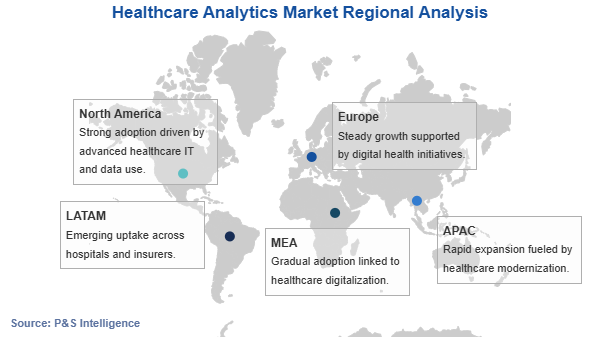
North America remains the largest regional market, with 40% share, while Asia-Pacific is the fastest-growing, at 22.9% CAGR, due to rapid healthcare infrastructure expansion.
Healthcare Analytics Market Overview
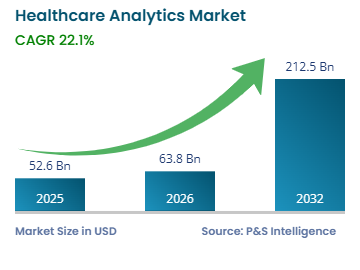
The healthcare analytics market size was USD 52.6 billion for 2025, and it will grow by 22.1% during 2026–2032, to reach USD 212.5 billion by 2032.
The market is expanding because healthcare organisations are under constant pressure to improve care quality while controlling costs. This is forcing organisations to adopt data-driven efficiency and cost-control measures. Health spending averaged 9.3% of the GDP across OECD countries in 2024. Hospitals, insurers, and life sciences companies generate huge volumes of clinical, financial, and operational data from electronic health records (EHRs), claims systems, medical imaging, and connected devices.
Organizations in the healthcare industry need to convert these large amounts of raw data into actionable intelligence to make better decisions regarding a variety of areas. These include the reduction of hospital readmissions, improvement in the treatment outcomes for patients, detection of fraudulent claims, and management of risk by payers. Ultimately, the adoption of advanced data-driven methods is driven by the increasing demand for value-based care and personalized medicine.
Integration of Advanced AI-Driven Analytics Tools Is Major Trend
In regards to analytics, the healthcare industry is shifting from traditional reporting systems to those that learn and improve with time. In a recent survey, around 75% of leading healthcare companies reported experimenting with or attempting to scale generative AI use cases in 2024. Hospitals and payers are now integrating AI and ML into their day-to-day operations, including both clinical and financial functions to optimize decision-making and operational efficiency. According to the OECD, 29% of member countries established national-level approaches to improve the use of AI in the health workforce in 2024. These national policy frameworks drive the deployment of AI tools into operational systems for non-data science teams, replacing static reports with real-time dashboards and allowing clinicians to prioritize high-value patient care.
Additionally, there is a growing trend of integrating data from various sources into one single platform, such as from EMRs/EHRs, wearable devices, and imaging systems. An increasing number of vendors are providing automatic insights versus just raw data, making analytics faster, smarter and more accessible across healthcare environments.
Rising Pressure to Reduce Healthcare Costs and Improve Patient Outcomes Drives Market
The growth of the health analytics market is being driven by the pressure to both provide better services and lower care costs. In 2024, OECD countries allocated an average of 9.3% of their GDP to healthcare, creating a sustained fiscal pressure, which drives hospitals toward data-driven efficiency. Many hospitals are operating with limited budget and resources and experiencing monetary penalties for sub-standard patient outcomes, thus increasing treatment costs. Similarly, insurance companies have a strong need to utilise analytical tools for managing their claims spending and preventing fraudulent claims from being submitted.
The national Medicare Fee-for-Service improper payment rate reached 6.55% in 2025, according to the Centers for Medicare & Medicaid Services. In addition, governments are pressuring healthcare organisations to move towards the value-based approach. Under this model, payment to the provider is dependent upon the quality of service, as opposed to its quantity.
Healthcare Analytics Market Segmentation Analysis
Component Analysis
Solutions are the larger category, holding a market share of 70%, because virtually all healthcare organisations have invested in some form of software platform to analyse their clinical, financial, and operational data. According to the Office of the National Coordinator for Health Information Technology, 71% of U.S. non-federal acute-care hospitals reported using predictive AI integrated into their EHRs in 2024. This validates the widespread embeddedness of advanced analytic capabilities within core hospital systems. Because healthcare systems must capture, analyse and visualise large amounts of data, these platforms become an integral component of their day-to-day operations, as well as a long-term element of their IT infrastructure.
Services are the faster-growing category, registering a CAGR of 22.4%, because many healthcare organisations lack in-house data science and integration expertise. According to the U.S. Bureau of Labour Statistics, health information technologist employment is projected to grow by 15% from 2024 to 2034. This will significantly outpace the average for all occupations, underscoring the acute shortage of internal expertise required to manage complex health data environments. Many hospitals require assistance in integrating their analytics software with current hospital systems and EHRs. In addition, there is an increasing demand for consulting, customisation, and managed services due to the increasing complexity of analytics environments.
The components analysed in this report are:
Solutions (Larger Category)
Clinical Analytics
Financial Analytics
Operational & Administrative Analytics
Population Health Analytics
Claims & Revenue Cycle Analytics
Risk & Quality Management Analytics
Services (Faster-Growing Category)
Analytics Consulting Services
Implementation & Integration Services
Support & Maintenance Services
Managed Analytics Services
Type Analysis
Descriptive is the largest category, holding a market share of 60%, as it is the base for all types of healthcare data analyses. According to the Office of the National Coordinator for Health Information Technology, approximately 96% of U.S. non-federal acute-care hospitals possess certified EHR systems, supporting the broader use of digital health data across healthcare operations.In general, most organisations use tools that report on past performance, in order to produce standard reporting. These tools help hospitals and payer systems monitor patient outcomes, billing trends, and operational metrics.
Predictive is the fastest-growing category, registering a CAGR of 22.3%, because many hospitals and healthcare organisations want to know what will happen next. According to the Press Information Bureau, the Government of India's deployment of AI-enabled tools, including predictive analytics, for tuberculosis management between 2022 and 2025 resulted in a 27% reduction in adverse TB outcomes. This demonstrates how predictive analytics uses history to predict how a disease will progress over time, which patients will likely need to be readmitted, and what financial risks exist. Some hospitals are using predictive models to quickly identify potential high-risk patients, so that the hospital can take proactive steps to prevent a crisis.
The types analysed in this report are:
Descriptive (Largest Category)
Predictive (Fastest-Growing Category)
Prescriptive
Deployment Model Analysis
On-premises is the largest category, holding a market share of 55%, because many hospitals and payer organisations continue to utilise internal IT infrastructure to protect sensitive patient information. As of 2023, only 40% of the pharmaceutical & life sciences companies reported fully migrating to cloud services, while the remainder maintain hybrid or on-premises infrastructure.
Many healthcare organisations prefer to be in charge of their own data, due to the strict data protection laws, such as the GDPR and CCPA. Legacy systems have been in place long enough that they have become an integral part of many hospitals' operations, and migration to a completely new system can be difficult. As such, many healthcare organisations will continue to use internal deployment models to comply with data security regulations.
Cloud-based is the fastest-growing category, because many healthcare providers have shifted to flexible and scalable IT systems. According to the European Commission, 45.2% of the enterprises in the EU’s healthcare sector purchased cloud computing services in 2023. They have done away with the necessity to make large upfront capital expenditures for data centre equipment; cloud also allows for much faster deployment and easier system updates. Many smaller hospitals and new healthcare businesses prefer cloud-based solutions due to their lower internal technical requirements.
The deployment models analysed in this report are:
On-Premises (Largest Category)
Cloud-Based (Fastest-Growing Category)
Hybrid
Application Analysis
Financial is the largest category, as controlling costs is still at the top of the agenda for most healthcare delivery systems. According to the CMS, the improper payment rate for Medicare Fee-for-Service claims reached 7.66% in 2024. Insurers and hospitals are constantly under pressure to minimise losses from improper claims payments, fraud, and poor revenue cycle operations. The impact of errors in payment or the inefficiency of the billing process can be quite substantial. In addition to identifying potential financial mismanagement, analytics tools allow payers to track abnormal spending trends and make changes before they become significant financial issues.
Clinical management is the fastest-growing category, as hospitals are increasingly using analytics to improve patient health outcomes. The U.S. Food and Drug Administration had authorised 950 AI/ML-enabled medical devices as of August 2024. Analytics platforms are being used to analyse the data these devices produce, to assist in diagnostics, treatment planning, and quality improvement. The increasing interest in the early detection of diseases and personalised medicine drives the adoption of clinical decision support systems (CDSS) and their integration into routine clinical practice.
The applications analysed in this report are:
Financial (Largest Category)
Claims
Revenue Cycle Management
Payment Integrity & Fraud
Waste
Abuse
Risk Adjustment & Assessment
Clinical Management (Fastest-Growing Category)
Quality Improvement & Clinical Benchmarking
Clinical Decision Support
Reporting & Compliance
Comparative Analytics/Effectiveness
Precision Health
Medical Imaging Analytics
Population Health
Operational & Administrative
Supply Chain
Workforce
Strategic
Organisation Size Analysis
Large enterprises are the larger category, due to their sizeable financial and technical resources. Large hospital systems serve many patients and complex operational processes, which require sophisticated analytic tools. Because they manage such large numbers of patients, departments and systems, these companies generate large volumes of data each day.
Small & medium enterprises are the faster-growing category, registering a CAGR of 22.6%, primarily due to the improving access to technology at an affordable price. Reflecting this trend, according to the American Medical Association, 66% of surveyed physicians reported using AI tools in their practices in 2024, reflecting increased adoption driven by administrative efficiency, improved diagnostics, and broader clinical applications. Thus, this technology appeals to smaller clinics as well as regional healthcare providers who are looking to use data to improve their operational efficiency and quality of care.
The organization sizes analysed in this report are:
Large Enterprises (Larger Category)
Small & Medium Enterprises (SMEs) (Faster-Growing Category)
End User Analysis
Healthcare providers are the largest category, holding a market share of 40%, as they collect massive volumes of patient data. According to the World Health Organisation, 129 Member States had formally established national digital health strategies by the end of 2024. This provides the foundation for hospitals, clinics, and diagnostic centres to utilise analytics for clinical decisions, operational management, and financial tracking. The daily interaction with patients produces vast amounts of data. Providers utilise analytics to lower readmission rates, create better patient treatment plans, and optimise their resources, based on all this data.
Pharmaceutical & biotechnology companies are the fastest-growing category, registering a CAGR of 22.8%, due to their increasing reliance upon analytics to support the drug R&D process. Global R&D expenditure reached USD 2.87 trillion in 2024, reflecting the expanding role of data-intensive innovation across industries, including life sciences, as reported by the World Intellectual Property Organization. The pharmaceutical & biotech industry collects a vast amount of data from large-scale clinical trials and real-world evidence studies. These data sets provide valuable insights into patient cohorts, side-effects, therapeutic progress, and other aspects.
Drive strategic growth with comprehensive market analysis
Healthcare Analytics Market Regional Outlook
North America Healthcare Analytics Market Analysis
North America holds the largest share of the market, of 40%, due to the complexity of the payer–provider network, as well as the strict regulations on healthcare systems. The region displays extensive adoption of EHRs and integrated hospital information systems. In addition, many organisations are using analytics to monitor their operational efficiency, compliance, and patient outcomes. The stability and maturity of the digital infrastructure in the region, combined with the presence of a dedicated IT department in many healthcare institutions, encourage the deployment of health analytics solutions.
U.S. Healthcare Analytics Market Analysis
The largest in North America and the world, the U.S. market relies heavily on data and analytics for managing reimbursements. The volume of claims requiring analytical oversight to ensure billing accuracy and regulatory compliance is massive. Tracking continued performance under value-based care contracts and providing advanced tools for patient outcomes and operational efficiency within large hospital networks also remain a priority. The strong private investment in health technology, combined with strict compliance requirements, continues to drive the development of new analytics platforms.
Canada Healthcare Analytics Market Analysis
Provincial healthcare systems in Canada have historically emphasised long-term population health through centralised data management for provincial and national health goals and planning. As per the Canadian Institute for Health Information, Canadian hospitals recorded more than 16.1 million unscheduled emergency department visits during the 2024–2025 fiscal year. This reflects rising patient volumes, which necessitate data-driven resource allocation and wait-time management. Canadian government-led digital health initiatives are supporting better data sharing among hospitals, driving the usage of analytics for resource distribution and monitoring waiting times. Healthcare continues to be driven toward system-wide efficiencies, rather than competitive reimbursement models.
Asia-Pacific Healthcare Analytics Market Analysis
Asia-Pacific has the highest global CAGR, of 22.9%, due to the rapid expansion of healthcare and health IT infrastructure. Governments are implementing digital health programs, expanding telemedicine access, and modernising hospitals. There is a growing trend of using analytics platforms to manage large numbers of patients and integrate previously isolated care systems. In addition to the rising patient population from urbanisation and increasing demand for healthcare, the need for scalable analytics solutions is driving this trend.
China Healthcare Analytics Market Analysis
China dominates the APAC market owing to large-scale hospital digitisation and smart hospital initiatives. The number of hospitals nationwide reached 38,700 in 2024, to accommodate the rising demand for medical services. While the total number of medical institutions surpassed 1.09 million in 2024, as the country modernises its healthcare delivery network. Urban medical centres produce huge volumes of patient data, which is difficult to analyse without structured systems. The government is promoting health information platforms to link regional providers, and domestic technology firms are driving innovation and competition.
India Healthcare Analytics Market Analysis
India’s market growth is fuelled by the rapid expansion of the healthcare infrastructure and national digital health programs, which link public and private healthcare providers. India created more than 79.9 crore Ayushman Bharat Health Accounts (ABHA) in 2025, with over 67.19 crore health records linked with national health accounts. The idea is to establish a unified digital health identity and facilitate seamless data sharing. More hospitals are transitioning from paper records to EHRs, and private hospital chains are adopting analytics to improve operations and patient engagement. The drive to make healthcare affordable and accessible is encouraging providers to leverage data to implement efficiencies.
Europe Healthcare Analytics Market Analysis
Europe’s healthcare analytics market is shaped by public healthcare modernisation programs and cross-border health initiatives. The government is pushing for structured data collection, interoperability and centralised reporting from hospitals and clinics, thereby encouraging analytics use. Privacy and data protection regulations have a significant impact on how analytics platforms are implemented. Investments are focused on overall system-wide efficiency, quality monitoring and cost management, rather than expanding facilities at an individual level.
The regions and countries analysed in this report are:
North America (Largest Regional Market)
U.S. (Larger Country)
Canada (Faster-Growing Country)
Europe
Germany (Largest Country)
U.K. (Fastest-Growing Country)
France
Italy
Spain
Rest of Europe
Asia-Pacific (Fastest-Growing Regional Market)
China (Largest Country)
India (Fastest-Growing Country)
Japan
South Korea
Australia
Rest of APAC
Latin America
Brazil (Largest Country)
Mexico (Fastest-Growing Country)
Rest of LATAM
Middle East and Africa
Saudi Arabia (Largest Country)
U.A.E. (Fastest-Growing Country)
South Africa
Rest of MEA
Healthcare Analytics Market Share Analysis
The market is fragmented due to a wide range of technology companies and healthcare solution providers globally, which is why no single company has a dominant share of the overall landscape. Large software vendors offer broad analytics platforms, but most healthcare organisations work with niche players that provide focused solutions for clinical, financial, or operational needs. Cloud-based delivery models have also lowered entry barriers for newer firms, allowing them to compete with established vendors. Further, healthcare systems often choose multiple vendors for different applications, instead of relying on one provider. The ongoing product innovation and frequent partnerships among these vendors also keep competition active.
Key Players in the Healthcare Analytics Market:
Merative
SAS Institute Inc.
Oracle Corporation
SAP SE
Microsoft Corporation
Google LLC
Epic Systems Corporation
Optum, Inc.
McKesson Corporation
Zelis Healthcare, LLC
Siemens Healthineers AG
Koninklijke Philips N.V.
Dell Technologies Inc.
Wipro Limited
Sisense Inc.
Healthcare Analytics Market News
In February 2026, Optum, Inc. launched its AI-powered Value Connect platform to support value-based care workflows across payer and provider networks. The solution integrates with existing systems to identify care gaps, manage risk, and streamline coordination within clinical and administrative workflows.
In January 2026, Zelis Healthcare, LLC completed the acquisition of Rivet, integrating Rivet’s analytics platform with Zelis’ payment technology. The move adds advanced insights on claim payment patterns and denial trends across healthcare payer and provider systems.
In November 2025, Siemens Healthineers AG introduced its Optiq AI imaging technology for interventional systems, enabling real-time image processing and noise reduction in image-guided procedures. The technology is integrated into new imaging platforms used in radiology and cardiology workflows.
Frequently Asked Questions About This Report
Want a report tailored exactly to your business need?
Leading companies across industries trust us to deliver data-driven insights and innovative solutions for their most critical decisions. From data-driven strategies to actionable insights, we empower the decision-makers who shape industries and define the future. From Fortune 500 companies to innovative startups, we are proud to partner with organisations that drive progress in their industries.
Client Testimonials
Working with P&S Intelligence and their team was an absolute pleasure – their awareness of timelines and commitment to value greatly contributed to our project's success. Eagerly anticipating future collaborations.
McKinsey & Company
India
Unmatched Standards
Our insights into the minutest levels of the markets, including the latest trends and competitive landscape, give you all the answers you need to take your business to new heights
Complete Data Security
We take a cautious approach to protecting your personal and confidential information. Trust is the strongest bond that connects us and our clients, and trust we build by complying with all international and domestic data protection and privacy laws