This Report Provides In-Depth Analysis of the GCC Aviation Infrastructure Market Report Prepared by P&S Intelligence, Segmented by Infrastructure Type (Airport Terminals, Hangars, Runways, Control Towers, Navigation Systems, Cargo Handling Facilities, Support Facilities), Airport Type (Commercial, Military, General Aviation Airports), Ownership Model (Government-Owned, Privately-Owned, Public-Private Partnerships), Service Type (Construction, Maintenance, Repair, and Overhaul (MRO), Operation, Consulting and Advisory, Security, Environmental), and Geographical Outlook for the Period of 2019 to 2032
Explore the market potential with our data-driven report
GCC Aviation Infrastructure Market Future Outlook
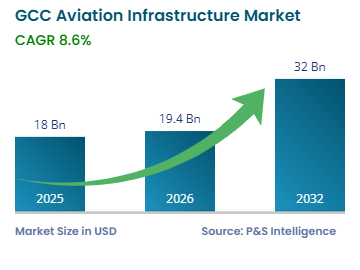
The GCC aviation infrastructure market size will be an estimated USD 18.0 billion for 2025, and it will grow by 8.6% during 2026–2032, to reach USD 32.0 billion by 2032.
The primary factors driving this robust growth include substantial government investments in airport modernization projects, surging air passenger traffic across the region, and the strategic positioning of GCC countries as global aviation hubs connecting East and West. The region's aviation infrastructure landscape is undergoing a transformative phase, with Saudi Arabia's King Salman International Airport, the UAE's Al Maktoum International Airport expansion, and Qatar's Hamad International Airport development collectively representing investments exceeding USD 200 billion.
Dubai International (DXB) continues to lead the region's recovery, having welcomed over 46 million passengers in the first half of 2025, a 2.3% year-on-year increase that puts it on track to exceed 96 million passengers for the full year. Similarly, Doha's Hamad International (DOH) served 25.9 million passengers, and the King Abdulaziz International (JED) in Jeddah saw a record 25.5 million passengers in the first half of the year. Abu Dhabi’s Zayed International (AUH) also saw a notable 13.2% rise, handling 15.5 million passengers.
Moreover, DXB processed more than 2.1 million metric tonnes of freight in the first half of 2025, a 12% increase that highlights its crucial role in global logistics. Further, airports across the UAE collectively handled over 2.2 million tonnes, and all Saudi Arabian airports processing 1.2 million tonnes in 2024 combined.
Integration of Smart Technologies and Digital Transformation Are Key Trends
The adoption of cutting-edge technologies in airport infrastructure represents a transformative trend reshaping the GCC aviation sector.
This trend is driven by the growing passenger volumes, ambitious tourism targets, and national vision programs prioritizing efficiency and innovation.
Airports across the region are implementing artificial intelligence, internet of things sensors, biometric systems, and automated passenger processing technologies to enhance operational efficiency and passenger experience.
Dubai International Airport's smart gates and automated immigration systems have reduced processing times by up to 50%, while Saudi Arabia's new airports are being designed with fully integrated digital ecosystems from inception.
This technological revolution extends beyond passenger-facing systems to include predictive maintenance platforms, digital twin technologies for infrastructure management, and advanced air traffic management systems.
The integration of 5G networks and edge computing capabilities is enabling real-time data analytics and decision-making, positioning GCC airports at the forefront of global aviation innovation.
These smart infrastructure investments are not only improving operational metrics but also supporting the region's broader digital transformation objectives outlined in various national vision programs.
Saudi Vision 2030 and the UAE’s Centennial 2071 programs emphasize innovation, efficiency, and technological leadership in the aviation sector.
According to the WHO, in 2019, 99% of the world's population was living in places where the WHO air quality guidelines levels were not met.
This is prompting GCC nations to integrate sustainable technologies and green airport initiatives into their infrastructure developments.
This, combined with the region's ambitious tourism targets under various national vision programs, is creating unprecedented demand for world-class aviation infrastructure across the Gulf states.
Particularly, Saudi Arabia's Vision 2030 aims to attract 150 million tourists annually.
Mega Airport Developments and Capacity Expansion Are Biggest Drivers
The unprecedented scale of airport expansion projects across the GCC region represents the most significant driver for aviation infrastructure market growth.
Saudi Arabia's USD 30-billion King Salman International Airport project in Riyadh aims to accommodate 120 million passengers annually by 2030, positioning itself as one of the world's largest airports.
Similarly, the UAE's Al Maktoum International Airport expansion, valued at USD 34.85 billion, targets a staggering capacity of 260 million passengers annually upon completion.
This would make it the world's largest airport by passenger capacity.
These mega-developments are fundamentally reshaping the regional aviation landscape, with Qatar’s Hamad International Airport recently completing its capacity expansion to over 65 million passengers annually.
The ambitious infrastructure investments align with national economic diversification strategies, as governments recognize aviation's critical role in driving tourism, trade, and economic growth.
The scale of these projects is creating a substantial demand for construction companies, engineering consultants, and specialized aviation infrastructure providers throughout the value chain.
Dubai International Airport handled nearly 87 million passengers in 2023, illustrating the need for capacity expansion.
The airport terminals category holds the largest market share in 2025, due to massive terminal expansion projects across all major GCC airports. The category's dominance is driven by the construction of new passenger terminals at Al Maktoum International Airport, King Salman International Airport, and the recent completion of Concourses D and E at Hamad International Airport. These terminal projects incorporate state-of-the-art passenger processing systems, extensive retail spaces, and world-class amenities designed to enhance the passenger experience and generate significant non-aeronautical revenues.
The cargo handling facilities category will have the highest CAGR, 8.8%, because the GCC region is witnessing a surge in e-commerce, logistics, and air freight operations. Rising trade volumes, expanding cargo airports, and increasing demand for fast, reliable supply chains are driving significant investments in advanced cargo handling infrastructure.
The infrastructure types analyzed in this report are:
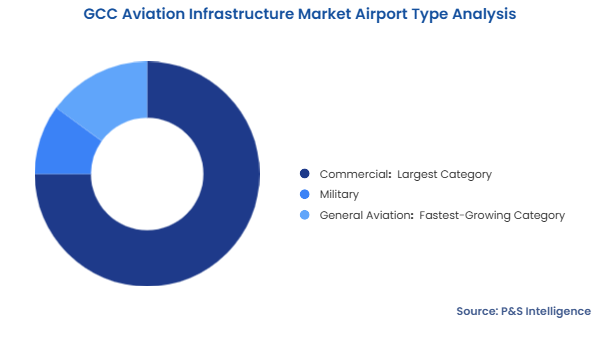
The commercial category holds the largest market share, of 75%, in 2025, driven by major investments in key international hubs, such as Dubai International, Hamad International, and King Khalid International airports. The growth of this category is supported by the record passenger traffic across the GCC and the strategic role of regional airports as global transit hubs. Commercial airport infrastructure investments encompass comprehensive developments, including new terminals, extended runways, enhanced ground support facilities, and integrated transportation connections to support seamless passenger journeys. As per available data, DXB manages 2,500 flights per day on average, while in the first half of 2025, DOH recorded an average of 750 take-offs and landings per day.
The general aviation category will have the highest CAGR, of 9.0%, driven by the increasing private jet ownership among high-net-worth individuals and the development of dedicated business aviation facilities. The growth in general aviation infrastructure reflects the region's economic prosperity and the demand for exclusive, convenient air travel options.
Dubai South (Al Maktoum International Airport saw a record high of 17,891 private jet movements in 2024, representing a 7% increase over the previous year. Moreover, Saudi Arabia’s business jet sector recorded a significant 24% jump in flight volumes in 2024, reaching a total of 23,612 flights. This was driven by a 26% increase in domestic flights and a 15% rise in international flights.
The airport types analyzed in this report are:
Commercial (Largest Category)
Military
General Aviation (Fastest-Growing Category)
Ownership Mode Analysis
The government-owned category holds the largest market share, of 65%, in 2025, underscoring the strategic significance of aviation assets and the substantial capital requirements for major airport developments. GCC governments continue to lead infrastructure investments through dedicated aviation authorities and sovereign wealth funds, ensuring alignment with national development strategies. The government ownership model enables coordinated planning, integration with broader transportation networks, and the pursuit of long-term economic objectives beyond immediate financial returns.
The public–private partnerships category will have the highest CAGR, of 8.9%, driven by governments' desire to leverage private sector expertise, share investment risks, and accelerate infrastructure delivery. Recent PPP initiatives include specialized terminal developments, ground handling facilities, and maintenance infrastructure, where private operators bring operational efficiency and commercial innovation. The PPP model is particularly attractive for non-core infrastructure components, allowing governments to focus resources on strategic assets while benefiting from private sector capabilities.
The construction category holds the largest market share, of 40%, in 2025, driven by the initiation of large-scale airport construction and expansion initiatives throughout the GCC. Major construction activities include the development of massive terminal complexes, runway extensions, and supporting infrastructure, with projects characterized by compressed timelines and complex engineering requirements. The construction services segment benefits from the region's commitment to developing world-class facilities that can accommodate next-generation aircraft and provide superior passenger experiences.
The maintenance, repair, and overhaul category will have the highest CAGR during the forecast period, due to the rapid expansion of airline fleets, increasing air traffic, and the growing focus on operational safety and regulatory compliance. As airports and airlines modernize their operations, regular maintenance and technical support have become critical, driving strong demand for MRO services. Additionally, the adoption of advanced diagnostic technologies, predictive maintenance, and digital MRO platforms is further accelerating growth in this segment, making it a key growth area for investors and service providers in the region.
The U.A.E. holds the largest market share, of 45%, in 2025, driven by the ambitious expansion projects at both Dubai and Abu Dhabi airports. Dubai, recognized as a global aviation capital, is developing a mega-project featuring five parallel runways, 400 aircraft gates, and integration with the Dubai South aerotropolis, creating an ecosystem supporting one million residents and workers. The country's strategic location between Europe, Asia, and Africa, combined with liberal aviation policies and world-class airlines, continues to attract infrastructure investments. Recent developments include the implementation of advanced air traffic management systems, sustainable aviation fuel facilities, and pioneering urban air mobility infrastructure for future air taxi services.
Saudi Arabia Aviation Infrastructure Market Size
Saudi Arabia will have the highest CAGR, of 8.7%, fueled by Vision 2030's ambitious aviation targets. The Kingdom aims to increase air connectivity to 250 destinations and handle 330 million passengers annually by 2030, necessitating massive infrastructure investments. The King Salman International Airport project in Riyadh, valued at USD 30 billion, exemplifies this ambition with plans for six parallel runways and capacity for 185 million passengers by 2050.
The Saudi aviation infrastructure market benefits from a comprehensive national strategy that includes developing 27 airports, establishing new airlines, including Riyadh Air; and creating integrated logistics hubs. Recent initiatives include partnerships with international operators for airport management, development of specialized cargo facilities, and integration of sustainable technologies across all new projects.
Qatar Aviation Infrastructure Market Size
Qatar's aviation infrastructure market maintains steady growth following the successful completion of major projects for the FIFA World Cup 2022. Hamad International Airport's recent expansion, including the opening of Concourses D and E, increased capacity to 65 million passengers annually, reinforcing Doha's position as a premier global hub. The airport's continued investment in passenger experience enhancement, including the ORCHARD indoor tropical garden and state-of-the-art retail facilities, demonstrates Qatar's commitment to maintaining world-class infrastructure standards.
Looking forward, Qatar's infrastructure investments focus on operational efficiency improvements, sustainability initiatives, and preparing for future growth. Qatar's strategic advantages include its central location for global connectivity, award-winning national carrier, and integrated approach to airport development that emphasizes both operational excellence and passenger experience enhancement.
The geographical breakdown of the market is as follows:
U.A.E. (Largest Market)
Saudi Arabia (Fastest-Growing Market)
Qatar
Kuwait
Oman
Bahrain
GCC Aviation Infrastructure Market Share
The market is consolidated with international engineering firms, construction conglomerates, and specialized aviation service providers competing for major projects. While major terminal construction projects tend to be dominated by large international consortia with proven track records in complex aviation projects, specialized segments such as navigation systems, security infrastructure, and environmental services show greater fragmentation with numerous specialized providers. Leading players are forming strategic partnerships to combine international expertise with local knowledge and to meet stringent in-country value requirements. The market has witnessed several significant developments including technology partnerships for smart airport solutions, joint ventures for sustainable infrastructure development, and strategic alliances between construction firms and specialized aviation technology providers.
Key GCC Aviation Infrastructure Companies:
TAV Construction
AI Naboodah Construction Group LLC
Binladin Contracting Group
Dubai Aviation Engineering Projects
ALEC Engineering & Contracting LLC
Bechtel Corporation
VINCI Airports
Al Jaber Group
SMEC Holdings Ltd.
Jacobs Engineering Group Inc.
Parsons Corporation
Fraport AG
GCC Aviation Infrastructure Market News
In September 2025, The Boeing Company signed an MoU with Saudi Arabia to explore partnerships and investments in the advanced air mobility sector, signaling a commitment to innovation in aviation infrastructure.
In July 2025, JINGDONG Property (JDP), the infrastructure investment and management platform of JD.com, formed a strategic alliance with Abu Dhabi Airports to collaboratively develop and manage a cutting-edge logistics facility within the Abu Dhabi Airports Freezone. The facility is set to cover a construction area of around 70,000 square meters, and it will cater to the increasing cross-border e-commerce needs of the region, while also improving air freight and distribution services throughout the GCC nations and the wider MENA area.
In July 2025, Khalifa Al Zaffin, the Executive Chairman of Dubai Aviation City Corporation, revealed that the initial phase of Dubai’s Al Maktoum International Airport will commence operations by 2032. Construction is advancing as scheduled, and a contract worth AED 1 billion has been awarded for the development of a second runway for the airport. Once completed and operational, the first phase of Dubai's new airport will accommodate up to 150 million passengers each year.
In April 2025, Airports Council International Asia-Pacific & Middle East revealed that airports in the APAC and MEA regions are projected to receive a total investment of USD 240 billion from 2025 to 2035 for enhancing current facilities and constructing new ones. Brownfield initiatives will represent USD 136 billion of this investment, facilitating an increase in capacity for an additional 680 million passengers and 14 million tonnes of cargo. Meanwhile, greenfield projects are expected to attract USD 104 billion, which will contribute to an increase in capacity for 562 million passengers and 57 million tonnes of cargo.
In March 2025, Hamad International Airport unveiled its state-of-the-art Concourses D and E. This expansion boosts the airport's annual capacity to over 65 million passengers, with advanced automated boarding systems and sustainable design features meeting LEED Gold certification standards.
Want a report tailored exactly to your business need?
Leading companies across industries trust us to deliver data-driven insights and innovative solutions for their most critical decisions. From data-driven strategies to actionable insights, we empower the decision-makers who shape industries and define the future. From Fortune 500 companies to innovative startups, we are proud to partner with organisations that drive progress in their industries.
Client Testimonials
Working with P&S Intelligence and their team was an absolute pleasure – their awareness of timelines and commitment to value greatly contributed to our project's success. Eagerly anticipating future collaborations.
McKinsey & Company
India
Unmatched Standards
Our insights into the minutest levels of the markets, including the latest trends and competitive landscape, give you all the answers you need to take your business to new heights
Complete Data Security
We take a cautious approach to protecting your personal and confidential information. Trust is the strongest bond that connects us and our clients, and trust we build by complying with all international and domestic data protection and privacy laws