Europe Electric Two-Wheeler Sharing Market Size & Share Analysis - Trends, Drivers, Competitive Landscape, and Forecasts (2026 - 2032)
This Report Provides In-Depth Analysis of the Europe Electric Two-Wheeler Sharing Market Report Prepared by P&S Intelligence, Segmented by Vehicle (Scooter/Moped, Kick Scooter), Trip (One-Way, Round), and Geographical Outlook for the Period of 2021 to 2032
Europe Electric Two-Wheeler Sharing Market Growth Potential
Key Highlights
Study Period
2021 - 2032
Market Size in 2025
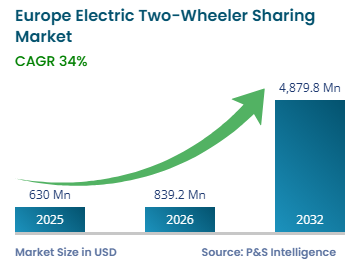
USD 630.0 Million
Market Size in 2026
USD 839.2 Million
Market Size by 2032
USD 4,879.8 Million
Projected CAGR
34%
Largest Country
Germany
Fastest-Growing Country
U.K.
Market Structure
Fragmented
Market Size
Explore the market potential with our data-driven report
Europe Electric Two-Wheeler Sharing Market Analysis
The European electric two-wheeler sharing market size was USD 630.0 million for 2025, and it will grow by 34.0% during 2026–2032, to reach USD 4,879.8 million by 2032.
This growth is driven by rising urban congestion, tightening greenhouse gas emission standards, and the rapid expansion of app-enabled fleet management platforms connecting users to shared electric scooters and mopeds across densely populated European cities.
The market is reinforced by a sustained continental push toward sustainable urban transport. The EU Urban Mobility Observatory reported that shared mobility trips across Europe reached 640 million in 2024, underscoring the structural shift away from private vehicle dependence toward lightweight, on-demand electric alternatives. Favorable low-emission zone policies are further accelerating market conditions. Many European cities restrict high-emission passenger vehicles within urban centers while allowing electric micromobility vehicles unrestricted or preferential access, encouraging commuters to shift toward shared electric scooters and mopeds.
Key Market Insights
The scooter/moped category holds the larger market share, of 70%, in 2025, reflecting the segment's structural head start over lighter alternatives.
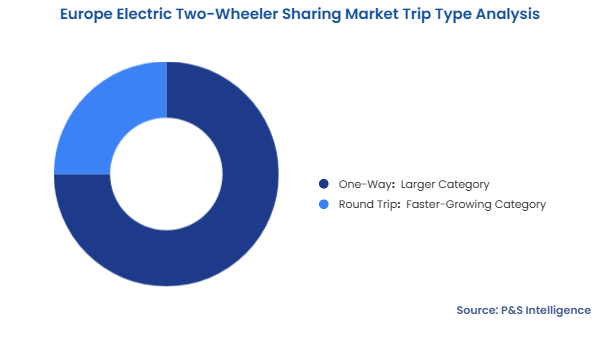
The one-way category holds the larger market share, of 75%, in 2025, driven by the widespread adoption of dockless deployment models.
The kick scooter segment is expected to record the highest CAGR of 34.2%, supported by its lower vehicle cost, which enables rapid fleet expansion, and the gradual legalization of kick scooters across more European markets.
Germany holds the largest market share, of 40%, in 2025, driven by strong micromobility adoption in major cities, supportive urban mobility policies, and the widespread presence of shared e-scooter operators.
The U.K. will have the highest CAGR, of 34.1%, driven by a structured, government-managed trial program systematically building the regulatory evidence base for national legalization.
Europe Electric Two-Wheeler Sharing Market Growth Factors
Expanding Low-Emission Zone Policies Is Key Trend
Urban vehicle access restrictions across European cities are functioning as a structural accelerator for the electric two-wheeler sharing market. As of 2025, low-emission zones operate across hundreds of European cities, with internal combustion engine vehicles facing phased access restrictions that directly elevate the utility of zero-emission shared alternatives. As car travel becomes progressively more restricted and costly in dense urban cores, commuters and short-trip users gravitate toward accessible, app-enabled electric scooters and mopeds that offer unrestricted access within these zones.
Mobility policy analyses indicated that more than 320 low-emission zones were active across Europe in 2022, with the number projected to reach around 507 by 2025, reflecting the rapid expansion of urban policies designed to reduce air pollution and encourage cleaner transport modes. A 2024 study commissioned by the European Commission and conducted by Transport Research Laboratory (TRL) and fka GmbH examined the need for harmonised regulatory frameworks for personal mobility devices across the EU, highlighting how fragmented national rules create barriers for micromobility deployment and recommending options for EU-wide technical standards to support safer and more consistent market development.
Transit Integration and Multi-Modal App Platforms Are Biggest Drivers
A defining transformation reshaping the Europe electric two-wheeler sharing market is the accelerating integration of shared electric scooters and mopeds into broader multi-modal urban transport ecosystems. Operators increasingly embed their fleets within journey planning applications, enabling users to combine train, bus, and shared micromobility into a single trip. This integration elevates the utility of electric two-wheelers beyond leisure use, positioning them as functional first- and last-mile connectors.
In 2024 alone, more than 312 million shared e-scooter trips were recorded across Europe and neighboring markets, covering over 562 million kilometers of travel, highlighting the scale of micromobility usage being integrated into urban transport systems. As European cities increasingly integrate micromobility services into unified Mobility-as-a-Service (MaaS) platforms, seamless connections between shared electric two-wheelers and public transport networks are strengthening their role in everyday urban mobility.
Operational Efficiency Gains Through Fleet Optimization Is Biggest Opportunity
The maturation of fleet management technology is creating measurable efficiency gains that expand market sustainability. Operators are increasingly deploying AI-driven battery swap logistics, predictive rebalancing algorithms, and swappable battery architectures to extend vehicle uptime and reduce per-trip operational costs. Evidence of improving operational utilization can be observed in mature European shared-mobility markets. For instance, Belgium recorded more than 33 million trips using shared bicycles and scooters in 2025, with approximately 2.5 million active users, highlighting the scalability of shared mobility services when supported by optimized fleet management and infrastructure. Additionally, utilization improvements are evident in micromobility fleets, where shared scooter trips increased by about 64% despite a roughly 42% reduction in scooter supply, indicating that operators are achieving higher vehicle productivity through optimized deployment strategies.
In Brussels, the number of shared scooters declined by 44% to around 7,200 vehicles, yet usage rose to more than 9.5 million trips, further demonstrating how tighter fleet management can significantly increase trip density and operational efficiency. These efficiency gains are opening pathways for subscription-based pricing models, corporate fleet partnerships, and integration with employer commuter benefit programs, each representing incremental revenue streams that reduce dependence on per-ride income alone.
Europe Electric Two-Wheeler Sharing Market Segmentation Analysis
Vehicle Type Analysis
The scooter/moped category holds the larger market share, of 70%, in 2025, driven by its structural head start, as electric mopeds and seated scooters entered European cities as early as 2017 through operators such as Felyx Sharing B.V., establishing a mature user base and operational ecosystem ahead of the kick scooter format. The seated configuration supports a broader rider demographic, including commuters carrying bags or wearing formal attire, while the higher speed ceiling, typically 45 km/h under EU AM-category regulations, enables mopeds to function viably on arterial roads that kick scooters cannot legally access. This expanded use case range sustains moped dominance across high-density cities such as Paris, Milan, and Amsterdam where trip distances commonly exceed 5 km.
The kick scooter category will have the higher CAGR, of 34.2%, driven by its significantly lower capital cost per vehicle, enabling operators to rapidly scale fleets in newly permitted cities, and by the progressive legalization of kick scooters across additional European markets. The UK Department for Transport confirmed that 18 live e-scooter rental trials are currently operating across England, with the program extended to May 2028 to support continued evaluation of micromobility regulation and safety frameworks.
The vehicle types analyzed in this report are:
Scooter/Moped (Larger Category)
Kick Scooter (Faster-Growing Category)
Trip Type Analysis
The one-way category holds the larger market share, of 75%, in 2025, driven by the widespread adoption of dockless deployment models. These systems allow users to start and end trips anywhere within a service zone without returning vehicles to a fixed location, making them well-suited for commuter travel, errands, and transit connections.
The round-trip category will have the higher CAGR, of 34.3%, propelled by two converging forces: the proliferation of dock-based and station-anchored shared moped schemes that incentivize return trips through preferential pricing structures, and the integration of shared two-wheelers into tourism and leisure mobility packages in cities such as Barcelona, Rome, and Amsterdam. Municipal regulators in several European cities are increasingly mandating designated end-of-trip parking zones as a licensing condition, which structurally nudges user behavior toward round-trip patterns.
The trip types analyzed in this report are:
One-Way (Larger Category)
Round Trip (Faster-Growing Category)
Drive strategic growth with comprehensive market analysis
Europe Electric Two-Wheeler Sharing Market Geographical Analysis
Germany Electric Two-Wheeler Sharing Market Size
Germany holds the largest market share, of 40%, in 2025, supported by a mature regulatory framework established through Germany’s Elektrokleinstfahrzeuge-Verordnung (eKFV), which legalized electric kick scooters for use on public roads in 2019. This early regulatory clarity enabled operators such as TIER Mobility, Voi, and Lime to rapidly scale fleets across major cities, including Berlin, Hamburg, Munich, and Cologne. Strong user adoption also supports market leadership, with shared e-scooter services recording around 80 million trips in Germany in 2023.
Germany also hosts one of the largest shared micromobility fleets in Europe, with over 100,000 shared e-scooters operating across major cities during peak seasons. High urban population density and strong public transport networks have increased demand for micromobility as a first- and last-mile solution. In addition, cities such as Berlin and Hamburg have expanded cycling lanes and designated parking zones for shared scooters, supporting organized fleet deployment and further strengthening Germany’s position as the largest electric two-wheeler sharing market in Europe.
U.K. Electric Two-Wheeler Sharing Market Size
The U.K. will have the highest CAGR, of 34.1%, driven by a structured, government-managed trial program systematically building the regulatory evidence base for national legalization. The U.K. Department for Transport (DfT) confirmed that 18 live rental e-scooter trials are currently active across England, with the program extended to May 2028 to gather further evidence for future national e-scooter legislation. London's trial, the country's largest, covering 300 km², has demonstrated accelerating adoption, with e-scooters available across more than 1,600 designated parking bays in 11 boroughs. Operators Lime and Voi are active participants, with usage driven by first- and last-mile connectivity demand in areas with limited public transport access.
Transport for London (TfL) reported more than 50% increase in total e-scooter trips between September 2024 and September 2025, rising from 1.3 million to more than 2 million journeys, with 95% of trips ending in designated parking bays. The U.K.'s growth trajectory is further supported by ongoing regulatory evaluations associated with the national e-scooter trial program, as policymakers assess long-term frameworks that could enable broader deployment and permanent regulation of shared micromobility services across major urban centers.
France Electric Two-Wheeler Sharing Market Size
France presents a significant market share within European electric two-wheeler sharing, shaped by divergent regulatory outcomes at the city level. In September 2023, Paris became the first European capital to ban free-floating shared e-scooter services, following a public consultation in which approximately 89% of participating voters supported the removal of a fleet of 15,000 shared scooters operated by Lime, TIER, and Dott.
The EU Urban Mobility Observatory (European Commission) reported that Paris banned shared e-scooter services in September 2023, making it the first European capital to do so, following a public consultation drawing 103,000 participants. The European Transport Safety Council reported that France strengthened electric scooter regulations in 2023, raising the minimum rider age from 12 to 14 and introducing stricter safety measures aimed at improving rider protection and reducing accident risks.
The countries of the market are as follows:
Germany (Largest Country Market)
U.K. (Fastest-Growing Country Market)
France
Spain
Italy
Netherlands
Austria
Portugal
Belgium
Poland
Switzerland
Rest of Europe
Europe Electric Two-Wheeler Sharing Market Competitive Landscape
The market has a fragmented, competitive structure, characterized by several pan-European platform operators competing for city-level permits alongside regional and country-specific specialists. No single player controls a dominant share across the continent, primarily because market access is determined by municipal licensing decisions rather than by scale advantages alone, a structural feature that distributes share across multiple operators and limits large-scale consolidation typically seen in other technology platform markets. The competitive landscape is further shaped by the increasing role of city procurement processes that award exclusive or semi-exclusive operating permits, effectively limiting the number of active operators per city to two to four players.
Key Europe Electric Two-Wheeler Sharing Companies:
Electric Mobility Concepts GmbH
Cooltra Motos S.L.
Cityscoot SAS
Felyx Sharing B.V.
Sharing Muving S.L.U.
YUGO Urban Mobility S.L.
MiMoto Smart Mobility Srl
Bird Rides Inc.
Neutron Holdings Inc. (Lime)
VOI Technology AB
Tier Mobility SE
Dott B.V.
Europe Electric Two-Wheeler Sharing Market News
In October 2024, Dott B.V. announced the consolidation of Tier Mobility operations under a unified Dott platform and mobile application, providing access to a combined fleet of around 250,000 electric scooters and e-bikes across 427 cities in 21 countries following the companies’ merger earlier in 2024.
In October 2024, Voi Technology AB completed its first-ever bond issuance, raising EUR 50 million in senior secured bonds under a total EUR 125 million framework, with the offering significantly oversubscribed by Nordic and international institutional investors.
In April 2024, Neutron Holdings, Inc. (Lime) announced a GBP 25 million London expansion plan following its exit from Paris after the city's referendum ban on shared e-scooters, redirecting capital toward the U.K.'s government-managed trial cities and reinforcing London as a strategic growth priority.
In March 2024, Cooltra Motos S.L. and Felyx Sharing B.V. merged operations to expand their presence in the European shared mobility market, forming a combined group operating around 28,000 vehicles across more than 30 cities in 9 countries.
Frequently Asked Questions About This Report
What is the market size of the Europe Electric Two-Wheeler Sharing Market?+
The market was valued at USD 630.0 million in 2025.
What is the expected growth rate of the Europe Electric Two-Wheeler Sharing Market?+
The market is growing at a CAGR of 34.0% during 2026-2032.
What factors are driving the growth of the Europe Electric Two-Wheeler Sharing Market?+
Key drivers include government initiatives for low-emission transport, increasing demand for last-mile mobility, rising fuel costs, and growing consumer preference for convenient app-based transportation.
How do electric two-wheeler sharing services operate in Europe?+
Electric two-wheeler sharing services typically operate through mobile applications that allow users to locate, unlock, and pay for shared electric scooters or mopeds, often using free-floating or dockless systems within designated service zones.
What role does sustainability play in the Europe electric two-wheeler sharing market?+
Sustainability is a key factor supporting market growth as shared electric two-wheelers help reduce urban emissions, traffic congestion, and dependence on private vehicles.
Want a report tailored exactly to your business need?
Leading companies across industries trust us to deliver data-driven insights and innovative solutions for their most critical decisions. From data-driven strategies to actionable insights, we empower the decision-makers who shape industries and define the future. From Fortune 500 companies to innovative startups, we are proud to partner with organisations that drive progress in their industries.
Client Testimonials
Working with P&S Intelligence and their team was an absolute pleasure – their awareness of timelines and commitment to value greatly contributed to our project's success. Eagerly anticipating future collaborations.
McKinsey & Company
India
Unmatched Standards
Our insights into the minutest levels of the markets, including the latest trends and competitive landscape, give you all the answers you need to take your business to new heights
Complete Data Security
We take a cautious approach to protecting your personal and confidential information. Trust is the strongest bond that connects us and our clients, and trust we build by complying with all international and domestic data protection and privacy laws