This Report Provides In-Depth Analysis of the Ethanolamines Market Report Prepared by P&S Intelligence, Segmented by Type (Monoethanolamine (MEA), Diethanolamine (DEA), Triethanolamine (TEA)), Application (Surfactants, Herbicides, Chemicals, Gas Treatment, Cement), and Geographical Outlook for the Period of 2021 to 2032
Explore the market potential with our data-driven report
Ethanolamines Market Overview
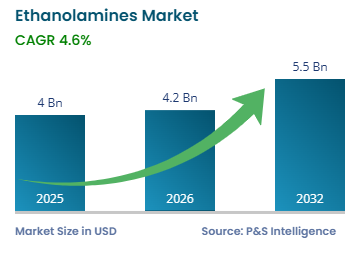
The ethanolamines market size was USD 4.0 billion for 2025, and it will grow by 4.6% during 2026–2032, to reach USD 5.5 billion by 2032.
This growth is supported by the expanding deployment of monoethanolamine, diethanolamine, and triethanolamine across surfactant production, herbicide formulations, and gas treatment operations, positioning these bifunctional amines as essential intermediates for detergents, agricultural chemicals, and carbon capture systems. The International Energy Agency (IEA) confirms that chemical absorption using amine-based solvents is the most technologically mature CO₂ separation technique for power plants and industrial facilities, with capture efficiencies typically reaching 85–95% in commercial-scale installations, accelerating demand from climate mitigation infrastructure.
The continued expansion of global natural gas processing and LNG infrastructure, which structurally depends on amine-based gas sweetening systems to meet sulfur and carbon dioxide specifications, further contributes to the market growth. According to World LNG Report 2025 and International Energy Agency report, global LNG liquefaction capacity grew by approximately 6.5 MTPA in 2024 to about 494.4 MTPA, and pipeline expansions through projects sanctioned to 2030 are expected to add a record 300 billion cubic metres per year of new export capacity, supporting sustained upstream and midstream investments in amine-based gas treatment systems used to remove acid gases and ensure pipeline- and export-grade gas quality.
Key Market Insights
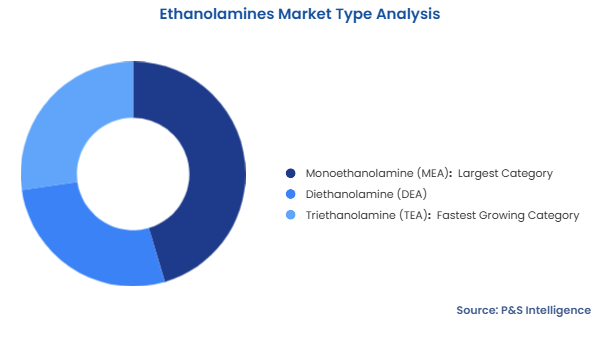
The monoethanolamine category holds the largest market share, of 45%, in 2025, driven by its dominant use in natural gas processing and industrial carbon capture applications.
The triethanolamine category will have the highest CAGR of 4.7%, driven by growing demand in personal care, advanced surfactants, and specialty cement applications due to its unique tertiary amine structure and three hydroxyl groups.
The herbicides category will have the highest CAGR, driven by rising global demand for crop protection amid limited arable land and population growth.
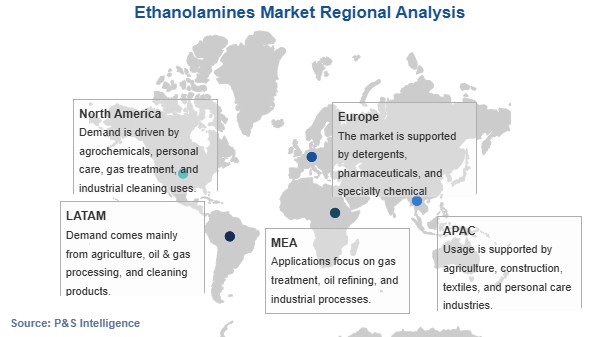
Asia-Pacific holds the largest 45% market share in 2025, driven by strong demand and cost-effective chemical production.
China is the largest country, while India is the fastest-growing country in the Asia-Pacific ethanolamines market.
Ethanolamines Market Dynamics
Urbanization and Rising Household Incomes Are Key Trends
Urban population expansion and rising disposable incomes in emerging economies are driving higher consumption of household cleaning products. This, in turn, increases demand for ethanolamines as essential surfactant manufacturing intermediates, with the World Bank reporting that the global urban population exceeded 56% of total population in 2023 and is expected to continue rising through 2030. Middle-class expansion in Asia-Pacific, particularly across India, Indonesia, China, and Southeast Asian markets, creates large cohorts of first-time consumers adopting packaged detergent products as household incomes cross consumption thresholds.
Moreover, manufacturing responses to this urbanization-driven demand directly benefit ethanolamine suppliers. Detergent producers formulate surfactants using ethanolamines, primarily monoethanolamine and triethanolamine, as pH adjusters, emulsion stabilizers, and fatty acid neutralization agents that enable production of high-performance liquid detergents, concentrated formulations, and specialty cleaning products targeting urban consumer preferences.
The trajectory strengthens through demographic and economic fundamentals. Over 1 billion people are expected to enter the global middle class between 2020 and 2030, according to World Bank projections, with the majority concentrated in Asia and Africa, where detergent market penetration rates remain substantially below developed economy levels. As dual-income urban households prioritize convenience and time savings, liquid detergent formats requiring ethanolamine-based surfactant systems gain market share relative to traditional powder formulations, with ethanolamine trade formally tracked under HS code 292211 in UN Comtrade, indicating its role as a globally traded detergent intermediate.
Agricultural Intensification and Herbicide Adoption Are Biggest Drivers
Global agricultural production systems aim to increase crop yields while managing limited arable land, creating sustained demand for herbicide formulations that incorporate ethanolamine salts as key intermediates. The Food and Agriculture Organization of the United Nations (FAO) reports that agricultural pesticide use reached 3.70 million tonnes, with herbicides now representing approximately 50% of total pesticides applied globally. This agricultural intensification translates directly into ethanolamine consumption through multiple mechanisms.
Regional consumption patterns reveal differentiated growth trajectories. Asia contributed over 50% of global pesticide use in mid-2020s, with rapid agricultural modernization in India, Southeast Asia, and other emerging markets driving accelerating herbicide adoption as smallholder farmers transition toward commercial production systems. North America and Latin America maintain high per-hectare application rates, particularly across corn, soybean, cotton, and sugar production systems, with hectares globally according to international biotechnology adoption statistics, enabling integrated weed management programs. This agricultural foundation is projected to strengthen through 2032 as global population growth toward 9.7 billion people by 2050 necessitates continued yield enhancement through crop protection chemicals, reinforcing structural ethanolamine demand across herbicide manufacturing value chains.
Additionally, regulatory oversight in developed markets further reinforces ethanolamine demand in compliant herbicide formulations. European regulatory authorities, including the European Chemicals Agency (ECHA), enforce substance registration and safety requirements under REACH, influencing formulation choices, documentation standards, and supply chain transparency for agrochemical products.
Sustainable and Bio-Based Formulation Development Is Key Opportunity
Environmental regulations, corporate sustainability commitments, and consumer preferences increasingly favor bio-based chemicals and reduced environmental footprint products, creating market potential for ethanolamines derived from renewable feedstocks. According to chemical assessments under the OECD Screening Information Dataset (SIDS) framework, conventional ethanolamine production relies on ethylene oxide derived from fossil-based ethylene reacted with ammonia, while emerging pathways utilize bio-ethylene produced from bioethanol derived from agricultural residues or industrial biomass, offering substantially lower lifecycle greenhouse gas emissions compared to petrochemical routes, a factor increasingly incorporated into regulatory and procurement decision-making for industrial chemicals.
Regulatory frameworks accelerate this transition across major markets. European Union chemical regulations under REACH require registration, hazard evaluation, and lifecycle documentation for more than 20,000 industrial substances, including ethanolamines, as administered by the European Chemicals Agency (ECHA), influencing formulation decisions and supplier selection. North American and Asian regulatory authorities including the U.S. Environmental Protection Agency (EPA), Health Canada, and national chemical registration agencies increasingly integrate sustainability considerations into detergent ingredient approvals, herbicide registrations, and industrial chemical assessments alongside traditional toxicological safety requirements.
Commercial adoption is reinforced by direct capital investment from chemical producers expanding sustainable feedstock integration. In 2023, BASF SE announced an investment of approximately USD 1 billion to expand bio-based and circular feedstock integration across its European chemical production network, including ethylene derivatives supplying downstream amines and surfactant raw materials, aligning with European Union climate policy objectives and long-term industrial decarbonization strategies.
Downstream adoption is reinforced by public sustainability commitments across end-use industries. Major detergent manufacturers have announced targets to achieve fully renewable or recycled carbon sourcing in cleaning product formulations by 2030, increasing procurement interest in bio-based surfactant intermediates including ethanolamines. Personal care brands increasingly use certified bio-based ingredients as product differentiation in premium segments, while agricultural chemical companies evaluate bio-based ethanolamine salts for herbicide formulations aligned with integrated pest management and reduced environmental impact objectives recognized within government and intergovernmental regulatory frameworks.
Ethanolamines Market Segmentation and Category Analysis
Type Analysis
The monoethanolamine category holds the largest market share, of 45%, in 2025, driven by its dominant use in natural gas processing and industrial carbon capture applications. MEA is widely deployed for CO₂ and H₂S removal across power generation, refining, and ammonia production due to its high reactivity with acidic gases and established absorber–stripper infrastructure. The International Energy Agency (IEA) confirms that amine-based chemical absorption represents the most mature and widely deployed CO₂ separation technology for power plants and industrial facilities, with MEA solutions typically formulated at 15-30% concentration demonstrating optimal balance between absorption capacity and energy requirements for solvent regeneration. Beyond gas treatment, MEA maintains steady demand as a surfactant intermediate and specialty chemical reactant, supported by extensive installed capacity and long-standing operational reliability.
The triethanolamine category will have the highest CAGR, of 4.7%, driven by accelerating demand in personal care formulations, advanced surfactant systems, and specialty cement additives where its tertiary amine structure and three hydroxyl groups deliver unique performance characteristics unavailable from monoethanolamine or diethanolamine alternatives. Personal care and cosmetics manufacturers increasingly specify TEA as emulsifier, pH balancer, and surfactant component in lotions, shampoos, and skin care products, capitalizing on consumer preference for gentle formulations and regulatory acceptance across major markets., with triethanolamine permitted for cosmetic use under the European Union Cosmetics Regulation (EC) No 1223/2009, subject to formulation compliance requirements.
The types analyzed in this report are:
Monoethanolamine (MEA) (Largest Category)
Diethanolamine (DEA)
Triethanolamine (TEA) (Fastest Growing Category)
Application Analysis
The surfactants category holds the largest market share, of 40%, in 2025, reflecting ethanolamines' essential role as intermediates in fatty acid neutralization, emulsifier production, and anionic surfactant synthesis serving household detergents, industrial cleaners, personal care formulations, and textile processing applications globally. Detergent manufacturers deploy ethanolamines primarily MEA, DEA, and TEA to produce alkyl sulfate and alkyl ether sulfate surfactants through reaction with fatty alcohols or fatty acids, creating the foaming and cleaning agents central to laundry products, dishwashing liquids, and multi-surface cleaners.
The herbicides category will have the highest CAGR, driven by global agricultural intensification pressures requiring enhanced weed management to maximize crop yields amid limited arable land expansion and rising food security imperatives supporting population growth toward 9.7 billion people by 2050. Herbicide manufacturers formulate active ingredients, including glyphosate, 2,4-D, dicamba, and other chemistries as ethanolamine salts to achieve optimal water solubility, handling characteristics, and application efficacy for pre-emergence and post-emergence weed control across cereals, oilseeds, fruits, vegetables, and specialty crops.
The applications analyzed in this report are:
Surfactants (Largest Category)
Herbicides (Fastest Growing Category)
Chemicals
Gas Treatment
Cement
Others
Drive strategic growth with comprehensive market analysis
Ethanolamines Market Regional Outlook
Asia-Pacific Ethanolamines Market Size
Asia-Pacific holds the largest market share, of 45%, in 2025, and it will have the highest CAGR, of 4.8%, driven by integrated petrochemical complexes, cost-competitive manufacturing infrastructure, and robust demand from detergent, agriculture, and gas processing sectors. China operates large-scale monoethanolamine and triethanolamine production facilities that supply domestic surfactant manufacturers and agricultural chemical formulators, while also serving export markets across Southeast Asia and other regions. India's expanding textile industry, growing personal care market, and agricultural sector sustain rising ethanolamine usage, supported by 6–7 million tonnes of annual detergent consumption and 140 million hectares of cultivated land requiring herbicide formulations.
Government industrial policies promoting downstream chemical manufacturing, investment in carbon capture infrastructure for coal-fired power plants and steel mills, and agricultural modernization programs reinforce regional demand trajectories. Indonesia, Thailand, and Vietnam exhibit accelerating consumption as economic development drives detergent penetration, construction activity requiring cement additives, and crop protection chemical adoption. The International Energy Agency CCUS Projects Database indicates that Asia-Pacific hosts numerous large-scale carbon capture projects with capacities exceeding 100,000 tonnes of CO₂ per year, supporting increased demand for amine solvents used in industrial gas treatment and carbon capture applications.
North America Ethanolamines Market Size
North America accounted for a significant share of the global ethanolamines market in 2025, driven by mature chemical production infrastructure concentrated in Texas and Louisiana, advanced carbon capture deployments, and strong demand from agricultural, gas processing, and surfactant industries. The United States operates multiple world-scale ethylene oxide and derivatives facilities that produce monoethanolamine, diethanolamine, and triethanolamine for domestic consumption and export markets.
Major agricultural regions including the Corn Belt and Great Plains sustain herbicide demand incorporating ethanolamine salts, particularly for glyphosate formulations and post-emergent weed control products applied across more than 300 million acres of U.S. cropland annually. Natural gas processing plants throughout the Permian Basin, Gulf Coast, and Rocky Mountain regions employ amine-based gas sweetening systems to remove hydrogen sulfide and carbon dioxide, ensuring pipeline specifications and LNG export quality. The U.S. Environmental Protection Agency (EPA) regulates herbicide product registrations under the Federal Insecticide, Fungicide, and Rodenticide Act (FIFRA), overseeing more than 17,000 registered pesticide products and establishing rigorous safety evaluations that directly influence ethanolamine-based formulation development and market access for agricultural applications.
Moreover, Canada contributes specialized production capacity and maintains significant consumption in oil sands operations, where ethanolamines function in gas treatment applications and as chemical intermediates, with oil sands production exceeding 3 million barrels per day, generating sustained acid-gas treatment requirements.
The regions and countries of the market are as follows:
North America
U.S. (Larger Country Market)
Canada (Faster-Growing Country Market)
Europe
Germany (Largest Country Market)
U.K. (Fastest-Growing Country Market)
France
Italy
Spain
Rest of Europe
Asia-Pacific (Largest and Fastest-Growing Regional Market)
China (Largest Country Market)
India (Fastest-Growing Country Market)
Japan
South Korea
Australia
Rest of APAC
Latin America
Brazil (Largest Country Market)
Mexico (Fastest-Growing Country Market)
Rest of LATAM
Middle East and Africa
Saudi Arabia (Largest Country Market)
South Africa
U.A.E. (Fastest-Growing Country Market)
Rest of MEA
Ethanolamines Market Competitive Landscape
The market exhibits semi-consolidation with several major multinational chemical companies maintaining significant market positions through integrated production capabilities, extensive ethylene oxide infrastructure, and established customer relationships across surfactant, agricultural chemical, and industrial gas treatment end-users. Market structure reflects economies of scale in ethylene oxide derivative production, technical service capabilities required for complex applications, and long-term supply agreements that create switching costs for large-volume consumers. The competitive landscape demonstrates stability in core product segments alongside emerging competition in specialty grades and bio-based alternatives where differentiation opportunities exist beyond commodity pricing dynamics.
Competitive dynamics center on feedstock cost management, production efficiency optimization, and customer service differentiation rather than technological breakthroughs or market structure transformation. However, emerging opportunities in bio-based production routes, carbon capture applications requiring high-purity MEA grades, and specialty formulations for personal care or electronics cleaning create potential for new entrant competition or market share gains by players investing in sustainable production capabilities and application development resources.
Key Ethanolamines Companies:
BASF SE
The Dow Chemical Company
Huntsman Corporation
INEOS Group Holdings S.A.
SABIC
Sadara Petrochemicals
Saudi Kayan Petrochemical Company
Nouryon
Nippon Shokubai Co., Ltd.
Oriental Union Chemical Corporation
Mitsui Chemicals Inc.
Amines & Plasticizers Ltd.
Ethanolamines Market News & Updates
In September 2024, BASF SE inaugurated a world-scale production plant for alkyl ethanolamines at its Verbund site in Antwerp, Belgium, expanding global annual production capacity for dimethyl ethanolamine (DMEOA) and methyl diethanolamine (MDEOA) by nearly 30% to over 140,000 tonnes per year.
In February 2024, BASF SE partnered with OQEMA AG to enhance distribution of monoethanolamine and specialty amine products across the United Kingdom market.
Frequently Asked Questions About This Report
What is the market size of the global ethanolamine market?+
The global ethanolamines market was valued at USD 4.0 billion in 2025.
Which type dominates the ethanolamines market?+
Monoethanolamine (MEA) dominates the ethanolamines market.
Which region holds the largest share of the ethanolamines market?+
Asia Pacific holds the largest share of the ethanolamines market.
Who are the key players in the ethanolamines market?+
The ethanolamine market is led by major global chemical manufacturers with integrated production and strong regional distribution networks.
What are the key challenges in the ethanolamines market?+
Key challenges include fluctuating raw material prices, stringent environmental regulations, and health concerns related to ethanolamine exposure.
What impact do regulatory policies have on the ethanolamines market?+
Regulatory policies affect the ethanolamines market through chemical safety standards and environmental regulations, increasing compliance costs while encouraging cleaner production practices.
Want a report tailored exactly to your business need?
Leading companies across industries trust us to deliver data-driven insights and innovative solutions for their most critical decisions. From data-driven strategies to actionable insights, we empower the decision-makers who shape industries and define the future. From Fortune 500 companies to innovative startups, we are proud to partner with organisations that drive progress in their industries.
Client Testimonials
Working with P&S Intelligence and their team was an absolute pleasure – their awareness of timelines and commitment to value greatly contributed to our project's success. Eagerly anticipating future collaborations.
McKinsey & Company
India
Unmatched Standards
Our insights into the minutest levels of the markets, including the latest trends and competitive landscape, give you all the answers you need to take your business to new heights
Complete Data Security
We take a cautious approach to protecting your personal and confidential information. Trust is the strongest bond that connects us and our clients, and trust we build by complying with all international and domestic data protection and privacy laws