This Report Provides In-Depth Analysis of the Enterprise Collaboration Market Report Prepared by P&S Intelligence, Segmented by Type (Internal, External), Deployment Type (Cloud-Based, On-Premises), Component (Solutions, Services), Enterprise Size (Large Enterprises, Small and Medium-Sized Enterprises (SMEs)), Industry (IT & Telecommunication, Government, Energy & Utilities, Banking, Financial Services, & Insurance (BFSI), Manufacturing, Retail & Consumer Goods, Healthcare, Travel & Hospitality), and Geographical Outlook for the Period of 2019 to 2032
Explore the market potential with our data-driven report
Enterprise Collaboration Market Analysis
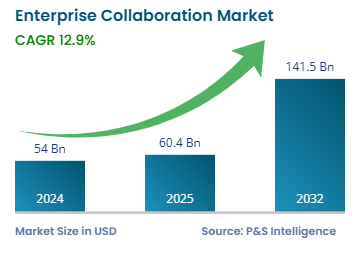
The enterprise collaboration market size was USD 54.0 billion in 2024, and it will grow by 12.9% during 2025–2032, to reach USD 141.5 billion by 2032.
The market growth is driven by the increasing demand for improved execution of external and internal communications within a company. Enterprise collaboration solutions are platforms or tools that allow organizations to share resources and information more efficiently. This may vary from a simple communication tool (e.g., emails) to more intricate management systems. Enterprise collaboration enables higher productivity among departments and workers. The market expansion is primarily driven by the accelerating adoption of hybrid work models, increasing integration of artificial intelligence in collaboration platforms, and rising demand for cloud-based solutions.
The surge reflects the critical role of collaboration platforms in maintaining business continuity and enhancing productivity across geographically dispersed teams. The integration of generative AI capabilities into collaboration tools represents a paradigm shift, with AI-powered features such as automated meeting transcription, intelligent task management, and predictive analytics becoming standard offerings. These advancements enable organizations to streamline workflows, reduce operational overhead, and accelerate decision-making processes.
Enterprise Collaboration Market Emerging Trends
Integration of Artificial Intelligence and Machine Learning Technologies Is Key Trend
The incorporation of AI and ML capabilities into enterprise collaboration platforms represents a fundamental shift in how organizations approach workplace communication and productivity.
Advanced AI algorithms now power intelligent features including real-time language translation, automated content summarization, and predictive task prioritization.
These technologies enable organizations to overcome language barriers, automate routine administrative tasks, and derive actionable insights from collaboration data.
Machine learning models analyze communication patterns and workflow data to identify bottlenecks, suggest process improvements, and optimize team performance.
Natural language processing capabilities enhance search functionality within collaboration platforms, enabling employees to quickly locate relevant information across multiple communication channels and document repositories.
The integration of sentiment analysis tools helps organizations monitor employee engagement and well-being, providing valuable insights for human resources management.
Furthermore, AI-powered virtual assistants streamline meeting scheduling, automate follow-up tasks, and facilitate knowledge sharing across teams, significantly reducing the time spent on coordination activities.
The Government of India has approved the IndiaAI Mission with a budget of INR 10,372 crore to build AI compute capacity, support startups, and develop ethical AI.
The National Data Sharing and Accessibility Policy mandates open, machine-readable government data to support AI/ML development.
Growing Mobile-First Adoption and WFH Culture Are Biggest Drivers
The growing usage of mobile devices to operate numerous social networking platforms is a key driver for the enterprise collaboration market growth.
It is observed that comparatively quite few people access social networking sites via computers, while most people use smartphones to access these websites.
In 2025, 73% of the U.S. population uses their smartphones for social media.
Furthermore, emerging economies, such as China and India, are also experiencing a similar trend, owing to the increasing usage of smartphones due to its easy accessibility.
In enterprise collaboration, these mobile and social-first tools enable employees to collaborate with each other from remote locations at any time.
They offer numerous benefits to businesses, such as enhanced productivity, cost reduction, better cooperation between employees, improved data sharing, real-time access to business information, remote work culture, and better employee and customer engagement.
The rise of work-from-home (WFH) culture has significantly accelerated the demand for enterprise collaboration solutions.
As remote and hybrid work models become the norm, businesses require reliable digital tools to ensure seamless communication, productivity, and project coordination across dispersed teams.
Cloud-based platforms, video conferencing, document sharing, and real-time messaging have become essential for maintaining workflow continuity and team engagement.
Companies are increasingly investing in integrated collaboration ecosystems to support virtual meetings, knowledge sharing, and workflow automation.
This shift has not only changed how organizations operate but also established digital collaboration as a strategic necessity for long-term resilience and efficiency.
As of 2024, approximately 28% of the global workforce engages in remote work, with 16% of companies operating fully remotely.
In the U.S., about 14% of employed adults work entirely from home, while 58% of white-collar workers prefer to work remotely at least three days a week.
In India, 12.7% of full-time employees work from home, and 28.2% follow a hybrid model.
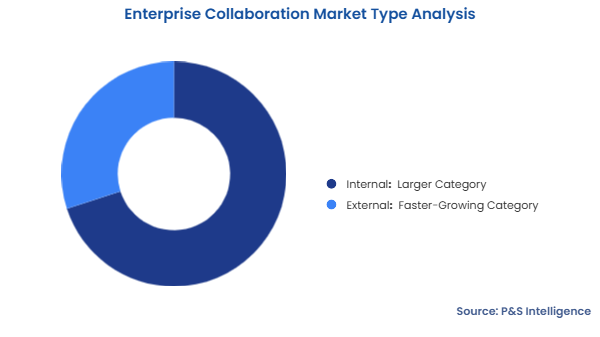
The internal category held the larger market share, of 70%, in 2024. This dominance stems from organizations' primary focus on enhancing communication and coordination among their employees, departments, and internal stakeholders. Internal collaboration tools encompass a wide range of functionalities including team messaging, video conferencing, project management, and knowledge sharing platforms that facilitate seamless interaction within organizational boundaries. The increasing complexity of business operations and the rise of cross-functional teams have amplified the need for robust internal collaboration solutions that break down silos and promote information flow across hierarchical levels.
The external category will have the higher CAGR, of 13.2%, because they enable organizations to build relationships with their clients, enhance revenue, reduce product development and marketing costs, and enhance customer service. This rapid growth reflects the expanding ecosystem of business partnerships, supplier networks, and customer engagement initiatives that require secure and efficient collaboration beyond organizational boundaries. Organizations are increasingly adopting external collaboration platforms to streamline vendor management, enhance customer support, and facilitate joint innovation projects with partners. The growth is further accelerated by the rise of digital supply chains and the need for real-time coordination with external stakeholders in industries such as manufacturing, healthcare, and retail.
The types analyzed in this report are:
Internal (Larger Category)
External (Faster-Growing Category)
Deployment Type Analysis
The on-premises category held the larger market share, of 65%, in 2024, and continues to serve specific market segments where data sovereignty, regulatory compliance, or security concerns mandate local data storage. Financial institutions, government agencies, and healthcare organizations often require on-premise solutions to meet stringent regulatory requirements.
The cloud-based category will have the higher CAGR, of 13.4%, due to its inherent advantages, including reduced infrastructure costs, automatic updates, enhanced scalability, and improved accessibility for remote workers. Cloud-based collaboration platforms enable instant deployment across global organizations without the complexity of managing on-premises infrastructure. The subscription-based pricing model of cloud solutions aligns with organizations' preference for operational expenditure over capital investments, particularly in uncertain economic conditions.
The deployment types analyzed in this report are:
Cloud-Based (Faster-Growing Category)
On-Premises (Larger Category)
Component Analysis
The solutions category held the larger market share, of 70%, in 2024, driven by organizations' need for comprehensive platforms that integrate multiple collaboration functionalities. Within solutions, unified communications emerged as the largest sub-segment, reflecting the critical importance of integrated voice, video, and messaging capabilities in modern workplaces. Enterprise social networks and project management solutions also showed significant adoption as organizations seek to replicate the engagement of consumer social platforms while maintaining enterprise-grade security and compliance features.
The services category will have the higher CAGR, of 13.6%. This growth is fueled by the increasing complexity of collaboration deployments and the need for specialized expertise in areas such as change management, user adoption, and platform integration. Professional services, including consulting, implementation, and training, are particularly in demand as organizations struggle to maximize return on investment from their collaboration platforms. Managed services are gaining traction as businesses seek to outsource the operational aspects of collaboration platform management, allowing internal IT teams to focus on strategic initiatives.
The components analyzed in this report are:
Solutions (Larger Category)
Unified Communications
Portals and Intranet Platforms
Enterprise Social Network
Project Management and Analytics
File Sharing and Synchronization
Services (Faster-Growing Category)
Professional
Managed
Enterprise Size Analysis
The large enterprises category held the dominant market share, of 60%, in 2024, reflecting their substantial investments in digital transformation initiatives and complex collaboration requirements. These organizations typically operate across multiple geographies, necessitating sophisticated collaboration platforms that can support thousands of users while maintaining performance and security standards. Large enterprises also have the resources to invest in comprehensive collaboration suites that integrate with existing enterprise systems, including ERP, CRM, and business intelligence platforms. Their adoption is driven by the need to maintain competitive a advantage through improved operational efficiency and faster decision-making processes.
The SMEs category will have the higher CAGR, of 13.9%. This growth is attributed to the democratization of enterprise-grade collaboration tools through cloud-based delivery models that eliminate substantial upfront investments. SMEs are increasingly recognizing that effective collaboration platforms can level the playing field, enabling them to compete with larger competitors by improving agility and innovation capacity. The availability of scaled-down versions of enterprise platforms with SME-friendly pricing models has accelerated adoption in this segment.
The enterprise sizes analyzed in this report are:
Large Enterprises (Largest Category)
Small and Medium-Sized Enterprises (SMEs) (Fastest-Growing Category)
Industry Analysis
The IT & telecommunications category held the largest market share, of 25%, in 2024, driven by the industry's inherently digital nature and early adoption of collaborative technologies. Technology companies utilize collaboration platforms not only for internal communication but also as testing grounds for new features and capabilities. The sector's distributed development teams, agile methodologies, and continuous innovation cycles create intense demand for sophisticated collaboration tools that support real-time code sharing, virtual pair programming, and seamless integration with development environments.
The healthcare category will have the highest CAGR, of 13.4%. The healthcare sector's digital transformation, accelerated by telehealth adoption and the need for secure patient data sharing, drives substantial investments in collaboration platforms. Healthcare providers require specialized collaboration solutions that ensure HIPAA compliance while facilitating communication among care teams, specialists, and administrative staff. The integration of collaboration platforms with electronic health records and clinical decision support systems enhances care coordination and improves patient outcomes.
The adoption of digital health and telemedicine technologies has significantly transformed healthcare delivery worldwide. In the United States, approximately 44% of patients reported receiving medical care virtually in the past year, with 75% of individuals with chronic illnesses utilizing virtual care services. In India, online doctor consultations surged from 0.55 million in 2019 to 2.4 million in 2023, with 90% of these consultations conducted via video. Regarding digital prescriptions, the NHS in England reported a 45% increase in digital prescription requests over the past year, amounting to 3.1 million repeat prescriptions per month. These statistics underscore the growing reliance on digital health solutions to enhance accessibility and efficiency in healthcare services.
The industries analyzed in this report are:
IT & Telecommunication (Largest Category)
Government
Energy and Utilities
Banking, Financial Services, & Insurance (BFSI)
Manufacturing
Retail & Consumer Goods
Healthcare (Fastest-Growing Category)
Travel & Hospitality
Drive strategic growth with comprehensive market analysis
Enterprise Collaboration Market Geographical Outlook
North America Enterprise Collaboration Market Size
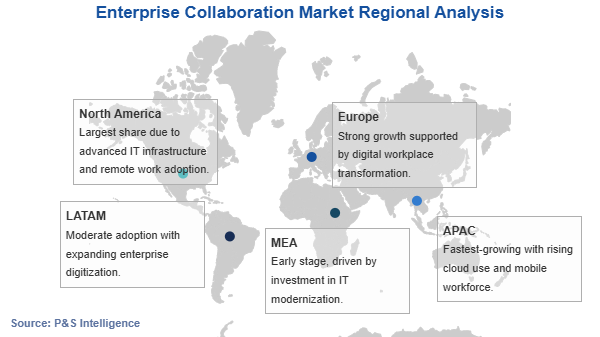
North America held the largest market share, of 40%, in 2024, due to the presence of leading market players, such as Facebook Inc., Microsoft Corporation, Google LLC, and Slack Technologies Inc. These organizations are providing technologically advanced solutions and products to small and large-scale companies in order to boost their productivity by facilitating enhanced internal and external communications. Such factors would further augment regional market growth in the coming years. Moreover, Canadian organizations contribute to regional growth by addressing unique needs, such as bilingual collaboration and remote work enablement.
U.S. Enterprise Collaboration Market Size
The U.S. dominates the market in the region, with enterprises across sectors implementing comprehensive digital workplace strategies. Federal and state government agencies have accelerated collaboration platform adoption to support distributed workforce models and improve citizen services. The U.S. government's Cloud Smart strategy has further accelerated cloud adoption, promoting secure, cost-effective, and flexible collaboration infrastructure across public sector agencies. Moreover, the proliferation of 5G networks across major metropolitan areas enables new collaboration experiences, including high-definition video conferencing and real-time document collaboration on mobile devices.
Asia-Pacific Enterprise Collaboration Market Size
Asia-Pacific will have the highest CAGR, of 13.9%, due to the rapid digitalization across emerging economies, expanding internet penetration, and government-led digital transformation initiatives. The region's mobile-first approach to technology adoption particularly favors cloud-based collaboration solutions accessible through smartphones and tablets. Moreover, India's thriving IT services sector and expanding startup ecosystem drive demand for cost-effective collaboration solutions that support distributed development teams. Japan's focus on workplace productivity improvements and society 5.0 initiatives creates opportunities for advanced collaboration technologies, including AI-powered translation and virtual reality meeting spaces.
China Enterprise Collaboration Market Size
China is a major contributor to regional adoption with massive investments in enterprise digitalization as part of its national digital economy strategy. The country's emphasis on indigenous technology development has spawned local collaboration platform providers that compete effectively with global vendors. These local platforms are designed to meet China's rules and language needs, and they are becoming more popular in areas such as education, manufacturing, and government work.
The geographical breakdown of the market is as follows:
North America (Largest Regional Market)
U.S. (Largest Country)
Canada (Fastest-Growing Country)
Europe
Germany (Largest Country)
U.K. (Fastest-Growing Country)
France
Italy
Spain
Rest of Europe
Asia-Pacific (Fastest-Growing Regional Market)
China (Largest Country)
India (Fastest-Growing Country)
Japan
South Korea
Australia
Rest of APAC
Latin America
Brazil (Largest Country)
Mexico (Fastest-Growing Country)
Rest of LATAM
Middle East and Africa
Saudi Arabia (Fastest-Growing Country)
South Africa
U.A.E. (Largest Country)
Rest of MEA
Enterprise Collaboration Market Share
The market is moderately consolidated due to the presence of dominant players and numerous emerging vendors. While companies like Microsoft, Google, and Cisco hold significant market shares, smaller and regional providers continue to gain traction by offering customizable solutions. Additionally, evolving customer preferences, low switching costs, and rapid innovation cycles contribute to market competitiveness.
Key Enterprise Collaboration Companies:
Medtronic plc
Terumo Medical Corporation
Cardinal Health Inc.
Boston Scientific Corporation
Cook Medical
BIOTRONIK Inc.
Abbott Laboratories
Becton, Dickinson and Company
Natec Medical Ltd.
Surmodics Inc.
Meril Life Sciences Pvt. Ltd.
BrosMed Medical
Enterprise Collaboration Market News
In August 2025, GCG Enterprise Solutions declared its strategic alliance with Egnyte to offer a cohesive platform to make it easier for organizations to handle, share, and safeguard their essential files in a time of hybrid work, strict compliance, and a growing need for secure collaboration.
In May 2025, Microsoft Corporation announced the integration of advanced AI copilot features in Teams, enabling automated meeting summaries, action item extraction, and intelligent task assignment based on conversation context.
In May 2025, Google LLC introduced real-time live speech translation in Google Meet, using Gemini AI, at their Google I/O 2025 conference.
In April 2025, Samsung SDS Co. Ltd. launched the Brity Works generative AI-based all-in-one collaboration & communication solution in India. The SaaS-based Brity Works is tailored for enterprise collaboration, integrating features such as Portal, Approvals, Mail, Messenger, Meeting, and Drive, all enhanced by Brity Copilot. It also delivers real-time captions through the speech-to-text technology, produces meeting summaries, and responds to inquiries based on the discussion. Furthermore, Brity Copilot can be trained on the company’s internal data, enabling easier access to specific information from a vast repository of historical data and documents.
In March 2025, Cisco Systems Inc. presented its vision for agentic AI collaboration, alongside new AI-driven collaboration solutions aimed at delivering futureproof experiences for customers, employees, and IT teams, at Enterprise Connect. The latest agentic AI innovations feature the general availability of the Webex AI Agent, while the additional solutions introduced across Collaboration Devices and the Webex Suite encompass new workflows in AI Assistant for Webex Suite to optimize employee experiences, Webex Calling Customer Assist, and AirPlay on Cisco Devices for Microsoft Teams Rooms.
In February 2025, Barco presented its updated ClickShare enterprise collaboration platform at ISE 2025, guaranteeing a tailored and seamless experience for attendees in BYOD rooms. Key features include automatic selection of the room's camera and audio, speaker recognition, meeting summary, and task assignment overview produced by Microsoft Copilot, an optimized shared display, and minimized voice isolation.
Want a report tailored exactly to your business need?
Leading companies across industries trust us to deliver data-driven insights and innovative solutions for their most critical decisions. From data-driven strategies to actionable insights, we empower the decision-makers who shape industries and define the future. From Fortune 500 companies to innovative startups, we are proud to partner with organisations that drive progress in their industries.
Client Testimonials
Working with P&S Intelligence and their team was an absolute pleasure – their awareness of timelines and commitment to value greatly contributed to our project's success. Eagerly anticipating future collaborations.
McKinsey & Company
India
Unmatched Standards
Our insights into the minutest levels of the markets, including the latest trends and competitive landscape, give you all the answers you need to take your business to new heights
Complete Data Security
We take a cautious approach to protecting your personal and confidential information. Trust is the strongest bond that connects us and our clients, and trust we build by complying with all international and domestic data protection and privacy laws