Control Valve Market Size & Share Analysis - Key Trends, Future Opportunities, Growth Strategies, and Forecasts (2025 - 2032)
This Report Provides In-Depth Analysis of the Control Valve Market Report Prepared by P&S Intelligence, Segmented by Type (Ball, Butterfly, Cryogenic, Globe), Material (Stainless steel, Cast Iron, Alloy Based), Actuation Technology (Manual, Pneumatic, Hydraulic, Electric), End User (Oil & Gas, Chemicals, Energy & Power, Water & Wastewater Treatment, Food & Beverages, Pharmaceuticals), and Geographical Outlook for the Period of 2019 to 2032
Explore the market potential with our data-driven report
Control Valve Market Analysis
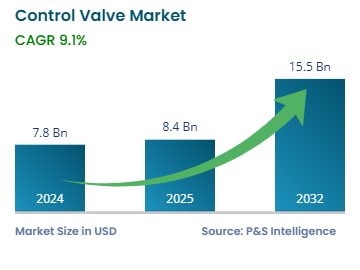
The global control valve market generated an estimated revenue of USD 7.8 billion in 2024, which is expected to witness a CAGR of 9.1% during 2025–2032, to reach USD 15.5 billion by 2032. This growth can be attributed to the increasing demand for efficient fluid control systems across various industries, such as oil & gas, water treatment, power generation, and chemical processing.
According to the International Energy Agency (IEA), global oil supply—including crude, condensate, and other liquids—is averaging around 104 million barrels per day in 2025, with crude oil alone accounting for approximately 82.4 million barrels per day, as reported by the U.S. Energy Information Administration (EIA). In 2023, total global production of petroleum liquids surpassed 4.5 billion tonnes, based on data from BP’s Statistical Review of World Energy.
For natural gas, the International Gas Union (IGU) reported that global production reached approximately 4.1 trillion cubic meters in 2023. This reflects gas’s increasing role in the global energy mix, particularly for power generation, heating, and industrial processes.
Additionally, the growing adoption of automation and industrial digitalization, along with the rising need for safety and energy-efficient systems, is further driving the market expansion. As industries continue to emphasize operational efficiency and regulatory compliance, control valves, which play a crucial role in regulating flow, pressure, and temperature in complex systems, are becoming indispensable components. These trends, combined with ongoing technological advancements in valve design and material science, are expected to fuel the market's upward trajectory in the years ahead.
Control Valve Market Emerging Trends & Growth Drivers
Adoption of Advanced Technologies in Smart Valves Is a Key Trend
The adoption of advanced technologies in smart valves presents a significant market opportunity for the global control valve market.
As industries increasingly embrace automation and Industry 4.0, the demand for intelligent and digitally integrated valve systems is growing rapidly.
Smart control valves are equipped with sensors, actuators, and communication technologies that allow them to transmit real-time data, enabling predictive maintenance, remote monitoring, and enhanced control over fluid dynamics.
These capabilities are crucial for improving the efficiency, reliability, and safety of operations in industries like oil and gas, chemicals, power generation, and water treatment.
The integration of IoT (Internet of Things) with smart valves allows operators to monitor valve performance and system conditions remotely, reducing downtime and minimizing the need for on-site maintenance.
Furthermore, predictive analytics can foresee potential issues before they lead to failures, helping companies avoid costly repairs and operational interruptions.
This technological advancement aligns with the growing emphasis on operational efficiency, energy conservation, and minimizing environmental impact.
Smart and connected control valves are transforming industrial operations by enabling real-time monitoring, predictive maintenance, and remote control.
They slash unplanned downtime by up to 30%, boost equipment availability by over 20%, and cut maintenance costs by around 25%.
Enhanced energy management and precision control also drive efficiency gains.
Growing Chemical Industries Is Key Driver
One of the key drivers propelling the growth of the global control valve market is the expanding chemical industry.
As the global demand for chemical products continues to rise, driven by applications across sectors such as pharmaceuticals, agriculture, manufacturing, and consumer goods, the need for efficient, precise, and reliable control systems becomes more critical.
Control valves play a pivotal role in regulating the flow, pressure, and temperature within chemical processing plants, ensuring that production processes run smoothly, safely, and within regulatory standards.
As chemical plants become more complex, with a growing need for automation, control valves offer essential functionality to maintain optimal operating conditions, enhance productivity, and prevent hazardous situations.
Moreover, the chemical industry is increasingly focusing on energy efficiency, sustainability, and reducing emissions, further increasing the demand for advanced control valve technologies.
These valves help optimize the use of energy and resources, contributing to more environmentally friendly and cost-effective operations.
Complications Associated with Installation and Maintenance
A significant challenge facing the global control valve market is the complications associated with the installation and maintenance of control valves.
Installing control valves, especially in complex industrial systems, requires precise alignment, integration with existing infrastructure, and calibration to ensure accurate and reliable operation.
Any errors in installation can lead to operational inefficiencies, reduced performance, or even system failure, which can be costly and time-consuming to rectify.
Additionally, the maintenance of control valves is a highly specialized process that requires skilled technicians and knowledge of intricate valve mechanics.
Control valves often operate under demanding conditions, such as extreme pressures, temperatures, and corrosive environments, which can lead to wear and tear, valve malfunction, or degradation of performance over time.
This necessitates frequent maintenance and sometimes complete overhauls, further increasing operational costs and downtime.
For industries operating on tight schedules, prolonged maintenance or unexpected valve failures can disrupt production and result in significant financial losses.
Control Valve Market Segmentation Analysis
Type Insights
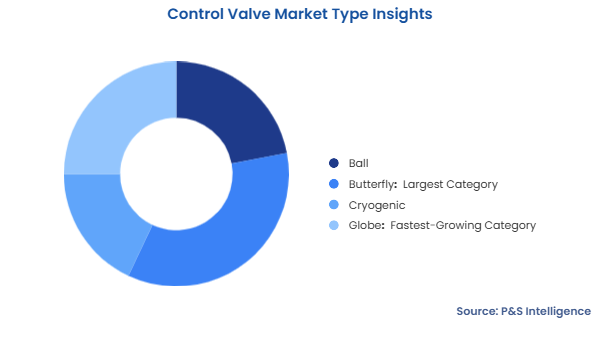
The butterfly category accounted for the largest share, of around 35%, in 2024, on account of the small size of such variants and their ability to open and close quickly when actuated. Additionally, butterfly valves are precise in controlling the flow of the liquids, which makes them advantageous in industrial applications.
Globe is the fastest-growing category during the forecast period. Demand for globe valves is growing across industries due to their ability to offer precise flow regulation, especially in high-pressure and high-temperature systems. Industries like oil & gas, power, and water treatment favor them for their reliability, safety, and compatibility with smart systems that reduce maintenance and operational downtime.
We have analyzed these types:
Ball
Butterfly (Largest Category)
Cryogenic
Globe (Fastest-Growing Category)
Actuation Technology Insights
The pneumatic category accounted for the largest share in 2024 and it will also have the highest CAGR. This is attributed to the ability of this technology to provide precise linear motion in a wide range of temperatures. Furthermore, the high success rate of pneumatic control valves in the oil & gas industry also boosts their revenue.
These actuation technologies have been covered:
Manual
Pneumatic (Largest and Fastest-Growing Category)
Hydraulic
Electric
Material Insights
The stainless steel category is projected to grow at the highest CAGR, of 9.7%, during 2025–2032, after holding the largest market share in 2024. This growth is primarily driven by stainless steel’s exceptional durability, corrosion resistance, and high strength, which make it an ideal choice for demanding applications in industries such as oil & gas, chemical processing, power generation, and water treatment.
Stainless steel control valves can withstand extreme temperatures, high pressures, and aggressive media, ensuring reliable and consistent performance even in the harshest operational conditions. Moreover, stainless steel valves offer longer lifespans and require less maintenance compared to other materials, leading to reduced operational costs over time.
This cost-effectiveness, coupled with the increasing focus on safety, sustainability, and efficiency across industries, has made stainless steel the material of choice for modern industrial control systems.
During the study, we have analyzed the following materials in the report:
Stainless steel (Largest and Faster-Growing Category)
Cast Iron
Alloy Based
Others
End User Insights
The oil & gas category accounts for the largest share in 2024. This sector heavily relies on control valves for efficient fluid and gas regulation, critical to the operation of refining, upstream production, and pipeline transportation. Control valves in the oil and gas industry help manage the flow of crude oil, natural gas, and various other chemicals, ensuring safety, efficiency, and compliance with stringent environmental standards.
The increasing global demand for energy, along with the push toward more sustainable energy practices, is further driving growth in the oil and gas sector, which in turn elevates the demand for high-performance control valves. Additionally, the rise in exploration and production activities in both mature and emerging oil fields increases the need for sophisticated control systems to maintain operational stability and prevent equipment failures.
Together, oil and gas continue to dominate the global energy landscape, contributing nearly 75–80% of global primary energy consumption, according to the IEA and World Energy Council. Despite the rise of renewables, fossil fuels remain central to meeting global energy demand, with oil and gas infrastructure and production still expanding in key regions.
Chemicals are the fastest-growing category in the market during the forecast period. The industry consists of processing units, mixing units, and storage units, which require different kinds of control valves. For example, in the mixing unit, electrically operated valves are used. Also, ball valves are used for controlling the flow of pure liquids. The storage units generally use the cryogenic valve when high-pressure liquids and gases at extremely low temperatures need to be stored.
The global chemical sector is a vast industrial powerhouse, producing around 4.1 billion tonnes of chemicals annually and operating tens of thousands of plants worldwide, particularly across Asia-Pacific, which accounts for over half of global capacity. It contributes roughly 7% of global GDP, underpinning diverse industries and innovation.
The following end user are included in the report:
Oil & Gas (Largest Category)
Chemicals (Faster-Growing Category)
Energy & Power
Water & Wastewater Treatment
Food & Beverages
Pharmaceuticals
Others
Drive strategic growth with comprehensive market analysis
Control Valve Market Regional Market Performance
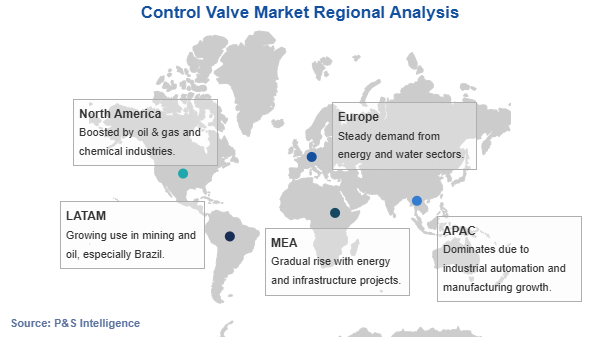
APAC is the largest market with approx. 40% share and the fastest-growing, with 9.7% CAGR during 2025-2032. The high demand for control valves is driven by its growing penetration in the different industries, such as oil a& gas, power generation, water & wastewater treatment, and automotive. There has been discovery of new reserves of crude oil in China, which is leading to the increased use of control valves for maintaining the production and flow rate in these oil and gas fields. Also, with the increase in the population, there is a rise in the need for energy. Countries such as India and China now have a high need for energy, attributed to the rise in set up of new power generation plants. These new plants will require the control valves in different units, such as production unit, process unit, and firefighting unit , which will drive the control valves market in the region.
China's total power generation capacity reached 2,920 GW in 2023, with coal-fired electricity supply increasing by 6.1% year on year to cover hydropower shortages. India's installed power generation capacity stood at 484,818.82 MW as of June 30, 2025, with a significant share from renewable sources. In Japan and South Korea, control valves are integral to their advanced thermal and nuclear power plants, ensuring efficient and safe operations. The chemical industry in India, valued at US$ 220 billion and expected to reach US$ 300 billion by 2030, further drives the demand for control valves. Similarly, China's chemical industry, being the third-largest producer in Asia, contributes to the growing need for precise flow control solutions.
Further, regions and countries analyzed for this report include:
North America
U.S. (Larger and Faster-Growing Country Market)
Canada
Europe
Germany (Largest Country Market)
UK (Fastest-Growing Country Market)
France
Italy
Spain
Rest of Europe
Asia-Pacific (APAC) (Largest and Fastest-Growing Regional Market)
China (Largest Country Market)
Japan
India (Fastest-Growing Country Market)
South Korea
Australia
Rest of APAC
Latin America (LATAM)
Brazil (Largest and Fastest-Growing Country Market)
Mexico
Rest of LATAM
Middle East and Africa (MEA)
Saudi Arabia (Largest Country Market)
South Africa
U.A.E. (Fastest-Growing Country Market)
Rest of MEA
Control Valve Market Share
The market is generally considered fragmented, with numerous players operating across various regions and catering to different industry needs. This is primarily due to the wide variety of control valve applications across industries such as oil and gas, power generation, chemicals, water treatment, and pharmaceuticals. These industries have unique demands in terms of valve specifications, materials, and performance characteristics, which leads to the presence of a broad range of manufacturers offering tailored solutions.
In addition to large multinational companies, there are numerous small and medium-sized enterprises (SMEs) operating in niche markets and specialized applications. These smaller companies often focus on specific regions, product lines, or particular types of control valves, contributing to the overall fragmentation of the market. While some of the major players, such as Emerson Electric, Flowserve Corporation, and Schneider Electric, hold a significant market share, the overall competitive landscape remains diverse with a variety of companies offering different levels of innovation, product quality, and pricing.
Key Control Valve Companies:
Emerson Electric Co.
Eaton Corporation plc
Flowserve Corporation
IMI plc
Alfa Laval AB
AVK Holding A/S
Honeywell International Inc.
Velan Inc.
Christian B
Valvitalia SpA
Spirax-Sarco Limited
Curtiss-Wright Corporation
Control Valve Market News & Updates
In November 2023, Emerson Electric Co. unveiled its new Fisher Whisper Trim Technology, designed for use in rotary and globe valves. The next-generation Fisher Whisper Trim technology tackles noise challenges by utilizing additive manufacturing and other advanced techniques to create trim designs with enhanced performance capabilities.
In June 2023, Aquana LLC, a subsidiary of Geospace Technologies Corporation, introduced the Actuator Valve Serial (AVS) within the Water IoT platform. The Aquana AVS is a remote shutoff ball valve with an IP68 rating, engineered for integration with any current advanced metering infrastructure (AMI) platform.
In June 2023, Honeywell International Inc. made Fokker Services B.V. a service center and channel partner for the repair and overhaul services of Honeywell’s pre-cooler control valve (PCCV).
In June 2023, Flowserve Corporation announced the licensor approval for its Valtek Valdisk high-performance butterfly valve for use in pressure swing adsorption (PSA) applications. The valve is designed for chemical plants, oil refineries, and other facilities that require control valves capable of maintaining tight shutoff under high-cycle and bi-directional flow conditions.
Want a report tailored exactly to your business need?
Leading companies across industries trust us to deliver data-driven insights and innovative solutions for their most critical decisions. From data-driven strategies to actionable insights, we empower the decision-makers who shape industries and define the future. From Fortune 500 companies to innovative startups, we are proud to partner with organisations that drive progress in their industries.
Client Testimonials
Working with P&S Intelligence and their team was an absolute pleasure – their awareness of timelines and commitment to value greatly contributed to our project's success. Eagerly anticipating future collaborations.
McKinsey & Company
India
Unmatched Standards
Our insights into the minutest levels of the markets, including the latest trends and competitive landscape, give you all the answers you need to take your business to new heights
Complete Data Security
We take a cautious approach to protecting your personal and confidential information. Trust is the strongest bond that connects us and our clients, and trust we build by complying with all international and domestic data protection and privacy laws