This Report Provides In-Depth Analysis of the Asia-Pacific Outdoor Lighting Market Report Prepared by P&S Intelligence, Segmented by Product Type (LED Lights, High-Intensity Discharge (HID) Lamps, Fluorescent Lights, Plasma Lamps), Application (Street Lighting, Parking Lots, Stadiums, Highways, Tunnel Lights), Distribution Channel (Commercial, Retail), Component (Fixture, Control), and Geographical Outlook for the Period of 2021 to 2032
Explore the market potential with our data-driven report
Asia-Pacific Outdoor Lighting Market Future Outlook
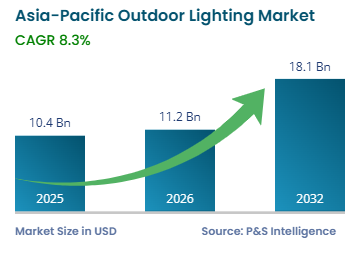
The Asia-Pacific outdoor lightning market size was estimated USD 10.4 billion for 2025, and it will grow by 8.3% during 2026–2032, to reach USD 18.1 billion by 2032.
This growth is supported by rapid urbanization and smart city initiatives across the region, positioning outdoor lighting as critical infrastructure for public safety and urban development.
Regional market growth is reinforced by national climate commitments under the Paris Agreement, where energy-efficient public infrastructure, including outdoor lighting, is a recognized pathway for emissions reduction across Asia-Pacific economies. Multilateral development banks, including the Asian Development Bank (ADB) and World Bank, prioritize urban infrastructure, transport corridors, and energy efficiency in sovereign and municipal lending programs, indirectly supporting outdoor lighting deployment. The Asian Development Bank (ADB) Annual Report 2024 indicates that ADB committed about USD 24.3 billion from its own resources plus USD 14.9 billion in co-financing for development projects across Asia and the Pacific in 2024.
Smart City Integration and IoT Connectivity Are Key Trends
The Asia-Pacific outdoor lighting market is undergoing a fundamental transformation through smart city integration, with connected lighting systems becoming integral to urban digital infrastructure.
Municipalities across the region are deploying IoT-enabled lighting networks that serve multiple functions beyond illumination, including environmental monitoring, traffic management, and public safety enhancement.
Singapore’s Smart Nation efforts include remote monitoring and sensor-network trials leveraging streetlighting infrastructure, alongside island-wide LED replacement.
This transformation extends beyond major cities as secondary urban centers adopt scalable smart lighting platforms, indicating sustained market evolution through 2032.
National smart city frameworks in countries such as Singapore, China, India, Japan, and South Korea formally recognize intelligent lighting as a core layer of urban digital infrastructure.
Intergovernmental platforms such as UN-Habitat’s Smart Cities Programme promote connected public lighting as part of integrated urban service delivery, encouraging adoption by secondary and emerging cities.
Government Energy Efficiency Mandates and Infrastructure Modernization Are Biggest Drivers
Regulatory frameworks mandating energy efficiency across Asia-Pacific are driving systematic outdoor lighting market expansion through phased LED conversion requirements and performance standards.
National governments have established specific timelines for replacing conventional lighting with energy-efficient alternatives, creating predictable demand patterns and investment certainty.
Infrastructure modernization programs linking lighting upgrades with broader urban development projects amplify this driver, as governments leverage lighting renovations to achieve multiple policy objectives including carbon reduction, public safety enhancement, and smart city readiness.
Many Asia-Pacific countries enforce minimum energy performance standards (MEPS) and public procurement rules that favor LED-based outdoor lighting systems over legacy technologies.
National infrastructure modernization programs increasingly bundle lighting upgrades with road safety, urban renewal, and climate resilience initiatives, ensuring long-term public funding visibility for the sector.
The outdoor lighting market in the Asia-Pacific region is significantly influenced by government policies, energy efficiency mandates, and infrastructure modernization initiatives.
In India, the Street Lighting National Programme (SLNP) has successfully replaced over 131 lakh traditional streetlights with energy-efficient LEDs, resulting in an annual savings of approximately 8,806 million kWh and a reduction in peak electricity demand by about 1,459 MW.
Additionally, the UJALA program has distributed more than 36 crore LED bulbs and tube lights, making a substantial contribution to national energy savings and emissions reduction.
In China, millions of streetlights have been retrofitted across numerous cities, including smart city projects in Beijing and Shanghai, achieving energy reductions of 60–70%.
Japan’s Top Runner Program mandates LED efficiency standards for municipal and industrial lighting, while South Korea requires the adoption of high-efficiency LEDs in public infrastructure, integrating smart city concepts.
Australia’s National Energy Productivity Plan promotes LED streetlight retrofits in cities such as Sydney and Melbourne, aligning with climate action and public safety goals.
Thailand’s Energy Efficiency Development Plan has transitioned tens of thousands of municipal streetlights to LED technology, leading to reductions in both energy consumption and maintenance expenses.
Together, these initiatives foster a reliable, policy-supported demand for energy-efficient outdoor lighting, aiding in carbon reduction, enhancing public safety, and advancing smart city development across the Asia-Pacific region.
The LED lights category holds the largest market share, of 70%, in 2025, and it will have the highest CAGR, dominating through superior energy efficiency, delivering much higher luminous efficacy than legacy technologies, supporting lower energy use. Government mandates across the region explicitly require LED adoption for public lighting projects, with procurement specifications excluding conventional technologies. The LED component manufacturing scale has driven substantial cost reductions over recent years, narrowing the price gap with fluorescent alternatives. Combined with typical operational lifespans of around 50,000 hours, this continues to support widespread LED adoption in outdoor lighting.
As technology improvements enable smart functionality integration. Next-generation LED systems incorporating sensors, wireless connectivity, and adaptive controls create additional value propositions beyond energy savings. UNEP’s U4E work highlights that efficient lighting transitions can deliver material CO₂ reductions, depending on policy ambition and adoption levels. UNEP’s United for Efficiency (U4E) program actively supports governments in developing policy roadmaps for efficient outdoor lighting, reinforcing long-term LED dominance in public infrastructure.
The product types analyzed in this report are:
LED Lights (Largest and Fastest-Growing Category)
High-Intensity Discharge (HID) Lamps
Fluorescent Lights
Plasma Lamps
Application Analysis
The street lighting category holds the largest market share, of 45%, in 2025, reflecting the extensive road infrastructure requiring illumination across the region. Safety regulations mandate minimum illumination levels for major thoroughfares, creating non-discretionary demand regardless of economic conditions. The need for street lighting in the Asia-Pacific region is increasing swiftly as a result of urbanization, smart city projects, and energy efficiency regulations. Governments in India, China, Japan, South Korea, Australia, and Thailand are spearheading extensive LED retrofitting and new installations to substitute traditional lamps.
Initiatives such as India’s Street Lighting National Program (SLNP) and China’s smart city streetlight enhancements have resulted in millions of LED installations, achieving energy savings of up to 70%. The growing emphasis on public safety, carbon reduction objectives, and the modernization of infrastructure continue to bolster ongoing demand and extensive implementation throughout the APAC region.
The highways category will have the highest CAGR, of 8.5%, due to extensive expressway expansion, rising investments in smart highway infrastructure, and stricter road safety regulations. New highway projects generate fresh lighting demand, while higher lighting specifications and adoption of adaptive, sensor-based systems further accelerate revenue growth across the region. National expressway and logistics corridor programs across Asia-Pacific prioritize highway lighting as part of traffic safety and night-time mobility policies, supporting higher growth in this application.
The Asian Highway Network covers 145,000 km across 32 countries, of which 112,800 km are operational. In India, the national highway network exceeds 146,000 km, with upgrades and new corridors under the Bharatmala initiative. Safety improvements include highway lighting, such as installations along NH‑66 to improve visibility in construction zones. By 2030, APAC could add up to 8 million kilometres of roads, making lighting and safer road design essential for supporting passenger and freight traffic, which accounts for over 75 % of regional transport demand.
The applications analyzed in this report are:
Street Lighting (Largest Category)
Parking Lots
Stadiums
Highways (Fastest-Growing Category)
Tunnels Lights
Others
Distribution Channel Analysis
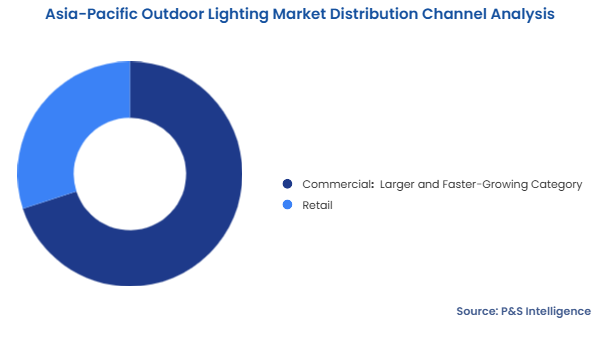
The commercial category holds the largest market share, of 70%, in 2025, and it will have the highest CAGR, of 8.6%, driven by retail complexes, office buildings, and hospitality establishments prioritizing aesthetic lighting for competitive differentiation. Extended operating hours in commercial districts require reliable lighting infrastructure, with businesses investing in architectural lighting to enhance brand visibility.
Commercial lighting procurement increasingly aligns with green building codes and sustainability certifications, encouraging adoption of advanced outdoor lighting systems in business districts and mixed-use developments. Public-private partnership (PPP) frameworks enable commercial entities and ESCOs to participate in lighting upgrades, accelerating deployment through performance-based contracts.
The distribution channels analyzed in this report are:
Commercial (Larger and Faster-Growing Category)
Retail
Component Analysis
The fixture category holds the largest market share, of 75%, in 2025. This is attributed to the mass installation and legacy acceptance as outdoor lighting technology to generate artificial light through the use of various lighting sources such as LEDs, fluorescent lights, and others.
The control category will have the highest CAGR, due to rapid development and advancements in lighting system controls, particularly in countries such as China, Japan, and India. This growth is further supported by government-backed smart city and digital infrastructure programs that encourage the adoption of adaptive lighting, remote monitoring, and centralized management systems to improve energy efficiency and reduce maintenance costs.
The components analyzed in this report are:
Fixture (Larger Category)
Control (Faster-Growing Category)
Drive strategic growth with comprehensive market analysis
China holds the largest market share, of 40%, in 2025, driven by extensive urbanization programs and manufacturing dominance. The nation's New Urbanization Plan targets smart infrastructure deployment across cities, with outdoor lighting forming essential components of urban transformation initiatives. Manufacturing advantages enable competitive pricing, with domestic production facilities supplying both local demand and regional exports.
According to MOHURD policies and local implementation reports, significant progress has been made in upgrading public streetlights to LED technology across Chinese cities during 2022–2024, reflecting widespread adoption of energy-efficient outdoor lighting. The market trajectory remains robust, supported by Belt and Road Initiative projects extending lighting infrastructure across participating regions. Provincial governments mandate LED conversion timelines, with eastern coastal provinces achieving near-complete transitions while western regions accelerate deployment. Integration with 5G infrastructure creates additional growth vectors as smart poles combine lighting with telecommunications capabilities. Integration of lighting with 5G and smart pole initiatives aligns with national digital infrastructure strategies, creating additional growth avenues.
India Outdoor Lighting Market Size
India will have the highest CAGR, of 8.4%, driven by the Smart Cities Mission encompassing 100 cities with dedicated lighting modernization budgets. Rising electricity costs and grid reliability challenges accelerate solar LED adoption, particularly in rural and semi-urban areas where grid connectivity remains inconsistent.
Municipal corporations increasingly adopt performance-based contracting models, attracting private investment while ensuring maintenance standards. The trajectory indicates sustained expansion as smaller tier-2 and tier-3 cities initiate lighting upgrades, supported by central government subsidies and green bond financing mechanisms targeting energy efficiency infrastructure.
India’s Smart Cities Mission and urban transport programs encourage LED and solar-based outdoor lighting as part of sustainable urban service delivery. Central government support mechanisms and municipal contracting reforms facilitate private participation in lighting upgrades through performance-linked models.
Japan Outdoor Lighting Market Size
Japan maintains technological leadership in the outdoor lighting market with mature infrastructure limiting volume growth. Advanced smart lighting systems integrate seismic sensors, adaptive controls, and emergency response capabilities, reflecting Japan's emphasis on disaster resilience. Market evolution focuses on replacement cycles and technology upgrades rather than new installations, with municipalities prioritizing connected systems enabling remote monitoring and predictive maintenance. The 2025-2030 infrastructure renewal plan allocates substantial budgets for lighting modernization ahead of aging infrastructure challenges.
Japan’s infrastructure renewal and disaster-resilience policies promote advanced outdoor lighting systems capable of remote monitoring and emergency response integration. Municipal replacement cycles are aligned with national standards for energy efficiency and public safety, supporting steady modernization demand.
The countries of the market are as follows:
China (Largest Country Market)
India (Fastest-Growing Country Market)
Japan
South Korea
Australia
Rest of Asia-Pacific
Asia-Pacific Outdoor Lighting Market Share
The market is a semi-consolidated structure, and concentration reflects significant economies of scale in manufacturing, established distribution networks across diverse geographic markets, and technological capabilities required for smart lighting solutions. Regional consolidation continues through strategic acquisitions as global players acquire local manufacturers to gain market access and production capabilities, while technology partnerships enable traditional lighting companies to integrate IoT and connectivity features essential for smart city deployments.
Market evolution shows increasing segmentation between technology leaders offering comprehensive smart city solutions and cost-focused manufacturers serving price-sensitive segments. This differentiation creates distinct competitive clusters, with premium players targeting large-scale urban projects while regional manufacturers dominate smaller municipal contracts. Future competitive dynamics will likely emphasize software capabilities and ecosystem integration as lighting becomes increasingly embedded within urban digital infrastructure.
Key Asia-Pacific Outdoor Lighting Companies:
Signify N.V.
OSRAM Licht AG
Zumtobel Group AG
Eaton Corporation plc
Syska LED Lights Pvt. Ltd.
Dialight plc
General Electric Company
Hubbell Incorporated
Cree Lighting
Nichia Corporation
Seoul Semiconductor
Panasonic Holdings Corporation
Opple Lighting Co., Ltd.
Havells India Ltd.
Wipro Enterprises Pvt. Ltd.
Asia-Pacific Outdoor Lighting Market News
In November 2025, Itron Inc. partnered with Connected Lighting Solutions (CLS) in Australia to enhance the deployment of smart street lighting technology and improve operational efficiency.
In October 2025, Nichia Corporation and ams OSRAM signed a comprehensive patent cross-license agreement covering nitride-based semiconductor products including outdoor LED components. The collaboration enables both companies to accelerate the development of next-generation outdoor lighting technologies with improved efficiency.
Frequently Asked Questions About This Report
What is the market size of the Asia-Pacific outdoor lighting market in 2025?+
The Asia-Pacific outdoor lighting market is USD 10.4 Billion in 2025.
What is the growth rate of the Asia-Pacific outdoor lighting market?+
The Asia-Pacific outdoor lighting market is growing at a CAGR of 8.3% during the forecast period.
Which country dominate the Asia-Pacific outdoor lighting market?+
China dominate the Asia-Pacific outdoor lighting market.
Which technology is most widely used in outdoor lighting across Asia-Pacific?+
LED lighting is the dominant technology in the Asia-Pacific outdoor lighting market.
How are smart city projects driving outdoor lighting demand in Asia-Pacific?+
Smart city initiatives are increasing demand for connected and intelligent outdoor lighting systems for streets, highways, and public spaces across the region.
What are the major applications of outdoor lighting in Asia-Pacific?+
The major applications include street and roadway lighting, public spaces, commercial areas, industrial facilities, and infrastructure projects.
Want a report tailored exactly to your business need?
Leading companies across industries trust us to deliver data-driven insights and innovative solutions for their most critical decisions. From data-driven strategies to actionable insights, we empower the decision-makers who shape industries and define the future. From Fortune 500 companies to innovative startups, we are proud to partner with organisations that drive progress in their industries.
Client Testimonials
Working with P&S Intelligence and their team was an absolute pleasure – their awareness of timelines and commitment to value greatly contributed to our project's success. Eagerly anticipating future collaborations.
McKinsey & Company
India
Unmatched Standards
Our insights into the minutest levels of the markets, including the latest trends and competitive landscape, give you all the answers you need to take your business to new heights
Complete Data Security
We take a cautious approach to protecting your personal and confidential information. Trust is the strongest bond that connects us and our clients, and trust we build by complying with all international and domestic data protection and privacy laws