Asia-Pacific LED Lighting Market Size & Opportunities Analysis - Growth Strategies, Competitiveness, and Forecasts (2026 - 2032)
This Report Provides In-Depth Analysis of the Asia-Pacific LED Lighting Market Report Prepared by P&S Intelligence, Segmented by Product Type (Luminaires, Lamps), Installation Type (Retrofit, New Installation), Application (Indoor, Outdoor), and Geographical Outlook for the Period of 2021 to 2032
Explore the market potential with our data-driven report
Asia-Pacific LED Lighting Market Future Outlook
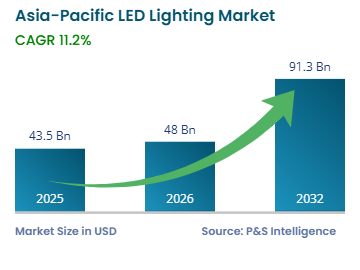
The Asia-Pacific LED lighting market size was USD 43.5 billion for 2025, and it will grow by 11.2% during 2026–2032, to reach USD 91.3 billion by 2032.
The market growth is supported by rapid urbanization across the region. According to UNESCAP, the urban population of Asia-Pacific is expected to increase by 50% by 2050, resulting in an unprecedented need for energy-efficient lighting solutions for all forms of infrastructure lighting. Governmental policies mandating reductions in energy consumption, decreasing costs for LED components, and rapidly developing smart city initiatives in major economic regions will further enhance the transition from traditional lighting sources to LED lighting.
Additionally, the concentration of global LED manufacturing capacity in this region enables low-cost, fast deployment of LED lighting into residential, commercial, industrial, and outdoor environments. Furthermore, strong demand from infrastructure modernization efforts, coupled with increasing adoption of intelligent lighting controls and IoT connectivity, makes it clear that the Asia-Pacific region will continue to dominate global LED lighting expansion through 2032.
Asia-Pacific LED Lighting Market Trends & Drivers
Smart Connectivity and IoT Integration Are Key Trends
Smart connection and integration of the IoT to LED lighting will fundamentally alter the way LED lighting is implemented in the Asia-Pacific region.
The governments of Asia-Pacific, including India, China and Japan are implementing smart lighting into their smart city development strategies to provide a real time means of monitoring, controlling, and collecting data to optimize urban management.
The smart lighting system enables municipalities and building managers to adjust the brightness level of the lighting in response to traffic flow, weather conditions, and/or occupancy detected.
This increases the energy efficiency of the lighting beyond what can be achieved with static LED lighting and providing predictive maintenance capabilities which will decrease operational costs.
The use of wireless communication technologies including Zigbee, Z-wave and Wi-Fi protocols has enabled devices to communicate seamlessly without having to install an extensive wiring infrastructure, thereby decreasing the cost of installing these types of systems.
Technology companies and lighting manufacturers have formed alliances to develop artificial intelligence-based control features in LEDs, allowing users to remotely control lighting via mobile apps, integrate with building automation systems, and automatically adjust lighting levels.
As a result of this shift toward intelligent and networked LED lighting, there has been an acceleration of enterprise adoption among commercial and industrial property developers and municipal infrastructure providers.
IoT compatibility is increasingly expected as a standard feature of commercial, industrial, and municipal LED lighting projects.
Government Energy Efficiency Mandates and Urbanization Pressures Are Biggest Drivers
Escalating energy prices and government-mandated energy efficiency targets are resulting in the increased replacement of traditional lighting technologies with LED lighting systems in both residential, commercial and public infrastructure applications.
UNESCAP estimates that the Asia-Pacific's urban population of over 2.2 billion will increase by 50% by 2050, requiring unprecedented amounts of energy-efficient infrastructure as cities continue to expand their electricity generation and distribution capacity.
Energy conservation frameworks established at the national level within government policy initiatives have created long-term regulatory pressures that drive the adoption of LED lighting.
These include China's 13th Five-Year Plan targeting a 15% reduction in energy intensity and Japan's Top Runner Program which establishes mandatory efficiency standards for equipment and appliances.
India's UJALA program has distributed over 368.7 million LED bulbs nationally.
Government agencies have translated these policies into procurement specifications for government buildings, municipal street lighting bids, and building codes that limit or eliminate less energy-efficient technologies from being used in new construction and major renovation projects.
Policymakers view LED lighting as a key enabler to achieve climate commitments and energy security objectives and will maintain regulatory support through subsidies, preferential financing, and faster depreciation allowance for commercial and institutional customers to enhance ROI calculations.
Asia-Pacific LED Lighting Market Segmentation Analysis
Product Type Analysis
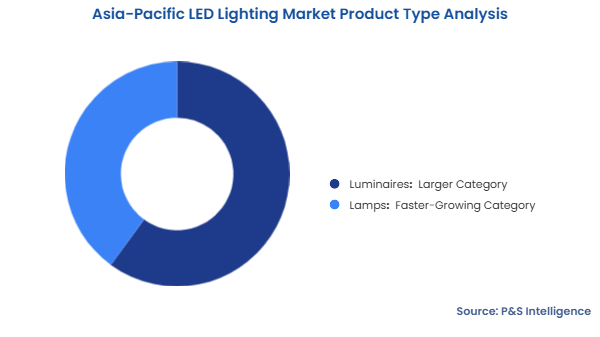
The luminaires category holds the largest market share, of 60%, in 2025, as they have been widely used in commercial and industrial applications as well as in various public infrastructure projects which use integrated lighting systems with optical design capabilities, thermal management components and electronic controls. They meet the specific lighting needs of a variety of applications e.g., commercial buildings, industrial facilities and public infrastructure projects that require specific light distributions, weather resistance for outdoor applications, and architectural specifications that influence commercial and municipal purchasing decisions. In addition, the large-scale production of luminaires in China, Japan and South Korea provides cost-competitive luminaire systems to support the demand of these applications.
The lamps category will have the highest CAGR, of 11.4%, due to their affordability, ease of installation and ability to replace conventional bulbs in existing fixtures without modification. Government led programs to distribute LED lamps are expected to accelerate the adoption of lamps among price sensitive consumer segments in emerging markets. Additionally, the proliferation of smart homes is expected to drive lamp demand as consumers seek to purchase lamps that can be controlled via an application or voice command and offer features such as dimming capabilities and adjustable color temperatures.
The product types analyzed in this report are:
Luminaires (Larger Category)
Lamps (Faster-Growing Category)
Installation Type Analysis
The retrofit category holds the largest market share, of 75%, in 2025, providing a cost-effective solution for upgrading to energy-efficient LED systems while avoiding full electrical system replacement or major construction activities. Retrofits enabled customers to upgrade to new LED lighting systems at a much lower cost than replacing all existing lighting systems in commercial buildings, industrial facilities, and public infrastructure. This has resulted in millions of existing lighting points being upgraded to LED in mature urban areas in China, Japan, South Korea, and other countries in Southeast Asia.
Additionally, retrofit installations are dominated by A-lamps in residential and small commercial applications due to the ease of replacing existing incandescent bulbs with LED A-Lamps, while reflectors are the leading product type in retail and hospitality applications where directional lighting control is required.
The new installation category will have the highest CAGR, of 11.5%, driven by unprecedented construction activity in rapidly urbanizing economies such as India, Indonesia, Vietnam, and the Philippines. As a result of this construction activity, new installations are increasingly becoming the primary method for specifying LED lighting systems in residential, commercial, and industrial developments. In addition to the need for energy efficient lighting systems in these developments, the market is driven by new building codes, energy efficiency regulations and green building certifications that mandate the use of LED lighting systems instead of traditional lighting systems.
Smart city initiatives that install LED streetlights equipped with sensors, cameras, and communication devices to provide intelligent controls and IoT connectivity for urban infrastructure are driving the adoption of new installations. Similarly, the expansion of manufacturing facilities to produce electronics, automobiles and consumer goods requires the installation of LED industrial lighting systems that are capable of providing high quality illumination for high-bay applications, cleanrooms, and automated production lines.
The installation types analyzed in this report are:
Retrofit (Larger Category)
A-Lamps
Reflectors
T-Lamps
Other Lamps
New Installation (Faster-Growing Category)
Application Analysis
The indoor category holds the largest market share, of 60%, in 2025, driven primarily by strong demand from commercial applications due to their energy-saving potential and operating efficiencies. These include offices, retail stores, hotels, hospitals, government buildings, banks, schools, and public transportation hubs. Moreover, residential applications, although smaller in size, are benefiting from declining LED prices, government subsidy programs and increased consumer awareness about electricity savings. Industrial applications require specialized LED lighting systems to meet their unique safety standards, cleanroom protocols, and precision work environment requirements for consistent and flicker free illumination. These include automotive manufacturing, food and beverage processing, electronics assembly, energy generation, chemical processing, and pharmaceuticals.
The outdoor category will have the highest CAGR, driven by large-scale investments in road networks, transportation systems, public parks, parking facilities and sports complexes in rapidly developing Asia-Pacific economies. Road network upgrades to LED streetlights represent the largest outdoor segment, as governments prioritize streetlight modernization to reduce municipal electricity consumption and improve public safety through improved visibility.
Transportation-related applications, including airports, ports, rail and subway stations are using LED lighting systems to support 24-hour operation and passenger safety. Parks, parking facilities, and stadiums are utilizing LED lighting systems for their durability, instant-on capabilities, and control capabilities to adjust lighting dynamically for events and security purposes. Smart city initiatives that embed sensors, cameras, and communication equipment in LED streetlight poles to provide integrated urban infrastructure are expected to accelerate the growth of outdoor LED lighting deployments above historic replacement levels for conventional lighting. They combine illumination with environmental monitoring, traffic management, and public Wi-Fi connectivity.
The applications analyzed in this report are:
Indoor (Larger Category)
Commercial
Offices
Retail
Hospitality and tourism
Hospitals
Government
Banking, financial services and insurance (BFSI)
Education
Transportation
Others
Residential
Industrial
Automotive
Food and beverage
Electronics and semiconductors
Energy and utilities
Chemicals and pharmaceuticals
Oil and gas
Others
Outdoor (Faster-Growing Category)
Road network
Transportation
Parks
Parking spaces
Stadiums / sports complex
Others
Drive strategic growth with comprehensive market analysis
Asia-Pacific LED Lighting Market Regional Outlook
China LED Lighting Market Size
China holds the largest market share, of 35%, in 2025, driven by one of the most comprehensive governmental energy efficiency programs for lighting systems embedded in the country's 13th Five-Year Plan. Additionally, China’s rapid urbanization is driving the installation of millions of LED units annually in new construction projects. Financial incentives provided by the National Development and Reform Commission (NDRC) and the Ministry of Finance (MOF) have promoted the use of high-efficiency lighting products. Additionally, the China Green Lights Program was successful in shifting market priority from compact fluorescent lamps (CFLs) to LED technologies after 2010.
China’s standards bodies, including CNIS, support the gradual phase-down of mercury-containing CFLs in line with national sustainability goals. According to the NDRC and MOF, revised minimum energy performance standards for lighting are expected to contribute significantly to long-term carbon-emission reductions by 2050. Moreover, the presence of local manufacturing capability in China, the cost of LED products produced in China can be 40-60% lower than those manufactured in Western countries.
Furthermore, the widespread adoption of LED lighting in commercial buildings, industrial facilities and transportation infrastructure in China is due to smart city development programs and increased purchasing power of middle class. Procurement guidelines and efficiency requirements strongly favor LED lighting in tertiary hospitals and public institutions.
India LED Lighting Market Size
India will have the highest CAGR, of 11.3%, driven by two factors, including unprecedented government-led distribution programs and ambitious plans for infrastructure modernization. The Indian Ministry of Power reported that the UJALA program had distributed 368.7 million LED bulbs to households throughout India as of January 2025, providing annual energy savings of approximately 47,883 million kWh and reducing electricity costs for households by about INR 19,153 crore (USD 2.24 billion). Under the Street Lighting National Programme (SLNP), approximately 13.1 million LED streetlights have been installed across urban and rural areas, resulting in annual energy savings of around 8,800–9,000 million kWh and contributing to a peak demand reduction of about 1,500 MW.
Smart City Initiatives in India are also driving the adoption of LED lighting through integrated urban development projects. These initiatives have included installing over 84,000 CCTV cameras, intelligent traffic management systems, and energy-efficient public lighting, thereby stimulating commercial and municipal procurement of LED lighting. In addition, the dramatic decrease in the price of LED bulbs from 450 rupees in 2014 to 70 rupees under the UJALA program eliminated affordability barriers and enabled the market penetration of LED lighting to expand from less than 1% in 2013-14 to over 60% by 2020.
The countries of the market are as follows:
China (Largest Country)
India (Fastest-Growing Country)
Japan
South Korea
Australia
Rest of APAC
Asia-Pacific LED Lighting Market Share
The market is fragmented with numerous international companies, regional and domestic specialists, and many different levels of competitors within the lighting industry based upon product category, price segment, and geographic area. Strategic approaches for competitive differentiation include leveraging comprehensive product portfolios and multinational distribution networks, focusing on chip technology and materials science innovation, and emphasizing cost competitiveness and localized customer relationships.
Additionally, Capacity expansion into emerging Southeast Asian markets, technology partnership to accelerate smart lighting development, and vertical integration to secure LED component supply chains are strategic initiatives that contribute to the evolution of the competitive landscape. The convergence of the electronics and illumination industries will continue as traditional lighting manufacturers update their business models to provide intelligent and energy-efficient products, while semiconductor technology leaders expand downstream into complete lighting systems.
Key Asia-Pacific LED Lighting Companies:
Signify N.V.
OSRAM Licht AG
Cree Inc.
Zumtobel Group AG
Panasonic Corporation
LG Electronics Inc.
Samsung Electronics Co., Ltd.
Stanley Electric Co., Ltd.
Koito Manufacturing Co., Ltd.
Seoul Semiconductor Co., Ltd.
Opple Lighting Co., Ltd.
NVC Lighting Technology Corporation
Asia-Pacific LED Lighting Market News
In March 2025, Signify Holding and Dixon Technologies announced a joint venture to manufacture LED Lighting Products and Accessories in India, combining Signify’s technical expertise and Dixon’s manufacturing capabilities to provide cost effective solutions that support India’s “Make in India” initiative and enhance the domestic production of LED products.
In January 2024, Nichia Corporation launched a Chip-Scale LED designed to enable thinner and lighter luminaire designs. The introduction of this chip-scale LED addresses the need for smaller, more compact LED components that meet the needs of architectural lighting applications across commercial and residential segments.
Frequently Asked Questions About This Report
What is the market size of the Asia-Pacific LED lighting market in 2025?+
The Asia-Pacific LED lighting market is valued at USD 43.5 billion in 2025.
What is the growth rate of the Asia-Pacific LED lighting market?+
The Asia-Pacific LED lighting market is growing at a CAGR of 11.2% during the forecast period.
What are the key factors driving the market?+
Key growth drivers include urbanization, energy efficiency regulations, and smart city projects.
Which country dominates the Asia-Pacific LED lighting market?+
China dominates the Asia-Pacific LED lighting market.
What is the nature of the Asia-Pacific LED lighting market?+
The Asia-Pacific LED lighting market is fragmented.
Want a report tailored exactly to your business need?
Leading companies across industries trust us to deliver data-driven insights and innovative solutions for their most critical decisions. From data-driven strategies to actionable insights, we empower the decision-makers who shape industries and define the future. From Fortune 500 companies to innovative startups, we are proud to partner with organisations that drive progress in their industries.
Client Testimonials
Working with P&S Intelligence and their team was an absolute pleasure – their awareness of timelines and commitment to value greatly contributed to our project's success. Eagerly anticipating future collaborations.
McKinsey & Company
India
Unmatched Standards
Our insights into the minutest levels of the markets, including the latest trends and competitive landscape, give you all the answers you need to take your business to new heights
Complete Data Security
We take a cautious approach to protecting your personal and confidential information. Trust is the strongest bond that connects us and our clients, and trust we build by complying with all international and domestic data protection and privacy laws