This Report Provides In-Depth Analysis of the Asia-Pacific Emergency Lighting Market Report Prepared by P&S Intelligence, Segmented by Power System (Self-Contained, Central, Hybrid), Battery Type (Lithium-ion (Li-ion), Lead-Acid, Nickel-Cadmium (Ni-Cd), Nickel-Metal Hydride (Ni-MH)), Light Source (Light Emitting Diode (LED), Fluorescent, Induction, Incandescent), Component (Hardware, Services, Software), Application (Commercial, Industrial, Residential), and Geographical Outlook for the Period of 2021 to 2032
Explore the market potential with our data-driven report
Asia-Pacific Emergency Lighting Market Future Outlook
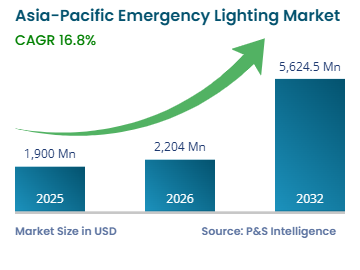
The Asia-Pacific emergency lighting market size was USD 1,900.0 million for 2025, and it will grow by 16.8% during 2026–2032, to reach USD 5,624.5 million by 2032.
The market is growing due to increased focus on safety for occupants, increased enforcement of fire safety laws and regulations, and increasing regulatory requirements for all types of commercial and public property to have emergency preparedness plans in place.
Government agencies in the Asia-Pacific region are enforcing stricter building safety laws and regulations, fire codes, and evacuations standards that require the installation of emergency lighting systems in commercial buildings, industrial sites, residential units, and public buildings. International safety standards are being adopted through government-enforced regulatory frameworks, resulting in faster adoption of emergency lighting systems in new construction projects and retrofit projects.
Growing urban populations and continued investment in large-scale infrastructure such as hospitals airports, schools, and industrial parks are continuing to drive demand for emergency lighting systems. In addition to being considered a key safety feature for emergency situations, emergency lighting is becoming increasingly viewed as a required safety system component to support ongoing market growth.
In addition to government-mandated regulatory requirements, other factors contributing to growth include government-promoted efforts to promote energy efficiency and sustainability, along with smart building concepts, leading to greater adoption of high-efficiency emergency lighting systems. Further, modernization of public properties and increasing scrutiny of regulatory compliance mechanisms are expected to provide long-term support for the continued growth of the Asia-Pacific emergency lighting market through the forecast period.
Asia-Pacific Emergency Lighting Market Dynamics
Adoption of Smart and Connected Emergency Lighting Systems Is Key Trend
The growing movement toward adopting smart and networked emergency lighting systems in the Asia-Pacific region is driven by an increasing number of building owners, managers, and developers to improve the operational efficiency of their buildings and meet requirements for regulatory compliance. Industry analysts report that in excess of one-third of all new emergency lighting systems installed in large commercial and public buildings throughout the Asia-Pacific region now include some form of smart monitoring or automated testing feature. The highest rate of adoption of these smart emergency lighting systems is occurring in airport buildings, hospital buildings, metro rail networks, data center buildings, and large industrial facilities.
Networked emergency lighting systems with automatic self-testing, remote fault detection, and remote monitoring capabilities are reducing the amount of time and resources required to perform routine inspections by between 25-40%. These same networked emergency lighting systems are also reducing the overall cost of maintaining these systems by up to 30% when compared to stand-alone emergency lighting systems. This is especially true in those countries requiring fire safety authorities to mandate monthly functional testing, annually conducted duration testing and documentation of compliance reporting, both of which add additional operational burdens to property owners.
Government-led initiatives in the areas of smart buildings, smart cities and digital infrastructure across the Asia-Pacific region are driving this trend forward at an ever-increasing pace. As part of these government led initiatives, many of the specifications for public infrastructure projects require emergency lighting systems capable of integration into Building Management Systems (BMS), Safety Networks, etc. to allow for real-time status visibility and to facilitate rapid response to failure events. As regulatory agencies and inspectors continue to scrutinize and inspect emergency lighting systems more frequently, it is anticipated that the demand for software-enabled, networked emergency lighting systems will outpace the demand for traditional or stand-alone emergency lighting systems throughout the remainder of the forecast period.
Stringent Fire Safety Regulations and Mandatory Compliance Requirements Drive Market
The implementation of enhanced fire safety regulations and the enforcement of mandatory compliance by governments across the region is a key driver of the Asia-Pacific emergency lighting market. Regulations regarding emergency lighting are required under National Building Codes, Fire Safety Acts, Evacuation Rules and other legislation, requiring clearly visible escape routes, minimum light levels, and specific duration times during loss of electrical power in commercial buildings, industrial plants, residential complexes, and public infrastructure.
Statutory fire safety regulations have been put into place by government agencies; these regulations require that emergency lighting systems undergo monthly functional tests, annual tests lasting the full duration of operation and the maintenance of inspection and record-keeping documentation to be produced upon request from regulatory auditors and prior to renewal of occupancy permits. In many Asia-Pacific countries, building completion certificates, occupancy permits and operational licenses can only be issued after demonstration of compliance with the emergency lighting regulations, resulting in increased liability for property owners and facility managers.
Additionally, emergency lighting system requirements are being increasingly incorporated into project specifications and tender documents as part of government-led urban safety initiatives, Smart City programs, Public Infrastructure Guidelines, etc. The enforcement of emergency lighting system installation has also become more stringent through increased frequency of inspections, certification mandates and fines/penalties for non-compliance thereby making emergency lighting systems a regulatory requirement versus an optional safety measure; driving sustained demand throughout the Asia-Pacific region.
There were 761 reported electrical fires in Cambodia that resulted in 54 fatalities and 97 injuries in 2023. Additionally, there were 2,286 reported electrical fires in Indonesia with approximately 53% of those fires being due to an electrical short circuit in 2023. The Philippines experienced a 40% increase in fire incidents through June of 2024 for a total of 9,568 fires. In addition, the Telangana State Fire Department (India) received 8,861 fire emergency distress and rescue call requests in 2025 with a total of 163 fatalities as a result of fires in Telangana during 2025. In 2023, the Civil Defence Force in Singapore responded to 1,954 fires which is an increase of 8.6% compared to the number of fires in 2022.
The self-contained category held the largest market share, of 60%, in 2025, driven by their strong alignment with regional fire safety regulations and building codes that mandate luminaire-level emergency illumination for escape routes, corridors, stairwells, and exits. The majority of national building codes and fire safety regulations throughout the APAC region have mandates for emergency illumination at the luminaire level along escape routes, corridors, and exits, but do not require centralized battery infrastructure to be installed in conjunction with this mandated feature. Therefore, self-contained emergency lighting systems represent the easiest and most widely accepted compliance solution for most jurisdictions in the region.
In addition, many of the fire authorities within the APAC Region, in order to fulfill their obligations to provide safe buildings to occupants, mandate that each emergency luminaire demonstrates an acceptable Minimum Operating Duration during Power Failure as part of occupancy certification and periodic inspections. Additionally, lower upfront costs, fewer wiring requirements and faster regulatory approvals further reinforce the dominance of self-contained emergency lighting systems in small-mid scale facilities throughout the region.
The hybrid category will have the highest CAGR, of 17.0%, driven by increasing policy emphasis on system redundancy, centralized supervision, and higher safety assurance in large and complex facilities. Government regulations and technical guidelines for high-occupancy and critical infrastructure projects such as airports, metro rail systems, hospitals, data centers, and large industrial plants, increasingly mandate enhanced monitoring, fault detection, and resilience while maintaining local backup capability.
Hybrid systems, which utilize centralized power and control with luminaire-level battery backup, meet the regulatory expectations of these jurisdictions. Additionally, smart city initiatives and government funded infrastructure initiatives throughout the APAC region, frequently specify emergency lighting systems that can be integrated with building management and safety systems, automated testing, and centralized compliance reporting, features that are best provided by hybrid architectures.
The power systems analyzed in this report are:
Self-Contained (Largest Category)
Central
Hybrid (Fastest-Growing Category)
Battery Type Analysis
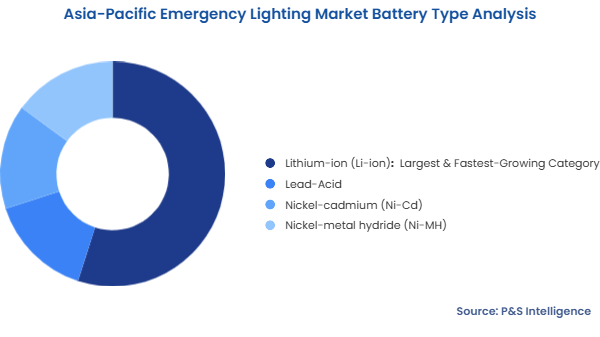
The lithium-ion category held the largest market share, of 55%, in 2025, and it will have the highest CAGR, due to its strong connection to current safety regulations, energy efficiency regulations and lifecycle performance criteria. Regulatory fire safety provisions require a minimum duration for operation and consistent performance during power failures, as well as longer lifecycles than alternative battery types such as lead-acid and nickel-based batteries. Additionally, regulatory energy efficiency initiatives promoting reduced maintenance and sustainable technologies will continue to promote lithium-ion adoption in the region through commercial buildings, public infrastructure, and smart city projects.
The light-emitting diode category held the largest market share, of 80%, in 2025, and it will have the highest CAGR, driven by the minimum level of illumination and the required operating duration of emergency lighting systems, both of which LEDs provide at a lower energy usage rate compared to traditional forms of emergency lighting. As government agencies adopt energy efficiency policies and green building standards, they are increasingly specifying LEDs for use in emergency lighting applications. This has increased large-scale adoption of LEDs across commercial and public infrastructure.
LEDs are also the fastest growing light source, due to government-sponsored retrofit programs, energy efficiency mandates and environmental sustainability targets, the replacement of fluorescent and incandescent emergency lighting is increasing rapidly. LEDs consume up to 40-60% less energy than traditional forms of emergency lighting, while reducing maintenance costs by greater than 50%. Therefore, LEDs are becoming the preferred option for new construction, smart city development, and public infrastructure upgrades across the region.
The hardware category held the largest market share, of 70%, in 2025, due to the required installation of physical components by national building codes and fire safety regulations which are mandated for all buildings that comply with these codes. All new constructions and retrofits are required to include hardware components including emergency lighting fixtures, exit signs, batteries, and control units for compliance. High volumes of commercial, residential, and public buildings are being completed across the Asia Pacific and this continues to support a high level of demand for emergency lighting hardware.
The software category will have the highest CAGR, of 17.1%, primarily due to the increased frequency of inspections requiring automated testing, fault logging, and digital documentation for compliance purposes. Increasingly governments are mandating the inclusion of central monitoring systems and Building Management System (BMS) integration into smart building and smart city initiatives. The use of software-based emergency lighting can reduce inspection labor costs by up to 25-40% thereby increasing adoption in areas such as airport, hospital, metro and commercial buildings.
The components analyzed in this report are:
Hardware (Largest Category)
Services
Software (Fastest-Growing Category)
Application Analysis
The commercial category held the largest market share, of 50%, in 2025, driven by mandatory requirements under national building codes and fire safety regulations. Commercial buildings, including office buildings, schools, medical facilities, shopping malls, hotels, etc., require emergency lighting to enable people to safely evacuate a building if there is an electrical outage. In addition to high occupancy rates, commercial property owners also face ongoing compliance-related installations resulting from regulatory agency site visits. The ongoing development of new commercial properties and the number of commercial property owners retrofitting existing properties throughout the Asia-Pacific region have helped to maintain the commercial segments leading share of the emergency lighting market.
The industrial category will have the highest CAGR, of 16.9%, due to the increasing demand for manufactured goods and related infrastructure, i.e., warehouse space, data center space, logistics hub space. Emergency lighting is required in the design and operation of all industrial facilities, as a condition of their operating permits and related compliance, including the length of time the emergency lighting will be available after a loss of power. The increased scrutiny of safety violations in higher risk industries and the resulting increased frequency of compliance audits and investigations have accelerated the rate at which emergency lighting systems are being installed in the industrial marketplace.
The applications analyzed in this report are:
Commercial (Largest Category)
Industrial (Fastest-Growing Category)
Residential
Others
Drive strategic growth with comprehensive market analysis
China held the largest market share, of 45%, in 2025, due to the scale of construction activity, a centralized government regulatory environment, and a nationwide program to enforce policy-based safety standards for emergency lighting. China has one of the world's largest installed bases of commercial and public buildings and has had significant and consistent investment in urban redevelopment, transportation infrastructure, healthcare facilities, and industrial park development. The demand for emergency lighting was enhanced by required safety inspections or evaluations where all emergency lighting systems were inspected prior to occupancy and after a new facility was completed, so that they would be required for project completion.
Additionally, China's national standards system (GB Standards) established the minimum technical performance, test methodologies, and reliability specifications for emergency lighting equipment, which resulted in the widespread use of these standards throughout each province. Government initiatives for urban safety upgrades, the renovation of older buildings and the modernization of public infrastructure have provided ongoing demand for replacement and retrofit of emergency lighting systems. Additionally, the ability of domestic manufacturers to produce compliant, domestically certified emergency lighting products has also contributed to China's dominant market position in the Asia-Pacific region.
In 2024 through August, there were approximately 660,000 fire incidents throughout China, resulting in approximately 1,324 deaths and 1,760 injuries. Of those, approximately 208,000 (or 31.4%) were electrical in origin. The first ten months of the most current reporting year saw an estimated 721,000 fires across the nation, which resulted in approximately 1,486 fatalities and 1,801 injuries.
Additionally, approximately 219,000 (or 30.5%) of fires during that time frame were attributed to electrical failures. Through May of 2024, national emergency services responded to approximately 864,000 emergency rescue calls and successfully rescued or relocated approximately 131,000 individuals. Fires made up of over half of the total number of incidents. Some examples of recent fire incidents involving large numbers of casualties include a fire at a Nanjing building in February 2024, which resulted in at least 15 deaths and 44 injuries; and a fire at a Beijing hospital in April 2023, which resulted in 29 deaths and 39 injuries.
India Emergency Lighting Market Size
India will have the highest CAGR, due to the vast increase in regulated building stock coupled with the increasing enforcement of safety regulations across all new and existing buildings. There has been an unprecedented boom in the construction of commercial office buildings, industrial parks, warehouses, metro stations, airports and hospitals, each being required to undergo safety approval prior to opening to the public. The strict enforcement of the National Building Code (NBC) and the State Fire Service Rules, both of which require mandatory emergency lighting, will continue to fuel growth through mandatory requirements for occupancy certification, trade license renewal and periodic fire safety renewals.
The increasing scale of government-funded infrastructure projects and urban development initiatives will also continue to drive demand for safety-compliant systems in public buildings and transportation infrastructure. As well as the increasing number of inspections from local fire authorities across multiple states, there has been an increase in the penalty for non-compliance to emergency lighting requirements. This trend is leading to an even greater rate of adoption of emergency lighting into new and retrofitted buildings. In comparison to other mature markets in the Asia-Pacific region, India's lower installed base and increasing regulatory coverage provide the greatest potential for growth.
The Telangana Fire Department responded to 8,861 emergency fire calls for assistance in 2025, resulting in an estimated loss of 163 lives and large-scale damage to properties; of these calls, 2,244 were due to electrical short-circuits. During FY 2024-25 in New Delhi, there were approximately 7,312 fire-related events; and of those, 5,506 occurred in residential housing units - 98% of which lacked valid fire safety certifications. Nationally, it is estimated that 7,054 fires occurred in 2023, and resulted in 6,891 deaths and 284 injuries; many of these fires were attributed to electrical and hazardous conditions.
The Delhi Fire Service has received over 400,000 emergency calls over the last 15 years, and as a result of these emergencies, over 6,600 lives have been lost, including from fires, building collapses and other emergency situations. There have also been several specific major incidents; one such incident was the 2025 factory fire in Gujarat, in which 21 individuals died and six others were injured.
The countries of the market are as follows:
China (Largest Country)
India (Fastest-Growing Country)
Japan
Australia
South Korea
Rest of Asia-Pacific
Asia-Pacific Emergency Lighting Market Share
The market is semi-consolidated driven by the presence of a limited number of global multinational leaders alongside a large base of regional and local suppliers. These few, multi-national companies, such as Signify Holding, Eaton Corp, Plc, Schneider Electric, SE, ABB Ltd., and Legrand S.A., capture the largest commercial, industrial and public infrastructure projects requiring certified products, integrated systems, and documentation of compliance. The benefits of these global suppliers include having certification for their products globally, a broader product portfolio than most other players and the capability to comply with the stringent regulatory and inspection requirements of major, commercial, and industrial customers.
Additionally, there are many regional and local suppliers operating in various APAC countries in the residential and small commercial/industrial areas where local certification, cost competitiveness and distributor network capabilities are key factors. As country-specific standards and procurement processes exist, which prevent any single player from crossing borders, the opportunity for a completely consolidated marketplace does not exist. Therefore, while leadership may exist in the regulated, high-value-added project areas, competition still exists throughout the volume-based segments, creating a semi-consolidated marketplace structure.
Key Asia-Pacific Emergency Lighting Companies:
Signify Holding
Eaton Corporation plc
Schneider Electric SE
ABB Ltd.
Legrand S.A.
Zumtobel Group AG
Honeywell International Inc.
Acuity Brands, Inc.
Hubbell Incorporated
Emerson Electric Co.
Beghelli S.p.A.
OSRAM Licht AG
Asia-Pacific Emergency Lighting Market News
In June 2025, Signify N.V. expanded the Interact connected lighting product line to include wireless emergency lighting and cloud-based monitoring & automated testing features. The cloud-based interact building manager is used to centrally manage all aspects of emergency lighting systems; enable regulatory compliant reports & optimize routine maintenance, enhancing the ability of commercial and public infrastructure buildings throughout the Asia-Pacific Region to comply with regulations regarding emergency lighting.
In March 2024, Eaton Corporation plc displayed new emergency lighting luminaries & digital software solutions to the trade at Light + Building 2024. This portfolio addresses the growing need for safe evacuation procedures, automated testing & simplified maintenance of emergency lighting systems, due to increasing regulatory compliance & inspection needs in commercial & industrial buildings.
In April 2023, Inventronics acquired the Digital Systems business of ams OSRAM in Europe and Asia. The acquisition provided Inventronics with additional technical capabilities in the development of LED drivers & connected lighting products; both of which are critical enablers of modern & smart emergency lighting systems.
Frequently Asked Questions About This Report
What is the market size of the Asia-Pacific emergency lighting market?+
The Asia-Pacific emergency lighting market was valued at USD 1900.0 million in 2025.
What are the key drivers of the Asia-Pacific emergency lighting market?+
Key drivers include safety regulations, urbanization, and infrastructure development.
Which countries dominate the Asia-Pacific emergency lighting market?+
China dominates the Asia-Pacific emergency lighting market.
What is the market nature of emergency lighting in Asia-Pacific?+
The APAC emergency lighting market is semi-consolidated.
What trends are shaping the Asia-Pacific emergency lighting market?+
Major trends include LED adoption, smart emergency lighting, and IoT integration.
Want a report tailored exactly to your business need?
Leading companies across industries trust us to deliver data-driven insights and innovative solutions for their most critical decisions. From data-driven strategies to actionable insights, we empower the decision-makers who shape industries and define the future. From Fortune 500 companies to innovative startups, we are proud to partner with organisations that drive progress in their industries.
Client Testimonials
Working with P&S Intelligence and their team was an absolute pleasure – their awareness of timelines and commitment to value greatly contributed to our project's success. Eagerly anticipating future collaborations.
McKinsey & Company
India
Unmatched Standards
Our insights into the minutest levels of the markets, including the latest trends and competitive landscape, give you all the answers you need to take your business to new heights
Complete Data Security
We take a cautious approach to protecting your personal and confidential information. Trust is the strongest bond that connects us and our clients, and trust we build by complying with all international and domestic data protection and privacy laws