This Report Provides In-Depth Analysis of the Asia-Pacific Chiller Market Report Prepared by P&S Intelligence, Segmented by Chiller Type (Screw, Scroll, Absorption, Centrifugal, Reciprocating), End User (Commercial, Industrial, Residential), and Geographical Outlook for the Period of 2021 to 2032
Explore the market potential with our data-driven report
Asia-Pacific Chiller Market Future Outlook
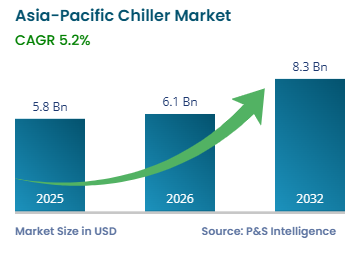
The Asia-Pacific chiller market size was USD 5.8 billion for 2025, and it will grow by 5.2% during 2026–2032, to reach USD 8.3 billion by 2032.
The market growth is driven by growing demand for central air conditioning systems for commercial, industrial, and residential markets, which can be attributed to the effects of rapid urbanization, increasing levels of industrialization, and ongoing expansion of infrastructure development in the region. The increased commercial building size, increasing investment in manufacturing facilities, and the increasing trend of adopting energy-efficient HVAC systems resulting from increasingly restrictive government regulations concerning the environment, further contribute the market growth. China, India, Japan, and South Korea have seen a steady increase in demand for chillers from hospitals, office buildings, data centers, airports, and industrial plants, among other applications.
Government programs that support energy efficiency, and building codes that provide performance standards for buildings, will contribute to an environment that supports the use of highly efficient chillers and accelerate the replacement of existing cooling equipment with new, more efficient technology. Smart City projects and District Cooling Systems being implemented in larger metropolitan areas throughout the region will position larger capacity centrifugal and absorption chillers as essential components of the long term plans for sustainable cities.
The attractive characteristics of the chillers market in the region include a strong industrial base, a more favorable climate for investing in capital assets, and a greater emphasis on reducing carbon emissions in the region. The growth in high-value sectors including pharmaceuticals, food and beverages processing, electronics manufacturing, and healthcare infrastructure, combined with an increased need for cooling due to regional climate conditions, will continue to attract both domestic and international HVAC manufacturers looking for a strategic entry into the emerging Asian Pacific cooling systems marketplace.
Asia-Pacific Chiller Market Dynamics
Increasing Adoption of High-Efficiency and Low-Carbon Chiller Technologies Is Key Trend
Over 50% of all global CO2 emissions are produced by the Asia-Pacific region, which makes the Asia-Pacific the world's most emitting region. About 80% of energy in Southeast Asia comes from fossil fuels; coal generates about 50% of electricity in the region and about 80% of power sector emissions in the region. Approximately 92% of the Asia-Pacific region's population is exposed to levels of air pollution that exceed World Health Organization (WHO) guidelines. Air pollution leads to an estimated 4-4.5 million premature deaths annually in the Asia-Pacific region. Economic damage from climate related impacts could reduce Asia-Pacific Gross Domestic Product (GDP) by as much as 24% by 2100 if no further action is taken on climate.
An increasing number of countries around the world are transitioning away from traditional chillers and toward high-efficiency and low-carbon chiller systems because they reduce both energy use and greenhouse gas emissions. Governments throughout the Asia-Pacific region are working to develop minimum energy performance standards and building energy codes for heating, ventilation, and air conditioning (HVAC) equipment in an effort to address rising energy demand caused by the growing need for air conditioning.
In addition, major economies such as China, India, Japan, and South Korea continue to establish stricter energy efficiency rating labels for commercial cooling systems and set higher performance levels for those systems in order to encourage customers to purchase products that have higher coefficient of performance (COP), variable speed, and other energy efficient characteristics.
The combination of these governmental actions is driving many owners and operators to replace older or inefficient cooling systems and is also causing them to require all new purchases to meet specific energy efficiency requirements.
The slow phase-in of low-Global Warming Potential (GWP) refrigerants is being introduced to comply with national and international climate change agreements. Many Asian countries are developing phasedown plans for hydrofluorocarbons (HFCs), which were identified as having high GWP, under the Kigali amendment to the Montreal protocol.
Additionally, as indicated by the UNEP, several Asian countries have taken policy initiatives to advance the deployment of cool, climate-friendly technologies, through updating refrigeration standards and providing guidance to industry on compliance with new regulations. Many major markets, including China, India and Japan, are establishing stricter regulations on refrigerants used in large commercial and industrial cooling systems. this will accelerate the conversion to chillers that utilize alternative, lower GWP refrigerants.
The implications of these regulatory changes will affect how manufacturers design their equipment, the procurement decisions made by owners and operators and their long term strategic investments in chillers and ultimately influence how owners and operators make future decisions about which chillers to deploy.
Government-Led Infrastructure Expansion and Urban Development Are Biggest Drivers
The longevity of government-funded infrastructure and urban planning programs across the region is a significant driver for the market. The national development plans in China, India, Japan, and South Korea have identified a number of areas for large-scale investments in commercial buildings, transportation hubs, healthcare facilities, industrial parks, and public infrastructure that would benefit from central air conditioning systems.
According to the Asian Development Bank, Asia-Pacific represents more than half of global infrastructure investment needs due to rapid urban population growth and metropolitan expansion. This scale of infrastructure development, particularly in large commercial buildings, transportation hubs, and industrial facilities, supports sustained demand for centralized cooling architectures, where large-capacity chillers serve as core mechanical systems.
Governments across Asia-Pacific are driving large-scale infrastructure investment. China approved about RMB 295 billion (USD 42 billion) in nationally planned infrastructure projects under its early 2026 investment program and allocated around CNY 800 billion (USD 114 billion) to major national infrastructure initiatives in 2025. India’s government reported capital expenditure of about INR 6.6 trillion (USD 92 billion) in April–November 2025, reflecting increased public spending on infrastructure, and has announced a public-private partnership pipeline of 852 projects worth over INR 17 lakh crore (USD 205 billion).
In Southeast Asia, government budget data show public investment levels of around 6% of GDP in Cambodia and about 4% of GDP in Lao PDR, much of it directed toward infrastructure. Vietnam has also begun construction of a 391-km government-backed railway link to China valued at about USD 7.7 billion, underscoring the scale of state-led transport development across the region.
The urban development initiatives backed by the government are further driving demand for chillers by rapidly expanding the amount of high-density commercial and retail districts, airport terminals, metro systems, data centers, and other institutional buildings. For example, Indian national programs, including large-scale urban redevelopment and modernization of public infrastructure, are increasing the density of cooling-intense assets in key cities; whereas China's continued focus on developing large-scale industrial zones, logistics hubs, and technology parks through urbanization and industrial upgrading strategies is also dependent upon large-scale central air conditioning architecture using chillers as the core mechanical components versus just additional discretionary equipment.
Regional assessments by inter-governmental agencies, such as the United Nations Department of Economic and Social Affairs, suggest that the Asia-Pacific will be the fastest-growing region in terms of urbanization over the next few decades, with an accompanying increase in urban floor space and public infrastructure. As such, the long-term capital expenditures made by governments toward the expansion of the built environment are generating a stable base for demand for chiller systems in the form of both commercial, industrial, and institutional applications regardless of the cyclical nature of the economy.
Asia-Pacific Chiller Market Segmentation Analysis
Chiller Type Analysis
The screw category held the largest market share, of 40%, in 2025, due to its ability to be used for large-scale public and industrial applications with continuous usage such as hospitals, airports, metro systems and industrial complexes. Organizations such as the World Health Organization have emphasized the need for reliable and continuous indoor environmental control, which can support the use of a central cooling architecture. These are often used in large-scale applications, as they provide sustained operation capabilities for medium to high capacities and are designed for longer product life cycles, therefore providing a mainstay of the mechanical infrastructure versus an accessory or non-essential piece of equipment.
The scroll category will have the highest CAGR, of 5.3%, due to the increasingly widespread adoption by mid-scale commercial and institutional buildings, and small-scale urban development projects, such as single-tenant office buildings. According to urban development projections, a majority of new urban floor space added in the Asia-Pacific region is expected to be concentrated in low- to mid-rise buildings, rather than large centralized complexes.
The regional public sector's urban planning and building programs are placing emphasis on rapid build-out, modular construction, and compact space-saving mechanical solutions for offices, schools, local health care facilities, and multi-family residential units/mixed-use developments. As a result of this focus on quick deployment, modularity and compactness, scroll chillers are being selected over other types of chillers for these project types, primarily due to their relatively low installed cost, ease of installation, and high operating efficiencies at part load conditions, making them suitable for both government-supported projects and private developers in secondary cities and developing urban zones.
The chiller types analyzed in this report are:
Screw (Largest Category)
Water-Cooled
Air-Cooled
Scroll (Fastest-Growing Category)
Water-Cooled
Air-Cooled
Absorption
Steam
Hot Water
Direct-Fired
Centrifugal
Reciprocating
End User Analysis
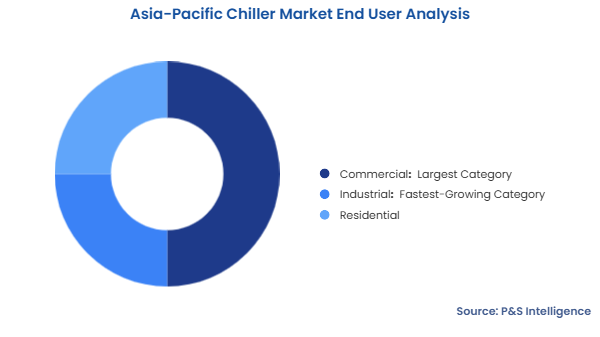
The commercial category held the largest market share, of 50%, in 2025, supported by high level of urbanization and large commercial and institutional structures. The U.N.'s Department of Economic and Social Affairs reports that the Asia-Pacific will account for nearly 60% of all urban population growth globally, and thus, there will be a sustained build-out of new office space, hospitals, airports, shopping malls, etc. Since these commercial and institutional structures are generally too large to cool using local room air conditioning units or packaged rooftop units and have both higher occupancy densities and longer operating hours than residential structures, they also represent the largest installed base of chillers among all customer categories.
The industrial category will have the highest CAGR, of 5.4%, due to the fact that Asia-Pacific is currently experiencing an unprecedented amount of manufacturing investment globally. As reported by the United Nations Industrial Development Organization, manufacturing value-added in Asia-Pacific is greater than 50% of the global total and continues to grow rapidly in sectors such as chemicals, pharmaceuticals, food and beverages, electronic products, and automobile manufacturing. The increasing use of chillers for process cooling as opposed to comfort cooling is expected to drive significantly more growth compared with the commercial and residential end-use categories.
The end users analyzed in this report are:
Commercial (Largest Category)
Transportation
Hospitality
Healthcare
Supermarkets / Hypermarkets
Offices and Buildings
Government
Others
Industrial (Fastest-Growing Category)
Chemical
Food and Beverage
Pharmaceutical
Automotive
Energy and Utilities
Oil and Gas
Others
Residential
Drive strategic growth with comprehensive market analysis
Asia-Pacific Chiller Market Geographical Analysis
China Chiller Market Size
China held the largest market share, of 40%, in 2025, due to the scale, structure and cooling requirements of its built environment and industrial base. China has the largest stock of large-format buildings and industrial facilities in the region including mega-airports, large-scale hospital campuses, extensive data center facilities, high-density commercial office towers etc., all of which require centralized cooling systems, thus creating a greater need for chillers rather than decentralized air conditioning systems and ultimately creating a much larger installed base of chillers in China than in any other Asia Pacific country.
Another important factor that contributes to the magnitude of China's market size is China's unparalleled concentration of energy- and process- intensive industrial capacity. China is the world's largest producer of products such as chemicals, petrochemicals, metal products, electronic products, and pharmaceuticals, all of which use chillers to provide continuous process cooling. Process cooling creates higher chiller capacity demands, longer operating hours, and lower cyclicality when compared to commercial cooling demands, thus contributing to China having a larger market size relative to other Asia Pacific countries.
Additionally, China has developed one of the largest district cooling and centralized energy system footprints, primarily in high-density urban areas, industrial parks, economic development zones, and large public infrastructure clusters. Most district cooling schemes and centralized utility plants use large-capacity centrifugal and screw chillers as their primary cooling asset, thereby creating an average system size and total installed capacity that is larger than most other Asia Pacific countries. Centralized approaches to urban and industrial cooling are also much more common in China than in most other Asia Pacific countries, thus contributing to China's leadership position.
Furthermore, China's domestic HVAC manufacturing ecosystem plays a supportive role in expanding the market size. China has a high vertically integrated chiller manufacturing supply chain, including compressors, heat exchangers, control systems, and complete chiller assembly. The local manufacturing capability provides quicker and more affordable chiller deployment options, both in terms of faster delivery and more localized product customization, and therefore encourages more widespread adoption of chiller-based cooling solutions in commercial and industrial applications.
By 2017, China's building cooling electricity usage had grown to near 400 TWh, as a result of being one of the fastest growing uses of power in the nation. Since 2000, cooling demand has contributed about 7% of China’s overall growth in electricity use. It is estimated that the cooling capacity available in China’s buildings will grow by more than two times from 2017-2030. China manufactures about 70% of the world's air conditioning devices — both through domestic deployment and through rapid expansion of cooling infrastructure.
India Chiller Market Size
India will have the highest CAGR, due to a convergence of the government's expansion of infrastructure, updates to building codes to improve building performance, policy reforms to promote industry, all of which are accelerating the adoption of centralized cooling systems, and therefore has structurally higher growth rates.
One of the main drivers of this growth is the increased adoption of national building energy regulations, specifically the Energy Conservation Building Code (ECBC) published by the Bureau of Energy Efficiency (BEE) under the Ministry of Power. The ECBC sets minimum energy performance standards for large commercial buildings, including office buildings, hospitals, airports, shopping malls, etc., building types that typically require a central HVAC architecture. As the ECBC is adopted in each of India's states, the new large-format buildings are increasingly being designed with chiller-based cooling systems from the outset, and therefore accelerating the growth of the Indian chiller market.
India's status as the fastest-growing chiller market is further strengthened by industrial policy reforms and manufacturing expansion initiatives implemented by the Indian government. The Production-Linked Incentives scheme and the development of industrial corridors are creating rapid increases in capacity in sectors such as pharmaceuticals, food processing, chemicals, electronics, and data-center infrastructure, all of which rely heavily on process cooling, i.e., where chillers are needed to maintain temperature, ensure quality, and support continuous operation.
At the same time, India is moving in line with international frameworks related to climate and the transition of the cooling sector, including implementing its commitments under the Kigali Amendment through national cooling strategies, and inter-governmental cooperation facilitated by international organizations such as the UNEP, are promoting the development and deployment of climate-appropriate and efficient cooling infrastructure to meet the growing demand for cooling. Therefore, the adoption of modern chiller systems in new constructions, as opposed to incremental and decentralized cooling solutions, is further supporting the rapid growth of the Indian chiller market.
India's total cooling demand will increase approximately 800% through 2037-38 relative to 2017-18 (buildings, transportation, industrial). The government's energy analysis indicates that in 2017-18, less than 10% of Indian households had an air conditioner; this%age is expected to be just over 20% by 2027-28 and close to 40% by 2037-38, resulting in a sharp increase in both electric power and cooling loads. Estimated growth in cooling energy use is projected to exceed 100% by the end of the 2020s. On the system side, India's summer peak electricity demand increased from approximately 148 GW in 2014 to around 250 GW in 2024.
The countries of the market are as follows:
China (Largest Country)
India (Fastest-Growing Country)
Japan
South Korea
Australia
Rest of APAC
Asia-Pacific Chiller Market Share
The market is semi-consolidated with major regional manufacturers as well as many small and regional suppliers providing chillers for varying capacities and applications. The majority of large and high-technology projects, such as District Cooling Systems, airport and Metro Infrastructure, large Data Centers, and Heavy Industrial Facilities, etc., are typically supplied by manufacturers with proven engineering capability and substantial reference lists that demonstrate the evidence of their ability to meet both stringent performance and reliability criteria. As a result, it limits competition among a smaller number of qualified suppliers at the higher end of the market.
Additionally, mid-sized and small capacity chiller markets are served by a greater number of manufacturers, especially in China, India, and Southeast Asia, where cost competitiveness, local manufacturing, customization and being closer to the customers all contribute to the importance of these areas of the market. Climate variations, country-specific regulations and localized purchasing practices also influence competition throughout this geographic area.
Key Asia-Pacific Chiller Companies:
Thermax Limited
Johnson Controls International plc
Ingersoll Rand plc
Daikin Industries Ltd.
Midea Group Co., Ltd.
Mitsubishi Electric Corporation
Carrier Global Corporation
Trane Technologies plc
LG Electronics Inc.
Hitachi Ltd.
Samsung Electronics Co., Ltd.
Toshiba Corporation
Asia-Pacific Chiller Market News
In May 2024, w Global Corporation introduced a "made-in-India" 30RB air-cooled modular scroll chiller, which is intended for use in various applications such as railway/metro infrastructure, commercial buildings, and industrial facilities. The introduction of this product will strengthen Carrier’s localized chiller manufacturing/supply capacity in the Asia-Pacific region.
In June 2023, Johnson Controls International plc introduced the YORK YVAM air-cooled magnetic bearing centrifugal chiller utilizing ultra-low Global Warming Potential (GWP) refrigerant R-1234ze. The introduction of this product has expanded Johnson Controls’ high-efficiency chiller offerings for large commercial buildings and hyperscale/colocation data centers. The expanded chiller offerings are expected to support increasing demand in the Asia-Pacific markets.
In May 2023, Trane Technologies Plc completed the acquisition of MTA, an Italian-based manufacturer and distributor of industrial refrigeration, HVAC, and process cooling equipment. This acquisition is expected to enhance Trane's sustainable HVAC and industrial process cooling offerings (including chillers), thereby enhancing the company's capabilities to serve customers/end-users globally, including those located in the Asia-Pacific region.
Frequently Asked Questions About This Report
What is the market size of the Asia Pacific chiller market?+
The Asia Pacific chiller market size was valued at USD 5.8 billion in 2025.
What are the key drivers of the Asia Pacific chiller market?+
Key drivers include expansion of data centers, growth in pharmaceutical and food processing industries, rising commercial construction, increasing adoption of district cooling, and stricter energy efficiency regulations across major Asia Pacific economies.
Which countries dominate the Asia Pacific chiller market?+
China dominates the Asia Pacific chiller market.
What are the major types of chillers used in Asia Pacific?+
The market primarily includes screw chillers, scroll chillers, absorption chillers, centrifugal chillers, and reciprocating chillers.
What trends are shaping the Asia Pacific chiller market?+
Major trends include rising demand for energy-efficient and low-GWP refrigerant chillers, increased use of smart and IoT-enabled chillers, growth of data center cooling demand, and higher investment in sustainable and green building technologies.
Want a report tailored exactly to your business need?
Leading companies across industries trust us to deliver data-driven insights and innovative solutions for their most critical decisions. From data-driven strategies to actionable insights, we empower the decision-makers who shape industries and define the future. From Fortune 500 companies to innovative startups, we are proud to partner with organisations that drive progress in their industries.
Client Testimonials
Working with P&S Intelligence and their team was an absolute pleasure – their awareness of timelines and commitment to value greatly contributed to our project's success. Eagerly anticipating future collaborations.
McKinsey & Company
India
Unmatched Standards
Our insights into the minutest levels of the markets, including the latest trends and competitive landscape, give you all the answers you need to take your business to new heights
Complete Data Security
We take a cautious approach to protecting your personal and confidential information. Trust is the strongest bond that connects us and our clients, and trust we build by complying with all international and domestic data protection and privacy laws