Americas Self-Checkout Systems Market Size & Share Analysis - Trends, Drivers, Competitive Landscape, and Forecasts (2026 - 2032)
This Report Provides In-Depth Analysis of the Americas Self-Checkout Systems Market Report Prepared by P&S Intelligence, Segmented by Offering (Hardware, Software, Services), Model Type (Cash-based, Cashless), Mounting Type (Standalone, Wall-mounted and Countertop), Vertical (Entertainment, Healthcare, Hospitality, Retail, Travel), and Geographical Outlook for the Period of 2021 to 2032
Americas Self-Checkout Systems Market Size Forecast
Key Highlights
Study Period
2021 - 2032
Market Size in 2025
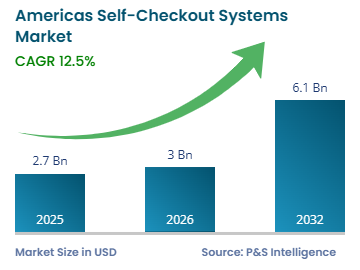
USD 2.7 Billion
Market Size in 2026
USD 3.0 Billion
Market Size by 2032
USD 6.1 Billion
Projected CAGR
12.5%
Largest Country
U.S.
Fastest-Growing Country
Mexico
Market Structure
Semi-Consolidated
Market Size
Explore the market potential with our data-driven report
Americas Self-Checkout Systems Market Overview
The Americas self-checkout systems market size was estimated at USD 2.7 billion for 2025, and it will grow by 12.5% during 2026–2032, to reach USD 6.1 billion by 2032.
The expansion in the adoption of artificial intelligence (AI), computer vision, and contactless payments technology and high digital payment penetration across North America support the growth of the market. Payments Canada reports that digital payments represented 86% of total payment volume and 77% of total payment value in 2024. They are critical tools for increasing operational efficiencies while enhancing the shopping experiences of customers.
Retailers made significant investment in automation through 2024–2025 due to increasing wage costs and employee shortage levels. Studies show that the use of self-checkout lanes can decrease required checkout labor by 20–30%, which also allows for increased sales volume per hour of operation during peak times. In addition, pilot studies have shown that AI-driven computer vision and improved item recognition capabilities have decreased scanning errors and shrinkage rates by 15–20%. The results from these efficiencies are contributing to the deployment of self-checkout lanes across multiple application software domains and are supporting the position of self-checkout lanes as a long-term strategic operating tool and not merely a short-term cost savings initiative.
Key Highlights
Hardware dominated the market in 2025 with a share of 65%, supported by PCI DSS and ADA compliance requirements.
Services represent the fastest-growing offering segment with a CAGR 12.8%, driven by demand for maintenance, cloud updates, and compliance management.
Cash-based systems dominated in 2025 with a share of 60%, supported by under-banked populations and cash-acceptance regulations in parts of the U.S.
The U.S. accounted for the largest share, 45%, while Mexico is projected to be the fastest-growing country market.
Retail remained the largest vertical, led by supermarkets and departmental stores with high transaction frequency.
Americas Self-Checkout Systems Market Trends & Drivers
AI-Driven Loss Prevention Technologies Are Trends in Market
The evolution of self-checkout from simple transactions to a complete loss-prevention system is being realized by using artificial intelligence, computer-vision technologies, and real-time data analysis to enhance the ability of self-service platforms. For years, major retailers experienced higher-than-expected (2–4%) shrinkage rates on self-checkouts compared to staffed registers which has caused many retailers to be hesitant to expand their self-service footprint.
The introduction of advanced AI-based self-checkout solutions that can identify items that were not scanned, verify the quantity of selected produce against the weight sensors for verification, and alert store personnel to potential fraudulent transactions have addressed retailers' number one operational concern while still providing the advantages of an unassisted checkout process. In 2024, Diebold Nixdorf introduced its AI-powered Vynamic Smart Vision | Shrink Reduction solution to help retailers address loss at self-service checkouts by detecting unscanned items and operational errors using computer vision. It complements the existing produce identification and automated age-verification features without needing to replace current infrastructure.
Retailers are using systems with artificial intelligence as dual-use investment vehicles to y eliminate labor dependence and maximize profit margins through the protection of these margins. This will drive all future capital allocation decisions, particularly as statutory minimum wage increases in California and New York continue to raise baseline retail labor costs and intensify automation-led capital planning.
This is being driven by a growing deployment of these systems at convenience stores, pharmacies, and quick-serve restaurants to tackle space constraints and high volume processing needs. These limitations have traditionally made it difficult to deploy traditional self-checkout systems, the trend has been further strengthened through government-driven rollout of digital payment technology (infrastructure) to consumers. According to Payments Canada, 86% of total payments processed in 2024 were made digitally.
Miniature hardware, edge-based computer vision processing, and software-defined checkout platforms enabled smaller footprints. These innovations help meet the regulatory requirements for both payment security and retail operationally, along with high-volume transaction processing needs in space-constrained environments.
Labor Shortages and Wage Inflation Are Biggest Drivers
Retailers are being forced to rapidly expand self-service kiosks as a result of persistent structural labor shortages, which are limiting their ability to grow into new markets, while at the same time increasing their operating cost structure. This is further supported by the U.S. Bureau of Labor Statistics' forecast that retail trade employment will decrease by 1.2% between 2024 and 2034, driving the use of automation technology and a combination of consolidation and e-commerce substitution trends.
The U.S. Census Bureau's Advance Monthly Retail and Food Services Sales reports show that total retail and food services sales increased by 4.0% in March 2024 relative to March 2023 (USD 709.6 billion), 3.9% in December 2024 relative to December 2023 (USD 729.2 billion), 4.2% in January 2025 relative to January 2024 (USD 723.9 billion), and 3.1% in February 2025 relative to February 2024 (USD 722.7 billion).
In comparison, the Bureau of Labor Statistics' Current Employment Statistics show that total retail trade employment has shown little net change throughout 2024 and into early 2025. There was a decline of approximately 25,000 retail jobs in December 2024, but modest increases in other months. As such, there is a growing demand for automation solutions in both hardware and software segments of the self-service kiosk market, specifically for stand-alone and modular self-service kiosks.
U.S. retailers continue to express ongoing difficulties in filling customer service jobs, despite pay increases. Staffing shortages are most pronounced during times of high volumes, when customers simply walk away from a store that cannot process their check-out timely. Labor availability continues to be an issue for the majority of U.S. retail companies at the start of 2025, as reported by the National Retail Federation. In addition, many frontline workers experience increased rates of employee turnover.
State and municipal governments continue to enact policies governing the use of predictive scheduling, overtime, and paid leave. This adds additional layers of complexity to staffing, thus solidifying automation as an essential business decision to address these issues. Apart from reducing labor costs, it offers retailers workforce flexibility. This enables them to meet the seasonally fluctuating customer demand, by fill the gaps created by missed shifts due to employee illness or unexpected absences. All this happens without creating negative experiences for customers and losing sales opportunities.
Americas Self-Checkout Systems Market Segmentation Analysis
Offering Analysis
The hardware category holds the largest market share, of 65%, in 2025. Retailers are investing significantly in physical barcode scanners, cash recyclers, payment card readers, receipt printers, and other components required to operate a self-checkout system. The average multi-year replacement cycle for self-checkout equipment is between 5 to 7 years, generating consistent, long-term demand for the existing supply base of self-checkout companies.
Additionally, PCI-DSS regulations mandate that all card accepting self-checkout equipment comply with this standard. ADA regulations require that all self-checkout equipment be designed and tested to meet these standards and continue to do so throughout its useful life. This creates significant barriers to new entrants into the self-checkout hardware marketplace, thereby maintaining hardware's position as the primary component for self-checkout systems in the retail environment.
The services category will have the highest CAGR, of 12.8%, as retailers face challenges with deploying and integrating a complex solution of hardware and software that requires continuous on-going maintenance and upgrades and support. This is why they turn to professional service providers for remote monitoring, predictive maintenance, field service dispatch, and software patch management for the uninterrupted operations. This shift is further reinforced by the consumer data protection obligations of the U.S. Federal Trade Commission and the Personal Information Protection and Electronic Documents Act (PIPEDA) in Canada.
The offerings analyzed in this report are:
Hardware (Largest Category)
Software
Services (Fastest-Growing Category)
Model Type Analysis
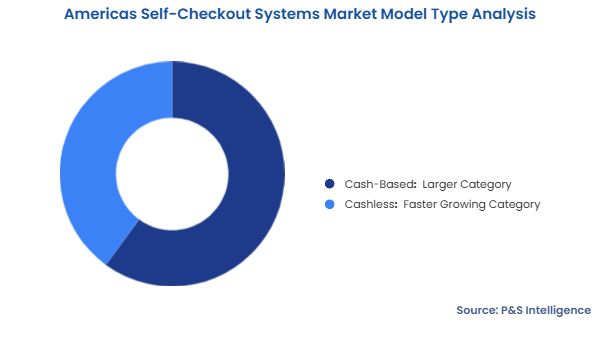
The cash-based category holds the largest market share, of 60%, in 2025, as cash usage remains high in suburban and rural areas in many developing countries, such as Brazil. Cash-based self-checkout systems are popular at convenience stores, QSRs, and independent groceries, where cash is still relevant despite long-term secular decline. The U.S. FDIC estimates that approximately 4.5% of U.S. households remain unbanked, which continues to create the need for cash-based self-checkout options. Offering customers multiple ways to pay for products with bill accepting, coin dispensing, and real-time currency validating components in cash-handling systems allows for greater transactional flexibility in under-banked communities.
The cashless category will have the highest CAGR, of 12.7%, as Pix instant payment adoption accelerates following its rollout by Banco Central do Brasil. They benefit from an increased use of contactless technology in cities and a developing contactless infrastructure. In 2024, according to Payment Canada, contactless transactions accounted for 58% of all payment transactions. Moreover, mobile wallets and contactless cards enable retailers to reduce the complexity of their checkout processes and deploy compact cashless terminals. Additionally, the regulatory and policy support for digital payments and financial inclusion adds to the growth of this category.
The model types analyzed in this report are:
Cash-Based (Larger Category)
Cashless (Faster Growing Category)
Mounting Type Analysis
The standalone category holds the largest market share, of 70%, in 2025, addressing deployment requirements in large grocery store chain locations that exceeded 10,000 sq ft in size with enough area for dedicated checkout islands. The independent design of enclosures allows for the grouping of multiple units into an express checkout zone and/or the distribution throughout a department in order to achieve the highest transactional volume possible. Additionally, standalone systems can be designed to satisfy ADA compliance requirements because of the need for both a cash-handling module and larger surface areas to interact with.
The wall-mounted & countertop category has the higher CAGR, as retailers throughout the two continents are making efforts to provide customers with quicker and more efficient checkout options and save valuable floor space. This is why these systems are quickly gaining popularity among convenience stores, pharmacies, specialty retailers, and fast-food locations.
Retailers get greater flexibility within their store layouts with these systems by eliminating the need for traditional checkout lines, and by allowing their customers to quickly check out and leave the premises. The reliability of self-checkouts has also increased with advancements in the use of touch screen interfaces, integrated payment technology, and loss prevention software. With increasing labor costs, and consumers expecting to be checked out at an ever increasing rate, compact self-checkouts are a growing strategic investment opportunity throughout the Americas.
The retail category holds the largest market share, of 75%, in 2025, because it encompasses most in-store payments. The data on retail trade from the U.S. Census Bureau indicates that the frequency of transactions, especially for food and beverages, is among the highest when compared to other categories with a high count of in-store transactions. This is an important factor in supporting the financial justification for automated checkout systems.
Competitive pressures to decrease wait time in queues continue to be a strong incentive to implement self-serve options, as the longer a customer waits in line, the less satisfied they will be and the less likely to visit again. This is particularly true for high-footfall retail environments with extended operating hours, where checkout congestion directly impacts customer throughput and store performance.
The hospitality category will have the highest CAGR, driven in part by the 24/7 operations of hotels, casinos, and entertainment venue. Here, self-service provides for continuous transactions, reducing the need for staff members to manually oversee or execute every transaction. In addition to enabling around-the-clock operation, self-service also supports contactless guest services and can be integrated into property management systems (PMS) to enable room charges and loyalty program capabilities.
The verticals analyzed in this report are:
Entertainment
Healthcare
Hospitality (Fastest-Growing Category)
Retail (Largest Category)
Hypermarkets & supermarkets
Department Stores
Convenience Stores
Others
Travel
Others
Drive strategic growth with comprehensive market analysis
Americas Self-Checkout Systems Market Regional Outlook
U.S. Self-Checkout Systems Market Size
U.S. holds the largest market share, of 45%, in 2025, with a large amount of self-service kiosks being deployed at big box stores, grocery stores, and c-stores due to severe staffing shortages and increased wages. The U.S. retail trade is also expected to lose jobs from 2020-2034 due to automated cashier technology. This will likely increase the demand for self-service kiosk technology that features AI-based loss prevention systems, weighing scales and mobile payment integration. According to the U.S. Bureau of Labor Statistics, automation and productivity-enhancing technologies are expected to continue exerting downward pressure on certain retail job categories, reinforcing long-term demand for self-service checkout infrastructure.
The large, national supermarket, grocery store, and general merchandise retail chains, such as Walmart, Kroger and Target, are expanding their self-service checkouts throughout each of these retail locations through the use of freestanding kiosks, wall mounted checkout stations, and scan and go applications on mobile devices, and in the smaller format, the convenience stores are increasing their deployment of counter top models for faster, lower basket transactions.
The investment in the computer vision technology-based checkout solutions will continue to drive market growth through 2032 and improve the accuracy of item recognition and loss prevention and also continue to be compliant with the Payment Card Industry Data Security Standards (PCI DSS), and the State's consumer data protection laws, i.e., the California Consumer Privacy Act (CCPA).
Mexico Self-Checkout Systems Market Size
Mexico will have the highest CAGR, of 12.6%, due to an increase in organized retail and an expansion of digital payment infrastructure. Larger Mexican cities, such as Mexico City, Monterrey, and Guadalajara, have smartphone penetration rates greater than 80%. The three largest grocery retailers in Mexico, Walmart de Mexico, Soriana and Chedraui, are expanding self-service checkout lanes in major urban markets. This is being done to speed up the shopping process, give better service, and keep pace with new digitally enhanced retail formats. In addition, the market share of modern trade over traditional, family-owned "mom-and-pop" stores is rising in urban and suburban markets.
Banco de Mexico and the Ministry of Finance's programs to promote national electronic payment rails and reduce reliance on cash are supported by federal efforts to increase merchant acceptance of both card-based and digital payment options that also lead to an indirect push toward self-checkout as complementary retail technology. In addition, the mounting type segment has evolved from Standalone Kiosks to Wall-Mounted and Countertop versions designed for smaller format retail store, specifically Convenience Stores and Pharmacies, in line with expanding Compact Urban Retail Footprints and Convenience Formats such as those associated with OXXO.
The countries of the market are as follows:
U.S. (Largest Market)
Canada
Brazil
Mexico (Fastest-Growing Market)
Rest of Americas
Americas Self-Checkout Systems Market Share
The market is semi-consolidated, with established point-of-sale technology providers maintaining a significant presence in software platform development, and extensive service networks due to their years of retail automation experience. The competition has high barriers to entry due to the need to develop partnerships with retailers, the complexity of integrating with an existing store infrastructure and the cost of developing AI and product recognition and loss prevention solutions. The competitive environment is stable as incumbent companies will continue to be innovative in areas such as computer vision, contactless payments and cloud based analytic platforms. At the same time, new competitors will focus on targeted opportunities within certain retail formats or geographic locations.
Key Americas Self-Checkout Systems Companies:
NCR Voyix Corporation
Diebold Nixdorf, Incorporated
Toshiba TEC Corporation
Fujitsu Limited
ITAB Shop Concept AB
Mashgin, Inc.
KIOSK Information Systems, Inc.
Everseen Limited
Flooid Group Ltd.
GLORY Ltd.
Crane Payment Innovations, Inc.
Digimarc Corporation
Americas Self-Checkout Systems Market News
In May 2025, Diebold Nixdorf Inc. expanded manufacturing and production capabilities at its North Canton, Ohio facility to support self-checkout and kiosk systems for grocery, general merchandise, quick-service restaurant, and fuel convenience retailers. This enhancement of the North American manufacturing footprint will allow for improved supply chain flexibility and faster delivery times as a result of increased demand for self-checkout solutions from the North American markets.
In February 2025, Fujitsu Frontech North America Inc. collaborated with Vori to deliver AI-enabled self-checkout solutions using Vori’s grocery retail operating system. The companies are focused on delivering self-service deployment options for independent grocers that can be integrated with their current POS environment, without having to replace the entire POS infrastructure.
In January 2025, NCR Voyix Corporation announced its Halo Checkout, an AI enabled self-checkout solution utilizing computer vision. It was developed with Everseen to enable the use of computer vision in identifying items and provide loss prevention capabilities for the convenience and fuel retail segments. Halo Checkout has been designed to increase the efficiency of checkouts and mitigate throughput issues that occur during peak hours in high-volume, high-frequency retail applications.
In January 2025, Toshiba Global Commerce Solutions demonstrated the MxP (Modular eXpansion Platform) family of self-serve solutions and the TCx 820 all-in-one PoS at the National Retail Federation’s Retail’s Big Show in New York. MxP is a modular self-service platform utilizing AI, computer vision, and ML to offer customizable and configurable checkout experiences scalable across a broad base of retail formats.
In January 2024, NCR Voyix Corporation introduced its Next Gen Self-Checkout Solution, which was built on the NCR Voyix Commerce Platform. This technology is designed with computer vision, RFID, and barcode scanning capabilities within a SaaS format for retailers to design hybrid checkout spaces that allow for both assisted checkout lanes and self-checkout lanes, as well as both cash and non-cash payment options, all from one central cloud-based management system.
Frequently Asked Questions About This Report
What is the market size of the Americas self-checkout systems market in 2025?+
The Americas self-checkout systems market was valued at USD 2.7 billion in 2025.
What is the CAGR of the Americas self-checkout systems market?+
The Americas self-checkout systems market is growing at a CAGR of 12.5% during the forecast period.
Which country dominates the Americas self-checkout systems market?+
The U.S. dominates the Americas self-checkout systems market.
What are the key drivers of growth in the Americas self-checkout systems market?+
Key growth drivers include rising labor costs, demand for faster checkout experiences, increasing adoption of AI vision systems, and expanding use of self-checkout in QSR and convenience retail formats.
Which vertical segment drives demand for self-checkout systems in the Americas?+
The retail segment represents the largest vertical segment.
Want a report tailored exactly to your business need?
Leading companies across industries trust us to deliver data-driven insights and innovative solutions for their most critical decisions. From data-driven strategies to actionable insights, we empower the decision-makers who shape industries and define the future. From Fortune 500 companies to innovative startups, we are proud to partner with organisations that drive progress in their industries.
Client Testimonials
Working with P&S Intelligence and their team was an absolute pleasure – their awareness of timelines and commitment to value greatly contributed to our project's success. Eagerly anticipating future collaborations.
McKinsey & Company
India
Unmatched Standards
Our insights into the minutest levels of the markets, including the latest trends and competitive landscape, give you all the answers you need to take your business to new heights
Complete Data Security
We take a cautious approach to protecting your personal and confidential information. Trust is the strongest bond that connects us and our clients, and trust we build by complying with all international and domestic data protection and privacy laws