This Report Provides In-Depth Analysis of the Acetic Anhydride Market Report Prepared by P&S Intelligence, Segmented by Application (Synthesizers, Reagents, Plasticizers, Coating Materials), End-Use Industry (Pharmaceuticals, Agriculture, Textiles, Food & Beverages, Tobacco, Plastics), and Geographical Outlook for the Period of 2021 to 2032
Explore the market potential with our data-driven report
Acetic Anhydride Market Future Key Insights
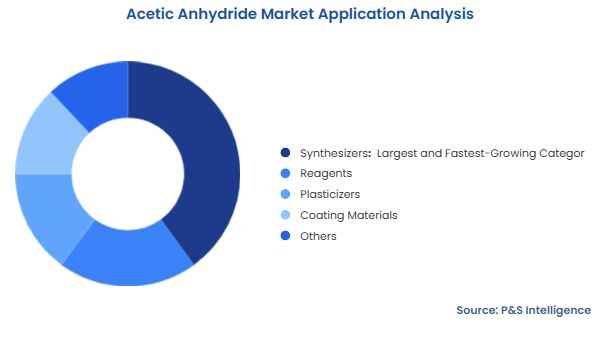
The synthesizers category accounted for the largest share, of 40%, and it is also the fastest-growing category, with a CAGR of approximately 4.0%.
The tobacco category accounted for the largest share, of 35%, in 2025.
The pharmaceutical category is the fastest-growing category over 2026–2032.
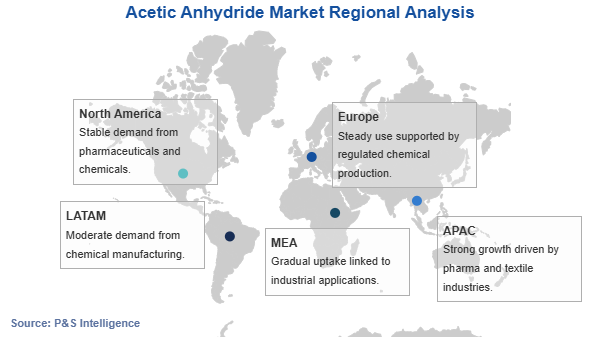
Asia-Pacific accounted for the largest share, of 40%, and it is also the fastest-growing region over 2026–2032, registering a CAGR of approximately 4.6%.
The global acetic anhydride market exhibits moderate consolidation.
Acetic Anhydride Market Future Outlook
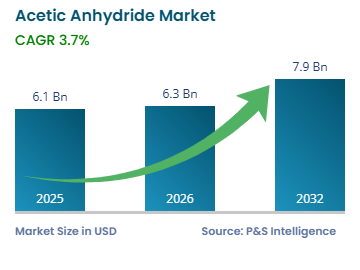
The global acetic anhydride market stood at USD 6.1 billion in 2025 and is projected to reach USD 7.9 billion by 2032, expanding at a compound annual growth rate of 3.7% over 2026–2032. The global acetic anhydride market is primarily driven by rising demand from pharmaceutical manufacturing (especially for analgesics like aspirin and paracetamol), increasing use in cellulose acetate for filters and textiles, and expanding applications in agrochemicals, plastics, and specialty chemicals.
The compound functions as an acetylating agent across pharmaceutical synthesis, cellulose acetate manufacturing, agrochemical intermediates, and specialty chemical production, positioning it as a foundational building block within multiple high-value industrial value chains.
Acetic anhydride is a critical intermediate in the manufacture of active pharmaceutical ingredients (APIs), including aspirin, acetaminophen, and a broad spectrum of analgesic and anti-inflammatory compounds. Beyond pharmaceuticals, the compound's utility in producing cellulose acetate anchors demand across tobacco, textiles, and plastics industries. Cellulose acetate sees high-volume consumption as the primary raw material for cigarette filter tows, textile fibers, and photographic films. Its role as a reagent in agrochemical synthesis further broadens the consumption base as crop protection requirements intensify across emerging agricultural economies.
Acetic Anhydride Market Emerging Trends and Growth Drivers
Sustainable Cellulose Acetate Is Trending
Acetic anhydride consumption is increasingly tied to biodegradable packaging, sustainable textile fibers, and optical film applications alongside the traditional cigarette filter tow segment. Research published in ACS Sustainable Chemistry & Engineering (2024) demonstrates that agro-residue-derived cellulose nanofibrils acetylated with acetic anhydride produce biobased coatings with superior hydrophobic and oleophobic barrier properties. This finding signals an emerging pathway for acetic anhydride into sustainable packaging applications.
Cellulose acetate is gaining traction as a biodegradable alternative in film packaging, eyewear, and filtration as consumer goods companies and regulators accelerate transitions away from petroleum-based plastics. It is produced almost exclusively through acetic anhydride-mediated esterification. This transition is broadening the application base for acetic anhydride beyond its historical tobacco-sector anchor, creating more diversified and resilient demand structures across the forecast period.
Expanding Pharmaceutical Production Driving Acetic Anhydride Demand
The global expansion of pharmaceutical synthesis operations represents the most structurally significant driver of acetic anhydride demand. The compound functions as the primary acetylating agent in producing aspirin, acetaminophen, cortisone, theophylline, and a range of antibiotics and hormonal medications. All these therapeutic categories are experiencing sustained volume growth as chronic disease prevalence rises across both developed and emerging economies.
The World Health Organization reports that noncommunicable diseases account for approximately 75% of global deaths, with cardiovascular diseases and cancers being the leading causes. This projection underpins long-term demand for analgesic and therapeutic APIs requiring acetylation steps in their synthesis routes. Generic pharmaceutical manufacturing has accelerated acetic anhydride consumption as producers in Asia and Latin America scale API output to meet growing access-to-medicine demand across lower-income markets. As pharmaceutical R&D pipelines advance complex multi-step synthesis formulations, per-unit acetic anhydride consumption per drug compound is increasing, reinforcing the demand trajectory well beyond the 2026–2032 forecast period.
Agrochemical Intermediate Demand in Emerging Markets Offers Opportunities
Intensifying agricultural production requirements across Asia-Pacific, Latin America, and Africa generate sustained demand for acetic anhydride as an intermediate in herbicide and plant growth regulator synthesis. The global agrochemicals market stood at USD 236.9 billion in 2024 and is projected to reach USD 322.9 billion by 2032, expanding at a CAGR of 4.1% over the period. Asia-Pacific is the largest consuming region.
Vast agricultural land bases, food security imperatives, and government-mandated crop yield targets in China, India, and Indonesia underpin this position. As emerging market governments invest in agricultural self-sufficiency programs and climate-adaptive crop protection formulations, the agrochemical pathway for acetic anhydride is projected to strengthen. India and Southeast Asia will be particularly active, where both crop protection intensity and domestic production capacity are expanding.
Precursor Control Regulations Constrain Supply Chain Flexibility
Acetic anhydride is classified as a Table I controlled precursor chemical under the United Nations 1988 Convention against Illicit Traffic in Narcotic Drugs and Psychotropic Substances. This classification creates a regulatory constraint that adds compliance cost and supply chain complexity across all jurisdictions. The International Narcotics Control Board reported that global seizures of acetic anhydride reached approximately 25,600 liters in 2022. Trafficking routes destined for illicit heroin production persist, compelling governments to maintain stringent import-export licensing, end-user certification, and transaction reporting requirements for all commercial volumes.
In North America and Europe, DEA registration requirements and EU REACH-based controls impose additional documentation and audit obligations on manufacturers and distributors. These regulatory burdens increase operational costs for legitimate producers, create procurement complexity for downstream users, and can delay capacity expansion approvals. This moderates the pace of market development even as underlying demand fundamentals remain supportive.
Acetic Anhydride Market Segmentation Analysis
Application Analysis
The synthesizers category accounted for the largest share, of 40%, in the global acetic anhydride market in 2025, and it is also the fastest-growing category, registering a CAGR of approximately 4.0% over 2026–2032. The compound's foundational role as an acetylating agent across organic chemical synthesis processes underpins both positions. Acetic anhydride is irreplaceable in synthesizing a wide range of chemical intermediates, including acetylated derivatives used in dye manufacturing, perfume production, explosive intermediates, and resin systems. Its reactivity profile, commercial availability, and cost-effectiveness make substitution technically and economically unviable.
Cellulose acetate synthesis operations globally reinforce this position further, consuming acetic anhydride in the esterification of cellulose to produce filter tow, textile fiber, and photographic film substrates. The breadth of synthesis applications across industrial chemistry, combined with the compound's classification as a versatile acetylating reagent with no direct equivalent at equivalent cost, sustains category leadership across the forecast period. The Medicines and Healthcare products Regulatory Agency and equivalent bodies globally mandate acetylation-grade purity specifications for pharmaceutical synthesis intermediates.
The market segments into the following applications:
Synthesizers (Largest and Fastest-Growing Category)
Reagents
Plasticizers
Coating Materials
Others
End-Use Industry Analysis
The tobacco category accounted for the largest share, of 35%, in the global acetic anhydride market in 2025. Cigarette filters are produced from cellulose acetate, which filters toxic contents and nicotine present in cigarettes. Cellulose acetate is produced through acetic anhydride-mediated esterification, driving high-volume consumption of the compound to meet filter tow demand across the tobacco industry. The Tobacco Atlas, published by the American Cancer Society and Vital Strategies, indicates that cigarette consumption is declining in high-HDI countries while remaining stable or increasing in low- and middle-HDI countries.
The pharmaceutical category is the fastest-growing category over 2026–2032. Acetic anhydride serves as the essential intermediate in producing aspirin, acetaminophen, and a broad portfolio of APIs including antibiotics, hormonal treatments, and anti-inflammatory compounds. These therapeutic categories sustain high-volume, recurring procurement cycles independent of economic conditions. The global expansion of generic drug manufacturing has intensified raw material sourcing across Asia and Latin America. Increasing complexity of new chemical entity synthesis processes requires multiple acetylation steps per compound, reinforcing per-unit consumption.
Pharmaceutical-grade acetic anhydride commands premium pricing relative to industrial grades, sustaining segment revenue leadership even when industrial-use volume is comparable in absolute terms. Regulatory agencies including the U.S. FDA and the European Medicines Agency require traceable, high-purity acetylating agents in drug synthesis, creating quality-driven barriers that favor established suppliers and reinforce demand concentration within the pharmaceutical sector.
The market segments into the following end-use industries:
Pharmaceuticals (Fastest-Growing Category)
Agriculture
Textiles
Food & Beverages
Tobacco (Largest Category)
Plastics
Others
Drive strategic growth with comprehensive market analysis
Acetic Anhydride Market Geographical Analysis
Asia-Pacific Acetic Anhydride Market Outlook
Asia-Pacific accounted for the largest share, of 40%, in the global acetic anhydride market in 2025, and is also the fastest-growing region over 2026–2032, registering a CAGR of approximately 4.6% across the period. Integrated chemical manufacturing ecosystems in China and India, large-scale cellulose acetate output for cigarette filter tow and textile fiber, rapidly expanding generic pharmaceutical production, and government-backed agricultural intensification programs driving agrochemical intermediate demand underpin this dual position. Rising healthcare access across Southeast Asian economies and accelerating API manufacturing investment further amplify regional consumption.
China Acetic Anhydride Market Growth
China holds the largest country market within Asia-Pacific. The country operates the world's largest cellulose acetate manufacturing base, oriented toward both domestic cigarette filter tow consumption and export markets. The Food and Agriculture Organization identifies China as one of the world’s leading producers and exporters of pesticides, supporting sustained demand for intermediates such as acetic anhydride used in agrochemical synthesis. Vertically integrated chemical production and access to low-cost acetic acid feedstock provide structural cost advantages that reinforce China's position as the region's dominant consumer and producer.
India Acetic Anhydride Market Trends
India is the fastest-growing country market within Asia-Pacific. India’s pharmaceutical exports increased from USD 25.4 billion in FY 2022–23 to USD 27.9 billion in FY 2023–24, registering approximately 9.67% growth, directly increasing acetic anhydride consumption for API synthesis. OECD and FAO data rank the country as the fourth-largest producer of agrochemicals globally, with domestic crop protection intermediate demand continuing to expand. Jubilant Ingrevia Limited commissioned a world-scale acetic anhydride plant at its Bharuch, Gujarat facility in 2023, adding approximately 60,000 metric tons of annual capacity and bringing its total to 210,000 metric tons. This investment reflects producer confidence in sustained domestic and export demand through the forecast period.
North America Acetic Anhydride Market Analysis
North America is the second-largest region, anchored by the rising high-purity pharmaceutical-grade consumption, presence of major drug manufacturers with an active pipeline, and stringent FDA quality requirements. Pharmaceutical manufacturing anchors acetic anhydride consumption across North America, driven by demand for analgesics and other active pharmaceutical ingredients. Cellulose acetate production for cigarette filters, textiles, and photographic films sustains additional high-volume consumption. Agrochemical and specialty chemical applications broaden the base further, supporting use in crop protection intermediates and high-performance materials. Expanding adoption in plastics, coatings, and dyes is opening additional demand channels. Well-established chemical manufacturing infrastructure ensures reliable supply, and ongoing process technology improvements are reinforcing production efficiency across the region.
The U.S. dominates regional consumption through large-scale API synthesis operations across established pharmaceutical manufacturing hubs. Canada is the fastest-growing country market within the region, with expanding specialty chemical manufacturing and growing pharmaceutical contract manufacturing activity serving both domestic and U.S. market demand underpinning this position.
USA Acetic Anhydride Market Growth
The pharmaceutical sector is the largest consumer of acetic anhydride in the United States, using it to manufacture active ingredients including aspirin, paracetamol, and other analgesics. Cellulose acetate production for cigarette filters, textiles, and photographic films sustains additional high-volume demand. Agrochemical, dye, and specialty chemical applications broaden the consumption base. Expanding use in plastics, coatings, and performance materials ties overall consumption closely to downstream industrial and healthcare activity.
Europe Acetic Anhydride Market Forecast
Europe is a stable market for acetic anhydride. Pharmaceutical manufacturing anchors regional consumption, with the compound widely used in producing active pharmaceutical ingredients including aspirin. Growth in polymers, coatings, and fine chemicals supports additional demand, and regulatory emphasis on high-purity chemicals reinforces consumption within these segments. Structural decline in traditional cellulose acetate applications moderates the overall growth rate relative to other regions.
Germany leads regional consumption as the hub of Europe's chemical and pharmaceutical industries. Germany’s chemical and pharmaceutical industry generated over EUR 200 billion in revenue in 2023, supported by strong contributions from pharmaceutical production. Regulatory constraints under the EU's REACH framework and controlled substances legislation governing acetic anhydride distribution moderate growth relative to Asia-Pacific. The UK is the fastest-growing country market within Europe, with pharmaceutical synthesis demand and expanding fine chemicals production driving this position. France, Italy, and Spain sustain demand through pharmaceutical manufacturing, food-grade starch modification, and textile and coatings applications.
Latin America Acetic Anhydride Market Development
Agricultural chemical production and expanding pharmaceutical manufacturing across key economies support Latin America's market growth. Brazil is the largest country market. Its position as a major agricultural producer requiring crop protection intermediates and growing generic drug manufacturing activity underpins this position. Mexico is the fastest-growing country market, with nearshoring investment in specialty chemical manufacturing and rising demand for acetylated food additives and coating materials linked to industrial expansion and foreign direct investment inflows driving growth.
Middle East & Africa Acetic Anhydride Market Expansion
Ongoing chemical industry diversification across Gulf Cooperation Council economies supports market development in Middle East & Africa. Saudi Arabia is the largest country market. Large-scale petrochemical infrastructure and government-led initiatives to develop downstream specialty chemical production as part of economic diversification away from crude oil dependency underpin this position. The UAE is the fastest-growing country market, with expanding pharmaceutical manufacturing capacity and growing demand for specialty coatings in construction and industrial applications tied to infrastructure investment programs driving this trajectory.
The market spans the following regions and countries:
North America
U.S. (Largest Country Market)
Canada (Fastest-Growing Country Market)
Europe
Germany (Largest Country Market)
U.K. (Fastest-Growing Country Market)
France
Italy
Spain
Rest of Europe
Asia-Pacific (Largest and Fastest-Growing Region)
China (Largest Country Market)
India (Fastest-Growing Country Market)
Japan
South Korea
Australia
Rest of Asia-Pacific
Latin America
Brazil (Largest Country Market)
Mexico (Fastest-Growing Country Market)
Rest of Latin America
Middle East & Africa
Saudi Arabia (Largest Country Market)
South Africa
U.A.E (Fastest-Growing Country Market)
Rest of MEA
Acetic Anhydride Market Share Analysis
The global acetic anhydride market exhibits a moderately consolidated competitive structure, with a limited number of large-scale integrated chemical producers controlling the majority of global production capacity. Capital intensity of acetic anhydride manufacturing requires dedicated acetyl chain infrastructure, including acetic acid feedstock integration, high-pressure carbonylation or ketene-process reactors, and stringent handling and storage systems. These requirements create substantial barriers to new market entry, consolidating supply among established producers.
Regulatory compliance obligations associated with precursor chemical status reinforce incumbency advantages further. Established producers with long-standing DEA, REACH, and national licensing frameworks are better positioned to navigate multi-jurisdictional compliance than prospective new entrants. Fragmentation exists at the lower end of the market among regional and specialty producers, but the top tier of global producers retains sufficient scale advantages in feedstock procurement, logistics, and regulatory compliance to sustain their positions.
Key Players in the Acetic Anhydride Market:
Eastman Chemical Company
Celanese Corporation
Jubilant Life Sciences Ltd.
Jiangsu Danhua Group Co. Ltd.
Saudi International Petrochemical Company
BP p.l.c
China National Petroleum Corporation
Taj Pharmaceuticals Limited
RLG Group
Daicel Corporation
Lonza Group Ltd.
Merck KGaA
Thermo Fisher Scientific Inc.
Vizag Chemical International
Tokyo Chemical Industry Co. Ltd.
Honeywell International Inc.
Acetic Anhydride Market News
In May 2025, Again and HELM AG held a ground-breaking ceremony in Texas City, Texas, for a new commercial facility designed to transform waste CO₂ into sustainable chemicals including acetic acid. The project aims to supply low-carbon raw materials to pharmaceutical, plastics, and textile industries.
In November 2024, INEOS AG signed a memorandum of understanding with Gujarat Narmada Valley Fertilizers & Chemicals Ltd (GNFC) to assess the feasibility of constructing a 600,000-tonne-per-year acetic acid plant at GNFC's Bharuch, Gujarat site, with commissioning targeted for 2028.
In April 2024, Eastman Chemical Company announced an off-list price increase of USD 0.05 per pound for its Sales Grade acetic anhydride across North and Latin American markets, citing rising input costs and supply-demand realignment.
Frequently Asked Questions About This Report
What will be the acetic anhydrides market 2032 size?+
In 2032, the market for acetic anhydrides will value USD 7.9 billion.
Which application leads the acetic anhydride industry?+
Synthesizers dominate the acetic anhydride industry with 40% revenue.
Which is the largest region in the acetic anhydrides market?+
APAC is the largest market for acetic anhydride, with 40% share.
What are the key acetic anhydrides industry drivers?+
The global acetic anhydride industry is driven by rising demand in the pharmaceutical, agrochemical, plastic and specialty chemical sector, and increasing use in cellulose acetate for filters and textiles.
What is the acetic anhydrides market nature?+
The market for acetic anhydride is moderately consolidated.
Want a report tailored exactly to your business need?
Leading companies across industries trust us to deliver data-driven insights and innovative solutions for their most critical decisions. From data-driven strategies to actionable insights, we empower the decision-makers who shape industries and define the future. From Fortune 500 companies to innovative startups, we are proud to partner with organisations that drive progress in their industries.
Client Testimonials
Working with P&S Intelligence and their team was an absolute pleasure – their awareness of timelines and commitment to value greatly contributed to our project's success. Eagerly anticipating future collaborations.
McKinsey & Company
India
Unmatched Standards
Our insights into the minutest levels of the markets, including the latest trends and competitive landscape, give you all the answers you need to take your business to new heights
Complete Data Security
We take a cautious approach to protecting your personal and confidential information. Trust is the strongest bond that connects us and our clients, and trust we build by complying with all international and domestic data protection and privacy laws